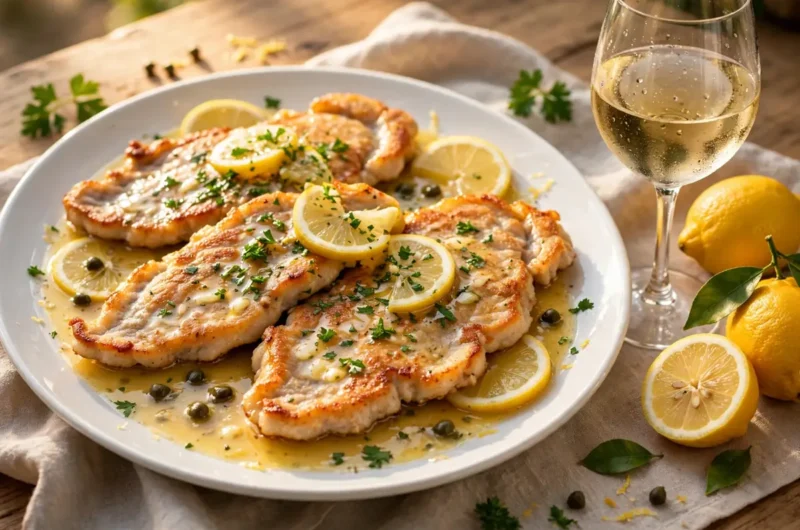
The veal piccata recipe that works starts with one decision: sear thin, evenly pounded cutlets fast in a hot skillet, then pull them out before building the pan sauce. Veal scaloppine is so thin and lean that the window between cooked and tough lasts seconds. Follow the steps below and you will serve tender cutlets in a glossy lemon-caper sauce in 40 minutes.
Veal scaloppine are thin slices cut from the leg, a lean, fine-grained muscle with little connective tissue. The muscle proteins myosin and actin begin to firm at roughly 120°F to 140°F (49°C to 60°C) and tighten hard above about 150°F (66°C), squeezing out moisture, which is why overcooked veal turns dry. The sauce is an emulsion, in which cold butter whisked into reduced wine, stock, and lemon juice breaks into tiny fat droplets held in suspension by milk proteins and phospholipids. Piccata is an Italian-American dish built on the Italian scaloppine tradition, with lemon, capers, and butter as its signature.
What Is Veal Piccata?
Veal piccata is thin veal cutlets dredged in flour, pan-seared, and served in a sauce of lemon juice, capers, white wine, stock, and butter. The flour coating is thin and the sauce is built in the same pan, so the browned bits from the veal flavor it.
It differs from veal marsala, which uses mushrooms and fortified Marsala wine. It differs from veal Francese, which dips the floured cutlet in egg before frying. It differs from veal parmigiana, which is breaded, fried, and baked under cheese and tomato sauce. It differs from chicken piccata only in the meat: veal is more delicate, tenderizes with less pounding, and cooks in about half the time.
Which Veal Cut Works Best for Piccata?
Use veal top round or leg cutlets sold as scaloppine, cut about 1/4 inch thick or pounded to that thickness. Leg meat is lean and fine-grained, so it stays tender with very brief cooking. If you slice a larger piece yourself, cut across the grain so the muscle fibers are short. Veal has almost no marbling, so there is no fat to render, and the olive oil and butter in the pan supply the browning fat.
If veal is hard to find or too expensive, use chicken breast cutlets pounded to 1/4 inch, which need 165°F (74°C), or pork tenderloin medallions pounded thin, which need 145°F (63°C). Neither matches veal’s tenderness.
How Thick Should the Cutlets Be?
Pound them to an even 1/4 inch, about 6 mm. Thickness controls cook time, and even thickness makes all eight cutlets finish together. A cutlet thicker than 3/8 inch needs longer in the pan, and by then the flour crust has darkened past golden.
What Equipment Do You Need?
What Ingredients Do You Need?
Use fresh lemons rather than bottled juice. Bottled juice tastes flat and sharp, and the fresh aroma compounds in the zest oils and juice carry the sauce. Use capers packed in brine, drained and lightly rinsed, rather than salt-packed unless you rinse them thoroughly. Use a dry, crisp white wine you would drink, such as pinot grigio or sauvignon blanc, because sweet or oaked wine makes the sauce cloying. Use unsalted butter, so you control the salt after the sauce reduces.
For the Veal
For the Piccata Sauce
The finishing butter must come straight from the refrigerator. Cold butter melts slowly, which gives the emulsion time to form. Soft butter melts instantly and the sauce turns oily.
Step by Step Process
Set Up and Prepare the Veal
Step 1. Measure and lay out everything before the pan goes on the stove: flour in the dish, wire rack ready, wine, stock, lemon juice, capers, garlic, and cold butter cubes within reach of the burner. The sear takes about 8 minutes and the sauce about 10, and neither allows a pause to measure. A sauce left waiting while you hunt for the lemon reduces past the point of recovery.
Step 2. Place two or three cutlets between sheets of plastic wrap with space between them. Pound with the flat side of the mallet from the center of each cutlet outward until it is an even 1/4 inch thick, using light, steady strikes rather than hard blows. Pounding breaks the muscle fibers and flattens the cutlet so it cooks through in about 2 minutes total. Even thickness means all cutlets finish together instead of some drying while others are still pink.
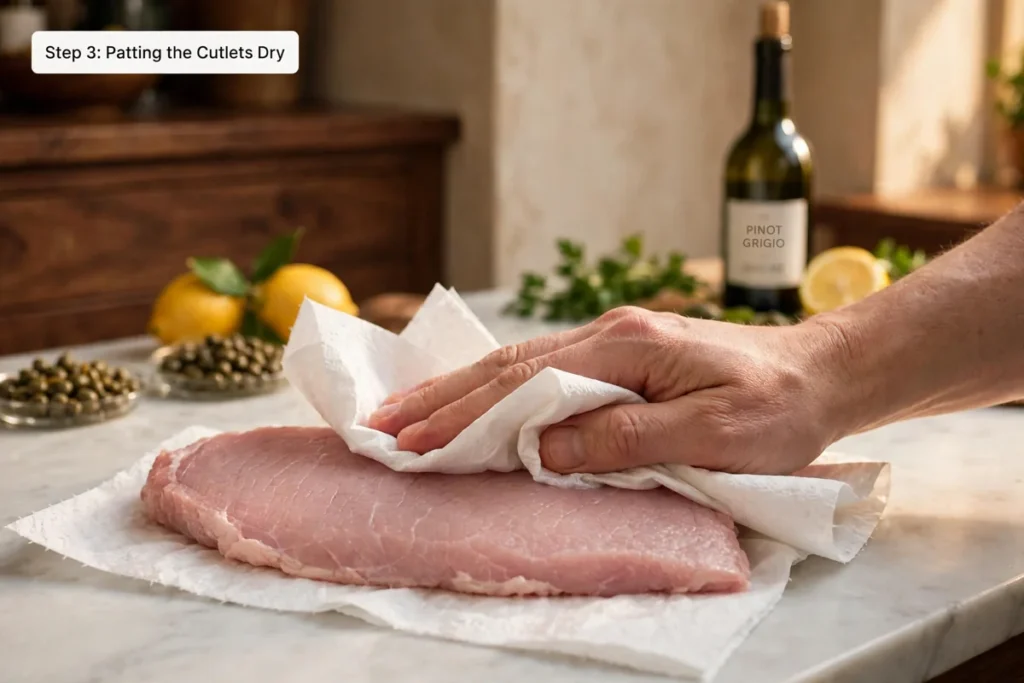
Step 3. Pat each cutlet dry on both sides with paper towels, pressing firmly. Surface water must evaporate before the meat can brown, and a wet surface holds the pan near the boiling point of water, 212°F (100°C). Browning chemistry needs a dry surface well above that. Wet cutlets steam into gray, pale meat with a gummy crust.
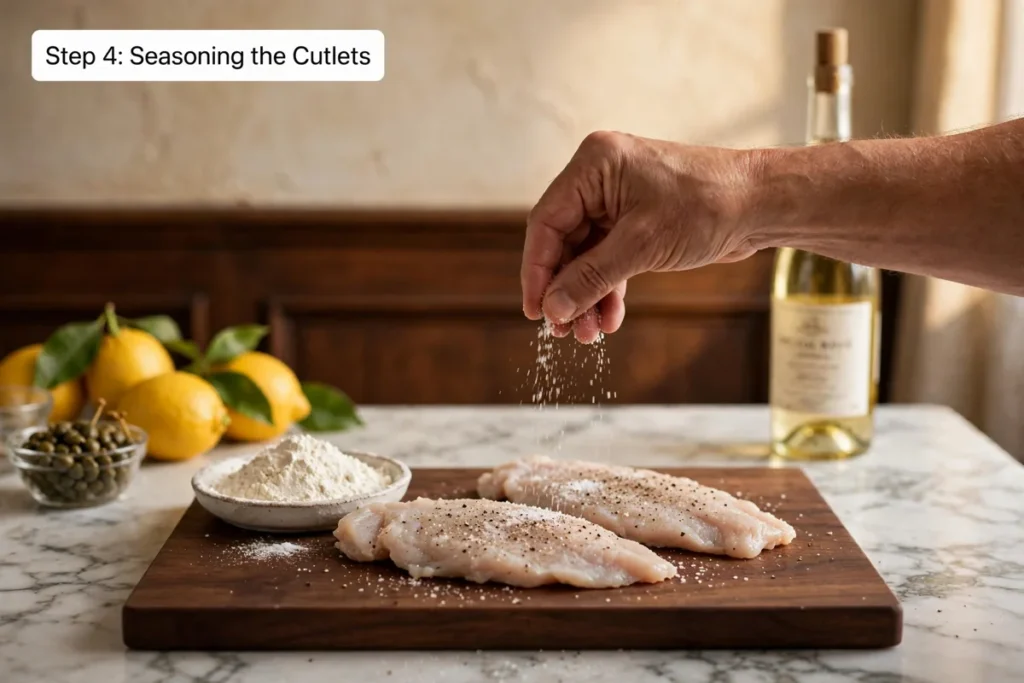
Step 4. Season both sides with the salt and pepper only at the moment you are ready to dredge, no earlier than 1 minute before the flour. Salt dissolves into surface moisture and pulls water out of the meat by osmosis within a few minutes, and seasoned veal that waits turns damp and makes the flour paste on contact. Seasoning right before dredging adds flavor without that surface water.
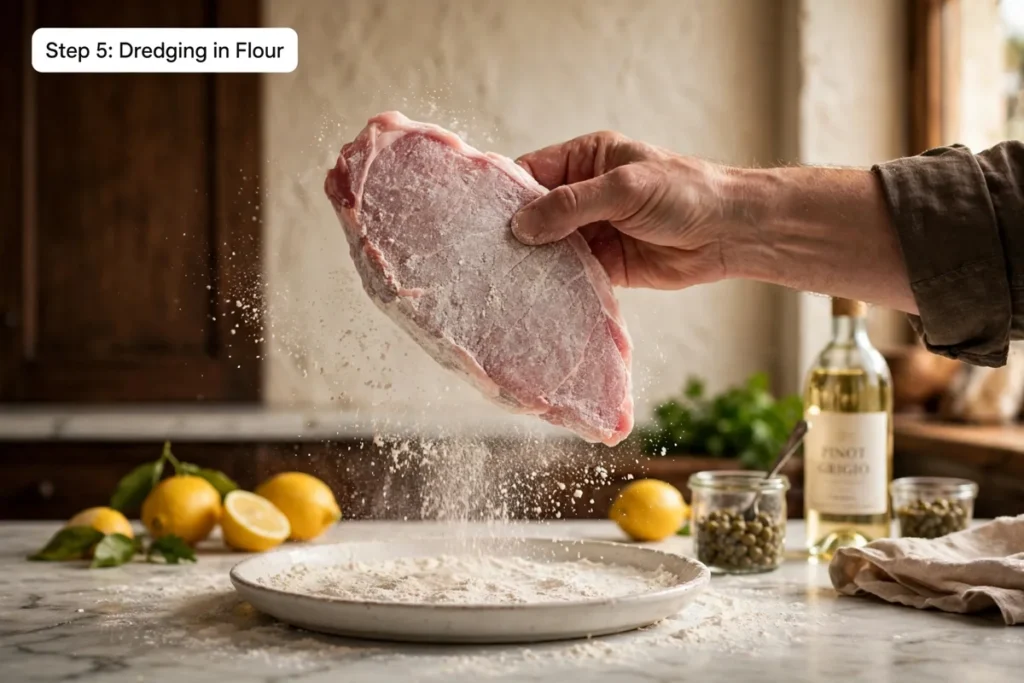
Step 5. Spread the flour in the shallow dish. Dredge one cutlet at a time, pressing lightly on each side, then lift it and shake it hard so all loose flour falls away. Dredge only what goes into the pan next, because flour that sits on meat absorbs moisture and turns into a gummy paste. The flour has two jobs: it dries the surface for browning, and the starch and protein in the thin coat brown through the Maillard reaction into a golden crust. A heavy coat traps steam under it and turns gummy.
Sear the Veal
Step 6. Set the skillet over medium-high heat for 2 to 3 minutes without any fat. Test the heat with a pinch of flour dropped into the dry pan: it should sizzle and begin to turn tan within 5 seconds. A pan that is not hot enough lowers its temperature the moment cold cutlets land, and the veal steams instead of searing. A pan that is too hot burns the flour before the veal cooks.
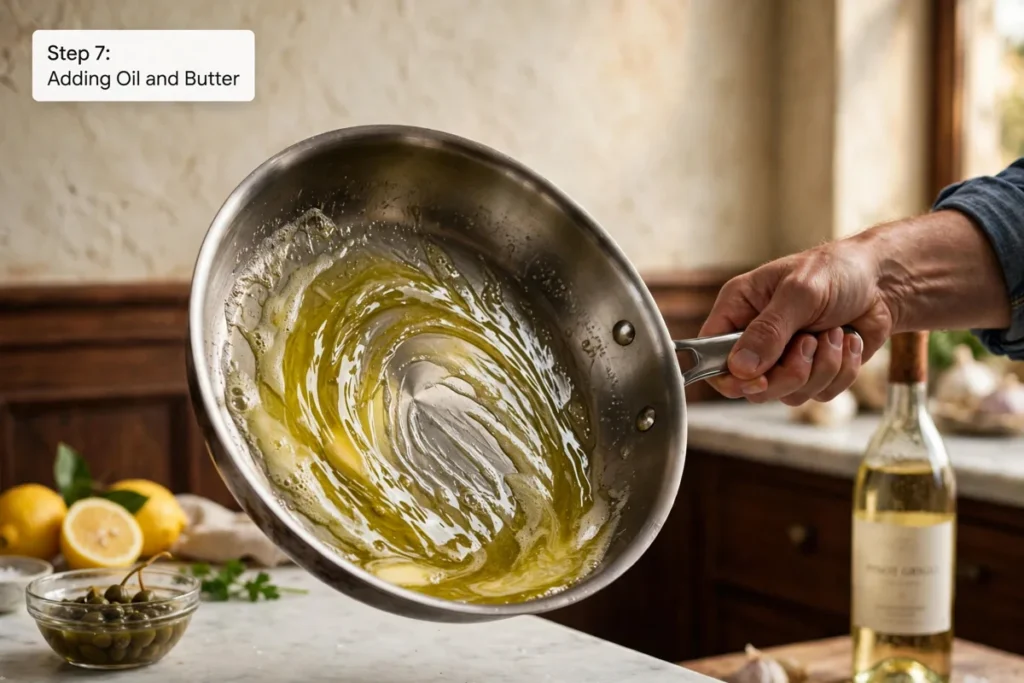
Step 7. Add 1 tablespoon of the olive oil and the 1 tablespoon of butter to the hot pan and swirl. Wait until the butter foam subsides and the fat shimmers. The oil raises the smoke point of the butter, so the milk solids brown without burning, and subsiding foam signals that the water in the butter has boiled off, leaving fat hot enough to sear. Cutlets added to foaming butter steam in the escaping water.
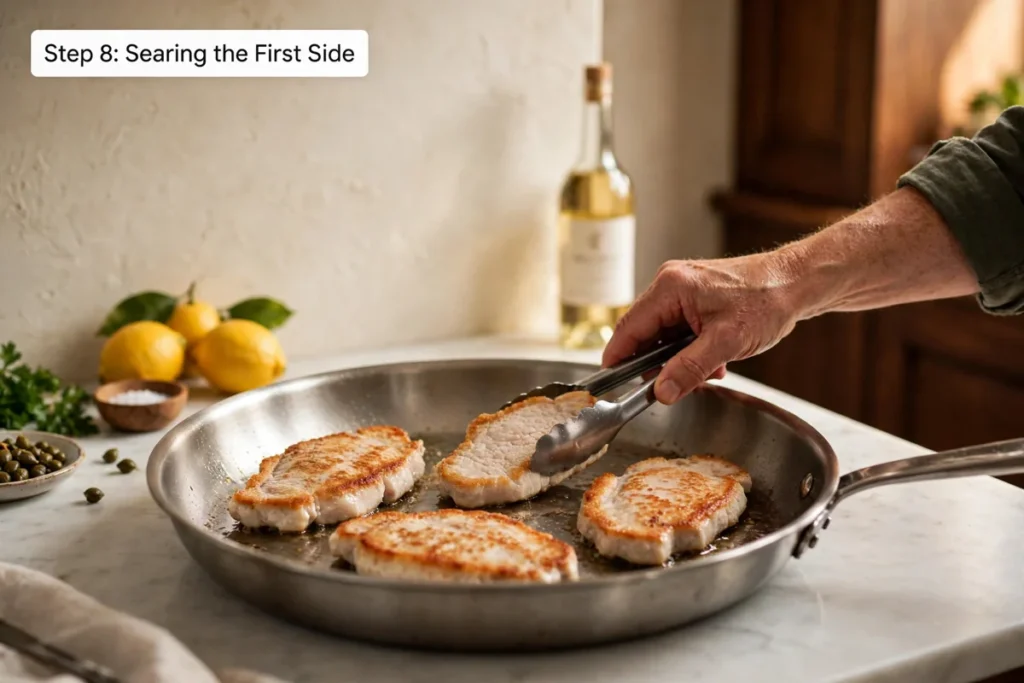
Step 8. Lay 3 or 4 cutlets in the pan in a single layer with at least 1/2 inch between them, placing each one away from you so the oil does not splash. Do not move them. Sear 90 seconds, until the underside is golden. The Maillard reaction between amino acids in the veal and reducing sugars in the flour coat produces browned, roasted flavor compounds on contact with the hot metal. Crowding the pan drops its temperature and traps steam, so cook in two batches.
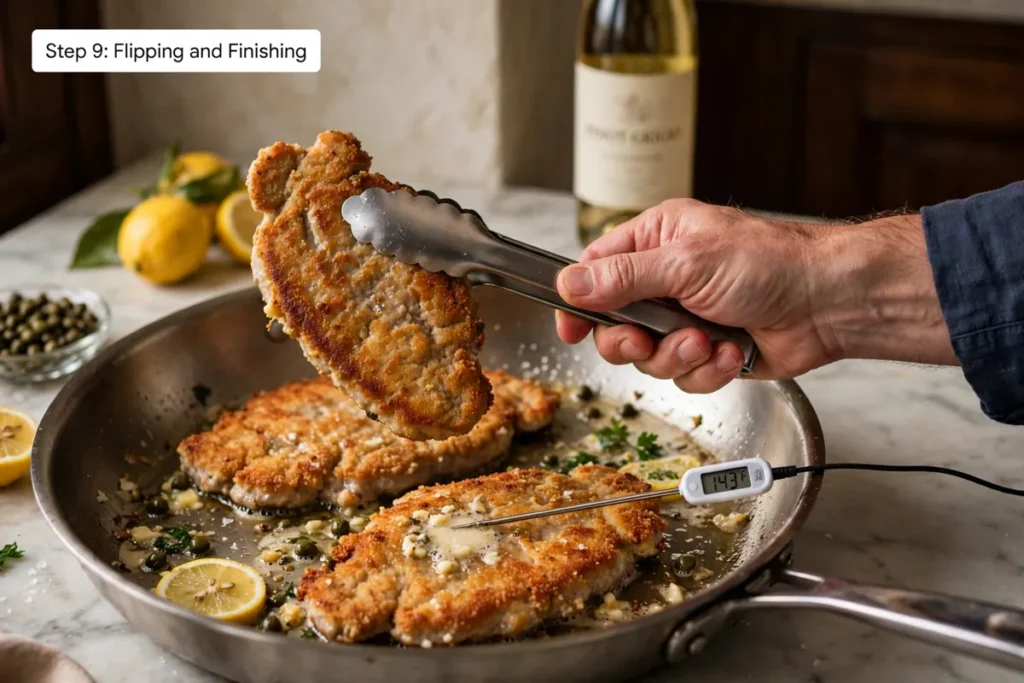
Step 9. Flip each cutlet with tongs and cook 30 to 60 seconds on the second side, until just cooked through and golden. The USDA safe minimum internal temperature for whole cuts of veal is 145°F (63°C) with a 3-minute rest. A thin cutlet reaches that temperature in the pan almost immediately, and it toughens quickly past about 150°F (66°C) as the muscle proteins tighten and squeeze out moisture. Check one cutlet by laying a thin-probe thermometer flat into its thickest edge.
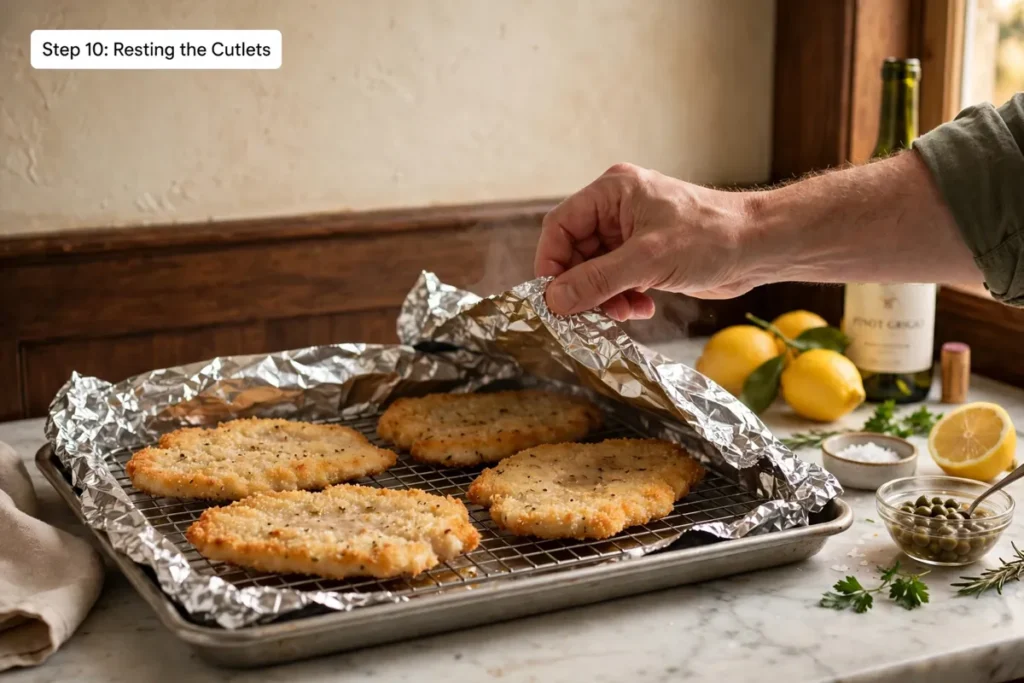
Step 10. Transfer the cutlets to the wire rack set over a sheet pan, spaced in one layer, and tent loosely with foil. Add the remaining 1 tablespoon of oil to the pan, wipe the pan only if it holds black bits, and sear the second batch the same way. The cutlets rest while the sauce is made, which meets the 3-minute USDA rest, and the rest lets the muscle relax so juice stays in the meat rather than running onto the plate. A rack keeps the underside crust crisp, because steam cannot collect beneath the cutlet. Carryover heat adds only a few degrees to meat this thin, so pull at 140°F to 145°F (60°C to 63°C).
Build the Pan Sauce
Step 11. Lower the heat to medium and pour off any burned oil, leaving the fond and about 1 tablespoon of fat. Add the grated garlic and stir for 20 seconds until fragrant. Pour in the white wine and scrape the bottom of the pan with a wooden spoon to loosen the fond. Garlic burns in under a minute and turns bitter, so it goes in only seconds before the liquid. The wine dissolves the fond, which holds concentrated Maillard flavor from the veal and flour crust.
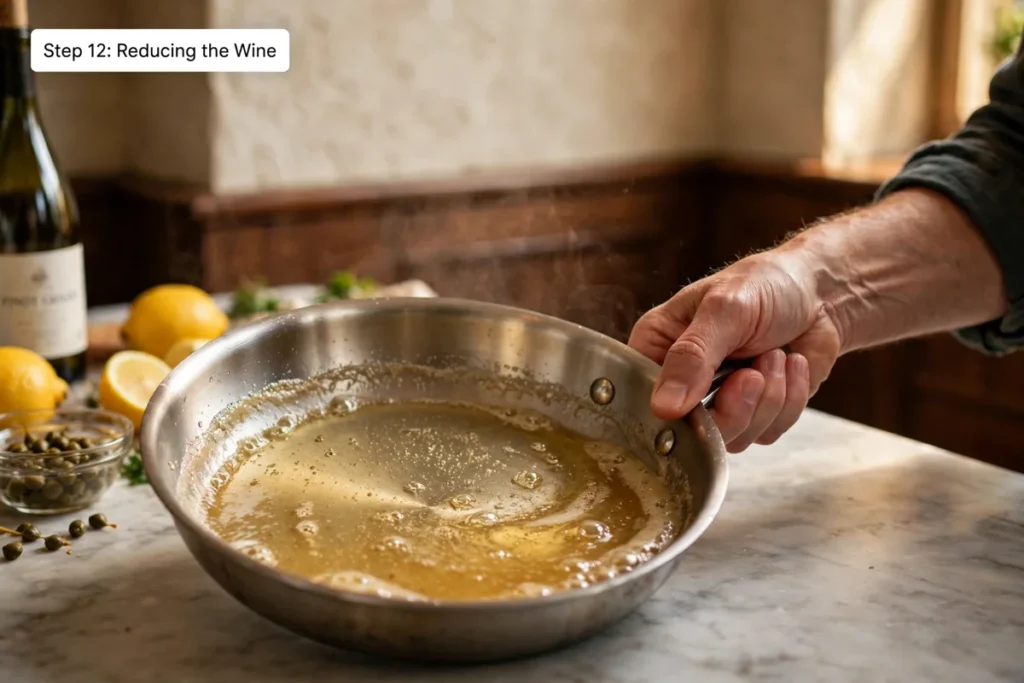
Step 12. Simmer the wine for 2 to 3 minutes until it reduces by half, to about 1/4 cup. Alcohol boils at 173°F (78°C), below water’s boiling point, so it evaporates first, and the harsh raw-alcohol smell fades while the wine’s acids and sugars concentrate. Reducing the wine before adding the stock keeps the sauce from tasting boozy and gives the sauce a more intense backbone.
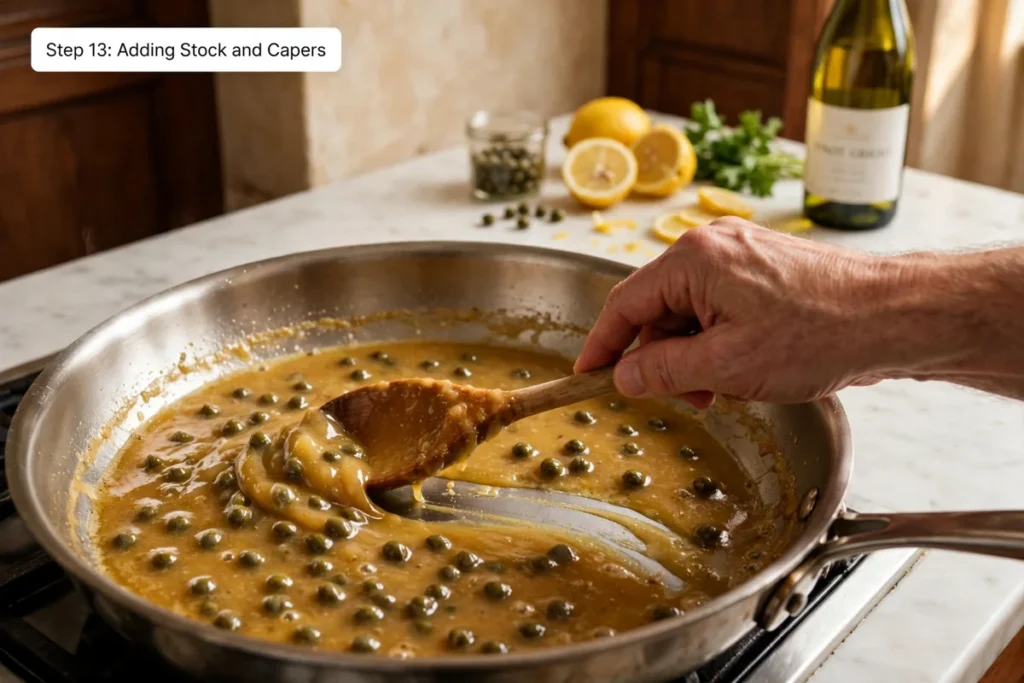
Step 13. Add the stock and the lemon juice and simmer 3 to 4 minutes until the liquid reduces to about 1/2 cup and lightly coats the back of a spoon. Stir in the capers in the last minute. Reduction concentrates flavor and gives the sauce enough body to hold the butter in suspension, and a thin, watery base cannot support an emulsion. Capers are the pickled flower buds of the caper shrub, and their brine and mustard-oil compounds add salty, pungent bite. Add them in the last minute so they warm without turning mushy.
Step 14. Remove the pan from the heat completely. Whisk in the cold butter one cube at a time, adding the next cube only after the previous one has melted and disappeared. Butter is about 80 percent fat, with water and milk proteins. Whisked in slowly off the heat, it melts into tiny fat droplets that the milk proteins and phospholipids coat and keep suspended in the acidic liquid, which gives the sauce body and sheen without cream. In a boiling sauce the butter melts all at once, the droplets merge, and the sauce separates into a greasy layer over thin liquid.
Finish and Serve
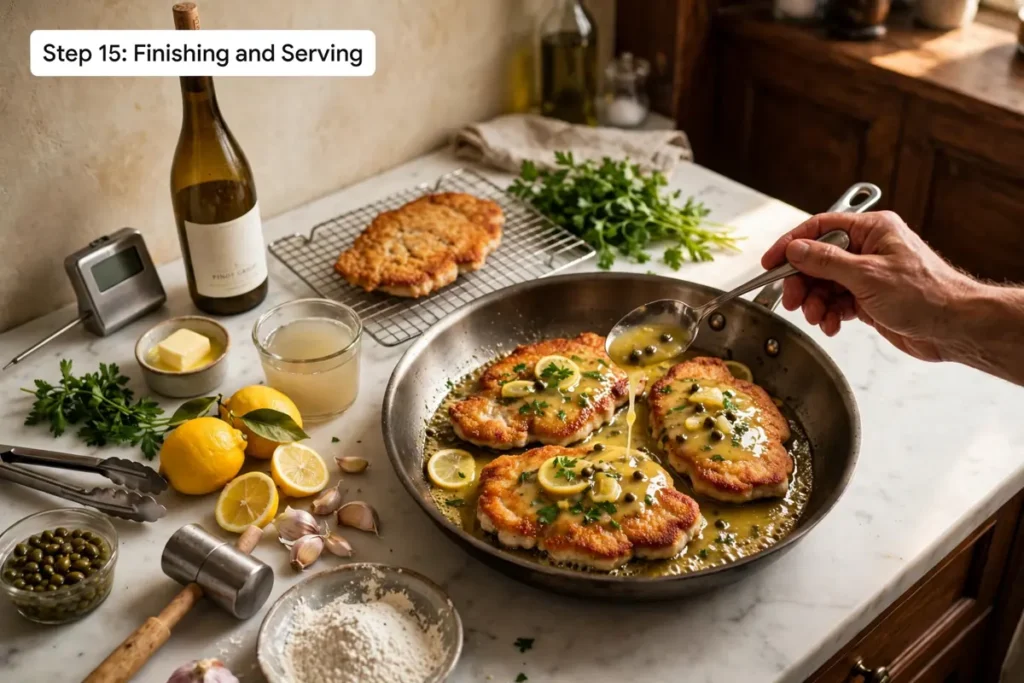
Step 15. Return the cutlets and any juice from the rack to the pan, spoon sauce over each for 20 to 30 seconds only, and scatter the parsley and lemon slices. Longer cooking toughens the veal as the proteins keep contracting. Taste the sauce and adjust: add a pinch of salt if flat, or a squeeze of lemon if heavy. Serve at once on warm plates.
Why Does Veal Piccata Depend on Heat Control?
Piccata fails because of temperature, and four separate reactions are happening on a small scale in one pan. Each has its own temperature window.
Muscle proteins tighten fast in thin veal. Myosin begins to firm at roughly 120°F to 140°F (49°C to 60°C), and actin follows at roughly 150°F to 165°F (66°C to 74°C). As these proteins contract, they squeeze water out of the muscle. A 1/4-inch cutlet passes through this range in about a minute, which is why veal turns from tender to dry in seconds. Pulling the cutlets at 140°F to 145°F (60°C to 63°C) keeps most of the moisture inside.
The Maillard reaction browns the flour crust. Amino acids from the veal and flour proteins react with reducing sugars when the surface is dry and hot, forming pyrazines, furanones, and other savory, roasted compounds. The reaction speeds up above about 300°F (150°C), and surface water holds the pan near 212°F (100°C) until it evaporates. That is why the veal must be patted dry, the flour coat thin, and the pan hot before the first cutlet lands.
The wine and lemon sauce is built on acid and reduction. Wine contributes tartaric and malic acids, and lemon juice contributes citric acid, about 5 to 6 percent by weight. Reducing the wine drives off ethanol, which boils at 173°F (78°C), and concentrates the acids and sugars. The lemon’s limonene, an aroma oil in the zest and juice, is fat-soluble, so it dissolves into the finishing butter and carries a bright citrus aroma through the sauce.
The sauce is a butter emulsion. Butter contains about 80 percent fat, with water, milk proteins such as casein, and phospholipids from the milk fat globule membrane. When cold butter is whisked into hot but not boiling liquid, it melts gradually, releasing fat as droplets that those proteins and phospholipids coat and keep from recombining. The reduced liquid supplies body, since the dissolved flour starch, gelatin from the stock, and concentrated solids thicken it enough to hold the droplets. Too much heat melts the butter at once, the droplets merge, and the emulsion breaks. A drop of cold liquid whisked in off the heat lowers the temperature and re-disperses the fat.
The sequence follows from those four windows: dry and hot for the crust, quick for the proteins, reduced for the acid, and cold and off the heat for the butter.
How Does Veal Piccata Compare to Similar Dishes?
The safe minimums above come from USDA guidance. Veal gives the most tender result and the fastest cook, while chicken and pork carry the same sauce at lower cost.
What Variations Can You Make?
Chicken Piccata
Slice 2 large boneless chicken breasts (about 1 lb or 454g) in half horizontally, pound to 1/4 inch, and cook 3 to 4 minutes per side until they reach 165°F (74°C). Chicken needs the higher temperature, and its firmer protein structure tolerates the longer time. Everything else, including the sauce, stays the same.
Pork Piccata
Cut pork tenderloin into 1/2-inch medallions, pound to 1/4 inch, and cook 2 to 3 minutes per side to 145°F (63°C) with a 3-minute rest. Pork tenderloin is lean and mild, so it takes the lemon-caper sauce well without competing with it.
Dairy-Free Piccata
Use 2 tablespoons of olive oil for the sear and replace the 3 tablespoons of finishing butter with 3 tablespoons of extra-virgin olive oil whisked in off the heat. Olive oil lacks the milk proteins that stabilize a butter emulsion, so the sauce comes out looser and thinner. Whisk it in slowly in a thin stream, and add 1/2 teaspoon of Dijon mustard to help hold it, since mustard contains emulsifying mucilage.
Piccata with Artichokes
Add 1/2 cup (85g) of drained, quartered, water-packed artichoke hearts with the capers in Step 13. Artichokes add a mild, slightly nutty, vegetal depth that rounds out the lemon’s sharpness. Pat them dry first so they do not dilute the sauce.
Lemon-Brown-Butter Piccata
Brown the finishing butter first: melt it in a small saucepan over medium heat until the milk solids turn amber and smell nutty, about 3 minutes, then cool it for 2 minutes. Whisk it into the sauce off the heat in Step 14 as a single pour. Browning develops nutty, toasted compounds in the milk solids, which adds depth. Because the butter is already liquid, the emulsion is looser and less glossy.
Dietary Adjustments and Substitutions
Gluten-Free Version
Dredge in 1/2 cup (60g) of white rice flour or a gluten-free all-purpose blend. Rice flour browns well and stays crisp, though the crust is slightly thinner. Check the stock label for wheat ingredients.
Lower-Sodium Version
Rinse the capers under cold water for 30 seconds, use unsalted stock, and cut the added salt to 1/4 teaspoon. Capers are packed in brine and carry much of the dish’s sodium, so rinsing removes a large share.
Alcohol-Free Version
Replace the wine with 1/2 cup (120ml) of extra stock plus 1 tablespoon of white wine vinegar or lemon juice. The sauce has less complexity and sweetness, but the acid keeps it bright.
Dairy-Free Version
Use the olive oil version above. All other ingredients are dairy-free.
Why Is My Veal Piccata Tough, Gray, or Greasy?
Tough veal is a timing failure, gray veal is a moisture and temperature failure, and a greasy sauce is a heat failure.
How Do You Store and Reheat Veal Piccata?
Scaling
For 8 servings, sear in four batches and build the sauce in one pan, because crowding the pan steams the veal.
Nutritional Information
Per serving: 1 of 4 servings, about 2 cutlets with sauce. These are estimates based on USDA FoodData Central values for veal leg and the listed ingredients, and they vary by brand and trim.
Frequently Asked Questions
Veal piccata is an Italian-American dish in which thin veal scaloppine seared in a hot, dry-surfaced pan brown through the Maillard reaction and finish near the USDA safe minimum of 145°F (63°C) before the muscle proteins tighten into toughness, while a pan sauce of reduced wine, stock, and lemon takes in cold butter off the heat to form a stable emulsion held by milk proteins and phospholipids, which makes heat control, not ingredient choice, the single technique decision that separates tender cutlets in a glossy sauce from dry meat in a greasy one. Save this recipe and try the chicken version on a weeknight.