
American (Pennsylvania Dutch) · Fruit Cakes Amish Apple Cake Recipe A moist, oil-based spiced sheet cake made with pre-cooked diced […]
Check Out..!
American · Cakes
Orange Pound Cake Recipe
This orange pound cake recipe rubs the zest into the sugar before creaming. The sugar pulls out the orange oils, so flavor fills every bite. Here is how.
- Prep: 20 min
- Cook: 65 min
- Total: 2 hrs 30 min
- Servings: 12
- Difficulty: Easy-Medium
- Dietary: Vegetarian
 Chef's review · Saba Aftab, Pastry Chef · Reviewed Nov 10, 2026
“Saba Aftab is a pastry chef, Masala TV presenter, and founder of Lil Bits by Saba. She reviews every dessert recipe on Journalist Recipes.”
Our investigation: 25 recipes add orange zest with the liquid ingredients after creaming, missing the fat-phase integration window entirely and producing a pound cake where the orange flavor concentrates in isolated zest pieces rather than permeating the full crumb the single technique that separates a genuinely orange-forward pound cake from a plain pound cake with orange bits in it.
Orange pound cake is an American enriched butter cake in which fresh orange zest is integrated into the sugar before the creaming stage releasing the zest’s limonene-carrying oil directly into the butter’s fat phase during creaming and the finished cake is finished with a warm orange glaze brushed on immediately after baking, producing a cake with orange character distributed through every fat-containing crumb bite and concentrated additionally at the glazed exterior surface through a dual-phase orange presence that no single-stage addition technique achieves. The zest-into-sugar fat-phase integration is the single most critical technique decision. The pound cake format with its 100 percent butter as the sole fat source is the ideal vehicle for fat-phase aromatic integration because the butter’s high fat content provides the maximum possible fat phase for limonene distribution, meaning that the technique’s full benefit is realized more completely in a butter-only pound cake than in any oil-supplemented cake format at the same zest quantity.
The pound cake is one of the oldest documented American cake formats deriving its name from the original British recipe formula of one pound each of butter, sugar, eggs, and flour that appears in Hannah Glasse’s The Art of Cookery Made Plain and Easy, first published in 1747, and in Eliza Smith’s The Compleat Housewife from 1727. The American pound cake tradition adapted the British formula through the addition of leavening absent in the original pound cake, whose only lift came from the air incorporated during the extended creaming of butter and sugar and the incorporation of regional flavor traditions including vanilla, lemon, and orange that the original British formula’s neutral, rich base accommodated readily. The orange pound cake represents one of the most natural applications of the citrus-fat-phase integration technique in American baking because the pound cake’s butter-dominant fat system is the exact fat phase that limonene’s log P value of 4.83 indicates maximal preference for, producing a cake where the orange aromatic compounds are not merely present but fundamentally embedded in the fat matrix that constitutes the majority of the cake’s structural and flavor foundation.
What Is Orange Pound Cake?
Orange pound cake is a dense, rich, butter-forward American cake in the pound cake tradition defined by its high butter-to-flour ratio, its dense, fine-grained crumb produced by the extended creaming of butter and sugar, and its specific orange character that permeates the crumb through fat-phase limonene integration rather than sitting at the surface as zest pieces or isolated orange-flavored pockets. It differs from a standard American layer cake with orange flavor in that the pound cake’s 100 percent butter fat system and higher fat-to-flour ratio produce a crumb that is significantly denser, more buttery, and more capable of carrying fat-soluble aromatic compounds than a layer cake at the same orange quantity. It differs from an orange chiffon or angel food cake in that the pound cake’s density is a quality rather than a flaw the rich, heavy slice of orange pound cake is the dessert category’s equivalent of a buttery shortbread in the cookie category, where density communicates richness rather than failure.
The orange glaze applied immediately after baking operates through the same capillary absorption mechanism documented in the Italian rum cake’s rum syrup soak, the Granny Cake’s caramel topping, and the gulab jamun cake’s syrup the hot crumb’s open starch network draws the glaze inward through capillary action, adding an additional orange and sugar layer to the exterior crumb that concentrates the orange character at every forkful’s point of entry into the cake. The dual-phase orange delivery limonene through the full crumb from the fat-phase integration and citrus acid-sugar from the glaze at the exterior is what makes a correctly made orange pound cake one of the most intensely, most completely orange-flavored baked goods in the American baking canon at the same zest quantity that a standard addition technique produces only a moderate, uneven orange background note.
What Equipment Do You Need?
| Equipment | Specification | Why It Matters |
|---|---|---|
| 9x5-inch loaf pan or 10-inch Bundt pan | Standard light-colored aluminum or non-stick | The pound cake's dense, high-fat batter bakes most evenly in a loaf pan or Bundt format; the loaf's rectangular cross-section provides even heat penetration through the dense batter, and the Bundt's central tube allows heat to penetrate the batter from the inside as well as the exterior sides and base. A round cake pan produces a pound cake that is excessively thick at the centre relative to the edges, resulting in a doughy centre despite correct edge doneness. |
| Stand mixer with paddle attachment | Full-size 5-quart | The extended creaming 5 to 7 minutes for the butter-orange sugar requires the stand mixer's sustained mechanical action. The paddle's broad contact surface creams the butter and orange sugar more uniformly than the whisk, and the extended creaming time requires the stand mixer's power consistency rather than a hand mixer that fluctuates in speed under load. |
| Microplane or fine box grater | Standard | For zesting the oranges before rubbing into the sugar; the Microplane removes only the colored outer layer containing the oil cells without penetrating the white pith's bitter limonin compounds. |
| Wooden spoon or rubber spatula | Standard | For rubbing the orange zest into the sugar before the mixer is used; the manual rubbing action against the bowl's base using the spoon or spatula back presses the zest against the sugar crystals more forcefully than the mixer's action, rupturing more oil cells per stroke than the mixer's gentler mechanical contact at low speed. |
| Pastry brush silicone | Standard | For applying the warm orange glaze to the hot cake immediately after baking; the silicone bristles withstand the hot cake's temperature and deliver the glaze evenly across the full surface and into the Bundt's ridges or the loaf's top surface and sides without the natural bristle brush's tendency to hold excess glaze in the bristle base. |
| Instant-read thermometer | Standard | For verifying the pound cake's internal temperature; the dense, high-fat batter's slow heat penetration makes visual and toothpick doneness assessment unreliable. The pound cake is done at 205 to 210°F at the thickest point, slightly above the standard layer cake's 200 to 205°F from the denser fat matrix requiring slightly more heat to set completely. |
What Ingredients Do You Need?
Use fresh navel or Valencia oranges for both the zest and the juice the same rationale as the chocolate orange cake’s fresh orange specification applies here with equal force. Navel oranges are preferred for the zest their peel contains the highest limonene concentration of any widely available American grocery store orange variety, at 68 to 82 percent of the peel’s volatile oil composition. Use unsalted butter at room temperature the pound cake’s extended creaming requires the butter to be at exactly 65 to 68°F for optimal aeration during the creaming stage. Below 60°F the butter is too firm to cream to the desired volume increase. Above 72°F the butter’s fat phase begins liquefying, reducing the emulsion’s ability to hold air and producing a denser, less aerated crumb.
For the Orange Pound Cake
| Ingredient | Volume | Weight |
|---|---|---|
| All-purpose flour | 2 cups | 240g |
| Baking powder | 1/2 teaspoon | 2g |
| Fine sea salt | 1/2 teaspoon | 3g |
| Fresh orange zest — from 2 to 3 large navel oranges | 2 tablespoons | 12g |
| Granulated white sugar | 1 1/2 cups | 300g |
| Unsalted butter, at exactly 65 to 68°F | 1 cup | 226g |
| Large eggs, room temperature | 4 eggs | 200g |
| Pure vanilla extract | 1 teaspoon | 5ml |
| Fresh orange juice | 1/4 cup | 60ml |
| Sour cream, room temperature | 1/4 cup | 60g |
The small quantity of baking powder 1/2 teaspoon rather than the 2 to 2.5 teaspoons of a standard layer cake reflects the pound cake’s primary leavening mechanism through air incorporation during creaming rather than chemical leavening. The baking powder provides a minimal supplemental lift that compensates for the inevitable partial deflation of the creamed air bubbles during the flour incorporation stage, without contributing enough carbon dioxide to produce the open, airy crumb that chemical leavening produces in a standard layer cake. The sour cream provides both moisture and the lactic acid that partially activates the baking powder’s leavening through the acid-base reaction that supplements the cream of tartar’s already-present acid component in double-acting baking powder.
For the Orange Glaze
| Ingredient | Volume | Weight |
|---|---|---|
| Powdered sugar, sifted | 1 cup | 120g |
| Fresh orange juice | 2 to 3 tablespoons | 30 to 45ml |
| Fresh orange zest, finely grated | 1 teaspoon | 2g |
| Fine sea salt | A pinch | 0.3g |
The orange glaze’s powdered sugar-to-orange juice ratio produces a glaze that is fluid enough at room temperature to brush onto the hot cake surface and penetrate through capillary absorption, but concentrated enough in dissolved sugar to set to a slightly tacky, slightly glossy exterior coating rather than fully absorbing and leaving no visible glaze character on the finished cake. The additional zest in the glaze provides a second application of fresh limonene at the cake’s exterior surface the glaze’s own fat-free liquid base cannot carry fat-soluble limonene as effectively as the crumb’s butter fat phase, but the zest’s physical presence in the glaze deposits intact oil cells at the exterior surface that release limonene at eating temperature.
Orange Pound Cake
A dense, butter-forward pound cake with orange zest rubbed into the sugar before creaming, finished with a warm orange glaze brushed on the hot cake.
Prep time
20
minutesCooking time
65
minutes Cool
1
HRTotal
2 hrs 30
minutesYield
12
slicesEasy-Medium
Ingredients
- For the Orange Pound Cake
2 cups (240g) all-purpose flour
1/2 teaspoon (2g) baking powder
1/2 teaspoon (3g) fine sea salt
2 tablespoons (12g) fresh orange zest — from 2 to 3 large navel oranges
1 1/2 cups (300g) granulated white sugar
1 cup (226g) unsalted butter, at exactly 65 to 68°F
4 large eggs, room temperature (200g)
1 teaspoon (5ml) pure vanilla extract
1/4 cup (60ml) fresh orange juice
1/4 cup (60g) sour cream, room temperature
1/4 tsp (0.8g) ground cloves
- For the Orange Glaze
1 cup (120g) powdered sugar, sifted
2 to 3 tablespoons (30 to 45ml) fresh orange juice
1 teaspoon (2g) fresh orange zest, finely grated
A pinch (0.3g) fine sea salt
Instructions
- Integrate Orange Into the Fat Phase
Zest sugar:
Rub 2 tbsp orange zest into the granulated sugar with the back of a spoon for 60–90 sec until sugar turns pale orange, clumps slightly, and smells strongly of orange.- Make the Pound Cake Batter
Cream:
Add 65–68°F butter to the orange sugar. Beat 5–7 min until very pale, almost white. Scrape bowl at 2 and 4 min.Eggs:
Add eggs one at a time, beating 30 sec after each. Add vanilla, beat 10 sec.Combine:
Alternate flour mixture with orange juice-sour cream flour, liquid, flour, liquid, flour low speed until just incorporated. Max 15–20 strokes on the final flour.- Bake the Pound Cake
Pan & bake:
325°F. Grease and flour the pan (parchment for loaf). Pour batter, smooth, make a shallow centre depression. Bake 60–70 min (loaf) or 50–60 min (Bundt). Do not open oven for first 40 min.Doneness:
Internal temp 205–210°F at the thickest point. Toothpick shows moist crumbs.- Glaze and Cool
Glaze:
Whisk powdered sugar, orange juice, zest, salt until smooth. Brush over the hot cake within 30 sec of oven removal.Cool:
15 min in pan, then release onto rack. Cool completely 1 hour minimum before slicing.
Step by Step Process
Integrate Orange Into the Fat Phase
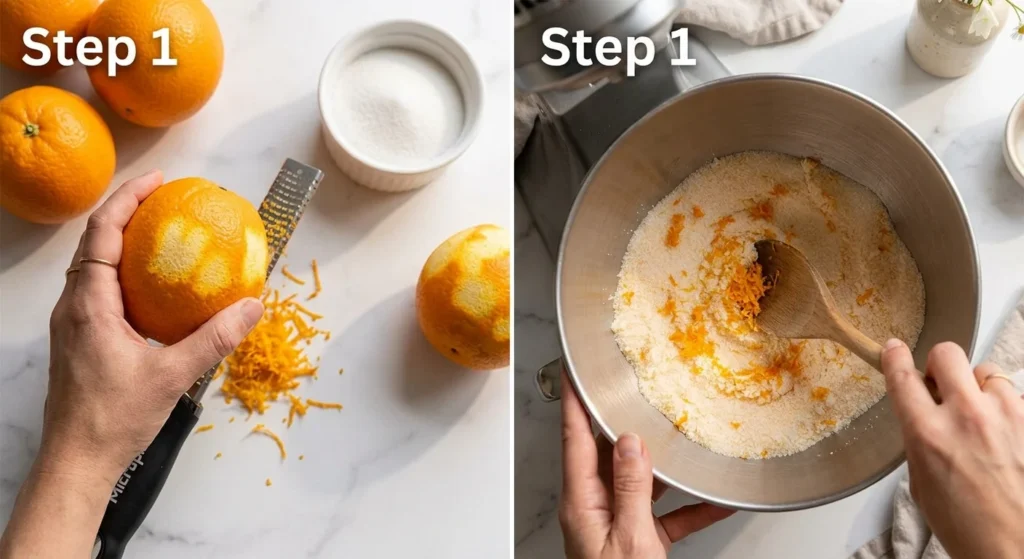
Step 1. Zest 2 to 3 large navel oranges using the Microplane stopping before the white pith is reached. Measure exactly 2 tablespoons (12g) of packed orange zest. Place the granulated sugar in the stand mixer bowl. Add the orange zest to the sugar. Using the back of a wooden spoon or rubber spatula, rub the zest against the sugar in the bowl pressing firmly and working the zest-sugar mixture against the bowl’s base in circular motions for 60 to 90 seconds until the sugar turns visibly pale orange, clumps slightly from the released zest oil, and produces a sharp, fresh orange fragrance that fills the work area.
The 60 to 90 second rubbing window is sufficient to rupture the majority of the zest’s surface oil cells against the sugar crystals’ abrasive edges. The limonene released from these ruptured cells adsorbs immediately onto the sugar crystal surfaces when the butter subsequently contacts this orange-scented sugar during creaming, the limonene transfers from the sugar surface into the butter’s fat phase within the first 30 seconds of mechanical contact, distributing the orange aromatic through the full fat matrix before any other ingredient is added.
Make the Pound Cake Batter
Step 2. Add the room-temperature butter at exactly 65 to 68°F to the orange sugar in the stand mixer bowl. Beat with the paddle at medium speed for 5 to 7 full minutes until the mixture is very pale, almost white, and has increased significantly in volume. Stop the mixer and scrape the bowl’s sides and base completely at the 2-minute and 4-minute marks the orange zest pieces have a slight tendency to collect at the bowl’s base rather than being fully incorporated into the creamed mixture during the early creaming phase, and scraping ensures complete zest-fat contact through the full creaming period.
The 5 to 7 minute creaming time significantly longer than the 3 to 4 minutes typical for a standard American layer cake is the pound cake’s primary leavening mechanism. Each minute of creaming at medium speed incorporates thousands of small air bubbles into the butter-sugar emulsion bubbles that expand during baking from the oven’s heat and the baking powder’s supplemental carbon dioxide to produce the pound cake’s characteristic fine, close crumb. Under-creaming produces a denser, flatter pound cake with a less fine crumb from fewer incorporated air bubbles. Over-creaming beyond 8 minutes can begin to break the emulsion as the butter warms from the mechanical heat of extended mixer action.
Step 3. Add the eggs one at a time, beating at medium speed for 30 seconds after each addition. This slow, sequential egg addition is the most important mixing protocol in pound cake production adding multiple eggs simultaneously overwhelms the butter-sugar emulsion’s capacity to absorb the additional aqueous phase, breaking the emulsion into a curdled, separated mixture that produces a dense, greasy crumb. The emulsion must absorb one egg’s water and protein before the next egg’s water is added, and the 30-second beating period between each egg provides the mechanical energy needed to distribute and stabilise each egg’s water phase in the continuous butter fat phase. Add the vanilla extract after the final egg and beat for 10 seconds.
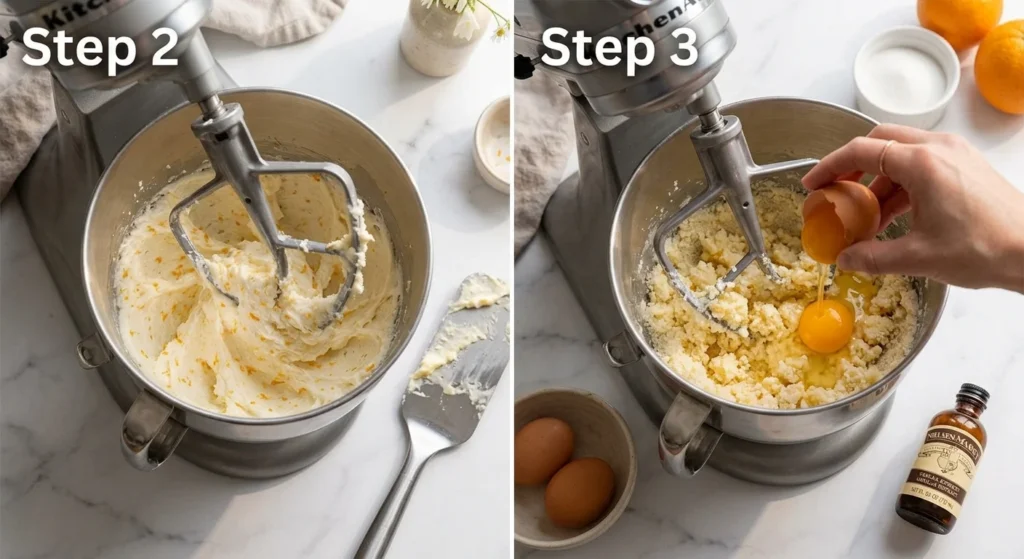
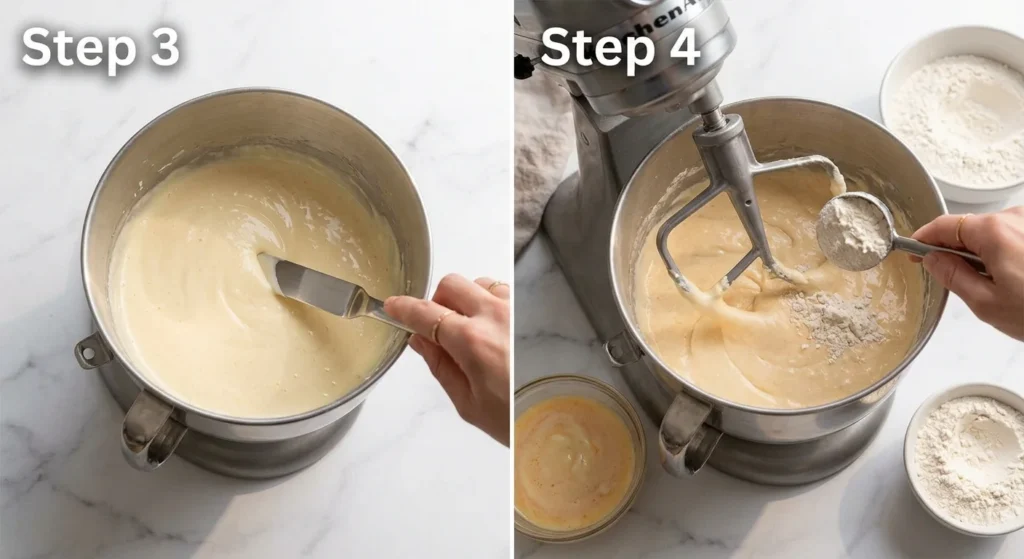
Step 4. Whisk together the flour, baking powder, and salt in a medium bowl. Combine the fresh orange juice and sour cream in a small bowl and whisk until smooth. Add the flour mixture in three additions alternating with the orange juice-sour cream mixture flour, liquid, flour, liquid, flour mixing at low speed after each until just incorporated. The final flour addition must be mixed at low speed for the minimum strokes needed no more than 15 to 20 turns of the paddle to prevent gluten over development that produces a tough, rubbery crumb in a high-fat pound cake batter where the flour’s gluten is less diluted by water than in a lower-fat batter.
Bake the Pound Cake
Step 5. Preheat the oven to 325°F (163°C). Grease the loaf pan or Bundt pan thoroughly with butter and dust with flour the dense, high-fat batter adheres to the pan more strongly than a standard layer cake batter and requires more thorough greasing at all surface details. Line the loaf pan’s base and two long sides with parchment paper leaving an overhang if using a loaf pan the parchment overhang allows the pound cake to be lifted from the pan cleanly after cooling without the dense crumb tearing at the base.
Pour the batter into the prepared pan it will not self-level from its thick consistency. Spread to all corners with the offset spatula, pressing the batter into all details of the Bundt pan if using. For a loaf pan, use the spatula to create a very slight shallow depression running along the centre of the batter’s length the depression guides the pound cake’s characteristic centre crack to open along a controlled line during baking rather than splitting randomly at a weak point.
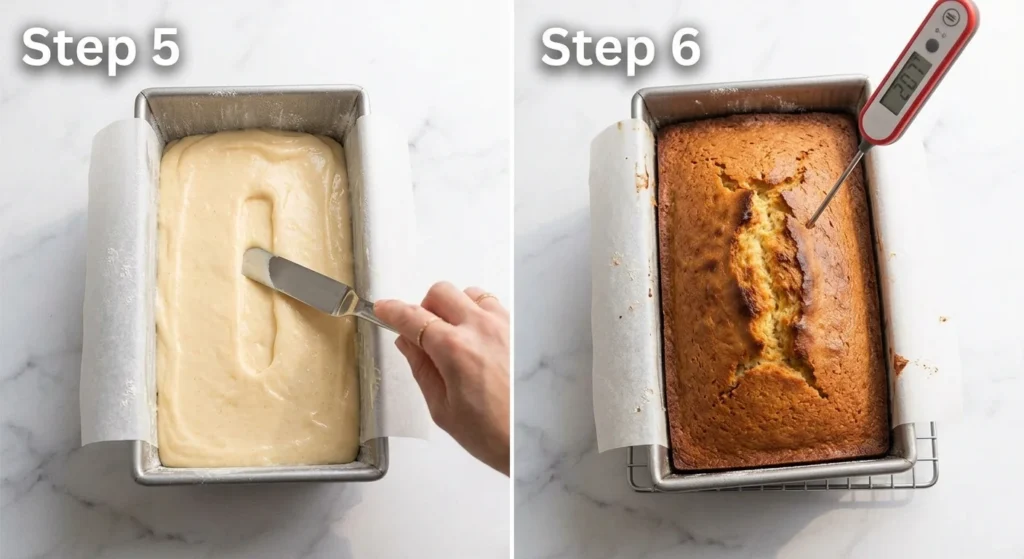
Step 6. Bake at 325°F for 60 to 70 minutes for the loaf format or 50 to 60 minutes for the Bundt format. The lower baking temperature relative to a standard layer cake’s 350°F is essential for the pound cake’s dense, high-fat batter at 350°F the exterior crust forms and browns before the dense interior has had time to set, producing a dark, thick crust over a doughy, under-baked centre. At 325°F the heat penetrates the dense batter more gradually, allowing the full depth of the cake to set before the exterior reaches an over-browned temperature.
Do not open the oven in the first 40 minutes the pound cake’s relatively modest leavening makes the crumb more vulnerable to the thermal shock of cold air entering the oven before the protein and starch network has set sufficiently to hold the incorporated air bubbles against the deflating pressure of the sudden temperature drop.
Verify doneness with the instant-read thermometer insert through the centre crack if present into the thickest interior point. The pound cake is done at 205 to 210°F. Supplement with the toothpick test moist crumbs, not wet batter.
Glaze and Cool
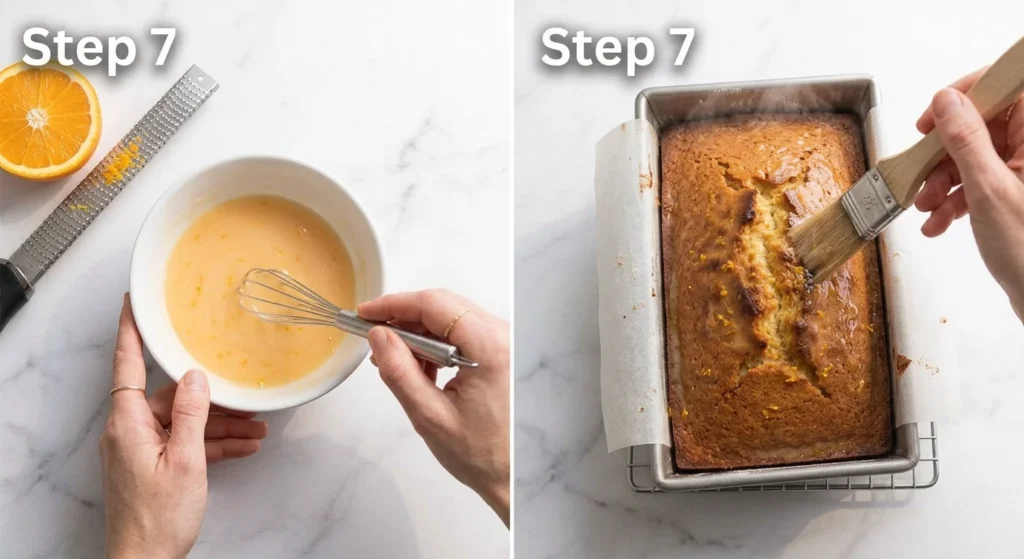
Step 7. Make the orange glaze while the pound cake is in the last 10 minutes of baking whisk together the sifted powdered sugar, fresh orange juice, orange zest, and salt until completely smooth. Start with 2 tablespoons of orange juice and adjust to 3 tablespoons if the glaze is too thick to brush it should flow freely from the brush without dripping rapidly.
Remove the pound cake from the oven. Immediately within 30 seconds brush the full glaze quantity over the hot cake surface while still in the pan. For a loaf pan, brush across the top surface and down the two exposed long sides if accessible. For a Bundt, brush across the fully exposed top surface. The hot cake draws the glaze through capillary absorption within 2 to 3 minutes of application the same warm-soak mechanism as the Italian rum cake, the Granny Cake, and the gulab jamun cake.
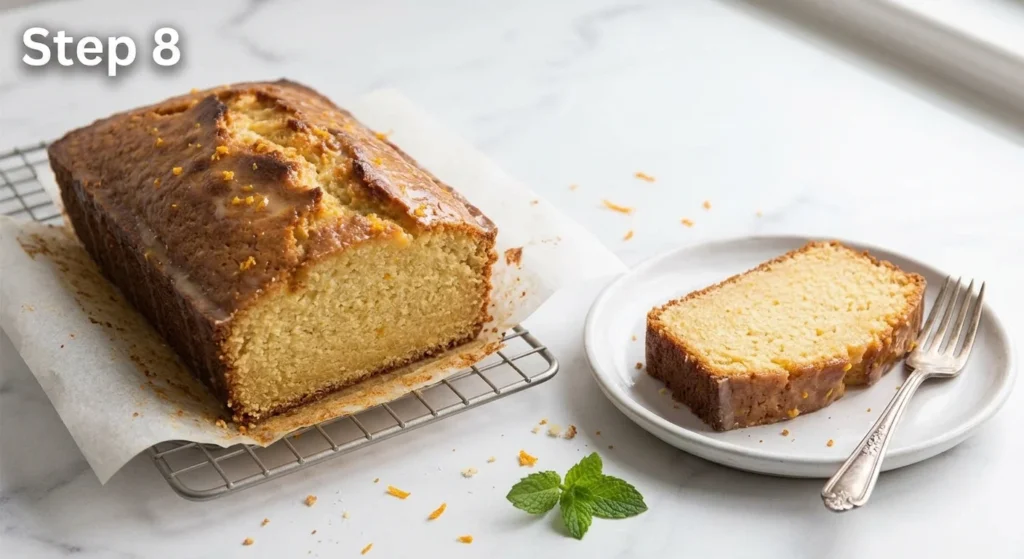
Step 8. Cool in the pan for 15 minutes after the glaze application, then release onto a wire rack by lifting the parchment overhang (loaf) or inverting (Bundt). Allow to cool completely on the wire rack minimum 1 hour before slicing. The pound cake’s dense crumb requires the full cooling period for the butter fat to solidify and the crumb structure to firm to the clean, sliceable consistency that is the pound cake format’s defining cutting characteristic.

Why Fat-Phase Zest Integration Produces Pervasive Orange Flavor Where Post-Creaming Addition Does Not
The difference in orange flavor distribution between an orange pound cake made with the zest-into-sugar fat-phase integration technique and one where the same quantity of zest is added with the liquid ingredients after the creaming stage is not a subtle difference in intensity it is a categorical difference in where the orange flavor is present in the finished crumb, and understanding why requires understanding limonene’s fundamental preference for fat over water.
Limonene the monoterpene that constitutes 68 to 82 percent of navel orange peel’s essential oil by weight has a log P value of 4.83, where log P is the logarithm of the partition coefficient between octanol (representing organic fats) and water. A log P of 4.83 indicates that at equilibrium, limonene distributes approximately 67,000 times more strongly into the fat phase than into the water phase limonene is, in practical baking terms, essentially entirely fat-soluble and essentially entirely water-insoluble. This extreme fat preference means that wherever a fat phase is available in the batter, the liberated limonene will distribute into it rather than remaining distributed through the aqueous phase.
When the orange zest is rubbed into the sugar and the orange sugar is creamed with butter, the limonene released from the ruptured oil cells finds the butter’s continuous fat phase immediately available it dissolves into the butter fat within the first 30 seconds of creaming contact. The creaming process then distributes this limonene-saturated butter fat through the entire batter as an emulsion during the subsequent mixing, carrying the dissolved limonene to every fat-containing portion of the batter volume. In the finished baked crumb, the butter fat is the continuous phase surrounding every starch granule and protein strand meaning the limonene that dissolved into the butter during creaming is present at every point in the crumb where fat exists, which is essentially the full crumb volume at the pound cake’s high butter content. Every bite of the finished pound cake melts the surrounding fat at mouth temperature and releases the dissolved limonene simultaneously the orange flavor is pervasive because the limonene is distributed through the continuous fat phase.
When the same zest is added with the liquid ingredients after the butter has been creamed and the eggs have been added at the point where the batter is an established emulsion of fat droplets in the aqueous phase the situation is fundamentally different. The established emulsion’s fat phase is no longer in the continuous, open contact with mixing ingredients that the early creaming stage provides the fat is now dispersed as discrete droplets through the aqueous continuous phase of the batter. The limonene released from the zest oil cells in this late-addition context still seeks the fat phase, but the fat is now accessed only at the surfaces of these discrete fat droplets rather than as an open, continuous fat matrix. The limited fat surface area available at this late stage means that much of the released limonene distributes into the aqueous phase rather than the fat phase it remains associated with the physical zest pieces where it was released rather than distributing through the batter’s fat matrix. In the finished crumb, the orange flavor is concentrated at and near the zest piece locations rather than throughout the fat-continuous crumb producing the isolated orange pockets that most tasters describe as “bits of orange flavor” rather than an orange-permeated crumb.
How Does Orange Pound Cake Compare to Related Citrus Pound Cakes?
| Attribute | Orange Pound Cake | Lemon Pound Cake | Lemon Blueberry Pound Cake | Lime Coconut Pound Cake | Grapefruit Pound Cake |
|---|---|---|---|---|---|
| Primary citrus aromatic | Limonene 68 to 82% of navel orange peel oil | Limonene plus elevated citric acid | Limonene plus blueberry malic acid and anthocyanin | Limonene plus linalool plus coconut lauric acid | Limonene plus naringenin bitter compound |
| Zest fat-phase integration | Yes zest rubbed into sugar before creaming | Yes identical technique | Yes identical technique | Yes lime zest rubbed into sugar | Yes grapefruit zest rubbed into sugar |
| Glaze composition | Fresh orange juice and powdered sugar | Fresh lemon juice and powdered sugar | Lemon glaze only and blueberries provide the additional top note | Lime juice, coconut extract, powdered sugar | Pink grapefruit juice, powdered sugar, tiny pinch of salt |
| Glaze application timing | Immediately post-oven warm-soak | Immediately post-oven | Immediately post-oven | Immediately post-oven | Immediately post-oven |
| Batter modification for fruit addition | None zest only | None zest and juice | Blueberries tossed in flour before folding in last | Toasted coconut folded in last | None zest and juice |
| Primary flavor tension | Orange brightness vs butter richness | Lemon brightness vs butter richness | Lemon-butter vs blueberry fruit | Lime-coconut tropical vs butter richness | Grapefruit bitter naringenin vs butter sweetness |
| Most common occasion | American everyday dessert, afternoon tea, brunch | American everyday dessert, spring celebration | American summer dessert, brunch | Tropical-themed American dessert | Sophisticated American adult dessert |
| Difficulty | Easy-Medium | Easy-Medium | Medium blueberry fold-in timing | Medium coconut toasting | Easy-Medium |
What Variations Can You Make?
Orange Cream Cheese Pound Cake
Replace 1/4 cup (57g) of the butter with 4 oz (113g) of room-temperature full-fat block cream cheese the cream cheese displaces some butter while adding its casein protein and lactic acid to the batter. Add the cream cheese after the butter and orange sugar have creamed for 3 minutes beat the cream cheese in for 1 minute before adding the eggs. The cream cheese’s casein protein supplements the egg albumin’s structural contribution, producing a slightly denser, more moist crumb with a pronounced tangy dairy character from the lactic acid that complements the orange’s citric acid brightness through the same acid-dairy complementarity documented in the cream cheese frosting preparations throughout this collection. The cream cheese pound cake is slightly less orange-forward than the standard version because the cream cheese’s own strong dairy character partially competes with the orange’s aromatic prominence compensate by increasing the orange zest to 2 1/2 tablespoons.
Blood Orange Pound Cake
Replace the navel orange with blood oranges Moro or Tarocco variety. Blood orange’s peel oil contains a lower limonene concentration than navel orange but a significantly higher linalool content the floral, slightly lavender-adjacent terpene alcohol that produces blood orange’s more complex, more nuanced aromatic character relative to standard orange. The blood orange juice in the glaze turns the glaze pale ruby-pink from the anthocyanin pigments applied to the golden-brown pound cake exterior the pale pink glaze produces the most visually distinctive orange pound cake variation. The blood orange version is the most appropriate for sophisticated adult celebration contexts where the more complex, less simply sweet aromatic character of the blood orange differentiates the preparation from the standard version at first bite.
Orange Olive Oil Pound Cake
Replace the butter entirely with extra-virgin olive oil at 3/4 cup (168ml) use the reverse creaming method rather than the standard creaming method, since olive oil cannot be creamed to incorporate air. Combine the dry ingredients first, add the oil, then the eggs, then the orange juice and sour cream. The olive oil pound cake is a denser, moister cake than the butter version from the oil’s 100 percent fat content with no water fraction — extending the room-temperature storage window to 5 to 6 days. The olive oil’s oleocanthal and oleacein phenolic compounds contribute a slight bitter, peppery background note that contrasts the orange’s citrus brightness through the same bitter-citrus complementarity that makes blood orange Negroni one of the most complex citrus-bitter cocktails in Italian bar culture. Use a high-quality Sicilian or Californian EVOO rather than a generic light olive oil the phenolic compound concentration is significantly higher in quality EVOO and the bitter-fruity character is the intentional flavor contribution rather than a deficit to be minimised.
Dietary Adjustments and Substitutions
Gluten-Free Version
Replace the all-purpose flour with a certified 1:1 gluten-free baking flour blend containing xanthan gum at exactly 240g. Increase the baking powder to 1 teaspoon (4g). The orange pound cake’s high butter-to-flour ratio makes it more successfully adaptable to gluten-free flour than most American cake formats the butter’s fat provides the primary structural richness and the xanthan gum’s binding function supplements the absent gluten’s structural role in a batter where the fat content reduces the demand on the flour’s protein network compared to a leaner batter. The zest-into-sugar fat-phase integration technique requires no modification it is a fat-phase mechanism independent of the flour type.
Dairy-Free Version
Replace the butter with Miyoko’s Creamery dairy-free butter sticks at the same weight (226g). Replace the sour cream with unsweetened coconut yogurt at the same weight (60g). The zest-into-sugar technique works identically with Miyoko’s dairy-free butter the limonene released from the ruptured zest oil cells dissolves into the coconut oil-based fat phase with the same fat-phase distribution efficiency as dairy butter. The coconut oil’s lauric acid fat carries the limonene through the crumb as effectively as dairy butter’s mixed fatty acid profile the finished dairy-free orange pound cake has an orange character comparable to the dairy version with a subtle coconut background note from the lauric acid’s own aromatic contribution.
What Are the Most Common Problems When Making Orange Pound Cake?
| Problem | Most Likely Cause | Prevention or Fix |
|---|---|---|
| Orange flavor concentrated in zest pieces rather than permeating crumb | Zest added with liquid ingredients rather than rubbed into sugar before creaming and limonene never entered the fat phase | Always rub zest into sugar as the absolute first step before any butter contact. If already baked with insufficient fat-phase integration then serve with fresh orange curd alongside each slice. The curd's concentrated orange flavor supplements the crumb's insufficient distribution at the plate level. |
| Dense, gummy crumb without rise | Butter too cold and insufficient air incorporated during creaming | Verify butter temperature at exactly 65 to 68°F before creaming begins. If the crumb is already gummy then the cake is edible but denser than intended. Cream the butter for the full 5 to 7 minutes in the next batch at verified temperature. |
| Curdled, greasy batter after egg addition | Eggs too cold and cold egg protein broke the warm butter emulsion | Always use room-temperature eggs. If curdled then add 2 tablespoons of flour and beat at low speed for 20 seconds to re-emulsify before continuing. Minor curdling at this stage resolves when the flour is added but severe curdling produces a greasy crumb. |
| Dark exterior before centre is set | Oven temperature too high and exterior browned before heat penetrated the dense batter centre | Always bake at 325°F rather than 350°F. If already dark at 55 minutes with an under-baked centre then tent loosely with aluminium foil and continue baking at 325°F until the thermometer reads 205°F. |
| Glaze pooled on surface without absorbing | Cake had cooled before glaze was applied and capillary channels closed | Always apply glaze within 30 seconds of oven removal. If pooling occurred then pierce the top surface in a grid with a thin skewer and pour warm glaze over the pierced surface. The skewer holes provide manual capillary channels for partial absorption. |
How Do You Store Orange Pound Cake?
| Storage Method | Duration | Instructions |
|---|---|---|
| Room temperature, under a cake dome or wrapped in plastic wrap | Up to 5 days | The pound cake's high butter content and the orange glaze's sugar layer together produce exceptional moisture retention at room temperature. The butter fat prevents moisture loss from the crumb and the glaze's hygroscopic sugar draws ambient moisture inward rather than losing crumb moisture to the environment; the same mechanism documented in the Granny Cake's caramel topping. The orange limonene in the fat phase does not evaporate significantly at room temperature below 72°F; the fat-phase binding mechanism that produced the pervasive orange distribution also protects the dissolved limonene from evaporative loss. |
| Refrigerated, wrapped tightly in plastic wrap | Up to 7 days | The pound cake firms significantly under refrigeration as the butter fat solidifies; bring to room temperature for 30 minutes before serving to restore the characteristic rich, buttery, dense-but-yielding crumb. Cold pound cake eaten directly from the refrigerator has a significantly less pleasant texture and suppressed aromatic expression from the cold temperature's reduction of limonene's volatility. |
| Frozen, individual slices wrapped in plastic wrap then foil | Up to 3 months | The high butter fat content freezes and thaws without significant textural change; the fat's solid-to-liquid transition during freezing and thawing does not rupture the crumb's structural network as water's ice crystal formation does in lower-fat preparations. Thaw at room temperature for 45 minutes. The fat-phase limonene is protected from freezer oxidation by the butter fat's antioxidant compounds and freezes and thaws with no significant aromatic degradation. |
Scaling
| Servings | All-Purpose Flour | Sugar | Butter | Eggs | Orange Zest | Orange Juice (batter) | Pan Format |
|---|---|---|---|---|---|---|---|
| 6 servings | 120g | 150g | 113g | 2 eggs | 6g | 30ml | 8x4-inch loaf pan |
| 12 servings (standard) | 240g | 300g | 226g | 4 eggs | 12g | 60ml | 9x5-inch loaf or 10-inch Bundt |
| 18 servings | 360g | 450g | 340g | 6 eggs | 18g | 90ml | 12-cup Bundt pan |
Nutritional Information
Per serving: 1 slice approximately 100g including orange glaze, based on 12 slices from a 9×5-inch loaf. Values calculated using USDA FoodData Central reference data.
| Nutrient | Per Serving | Nutrient | Per Serving |
|---|---|---|---|
| Calories | 368 kcal | Total carbohydrate | 48g |
| Total fat | 18g | Dietary fibre | 0.6g |
| Saturated fat | 11g | Total sugars | 34g |
| Cholesterol | 108mg | Protein | 4.2g |
| Sodium | 148mg | Vitamin C | 6mg (7% DV) |
Frequently Asked Questions
Why does rubbing orange zest into sugar before creaming produce more pervasive orange flavor than adding zest with the liquid ingredients?
Limonene’s log P value of 4.83 indicates it distributes approximately 67,000 times more strongly into fat than water at equilibrium making it essentially entirely fat-soluble in baking conditions. When zest is rubbed into sugar, the mechanical rupturing of the oil cells releases limonene onto the sugar surface where it immediately dissolves into the butter fat during creaming, distributing through the continuous fat phase that surrounds every starch granule and protein strand in the finished crumb. When zest is added with liquid ingredients after creaming, the established emulsion’s fat is already dispersed as discrete droplets the limited accessible fat surface area means much of the released limonene remains associated with the physical zest pieces rather than distributing through the continuous fat matrix, producing isolated orange pockets rather than pervasive orange character.
Why is the baking temperature 325°F rather than the standard 350°F?
The pound cake’s high butter-to-flour ratio and dense batter conduct heat significantly more slowly than a standard lean layer cake batter at the same depth. At 350°F the exterior surface browns and crusts before the dense interior has had sufficient time for the heat to penetrate and set the full crumb depth producing a dark, thick exterior crust over a doughy, under-baked centre regardless of extended baking time. At 325°F the exterior’s temperature rise is slower, allowing the interior to set simultaneously with the exterior’s browning and producing a uniformly cooked crumb from edge to centre with the characteristic golden rather than dark-brown exterior that indicates even heat penetration rather than surface-only heat accumulation.
Why must the orange glaze be applied immediately after baking rather than after cooling?
The hot cake’s starch network is at maximum porosity immediately post-oven the gelatinised starch chains have not yet begun retrogradation, and the capillary channels between air cells are at their widest diameter before cooling contraction begins. The warm glaze’s low viscosity at the pound cake’s 205 to 210°F surface temperature allows it to flow through these maximally open channels through capillary action, absorbing into the exterior crumb layer rather than pooling on the surface. As the cake cools, retrogradation narrows the channels and the glaze’s viscosity increases as it cools — both changes reduce absorption capacity progressively from the moment of oven removal, with meaningful capillary absorption possible only within the first 3 to 5 minutes post-oven.
Can I use store-bought orange juice instead of fresh-squeezed in the batter and glaze?
In the batter, yes at the 1/4 cup quantity in the batter, the orange juice’s primary functional contribution is acidity and liquid volume rather than aromatic complexity, and commercial orange juice’s citric acid content performs equivalently to fresh juice at this quantity. In the glaze, no the glaze is applied directly to the cake’s exterior surface and consumed without further cooking, meaning the orange juice’s aromatic compounds are present at full concentration in the finished glaze. Commercial orange juice’s pasteurisation and storage deplete its limonene and linalool aromatic compounds to trace levels the finished glaze tastes primarily of sweet citric acid rather than fresh orange. Use fresh-squeezed juice in the glaze at minimum even if commercial juice is used in the batter.
Orange pound cake is an American enriched butter cake in the 18th-century British pound cake tradition documented in Hannah Glasse’s The Art of Cookery Made Plain and Easy from 1747 whose defining quality is the pervasive, fat-distributed orange character produced by rubbing fresh navel orange zest into the granulated sugar before creaming, a technique that mechanically ruptures the zest’s limonene-filled oil cells against the sugar crystals’ abrasive surfaces and releases the limonene whose log P of 4.83 indicates 67,000-to-1 fat-over-water phase preference directly into the butter’s continuous fat matrix during the 5 to 7 minute creaming stage, distributing the orange aromatic through every fat-containing point in the finished pound cake’s dense, butter-rich crumb rather than concentrating it at isolated zest pieces, then reinforced at the exterior crumb layer by the warm orange glaze applied within 30 seconds of oven removal at the moment of maximum capillary absorption through the hot crumb’s open starch network a dual-phase orange delivery system whose fat-phase interior distribution and glaze-based exterior concentration together produce the orange pound cake’s defining quality of orange character perceptible from the first exterior bite through the last forkful of the dense, rich, butter-forward interior crumb.
Table of Contents
Recent Recipes
American · Layer Cakes Coconut and Carrot Cake Recipe Moist, oil-based spiced layer cake packed with freshly grated carrot and […]
Check Out..!
American Cakes Tandy Cake Recipe This Tandy cake recipe spreads peanut butter on the warm cake, then chills it before […]
Check Out..!
American · Cakes Portillo’s Chocolate Cake Recipe This Portillo’s chocolate cake recipe adds mayonnaise to the batter. Mayo is just […]
Check Out..!
American Cakes Funnel Cake Fries Recipe This funnel cake fries recipe uses a thicker batter than classic funnel cake, piped […]
Check Out..!Recent Blogs
I’ve glazed our Amish apple cake too hot, too cold, and exactly right, and the difference is not small. The […]
Read Blog..!
I’ve pulled a sunken Amish Apple Cake out of my oven, and I know the exact sinking feeling that comes […]
Read Blog..!
A cup measures volume, not weight, so a cup of flour and a cup of sugar weigh completely different amounts. […]
Read Blog..!
Every pasta shape was designed to carry a certain kind of sauce. Thin strands suit light sauces that coat, wide […]
Read Blog..!
Every egg method, from a jammy boiled egg to a silky French omelet, comes down to one fact: the white […]
Read Blog..!