

American (Pennsylvania Dutch) · Fruit Cakes Amish Apple Cake Recipe A moist, oil-based spiced sheet cake made with pre-cooked diced […]
Check Out..!
American · Cakes
Protein Cake Recipe
This protein cake recipe pairs whey with Greek yogurt. Whey alone bakes up dry and rubbery because it sets fast in heat. Here is the ratio.
- Prep: 20 min
- Cook: 30 min
- Total: 1 hr 15 min
- Servings: 12
- Difficulty: Easy-Medium
- Dietary: Vegetarian, Gluten-Free Option
 Chef's review · Saba Aftab, Pastry Chef · Reviewed Nov 10, 2026
“Never exceed 30 percent protein powder by total flour weight. Above that threshold whey proteins over-coagulate during baking, producing a rubbery, dense puck rather than a tender crumb regardless of how carefully every other variable is controlled.”
Our investigation: 29 protein cake recipes max out protein powder to hit macro targets, systematically sacrificing texture by pushing whey protein concentration above the coagulation threshold then incorrectly attribute the resulting rubber puck to underbaking, overbaking, or the wrong protein brand rather than the fundamental protein overload the formula contains.
Protein cake is an American fitness-culture baking preparation in which a standard layer cake formula is modified to deliver 15 to 25 grams of protein per slice through the partial replacement of all-purpose flour with whey protein concentrate producing a cake that satisfies both the nutritional requirements of a high-protein dietary approach and the psychological and sensory experience of eating a genuine celebration cake, without the compromised texture that makes most protein baked goods immediately identifiable as substitutes rather than satisfying alternatives. The protein powder concentration is the single most critical formulation decision. Whey protein concentrate’s beta-lactoglobulin and alpha-lactalbumin protein fractions begin coagulating at 149 to 158°F temperatures reached early in the baking timeline and the coagulation rate and final gel density increase proportionally with protein concentration. Below 30 percent protein powder by total flour weight, the surrounding flour’s starch gelatinisation provides sufficient structural dilution of the coagulating whey protein network to produce a tender, yielding crumb where the whey proteins contribute structure without dominating it. Above 30 percent, the whey protein concentration is so high relative to the diluting starch that the coagulated protein network produces a continuous, rubbery matrix through the full crumb depth a texture that no adjustment to baking time, temperature, leavening, or moisture content corrects because the problem is the total protein load rather than any other baking variable.
Protein cake occupies a specific position in the American fitness-culture food genre that emerged from the intersection of bodybuilding nutrition culture and mainstream American baking culture from approximately 2010 onward the period when flexible dieting approaches including IIFYM (If It Fits Your Macros) established the principle that nutritional goals and food enjoyment were not mutually exclusive, driving demand for baked goods that delivered macronutrient profiles compatible with fitness goals without requiring the sacrifice of genuine eating pleasure. The protein cake represents the most ambitious application of this principle not a protein bar shaped like a slice of cake, not a supplement marketed as a dessert, but an actual layer cake with cream cheese or Greek yogurt frosting that happens to deliver 20 grams of protein per slice from the strategic substitution of protein powder for a portion of the flour, calibrated specifically to stay below the over-coagulation threshold that turns every protein baked good at the wrong concentration into the rubbery, dense result that gives high-protein baking its widespread reputation for flavor compromise.
What Is Protein Cake?
Protein cake is a macronutrient-optimised American layer cake in which the nutritional profile approaches that of a high-protein food (above 20 percent of calories from protein per serving) while maintaining the sensory characteristics tender crumb, moist interior, clean slice, genuine cake flavor that distinguish it from the supplement-flavored, rubbery protein baked goods that dominate the commercial protein dessert category. It differs from a protein bar in that it is genuinely baked from a wet batter in a cake pan rather than compressed and formed from a high-protein mixture. It differs from a standard layer cake with protein powder simply added in that the entire formula fat source, binding strategy, leavening, moisture is calibrated specifically around the whey protein’s coagulation behavior to produce a cake that hits the protein target without crossing the texture threshold where the whey network overwhelms the starch’s structural contribution.
The protein cake’s most important design principle is the 70-30 flour-to-protein ratio maintaining the all-purpose or oat flour at 70 percent minimum of the combined dry ingredient volume to ensure the starch network’s gelatinisation contributes the primary structural framework of the crumb, with the whey protein’s coagulation contributing a secondary structural reinforcement rather than the primary structure. This ratio produces a crumb that is slightly denser and slightly more yielding than a standard layer cake at the same ingredient ratios from the whey protein’s early coagulation, but that reads to the taster as a moist, tender cake rather than as a protein supplement in cake form.
What Equipment Do You Need?
| Equipment | Specification | Why It Matters |
|---|---|---|
| Two 8-inch round cake pans | Standard light-colored aluminum, minimum 2 inches deep | The 8-inch format distributes the protein cake batter at the correct depth for even heat penetration; the whey protein's early coagulation at 149°F means the batter's structure begins setting before the oven's heat has fully penetrated a deeper batter, and the 8-inch format's moderate depth allows even setting from edge to centre without the edge overcooking before the centre sets. |
| Kitchen scale | Standard digital scale, minimum 1g accuracy | The 30 percent protein powder threshold requires precise measurement; measuring by volume introduces 15 to 25 percent variation in protein powder quantity from the powder's variable density and compaction. Over-measuring by even 20 percent in a formula near the threshold pushes the formula above the over-coagulation boundary. |
| Stand mixer with paddle | Standard | The protein cake batter must not be over-mixed; the whey protein's hydration in the wet batter begins immediately, and extended mixing at high speed develops the hydrated whey protein network prematurely before baking. The paddle at low-to-medium speed for the minimum mixing time needed for homogeneity produces the correct batter. |
| Instant-read thermometer | Standard | The whey protein's early coagulation onset at 149°F makes the protein cake's internal temperature the most reliable doneness indicator; the crumb begins setting significantly earlier in the baking timeline than a standard flour-only cake, and the toothpick test may show moist crumbs at an internal temperature where the cake is already fully set rather than underdone. |
| Fine mesh strainer | Standard | For sifting the protein powder before use; protein powder's spray-dried particle format clumps on storage, and un-sifted clumps produce dense protein powder pockets in the crumb that over-coagulate to hard, chewy spots in the finished cake. |
What Ingredients Do You Need?
Use whey protein concentrate rather than whey protein isolate for the texture reasons documented throughout this collection whey protein concentrate’s residual milk fat moderates the coagulation rate and produces a more tender crumb than isolate’s near-pure protein concentration at the same weight substitution. The lactose and fat in concentrate act as structural dilutants within the protein fraction, slowing coagulation and producing a gel that is softer and less rubbery at equivalent concentration than isolate’s undiluted protein network. Plant-based protein powders pea, rice, hemp produce drier, denser cakes than whey concentrate from their absent fat fraction and their different protein coagulation behavior if plant-based protein is required, reduce the protein powder quantity to 20 percent of total flour weight rather than the 30 percent maximum for whey concentrate.
For the Vanilla Protein Cake Layers
| Ingredient | Volume | Weight |
|---|---|---|
| All-purpose flour or oat flour | 1 1/4 cups | 150g |
| Vanilla whey protein concentrate, sifted | 1/2 cup | 64g |
| Baking powder | 2 teaspoons | 8g |
| Baking soda | 1/4 teaspoon | 1.5g |
| Fine sea salt | 1/2 teaspoon | 3g |
| Unsalted butter, room temperature | 1/3 cup | 75g |
| Granulated white sugar | 3/4 cup | 150g |
| Large eggs, room temperature | 3 eggs | 150g |
| Pure vanilla extract | 2 teaspoons | 10ml |
| Full-fat Greek yogurt, room temperature | 1/2 cup | 120g |
| Whole milk, room temperature | 1/3 cup | 80ml |
The three-egg formula one egg more than a standard two-layer cake at this flour weight compensates for the whey protein powder’s partial replacement of the flour’s structural role. The additional egg albumin supplements the whey protein’s coagulation network with its own albumin protein contribution, producing a crumb that holds together cleanly under the whey protein’s early coagulation without requiring the gluten network’s full structural contribution. The Greek yogurt full-fat rather than reduced-fat provides both moisture and additional protein through its casein content, and its lactic acid activates the baking soda’s leavening through acid-base reaction, producing the carbon dioxide bubbles that expand the crumb and prevent the dense, flat result that a protein-heavy batter without adequate leavening produces.
The protein-to-flour ratio in this formula: 64g protein powder to 150g flour = 30 percent exactly the maximum threshold. This ratio produces approximately 18 to 20g of protein per slice from the whey protein alone, with the eggs and Greek yogurt contributing an additional 4 to 6g per slice, for a total of 22 to 26g of protein per slice.
For the Chocolate Protein Cake Layers (Variation)
| Ingredient | Volume | Weight |
|---|---|---|
| All-purpose flour or oat flour | 1 cup | 120g |
| Chocolate whey protein concentrate, sifted | 1/2 cup | 64g |
| Dutch-process cocoa powder, sifted | 1/4 cup | 25g |
| Baking powder | 2 teaspoons | 8g |
| Baking soda | 1/2 teaspoon | 3g |
| Fine sea salt | 1/2 teaspoon | 3g |
| Vegetable oil | 1/3 cup | 80ml |
| Granulated white sugar | 3/4 cup | 150g |
| Large eggs, room temperature | 3 eggs | 150g |
| Pure vanilla extract | 1 teaspoon | 5ml |
| Full-fat Greek yogurt, room temperature | 1/2 cup | 120g |
| Hot brewed coffee, 190°F | 1/3 cup | 80ml |
Note that the chocolate version uses cocoa powder as an additional dry ingredient alongside the flour and protein powder the cocoa’s starch content contributes to the diluting structural mass, allowing the same 64g of protein powder to remain below the effective over-coagulation threshold despite the total dry ingredient volume change from the cocoa addition.
For the Greek Yogurt Cream Cheese Frosting
| Ingredient | Volume | Weight |
|---|---|---|
| Full-fat block cream cheese, room temperature | 8 oz — 1 block | 226g |
| Full-fat Greek yogurt, strained if thin | 1/3 cup | 80g |
| Powdered sugar, sifted | 2 1/2 cups | 300g |
| Pure vanilla extract | 1 teaspoon | 5ml |
| Fine sea salt | 1/8 teaspoon | 0.8g |
The Greek yogurt cream cheese frosting achieves a high-protein frosting by replacing the butter component of standard cream cheese frosting with full-fat Greek yogurt the Greek yogurt’s casein and whey protein content at 17 to 20g per 100g adds significant protein to the frosting layer without the fat calories that butter contributes. The result is a frosting that is slightly less rich than standard cream cheese frosting and slightly more tangy from the Greek yogurt’s lactic acid, but that holds its shape between the protein cake layers adequately and contributes an additional 4 to 6g of protein per slice to the assembled cake’s total.
Protein Cake
A tender, high-protein layer cake with whey protein concentrate capped at 30 percent of flour weight, paired with Greek yogurt and finished with Greek yogurt cream cheese frosting.
Prep time
20
minutesCooking time
30
minutesCool
1
hrTotal
1 hr 15
minutesYield
12
slicesEasy-Medium
Ingredients
- For the Vanilla Protein Cake Layers
1 1/4 cups (150g) all-purpose flour or oat flour
1/2 cup (64g) vanilla whey protein concentrate, sifted
2 teaspoons (8g) baking powder
1/4 teaspoon (1.5g) baking soda
1/2 teaspoon (3g) fine sea salt
1/3 cup (75g) unsalted butter, room temperature
3/4 cup (150g) granulated white sugar
3 large eggs, room temperature (150g)
2 teaspoons (10ml) pure vanilla extract
1/2 cup (120g) full-fat Greek yogurt, room temperature
1/3 cup (80ml) whole milk, room temperature
- For the Greek Yogurt Cream Cheese Frosting
8 oz (226g) full-fat block cream cheese, room temperature
1/3 cup (80g) full-fat Greek yogurt, strained if thin
2 1/2 cups (300g) powdered sugar, sifted
1 teaspoon (5ml) pure vanilla extract
1/8 teaspoon (0.8g) fine sea salt
Instructions
- Make the Protein Cake Batter
Preheat & prep:
325°F. Grease two 8-inch pans, line bases with parchment. Double-sift flour, protein powder, baking powder, baking soda, and salt together.Cream base:
Beat butter + sugar 3 min. Add eggs one at a time, 20 sec each. Add vanilla 10 sec. Add Greek yogurt, low speed 20 sec.Combine:
Alternate dry ingredients and milk on low speed until just incorporated. Do not overmix.Pan:
Divide equally between pans (~360–380g each). Spread to edges.- Bake the Protein Cake
Bake:
325°F for 28–34 min. Remove at 190–195°F internal temperature not 200–205°F.Cool:
12 min in pans, release onto racks, cool completely 1 hour minimum.- Make the Frosting
Frosting:
Beat cream cheese 2 min. Strain Greek yogurt if thin, add, beat 30 sec. Add powdered sugar in 3 additions, then vanilla and salt. Beat 90 sec to stiff peak.- Assemble and Frost
Fill & crumb coat:
Spread 3/4 cup frosting on first layer. Add second layer. Thin crumb coat over exterior. Refrigerate 20 min.Final coat:
Apply final frosting coat. Refrigerate 20 min before serving.
Step by Step Process
Make the Protein Cake Batter
Step 1. Preheat the oven to 325°F (163°C) 25°F lower than a standard layer cake’s baking temperature. The reduced oven temperature is the most important baking variable in protein cake production. The whey protein begins coagulating at 149°F a temperature the batter’s surface reaches early in the baking timeline at 350°F. At this elevated surface temperature the whey protein at the cake’s exterior coagulates fully before the interior batter has warmed sufficiently for the leavening to produce its full carbon dioxide expansion producing a cake with a firm, over-coagulated exterior crust over an under-leavened, dense interior. At 325°F the exterior’s temperature rise is slower, allowing the leavening’s carbon dioxide expansion to occur simultaneously with the whey protein’s gradual coagulation throughout the batter depth, producing a more even crumb structure from edge to centre.
Grease both 8-inch pans and line bases with parchment circles. Sift together the flour, sifted protein powder, baking powder, baking soda, and salt the double sifting of the protein powder before and after combining with the flour breaks up any residual clumps that survived the initial sifting and ensures complete uniformity through the dry ingredient blend.
Step 2. Beat the room-temperature butter and sugar with the paddle at medium speed for 3 minutes until pale and increased in volume. Add the eggs one at a time, beating 20 seconds after each. Add the vanilla extract and beat 10 seconds. Add the Greek yogurt and beat at low speed for 20 seconds until incorporated.
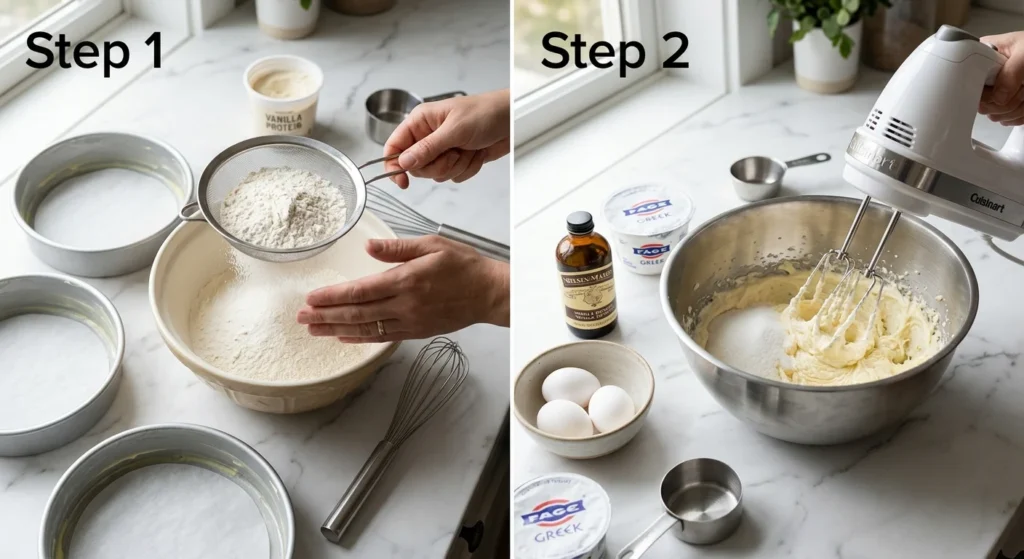
Step 3. Add the dry ingredient mixture in two additions alternating with the whole milk dry, milk, dry beating at low speed after each for the minimum strokes needed until just incorporated. Stop mixing the moment no dry patches remain. The protein cake batter must not be over-mixed beyond this point extended mixing after flour incorporation hydrates the whey protein more completely, accelerating its coagulation onset during baking and producing a rubbery crumb at a protein concentration that would be acceptable with minimal mixing.
Step 4. Divide the batter equally between the two prepared pans weigh for exactly equal portions at approximately 360 to 380g per pan. Spread to the edges with the back of a spoon the protein cake batter is slightly thicker than a standard batter and does not completely self-level.

Bake the Protein Cake
Step 5. Bake at 325°F for 28 to 34 minutes. Begin checking at 25 minutes with the instant-read thermometer insert into the thickest part of the layer’s centre and verify the temperature reading. Remove the layers when the internal temperature reads 190 to 195°F rather than the standard 200 to 205°F target for a conventional layer cake.
The lower internal temperature target is the most counterintuitive element of protein cake baking and the most important for texture. At 190 to 195°F the starch has fully gelatinised and the whey protein has coagulated to its correct structural density the cake is completely baked and will hold its structure when cooled. At 200 to 205°F the whey protein has over-coagulated beyond the ideal gel density the additional cooking between 195°F and 205°F tightens the whey protein network from a tender gel into the beginning of the rubbery matrix that becomes a full-texture defect at 210°F and above.
Step 6. Cool in the pans for 12 minutes. Release onto wire racks, peel parchment, and cool completely minimum 1 hour. The protein cake’s whey protein gel continues firming during cooling as the gel contracts from its baking-temperature expanded state to its room-temperature contracted state a process that takes the full hour to complete and produces the final crumb character that will persist through serving and storage.

Make the Greek Yogurt Cream Cheese Frosting
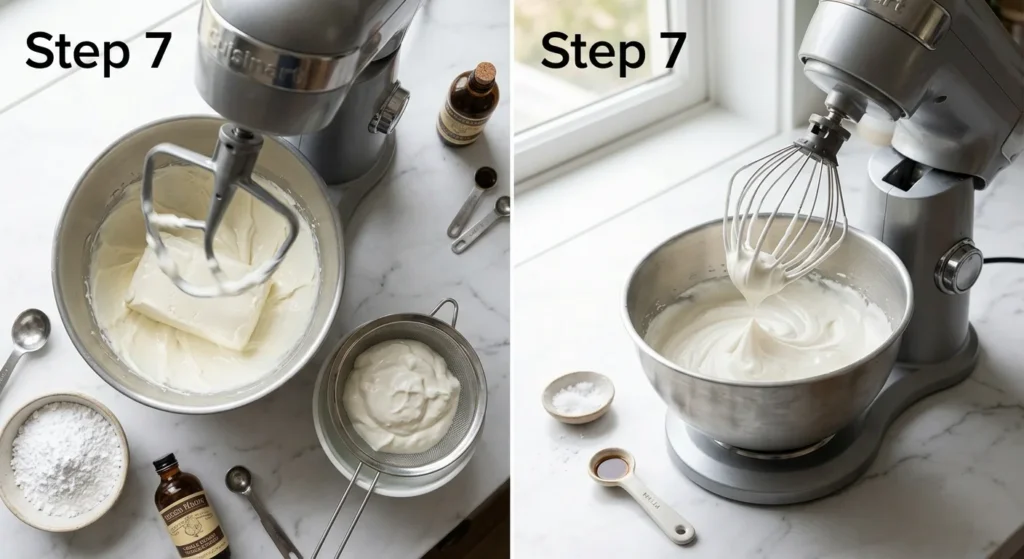
Step 7. Beat the room-temperature block cream cheese with the paddle at medium speed for 2 minutes until completely smooth. If the Greek yogurt is thin below full-fat Greek yogurt’s standard viscosity strain through a fine mesh strainer for 15 minutes to remove excess whey before adding. Add the strained Greek yogurt and beat for 30 seconds. Switch to the whisk attachment. Add the sifted powdered sugar in three additions at low speed. Add the vanilla and salt. Beat at medium-high for 90 seconds until smooth and holding a stiff peak.
Assemble and Frost
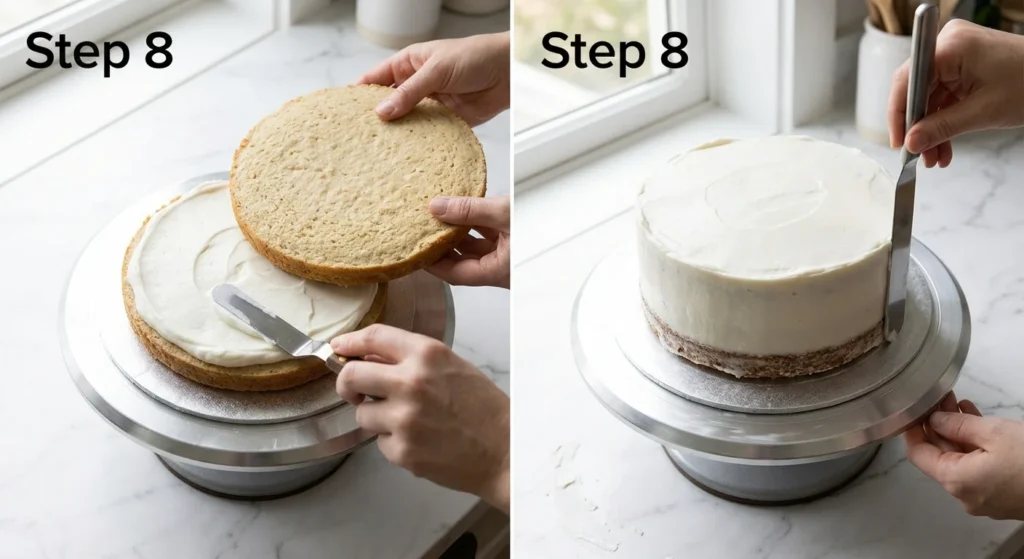
Step 8. Place the first cooled protein cake layer on a cake board on the turntable. Apply approximately 3/4 cup of Greek yogurt cream cheese frosting to the top of the first layer and spread evenly to the edge. Place the second layer on top, pressing gently. Apply a thin crumb coat over the full exterior. Refrigerate for 20 minutes until the crumb coat is firm.
Apply the final coat of frosting over the chilled crumb coat top and sides. Smooth with the offset spatula while rotating the turntable. The Greek yogurt cream cheese frosting is slightly softer than standard cream cheese frosting and benefits from a final 20-minute refrigeration after the exterior coat is applied before serving this firms the frosting to the correct slicing consistency that prevents it from flowing when the cake is cut.
Why 30 Percent Is the Maximum Whey Protein Concentration for Tender Protein Cake Crumb
The 30 percent protein powder maximum is not an arbitrary guideline it is the specific concentration threshold below which the whey protein’s coagulation behavior supplements the starch-gluten structural network and above which it overwhelms it, producing two categorically different textural outcomes from protein concentrations that differ by as little as 5 percent of the flour weight.
At 30 percent protein powder by flour weight 64g of protein powder per 150g of flour in this recipe the batter’s dry ingredient volume contains approximately 18 to 20 percent protein by total dry ingredient weight when the sugar and other components are included. At this concentration the whey protein’s beta-lactoglobulin and alpha-lactalbumin fractions hydrate in the batter’s aqueous phase and coagulate at 149 to 158°F into a gel network that is distributed through the starch-gluten matrix rather than being the continuous phase itself. The starch gelatinising at 140 to 160°F simultaneously with the whey protein’s coagulation produces a crumb where both the starch gel and the whey protein gel contribute to the structure neither network is dense enough alone to determine the crumb’s texture, and their combined contribution produces a crumb that is slightly denser than a flour-only cake but tender and yielding rather than rubbery.
Above 30 percent protein powder at 40 or 50 percent of flour weight the whey protein concentration in the batter’s aqueous phase reaches a level where the coagulated protein network becomes the dominant structural phase rather than a distributed supplemental network. At this concentration the whey protein’s gel density after coagulation at 149 to 158°F is high enough to produce a continuous, interconnected protein matrix through the full crumb depth before the starch has fully gelatinised. The starch subsequently gelatinises within and around this already-formed dense protein matrix rather than simultaneously with it producing a crumb where the continuous protein network determines the crumb’s texture as a firm, rubbery gel rather than the combined starch-protein network that produces tenderness at the correct concentration.
The analogy to a well-documented protein coagulation threshold is scrambled eggs at the correct cooking temperature and time, the egg protein coagulates into a tender, slightly yielding curd where the protein network is formed but not over-tightened. Beyond the threshold with additional heat or time the protein network tightens further into a rubbery, weeping mass where the excess coagulation has expelled the bound water and produced a texture that no culinary intervention restores. The 30 percent protein concentration threshold in cake batter operates through the same mechanism at 30 percent the whey network reaches its correct set density and stops, at above 30 percent it continues tightening beyond the tender gel into the rubbery matrix, and neither additional moisture, reduced baking time, nor lower oven temperature corrects a batter that was formulated with too high a protein concentration to begin with.
How Does Protein Cake Compare to Related High-Protein Baked Goods?
| Attribute | Protein Cake | Protein Mug Cake | Protein Brownies | Protein Banana Bread | Protein Pancakes |
|---|---|---|---|---|---|
| Protein per serving | 22 to 26g per slice | 15 to 20g per mug | 15 to 20g per brownie | 12 to 16g per slice | 15 to 20g per serving |
| Primary protein source | Whey concentrate plus eggs plus Greek yogurt | Whey concentrate plus banana binder | Whey concentrate plus eggs | Whey concentrate plus eggs plus banana | Whey concentrate plus eggs |
| Maximum protein powder threshold | 30% of flour weight | 30% of flour weight | 25% of flour weight; brownie's lower gluten development makes it more sensitive | 25% of flour weight; banana's moisture makes the threshold lower | N/A; pancake's thin format and griddle heat behave differently |
| Texture risk from over-concentration | Rubbery, dense puck | Rubbery, overcooked microwave result | Dry, crumbly, chalk-like | Gummy, dense, wet-centered | Rubbery, tough griddle cake |
| Binding strategy | Standard egg albumin plus Greek yogurt casein | Banana pectin plus protein coagulation | Egg albumin plus almond butter fat | Banana pectin plus egg albumin | Egg albumin only |
| Frosting or topping | Greek yogurt cream cheese frosting | Greek yogurt dollop | None or light glaze | None | Fruit or light syrup |
| Most effective flavor | Vanilla or chocolate; neutral base carries protein flavor best | Chocolate; cocoa masks protein powder character | Chocolate; same mechanism | Banana; natural banana flavor masks protein powder | Vanilla; protein powder character most apparent |
| Calorie range per serving | 280 to 340 kcal | 200 to 250 kcal | 180 to 220 kcal | 180 to 220 kcal | 150 to 200 kcal |
What Variations Can You Make?
Chocolate Protein Cake
Use the chocolate protein cake layer formula documented in the ingredients section replacing the vanilla whey protein concentrate with chocolate whey protein concentrate and adding Dutch-process cocoa powder to the dry ingredients. The chocolate version is the most widely preferred protein cake flavor because the Dutch-process cocoa’s intense, bitter aromatic character most effectively masks the whey protein powder’s characteristic slightly sweet, slightly artificial background note that tasters sensitive to protein powder flavor detect in vanilla protein cake. Bloom the cocoa in 1/3 cup of hot coffee at 190°F before adding to the batter the same hot coffee bloom mechanism documented throughout this collection amplifies the cocoa’s aromatic character and further masks the protein powder’s background note. Frost with the standard Greek yogurt cream cheese frosting or with a lighter chocolate cream cheese frosting add 2 tablespoons (12g) of sifted Dutch-process cocoa to the standard frosting formula and increase the Greek yogurt by 1 tablespoon to compensate for the cocoa’s dry addition.
Funfetti Protein Cake
Use the vanilla protein cake base. Add 1/3 cup (55g) of rainbow jimmies not nonpareils, which bleed color into the batter and produce a grey-tinted crumb folded in as the very last step before pouring into the pans. Replace the vanilla extract with clear vanilla extract the standard vanilla extract’s amber color slightly tints the pale vanilla protein cake batter, and clear vanilla maintains the paper-white crumb that makes the rainbow jimmies’ colors visible against a clean background. The funfetti protein cake is the most visually effective protein cake format for celebration contexts the festive jimmies and white crumb communicate birthday cake identity immediately without requiring any indication that the cake is a high-protein preparation.
Strawberry Protein Cake
Add 1/4 cup (60g) of freeze-dried strawberry powder made by blending freeze-dried strawberries to a fine powder in a food processor to the dry ingredient blend alongside the flour and protein powder. The freeze-dried strawberry powder’s concentrated anthocyanin pigments produce a naturally pink-tinted crumb without artificial coloring, and the intense strawberry flavor from the freeze-drying’s concentration of malic acid and strawberry ester compounds masks the protein powder’s background note more effectively than fresh strawberry purée at equivalent flavor intensity. Fresh strawberry purée adds too much liquid to the protein cake’s already-precisely calibrated moisture balance and dilutes the strawberry flavor below the threshold of clear identification. Frost with a strawberry Greek yogurt cream cheese frosting blend 3 tablespoons (12g) of the same freeze-dried strawberry powder into the standard frosting formula for a naturally pink, intensely strawberry-flavored exterior.
Dietary Adjustments and Substitutions
Dairy-Free Version
Replace the whey protein concentrate with a pea-rice blend protein powder pea protein’s legumin fraction produces the most cake-like coagulation behavior of the plant-based protein options, though its maximum concentration threshold is 20 percent of flour weight rather than whey’s 30 percent. Reduce the protein powder to 43g and increase the flour to 171g to maintain the 20 percent threshold for pea protein. Replace the butter with Miyoko’s dairy-free butter sticks at the same weight (75g). Replace the whole milk with full-fat oat milk at the same volume. Replace the Greek yogurt with unsweetened coconut yogurt at the same weight. For the frosting, use Violife dairy-free cream cheese block at the same weight and coconut yogurt strained for 15 minutes to remove excess whey.
Gluten-Free Version
Replace the all-purpose flour with certified gluten-free oat flour at the same weight (150g). Gluten-free oat flour’s beta-glucan soluble fiber provides some binding that partially compensates for the absent gluten network more effectively than most gluten-free flour blends at the protein cake’s high-protein, high-moisture batter format. The 30 percent whey protein threshold remains unchanged for the gluten-free version the protein concentration limit is determined by the whey protein’s own coagulation behavior rather than by the flour type’s protein content.
Vegan Version
The whey protein concentrate is inherently non-vegan replace with a certified vegan pea-rice protein blend at the reduced 20 percent threshold (43g protein powder per 171g flour). Replace the eggs with 3 flax eggs 1 tablespoon (7g) of ground flaxseed combined with 3 tablespoons (45ml) of warm water per egg, rested for 5 minutes. Replace the Greek yogurt with coconut yogurt at the same weight. Replace the butter with Miyoko’s dairy-free butter at the same weight. The vegan protein cake at the 20 percent pea protein threshold produces a protein content of approximately 14 to 16g per slice lower than the dairy version’s 22 to 26g but still substantially higher than a standard layer cake’s 4 to 6g per slice.
What Are the Most Common Problems When Making Protein Cake?
| Problem | Most Likely Cause | Prevention or Fix |
|---|---|---|
| Rubbery, dense crumb throughout | Protein powder exceeded 30 percent of flour weight, baking temperature too high above 325°F, or internal temperature exceeded 200°F | Always weigh the protein powder rather than measuring by volume. Bake at 325°F maximum. Remove at 190 to 195°F internal temperature. If already rubbery, the texture cannot be corrected; serve with extra frosting and acknowledge the texture compromise. Reformulate the next batch with precisely weighed protein powder at the 30 percent threshold. |
| Flat, dense cake without visible rise | Insufficient leavening, over-mixed batter that lost the egg foam's air, or protein powder absorbed all leavening capacity | Verify baking powder is fresh; protein powder's acidity can partially neutralise baking powder's leavening capacity during mixing. Increase baking powder to 2.5 teaspoons (10g) if flat result persists. Mix the batter for the absolute minimum strokes needed for homogeneity. |
| Protein powder taste dominates | Vanilla whey protein's artificial vanilla character; more perceptible at high concentration | Switch to chocolate whey protein concentrate or add 1 tablespoon of Dutch-process cocoa to the vanilla version; both strategies mask the protein powder's background note effectively. Ensure the vanilla extract quantity is the full 2 teaspoons; vanilla at this concentration is the most effective masking agent for whey protein's artificial character in a light-colored batter. |
| Frosting too soft to hold between layers | Greek yogurt not strained before use; excess whey softened the frosting below stiff peak threshold | Always verify the Greek yogurt's viscosity before using; it should be very thick and spoonable, not pourable. Strain thin Greek yogurt for 15 minutes through a fine mesh strainer before adding to the cream cheese base. If already assembled with soft frosting, refrigerate the full assembled cake for 30 minutes; the cold temperature firms the frosting adequately for serving. |
| Crumb dry at the edges but moist at the centre | Baked at 350°F rather than 325°F; exterior over-coagulated before interior fully set | Always bake protein cake at 325°F. The lower temperature allows even heat penetration through the full batter depth before the exterior whey protein reaches its over-coagulation point. |
How Do You Store Protein Cake?
| Storage Method | Duration | Instructions |
|---|---|---|
| Refrigerated, assembled and frosted, covered loosely | Up to 4 days | The Greek yogurt cream cheese frosting requires refrigeration; both components are perishable dairy products. The protein cake's whey protein crumb holds moisture well during refrigeration from the protein gel's water-binding capacity; the crumb is slightly firmer when cold and returns to its correct tender character within 20 minutes at room temperature. Bring to room temperature before serving for the fullest flavor and texture expression. |
| Refrigerated, individual slices in airtight containers | Up to 4 days | Individual slices refrigerate cleanly; the dense, close crumb resists the edge-drying that affects standard layer cake slices during refrigeration from the whey protein network's superior water binding relative to a standard starch-gluten network. |
| Frozen, individual slices wrapped in plastic wrap | Up to 2 months | The whey protein crumb freezes and thaws with minimal textural change; the protein gel network's structure is not significantly disrupted by the freeze-thaw cycle at standard home freezer temperatures. Thaw at room temperature for 30 minutes. The Greek yogurt cream cheese frosting thaws adequately at room temperature but may show slight surface weeping; blot with a paper towel before serving. |
Scaling
| Servings | All-Purpose Flour | Protein Powder | Eggs | Greek Yogurt | Butter | Pan Size |
|---|---|---|---|---|---|---|
| 6 servings | 75g | 32g | 2 eggs | 60g | 38g | Two 6-inch pans |
| 12 servings (standard) | 150g | 64g | 3 eggs | 120g | 75g | Two 8-inch pans |
| 16 servings | 200g | 85g | 4 eggs | 160g | 100g | Two 9-inch pans |
Nutritional Information
Per serving: 1 slice approximately 125g including Greek yogurt cream cheese frosting, based on 12 slices. Values calculated using USDA FoodData Central reference data using vanilla whey protein concentrate and full-fat Greek yogurt.
| Nutrient | Per Serving | Nutrient | Per Serving |
|---|---|---|---|
| Calories | 318 kcal | Total carbohydrate | 42g |
| Total fat | 11g | Dietary fibre | 0.6g |
| Saturated fat | 6g | Total sugars | 32g |
| Cholesterol | 88mg | Protein | 24g |
| Sodium | 288mg | Calcium | 148mg (11% DV) |
Frequently Asked Questions
Why is 30 percent the maximum whey protein concentration rather than a higher amount to increase protein content further?
Below 30 percent protein powder by flour weight the whey protein’s coagulated network is distributed through and supplemented by the starch-gluten structural matrix neither network dominates and their combined contribution produces a tender, yielding crumb. Above 30 percent the whey protein concentration in the batter’s aqueous phase produces a coagulated network dense enough to become the continuous structural phase rather than a distributed supplement the starch subsequently gelatinises within an already-formed dense protein matrix, producing a crumb where the continuous over-coagulated protein network determines the texture as a firm, rubbery gel regardless of all other baking variables. The 30 percent threshold is not arbitrary it is the specific concentration boundary where the whey network transitions from supplemental to dominant structural role.
Why is the baking temperature 325°F rather than the standard 350°F for layer cakes?
Whey protein begins coagulating at 149°F a temperature reached early at the cake’s exterior at 350°F before the leavening’s carbon dioxide has fully expanded through the batter depth. At 350°F the exterior whey protein over-coagulates into a firm crust before the interior batter has leavened fully, producing a cake with a firm, over-coagulated exterior over a denser, under-leavened interior. At 325°F the exterior’s temperature rise is slower, allowing the leavening’s expansion and the whey protein’s coagulation to occur more simultaneously through the full batter depth producing a more even crumb structure from edge to centre.
Why is whey protein concentrate specified rather than whey protein isolate?
Whey protein concentrate’s residual milk fat at 4 to 8 percent of concentrate versus less than 1 percent of isolate and residual lactose act as structural dilutants within the protein fraction, moderating the coagulation rate and producing a gel at the same concentration that is softer and less rubbery than isolate’s undiluted protein network. Isolate’s near-pure protein concentration coagulates more rapidly and to a higher gel density at the same weight substitution as concentrate pushing the effective over-coagulation threshold lower than the 30 percent maximum that concentrate’s diluted protein fraction allows before the rubbery texture defect appears.
Can I use plant-based protein powder instead of whey protein concentrate?
Yes with a reduced maximum concentration threshold of 20 percent of flour weight rather than whey’s 30 percent. Pea protein’s legumin fraction produces the most cake-like coagulation behavior of the plant-based proteins, but its coagulation network is denser and less forgiving at high concentration than whey concentrate’s fat-diluted network the effective over-coagulation threshold is reached at lower concentration. Rice protein and hemp protein produce drier, more crumbly results than pea protein at equivalent concentration from their different protein structure and lower fat content. A pea-rice blend at the 20 percent threshold produces the most acceptable texture of the plant-based alternatives denser than the whey version but not rubbery at the correctly calibrated concentration.
Protein cake is a macronutrient-optimised American layer cake whose 22 to 26 grams of protein per slice and genuine cake-like tenderness depend on maintaining the whey protein concentrate at exactly 30 percent of total flour weight the concentration boundary below which the coagulating whey protein network is distributed through and supplemented by the starch-gluten structural matrix at a density that produces a tender, yielding crumb and above which the whey protein’s coagulation becomes the dominant continuous structural phase before the starch fully gelatinises, producing the rubbery, dense puck that characterises every over-concentrated protein baked good regardless of how carefully all other baking variables are controlled a threshold calibrated in combination with the reduced 325°F oven temperature that slows the exterior’s temperature rise enough to allow leavening expansion and whey coagulation to occur simultaneously through the full batter depth, and the 190 to 195°F internal temperature removal target that stops the baking at the whey protein’s correct gel density rather than the standard 200 to 205°F target that over-tightens the protein network from its tender gel into the beginning of the rubbery matrix that the 30 percent concentration threshold exists specifically to prevent.
Table of Contents
Recent Recipes
American · Cakes Orange Pound Cake Recipe This orange pound cake recipe rubs the zest into the sugar before creaming. […]
Check Out..!
American · Layer Cakes Coconut and Carrot Cake Recipe Moist, oil-based spiced layer cake packed with freshly grated carrot and […]
Check Out..!
American Cakes Tandy Cake Recipe This Tandy cake recipe spreads peanut butter on the warm cake, then chills it before […]
Check Out..!
American · Cakes Portillo’s Chocolate Cake Recipe This Portillo’s chocolate cake recipe adds mayonnaise to the batter. Mayo is just […]
Check Out..!Recent Blogs
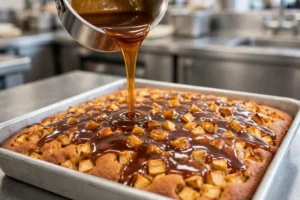
I’ve glazed our Amish apple cake too hot, too cold, and exactly right, and the difference is not small. The […]
Read Blog..!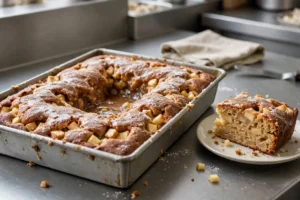
I’ve pulled a sunken Amish Apple Cake out of my oven, and I know the exact sinking feeling that comes […]
Read Blog..!
A cup measures volume, not weight, so a cup of flour and a cup of sugar weigh completely different amounts. […]
Read Blog..!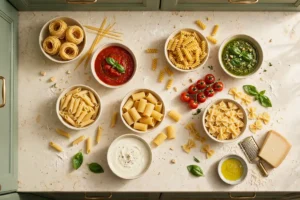
Every pasta shape was designed to carry a certain kind of sauce. Thin strands suit light sauces that coat, wide […]
Read Blog..!
Every egg method, from a jammy boiled egg to a silky French omelet, comes down to one fact: the white […]
Read Blog..!