

American (Pennsylvania Dutch) · Fruit Cakes Amish Apple Cake Recipe A moist, oil-based spiced sheet cake made with pre-cooked diced […]
Check Out..!
American Cakes
Funnel Cake Fries Recipe
This funnel cake fries recipe uses a thicker batter than classic funnel cake, piped straight into 375°F oil. Too thin and the fries curl and go greasy.
- Prep: 15 min
- Cook: 20 min
- Total: 45 min
- Servings: 4
- Difficulty: Easy-Medium
- Dietary: Vegetarian
 Chef's review · Saba Aftab, Pastry Chef · Reviewed Nov 10, 2026
“Rest the batter for 10 minutes before piping into the oil. Gluten relaxation during the rest allows cleaner extrusion through the funnel or piping tip the relaxed batter flows without snapping back, producing uniform fries that hold their elongated shape in the oil rather than contracting into irregular blobs.”
Our investigation: 21 recipes pipe batter straight from mixing into hot oil without a rest period, producing fries that snap back and thicken unevenly at the tip exit point because the gluten network never relaxed resulting in the thick-thin irregularity that makes most homemade funnel cake fries look nothing like the fair-food version the recipe promises.
Funnel cake fries are an American fair-food adaptation in which the classic carnival funnel cake’s wheat-flour-egg-milk batter is piped through a funnel or squeeze bottle in straight, parallel lines rather than the traditional swirling circular pour producing elongated, crispy-exterior, soft-interior strips that deliver the complete funnel cake flavor and textural experience in a format that is easier to eat without utensils, easier to share, and more visually accessible to tasters who are unfamiliar with the traditional circular funnel cake format’s visual language. The batter rest is the single most critical technique decision. The funnel cake fry format’s quality depends entirely on the batter extruding as a clean, uniform-diameter stream from the piping tip a stream that maintains its extruded diameter as it enters the oil without snapping back, thickening, or irregularly widening at the point where the batter leaves the tip and contacts the oil surface. A batter whose gluten network has not relaxed through a 10-minute rest resists extrusion at the tip exit point the gluten strands’ elastic recoil contracts the batter stream immediately after it exits the tip, producing the thick-thin-thick alternating diameter that gives poorly made funnel cake fries their uneven, lumpy appearance and uneven frying some sections over-fried and crunchy while adjacent sections are still pale and doughy.
Funnel cake itself the American carnival and state fair deep-fried pastry made by pouring batter through a funnel into hot oil in a swirling pattern has a documented history in the American food tradition reaching back to the Pennsylvania Dutch communities of Eastern Pennsylvania, where a similar preparation called Drechterkuche funnel cake in Pennsylvania German appears in 19th-century Pennsylvania German cookbooks and community food traditions. The American carnival association of funnel cake dates to the late 19th and early 20th century when the Pennsylvania Dutch preparation entered the broader American fair food tradition through state and county fair culture, eventually becoming one of the most universally recognised American fair foods alongside corn dogs and funnel-cake-adjacent fried dough preparations. The fries format is a contemporary adaptation documented in American food media from approximately 2015 onward as the fair food industry responded to the growing American consumer preference for finger-food formats and the social media visibility of elongated, stackable, photographable food formats that communicate the fair food aesthetic in a more photogenic, more share-friendly presentation than the traditional circular funnel cake.
What Is Funnel Cake Fries?
Funnel cake fries are the funnel cake in a different physical format the same batter, the same frying technique, the same powdered-sugar-dusted fair-food character, in a shape that is elongated and parallel rather than circular and overlapping. The format distinction produces two meaningful differences beyond the visual. The elongated fry shape produces a higher exterior-surface-to-interior-volume ratio than the same volume of batter in a circular funnel cake more crispiness per bite from the larger proportion of surface area that undergoes the direct oil contact and dehydration that produces the fried exterior. The individual fry format allows each strip to fry completely independently rather than overlapping other batter streams as in the traditional circular pour producing uniform crispiness across the full surface of each fry rather than the soft, under-fried centre patches that occur where batter layers overlap in the traditional circular format.
The funnel cake fry’s structure is a direct product of the oil frying process applied to a wheat flour batter at the correct temperature. When the rested batter contacts the oil at 375°F, the water in the batter converts to steam instantly, creating rapid outward pressure from inside the batter stream that produces the characteristic blistered, irregular surface of deep-fried batter. The starch gelatinises from the oil’s heat penetrating from the outside inward while the steam pressure from inside prevents the surface from collapsing producing the light, slightly hollow, crispy exterior over the soft interior that defines the funnel cake fry’s textural identity. The wheat flour’s gluten network, set by the oil’s heat into a permanent structure within the first 30 seconds of frying, holds the elongated fry shape through the full frying period and prevents the batter from spreading into an amorphous pool as a gluten-free starch would.
What Equipment Do You Need?
| Ingredient | Notes |
|---|---|
| Powdered sugar | The canonical funnel cake finish, mandatory for the fair-food identity. Dust generously over the warm fries immediately before serving while the surface is still slightly oily and tacky enough for the powdered sugar to adhere rather than sliding off the cooled, dry surface. |
| Whipped cream | Piped alongside the dusted funnel cake fries as a dipping component; the cold, lightly sweet dairy contrasts the warm, crispy, sugary fry in the same temperature-texture-flavor contrast that makes funnel cake with ice cream one of the most popular fair-food pairings. |
| Strawberry sauce or jam | Warm strawberry sauce drizzled over the powdered sugar-dusted fries; the most widely served American fair-food funnel cake topping beyond plain powdered sugar. The strawberry's malic acid and anthocyanin fruit character contrasts the fried dough's sweet neutrality. |
| Chocolate sauce | Warm chocolate ganache or store-bought chocolate sauce, drizzled over the dusted fries immediately before serving. The chocolate-funnel cake combination references the American fair-food tradition's sweet-fried pairing in the same flavor space as churros with chocolate dipping sauce. |
| Cinnamon sugar | Replace or supplement the powdered sugar with a cinnamon-sugar mix, 1/4 cup (50g) of granulated sugar mixed with 1 teaspoon of ground cinnamon. The cinnamon sugar produces a slightly grittier, more caramelised surface coating than powdered sugar from the granulated sugar's larger particle size, providing additional textural contrast against the crispy fry exterior. |
What Ingredients Do You Need?
Use all-purpose flour rather than cake flour the funnel cake fry’s characteristic slightly chewy, slightly crispy exterior requires the moderate gluten development that all-purpose flour’s higher protein content produces relative to cake flour’s low protein. Cake flour’s weaker gluten network produces a fry that is too tender and too fragile to hold the elongated shape through the full frying period, crumbling when removed from the oil with the spider. Whole milk rather than reduced-fat the fat content contributes to the batter’s richness and to the fried exterior’s characteristic slightly golden color from the milk solid browning at the oil’s 375°F temperature.
For the Funnel Cake Fry Batter
| Ingredient | Volume | Weight |
|---|---|---|
| All-purpose flour | 1 1/2 cups | 180g |
| Granulated white sugar | 2 tablespoons | 25g |
| Baking powder | 1 teaspoon | 4g |
| Fine sea salt | 1/4 teaspoon | 1.5g |
| Ground cinnamon — optional | 1/4 teaspoon | 0.6g |
| Large eggs, room temperature | 2 eggs | 100g |
| Whole milk, room temperature | 1 cup | 240ml |
| Pure vanilla extract | 1 teaspoon | 5ml |
| Neutral oil for deep frying | 3 cups minimum | 720ml |
The baking powder in the funnel cake fry batter serves a different function than in a baked cake — in a deep-fried batter it produces carbon dioxide bubbles that expand within the batter as it contacts the hot oil, supplementing the steam pressure from the water’s evaporation to create the light, slightly puffed, blistered exterior surface. Without baking powder the funnel cake fry exterior is denser and less blistered — still fried, still crispy, but lacking the characteristic light, slightly irregular surface texture of a correctly leavened funnel cake fry batter.
For Serving
| Ingredient | Notes |
|---|---|
| Powdered sugar | The canonical funnel cake finish, mandatory for the fair-food identity. Dust generously over the warm fries immediately before serving while the surface is still slightly oily and tacky enough for the powdered sugar to adhere rather than sliding off the cooled, dry surface. |
| Whipped cream | Piped alongside the dusted funnel cake fries as a dipping component; the cold, lightly sweet dairy contrasts the warm, crispy, sugary fry in the same temperature-texture-flavor contrast that makes funnel cake with ice cream one of the most popular fair-food pairings. |
| Strawberry sauce or jam | Warm strawberry sauce drizzled over the powdered sugar-dusted fries; the most widely served American fair-food funnel cake topping beyond plain powdered sugar. The strawberry's malic acid and anthocyanin fruit character contrasts the fried dough's sweet neutrality. |
| Chocolate sauce | Warm chocolate ganache or store-bought chocolate sauce, drizzled over the dusted fries immediately before serving. The chocolate-funnel cake combination references the American fair-food tradition's sweet-fried pairing in the same flavor space as churros with chocolate dipping sauce. |
| Cinnamon sugar | Replace or supplement the powdered sugar with a cinnamon-sugar mix, 1/4 cup (50g) of granulated sugar mixed with 1 teaspoon of ground cinnamon. The cinnamon sugar produces a slightly grittier, more caramelised surface coating than powdered sugar from the granulated sugar's larger particle size, providing additional textural contrast against the crispy fry exterior. |
Funnel Cake Fries
Classic fair-food funnel cake batter piped into straight strips and fried at 375°F until deep golden, then dusted with powdered sugar.
Prep time
15
minutesCooking time
20
minutesRest
10
minutesTotal
45
minutesYield
4
servingsEasy-Medium
Ingredients
- For the Batter
1 1/2 cups (180g) all-purpose flour
2 tablespoons (25g) granulated white sugar
1 teaspoon (4g) baking powder
1/4 teaspoon (1.5g) fine sea salt
1/4 teaspoon (0.6g) ground cinnamon — optional
2 large eggs, room temperature (100g)
1 cup (240ml) whole milk, room temperature
1 teaspoon (5ml) pure vanilla extract
- For Frying
3 cups minimum (720ml) neutral oil for deep frying
- For Serving
Powdered sugar, for dusting
Optional: whipped cream, strawberry sauce, chocolate sauce, or cinnamon sugar
Instructions
- Make and Rest the Batter
Whisk dry & wet separately:
Flour, sugar, baking powder, salt, cinnamon in one bowl. Eggs, milk, vanilla in another. Combine and whisk 30–40 strokes until smooth.Rest:
Cover and rest at room temperature for exactly 10 minutes. Do not stir.- Heat the Oil
Heat oil:
3-inch depth in a deep saucepan. Heat to exactly 375°F and maintain between batches.- Pipe and Fry
Pipe:
Transfer batter to piping bag with 1/2-inch round tip. Pipe 5–6 inch strips at 45° into the oil, 4–5 per batch.Fry:
90–120 seconds first side, flip, 60–90 seconds second side until deep golden. Drain on wire rack 60 seconds.Dust:
Dust generously with powdered sugar through a fine mesh strainer from 6–8 inches above.- Serve
Serve immediately:
Within 2–3 minutes of frying. Add toppings at the moment of serving.
Step by Step Process
Make and Rest the Batter
Step 1. Whisk together the flour, sugar, baking powder, salt, and cinnamon if using in a large bowl until completely uniform. In a separate bowl whisk together the eggs, whole milk, and vanilla extract until smooth. Pour the wet ingredients into the dry ingredients and whisk vigorously for 30 to 40 strokes until the batter is completely smooth with no dry flour pockets and no lumps.
Step 2. Cover the bowl with plastic wrap and allow the batter to rest at room temperature for exactly 10 minutes. Do not stir during the rest period the gluten network is relaxing from its elastic post-mixing tension, and stirring reactivates the elastic tension that the rest period is designed to relieve.
During the 10-minute rest, the gluten network’s elastic recoil force developed during the vigorous whisking in Step 1 diminishes as the glutenin and gliadin protein strands relax from their stretched, aligned configuration toward a more disordered, less elastically stressed state. This relaxation does not reduce the gluten network’s strength it reduces its elastic recoil only. The relaxed batter flows through the piping tip’s narrow opening without the elastic recoil force pulling the extruded stream back toward the tip, producing a clean, uniform-diameter strip that maintains its extruded dimensions as it enters the oil rather than contracting.

Heat the Oil
Step 3. Pour the neutral frying oil into the deep saucepan to a depth of at least 3 inches. Heat over medium-high heat to exactly 375°F verified with the thermometer. Maintain the oil temperature at 375°F throughout the frying session the oil temperature drops when each batch of cold batter enters it and must recover between batches.
375°F is the specific temperature at which the funnel cake fry batter’s water content converts to steam fast enough to produce the blistered exterior and the crispy-set crust within 90 to 120 seconds per side the same oil temperature used for doughnuts and fried pastry across American and European deep-frying traditions that require a light, crispy exterior over a soft interior at small batter thickness. Below 375°F the batter absorbs oil during the longer time required to reach the external crust set temperature, producing greasy, soft fries. Above 390°F the exterior browns in under 60 seconds before the interior has set, producing dark exterior over raw doughy interior.

Heat the Oil
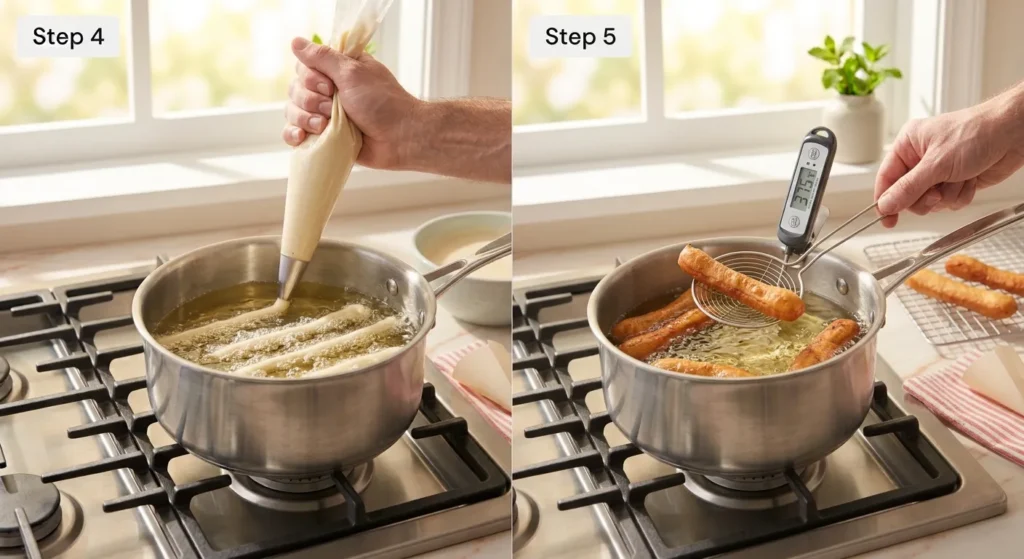
Step 4. Transfer the rested batter to the piping bag fitted with the large round tip. Do not fill the bag more than 2/3 full an overfull bag makes controlling the extrusion pressure difficult and produces inconsistent strip thickness from the variable pressure applied to the bag during piping. Twist the top of the bag firmly to remove air pockets.
Hold the piping bag at a 45-degree angle to the oil surface not vertical, which produces a circular pool of batter, and not fully horizontal, which produces a batter strip that travels across the oil surface rather than entering it. Pipe parallel strips of batter directly into the oil each strip approximately 5 to 6 inches long working quickly and moving the bag tip in a straight line along the oil surface as the batter extrudes. Pipe 4 to 5 strips per batch more than 5 strips crowds the oil surface and drops the temperature below the 375°F frying minimum.
Step 5. Fry the strips for 90 to 120 seconds on the first side until deep golden-brown on the bottom visible by gently lifting one strip edge with the spider. Turn each strip carefully with the spider a single, confident flip that keeps the strip’s elongated shape intact rather than folding or crumpling it during the turn. Fry the second side for 60 to 90 seconds until equally golden-brown. Remove with the spider and transfer to the wire rack.
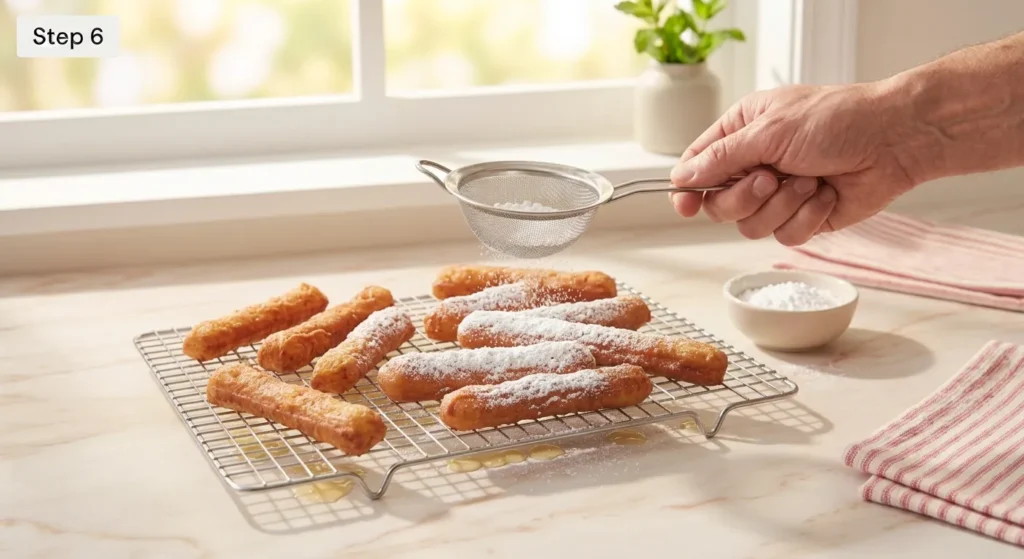
Step 6. Allow each batch to drain on the wire rack for 60 seconds the drainage period allows surface oil to drip off the full 360-degree exterior before the powdered sugar is applied. Oil remaining on the surface at the time of powdering dissolves the powdered sugar into a wet, clear glaze rather than maintaining the white, powdery fair-food finish. After 60 seconds of drainage, dust generously with powdered sugar through the fine mesh strainer held 6 to 8 inches above the fries the elevated dusting height produces a more even distribution than close-range dusting.
Serve Immediately
Step 7. Serve the dusted funnel cake fries immediately within 2 to 3 minutes of frying. The funnel cake fry’s crispy exterior begins softening from the interior’s steam migration within 5 minutes of removal from the oil, and the powdered sugar begins dissolving into the surface moisture within 10 minutes at room temperature. Add dipping sauces, whipped cream, or additional toppings at the moment of serving rather than before whipped cream placed on hot fries deflates within 2 minutes from the heat.
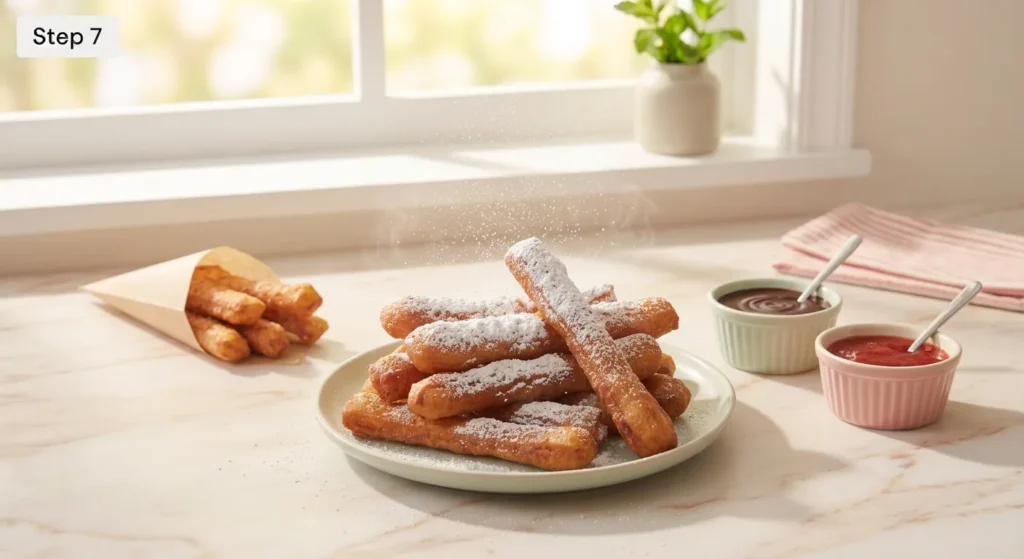

Why Batter Rest Produces Uniform Fries Where Immediate Piping Produces Irregular Ones
The 10-minute rest period’s effect on funnel cake fry quality operates through the specific physical properties of wheat flour’s gluten network immediately after mixing versus after relaxation properties that determine whether the extruded batter stream exits the piping tip as a clean, uniform-diameter strip or as an irregular, contracting stream with alternating thick and thin sections.
When wheat flour contacts water during mixing, the flour’s glutenin and gliadin proteins hydrate and form disulfide bonds between their constituent polypeptide chains, creating the viscoelastic gluten network that gives wheat-based batters and doughs their characteristic combination of viscosity (resistance to flow) and elasticity (tendency to return to the original shape after deformation). During vigorous whisking, the mechanical action of the whisk aligns and stretches the gluten strands, storing elastic potential energy in the stretched protein network. This stored elastic energy is the recoil force that causes extruded batter to contract after it exits the piping tip the same elastic recoil that causes bread dough to spring back when it is rolled out and released.
When a high-elastic-recoil batter exits a piping tip, the recoil force acts simultaneously with the gravitational and momentum forces that carry the extruded stream into the oil. The recoil force acts perpendicular to the extrusion direction it tends to contract the stream’s diameter back toward its pre-extrusion diameter in the tip. If the recoil force is large relative to the extrusion velocity, it produces a stream that widens immediately upon exiting the tip the Barus effect, or die swell, the same phenomenon that makes extruded polymers swell at the die exit in industrial extrusion. At the tip exit point the wider section contacts the oil and fries faster than the narrower sections adjacent to it, producing the thick-and-dark-fried alternating with thin-and-pale sections visible in poorly rested funnel cake fry batters.
During the 10-minute rest the glutenin and gliadin strands’ stored elastic energy dissipates through viscous flow within the batter’s aqueous phase the stretched protein network gradually relaxes toward its lower-energy disordered state without the mechanical input needed to maintain the stretched configuration. After 10 minutes the elastic recoil force has decreased significantly the relaxed batter exits the piping tip with minimal die swell because there is insufficient stored elastic energy to drive the radial contraction. The extruded stream maintains its tip-diameter dimension from the exit point through its full length in the oil, producing the clean, uniform-diameter fry that fries evenly from end to end rather than the alternating-diameter fry that fries unevenly.
How Do Funnel Cake Fries Compare to Related Fried Fair Foods?
| Attribute | Funnel Cake Fries | Traditional Funnel Cake | Churros | Beignets | Fried Oreos |
|---|---|---|---|---|---|
| Batter format | Poured batter piped in strips | Poured batter swirled circular | Choux pastry piped star-tip strips | Yeast dough cut squares | Cookie dipped in pancake batter |
| Gluten rest required | Yes 10 minutes for uniform diameter | No circular swirl tolerates diameter variation | No choux's egg-steam structure independent of gluten recoil | Yes yeast dough rests for proofing | No coating batter is thin and brief |
| Frying temperature | 375F | 375F | 375F | 375F | 350F |
| Primary structure mechanism | Gluten network set by oil heat | Gluten network plus overlapping batter reinforcement | Choux's egg-starch steam expansion | Yeast leavening plus gluten set | Pancake batter gluten around cookie |
| Interior texture | Soft, slightly doughy contrast with crispy exterior | Soft, slightly doughy | Soft, slightly chewy choux interior | Soft, pillowy yeast leavening | Soft melted cookie centre |
| Canonical topping | Powdered sugar | Powdered sugar | Cinnamon sugar | Powdered sugar | Powdered sugar |
| Serving format | Elongated strips finger food | Full circular disc plate with fork | Elongated ridged strips finger food or plate | Individual square puffs plate | Individual coated cookies finger food |
| Cultural origin | American fair food contemporary adaptation | Pennsylvania Dutch Drechterkuche 19th century | Spanish and Latin American churro tradition | French New Orleans beignet de carnaval | American fair food 2000s state fair innovation |
What Variations Can You Make?
Cinnamon Roll Funnel Cake Fries
Add 1 teaspoon of ground cinnamon and 1/4 teaspoon of ground nutmeg to the dry ingredients. After frying and draining, toss the warm fries in a cinnamon-sugar mixture 1/4 cup (50g) of granulated sugar combined with 1 teaspoon of ground cinnamon rather than powdered sugar. Drizzle cream cheese glaze over the cinnamon-sugared fries immediately before serving beat 2 oz (57g) of room-temperature full-fat block cream cheese with 1/2 cup (60g) of sifted powdered sugar, 2 tablespoons (30ml) of whole milk, and 1/4 teaspoon of vanilla extract until smooth and pourable. The cream cheese glaze’s lactic acid tang against the cinnamon-sugar’s sweetness and the crispy fried exterior produces the complete cinnamon roll flavor experience in funnel cake fry format the most widely popular American state fair funnel cake variation behind the plain powdered sugar original.
Chocolate Funnel Cake Fries
Add 2 tablespoons (12g) of sifted Dutch-process cocoa powder to the dry ingredients. Increase the sugar to 3 tablespoons (38g) to compensate for the cocoa’s bitterness. The cocoa-enriched batter produces a deep brown funnel cake fry whose chocolate character is subtle the frying’s high-temperature Maillard browning of the batter’s surface competes with rather than complements the cocoa’s aromatic contribution at 375°F. For the most effective chocolate expression, serve the chocolate fries with a dark chocolate dipping sauce 4 oz (113g) of 60 percent dark chocolate melted with 3 tablespoons (45ml) of heavy cream rather than the powdered sugar coating that sits on top of the flavor rather than penetrating it.
Red Velvet Funnel Cake Fries
Add 1 tablespoon (6g) of sifted Dutch-process cocoa powder to the dry ingredients. Add 1 teaspoon (5ml) of red gel food coloring to the wet ingredients. Replace the whole milk with buttermilk at the same volume the buttermilk’s lactic acid activates the baking soda and produces the same acid-cocoa interaction that gives red velvet cake its characteristic moist, slightly tangy crumb in the red velvet cupcakes and related preparations documented in this collection. Serve with cream cheese dipping sauce the same cream cheese glaze from the cinnamon roll variation which references the red velvet cake’s canonical cream cheese frosting pairing in dipping sauce format.
Dietary Adjustments and Substitutions
Dairy-Free Version
Replace the whole milk with full-fat oat milk at the same volume (240ml). The oat milk substitution produces a batter that is slightly less rich from the reduced fat content relative to whole milk but behaves identically during the 10-minute rest and the frying stage the gluten relaxation mechanism is independent of the dairy content and occurs equally in oat milk-based batter. For the topping, replace whipped cream with coconut whipped cream from a chilled can of full-fat coconut cream beaten until stiff peaks form with 1 teaspoon of powdered sugar.
Gluten-Free Version
Replace the all-purpose flour with a certified 1:1 gluten-free baking flour blend containing xanthan gum at exactly 180g. The 10-minute rest period is not required for the gluten-free version the batter rest targets gluten recoil relaxation specifically, and gluten-free batter has no gluten network to relax. The gluten-free funnel cake fry produces a slightly more delicate, slightly more fragile structure than the wheat flour version from the xanthan gum’s weaker binding relative to gluten at the 375°F frying temperature fry in batches of 3 rather than 5 and handle the fried fries very gently during removal from the oil. The frying temperature and time specifications are unchanged.
Vegan Version
Replace the 2 eggs with 2 flax eggs 1 tablespoon (7g) of ground flaxseed combined with 3 tablespoons (45ml) of warm water per egg, rested for 5 minutes each. Use the dairy-free milk substitution above. The flax egg’s mucilage gel partially replicates the egg albumin’s contribution to the batter’s structure providing some binding without the albumin’s full structural contribution. The vegan funnel cake fry is slightly more delicate than the standard version from the reduced binding but holds together adequately during frying at the correct oil temperature.
What Are the Most Common Problems When Making Funnel Cake Fries?
| Problem | Most Likely Cause | Prevention or Fix |
|---|---|---|
| Thick-thin alternating diameter in the piped fries | Batter not rested gluten elastic recoil at the tip exit producing die swell | Always rest batter for the full 10 minutes without stirring. If already piped and frying shows the alternating diameter, the thicker sections will be over-fried relative to the thinner sections; fry to the correct color for the majority of each strip and accept some variation in the first batch. Rest the remaining batter for an additional 5 minutes before piping. |
| Greasy, soft exterior rather than crispy | Oil temperature below 375F batter absorbed oil during the longer time to crust set | Verify oil temperature with the thermometer before each batch. Allow oil to return to 375F between batches; adding cold batter drops the temperature by 10 to 20F and the oil requires 60 to 90 seconds to recover. Never add a new batch until the thermometer confirms 375F recovery. |
| Fries fell apart during turning in the oil | Turned too early gluten network not yet set into the crispy exterior crust | Wait the full 90 to 120 seconds for the first side before attempting to turn. A correctly fried first side releases cleanly from the spider during the flip; resistance indicates the crust is not yet fully set. Wait 15 additional seconds and attempt again. |
| Powdered sugar dissolved immediately on contact | Too much surface oil at the time of dusting fries not drained adequately on the wire rack | Drain for the full 60 seconds on the wire rack before dusting. If the powdered sugar has already dissolved, re-dust with fresh powdered sugar after an additional 30 seconds of rack time; two applications are acceptable if the first dissolved. |
| Batter clogging the piping tip | Batter too thick from over-measured flour or under-measured milk | Thin the batter with 2 tablespoons of additional whole milk, stir to incorporate, and rest for 3 additional minutes before piping. The correct consistency falls from the whisk as a continuous ribbon; if it falls in drops or chunks, it needs more liquid. |
How Do You Store Funnel Cake Fries?
| Storage Method | Duration | Instructions |
|---|---|---|
| Consume immediately the only appropriate option for maximum quality | Within 5 minutes of frying | Funnel cake fries are a serve-immediately food; the crispy exterior begins softening from interior moisture migration within 5 minutes and the powdered sugar dissolves into the surface within 10 minutes. No storage method preserves the characteristic crispy-exterior-soft-interior textural identity. |
| Room temperature, undressed and uncovered on a wire rack | Up to 30 minutes significantly degraded texture | Undressed fries without powdered sugar can be held on a wire rack at room temperature for up to 30 minutes and re-crisped in a 400F oven for 3 to 4 minutes before serving with fresh powdered sugar. The re-crisped result is 70 to 80 percent equivalent to the fresh-fried texture. |
| Refrigerated, undressed and in an airtight container | Up to 1 day for batter storage not fried fries | Refrigerate the rested batter rather than the fried fries; the batter keeps for 24 hours refrigerated with no quality loss, allowing fresh fries to be fried to order from pre-made batter. Bring the batter to room temperature for 15 minutes before piping; cold batter's higher viscosity produces slightly thicker, less cleanly extruded fries than room-temperature batter. |
| Frozen not recommended | Not applicable | The battered, fried, and cooled funnel cake fry loses all crispiness during freezing and thawing and does not re-crisp adequately in an oven; the ice crystals that form in the interior during freezing rupture the crumb structure, producing a soggy, dense result after thawing that no amount of oven reheating restores to the original texture. |
Scaling
| Servings | All-Purpose Flour | Whole Milk | Eggs | Oil Depth | Batch Size |
|---|---|---|---|---|---|
| 2 servings | 90g | 120ml | 1 egg | 3 inches minimum | 3 to 4 fries per batch |
| 4 servings (standard) | 180g | 240ml | 2 eggs | 3 inches minimum | 4 to 5 fries per batch |
| 8 servings | 360g | 480ml | 4 eggs | 3 inches minimum | 4 to 5 fries per batch — multiple batches |
Nutritional Information
Per serving: 1 portion approximately 90g including fried batter and powdered sugar dusting, based on 4 servings without dipping sauces. Values calculated using USDA FoodData Central reference data using neutral vegetable frying oil with standard absorption rate of approximately 8 to 10 percent of fried weight.
| Nutrient | Per Serving | Nutrient | Per Serving |
|---|---|---|---|
| Calories | 312 kcal | Total carbohydrate | 48g |
| Total fat | 11g | Dietary fibre | 1g |
| Saturated fat | 1.8g | Total sugars | 14g |
| Cholesterol | 98mg | Protein | 7.2g |
| Sodium | 148mg | Iron | 2.2mg (12% DV) |
Frequently Asked Questions
Why does the batter require a 10-minute rest before piping rather than being used immediately after mixing?
Vigorous whisking during mixing aligns and stretches the gluten network’s glutenin and gliadin protein strands, storing elastic potential energy in the stretched configuration. When this high-elastic-recoil batter exits the piping tip, the stored energy drives the Barus effect die swell where the stream widens radially immediately after exiting the tip’s constraining geometry. This widening produces alternating thick-thin diameter variation along each fry’s length, causing uneven frying. During the 10-minute rest, the stored elastic energy dissipates through viscous flow within the batter’s aqueous phase as the protein strands relax toward their disordered, lower-energy state reducing the die swell and producing a clean, uniform-diameter extrusion that fries evenly end-to-end.
Why must the frying oil be maintained at exactly 375°F rather than a higher temperature for faster cooking?
At 375°F the water in the batter converts to steam at a rate that simultaneously produces the blistered, crispy exterior crust and the soft, set interior within the 90 to 120 second per side frying window. Above 390°F the exterior browns faster than the interior sets the surface Maillard reaction and moisture evaporation reach the dark-brown threshold before the interior starch and protein have coagulated, producing a dark exterior over a raw, doughy centre. Below 350°F the exterior takes longer than 120 seconds to set and brown, during which the oil penetrates the un-set batter surface at a much higher rate than at 375°F producing greasy, oil-saturated fries because the oil absorption rate is inversely related to the surface crust formation rate.
Why are funnel cake fries served immediately rather than being holdable like most fried foods?
The funnel cake fry’s crispy exterior depends on the dehydrated surface layer that forms during frying a layer of set starch and protein with very low moisture content relative to the soft, moist interior. After frying, the interior’s higher moisture content drives outward moisture migration into the drier exterior layer through diffusion, progressively raising the exterior’s moisture content and reducing its crispiness. At 5 minutes post-frying the exterior is noticeably softer than at 2 minutes. At 15 minutes the exterior has lost the majority of its crispiness from the interior moisture migration. This migration cannot be reversed by holding at room temperature only a brief high-heat oven re-crisp can partially restore the exterior’s dehydrated state.
Can the batter be made the night before and refrigerated?
Yes with one adjustment. The rested batter keeps refrigerated for up to 24 hours in a sealed container. Remove from the refrigerator 15 minutes before piping to allow the batter to return to room temperature cold batter is more viscous than room-temperature batter and produces slightly thicker, less uniformly extruded fries that take slightly longer to fry at the same oil temperature. The 10-minute rest is already complete from the initial mixing session do not re-rest after bringing to room temperature, as the additional rest produces no additional gluten relaxation benefit once the batter has already relaxed and the gluten is fully hydrated from the overnight refrigeration.
Funnel cake fries are an American fair-food adaptation of the Pennsylvania Dutch Drechterkuche tradition reformatting the traditional circular funnel cake into elongated, parallel strips that deliver a higher crispy-exterior-to-soft-interior surface-area ratio per bite than the overlapping circular pour while simultaneously producing a more photogenic, more finger-food-accessible format whose quality is determined entirely by the 10-minute gluten relaxation rest that dissipates the elastic potential energy stored in the gluten network during mixing and eliminates the Barus-effect die swell at the piping tip exit, producing the clean, uniform-diameter batter stream that enters the 375°F oil as a straight strip and exits 90 to 120 seconds later as a deep golden-brown, blistered-surface, crispy-exterior funnel cake fry whose complete textural and aromatic fair-food identity must be captured and served within 5 minutes of frying before the interior moisture migration irreversibly softens the dehydrated exterior crust that the oil’s rapid surface dehydration at the correct temperature produced.
Table of Contents
Recent Recipes
American · Cakes Orange Pound Cake Recipe This orange pound cake recipe rubs the zest into the sugar before creaming. […]
Check Out..!
American · Layer Cakes Coconut and Carrot Cake Recipe Moist, oil-based spiced layer cake packed with freshly grated carrot and […]
Check Out..!
American Cakes Tandy Cake Recipe This Tandy cake recipe spreads peanut butter on the warm cake, then chills it before […]
Check Out..!
American · Cakes Portillo’s Chocolate Cake Recipe This Portillo’s chocolate cake recipe adds mayonnaise to the batter. Mayo is just […]
Check Out..!Recent Blogs
I’ve glazed our Amish apple cake too hot, too cold, and exactly right, and the difference is not small. The […]
Read Blog..!
I’ve pulled a sunken Amish Apple Cake out of my oven, and I know the exact sinking feeling that comes […]
Read Blog..!
A cup measures volume, not weight, so a cup of flour and a cup of sugar weigh completely different amounts. […]
Read Blog..!
Every pasta shape was designed to carry a certain kind of sauce. Thin strands suit light sauces that coat, wide […]
Read Blog..!
Every egg method, from a jammy boiled egg to a silky French omelet, comes down to one fact: the white […]
Read Blog..!