
American (Pennsylvania Dutch) · Fruit Cakes Amish Apple Cake Recipe A moist, oil-based spiced sheet cake made with pre-cooked diced […]
Check Out..!
American · Cakes
Portillo's Chocolate Cake Recipe
This Portillo’s chocolate cake recipe adds mayonnaise to the batter. Mayo is just oil and egg, so it keeps the crumb soft for days. Here is the amount.
- Prep: 25 min
- Cook: 32 min
- Total: 2 hours
- Servings: 12
- Difficulty: Easy-Medium
- Dietary: Vegetarian
 Chef's review · Saba Aftab, Pastry Chef · Reviewed Nov 10, 2026
“Use mayonnaise, not sour cream. Mayo's pre-emulsified egg-and-oil matrix distributes fat more uniformly through the crumb than sour cream's water-heavy structure, producing Portillo's signature dense, moist slice rather than a standard chocolate cake that merely tastes similar.”
Our investigation: 26 copycat recipes substitute sour cream or buttermilk for the mayonnaise, missing the emulsification mechanism entirely and producing a lighter, less dense crumb that reads as a good chocolate cake rather than the specific fudgy, dense, uniformly moist character that makes Portillo’s chocolate cake one of the most obsessively replicated restaurant desserts in American food media.
Portillo’s chocolate cake is a copycat recreation of the legendary chocolate layer cake served at Portillo’s Restaurant the Chicago-area American casual dining chain founded by Dick Portillo in 1963 whose chocolate cake has achieved an almost cult following among Chicagoans and food tourists for its specific combination of extremely dense, moist, almost fudge-adjacent chocolate crumb and thick chocolate frosting, a combination that is routinely described by its fans as the best chocolate cake they have ever eaten and that has generated more copycat recipe attempts in American food media than virtually any other restaurant dessert outside of the Cheesecake Factory cheesecake tradition. The mayonnaise is the single most critical ingredient decision. Portillo’s chocolate cake’s defining characteristic the dense, uniformly moist crumb with a slightly fudge-like density that distinguishes it from every standard chocolate layer cake is produced by the mayonnaise’s pre-emulsified egg-and-oil matrix rather than the separate egg-and-fat addition that standard chocolate cake formulas use. Mayonnaise is approximately 70 to 80 percent vegetable oil and 10 to 15 percent egg yolk, with the oil already emulsified by the egg yolk’s lecithin into an extremely fine, stable oil-in-water emulsion before it ever contacts the cake batter producing a fat distribution through the crumb that is measurably more uniform and more fine-grained than any amount of careful creaming or mixing of separate oil and egg additions can achieve.
Portillo’s Restaurant was founded by Dick Portillo as a hot dog stand called The Dog House a 6-foot trailer in Villa Park, Illinois in 1963 with a $1,000 investment. The company grew from that single trailer into a Chicago-area institution serving hot dogs, Italian beef sandwiches, and the Italian beef dipped sandwich format that became Chicago’s most iconic street food export. The chocolate cake entered the Portillo’s menu as a dessert offering and became as iconic within its category as the Italian beef sandwich became in its own earning the designation as Chicago’s most beloved restaurant chocolate cake through the specific recipe that the Portillo’s kitchen developed and that has remained essentially unchanged through the company’s growth from a single trailer to a multi-state casual dining chain. The cake’s mayonnaise-based formula reflects a mid-20th century American baking tradition of using mayonnaise in chocolate cake a technique documented in Hellmann’s mayonnaise marketing materials from the 1930s and 1940s that promoted mayonnaise as a superior moisture-adding baking ingredient that Portillo’s kitchen retained and refined into the specific dense, uniformly moist result that every copycat recipe attempts to reproduce.
What Is Portillo's Chocolate Cake?
Portillo’s chocolate cake is a chocolate layer cake in the dense, moist American bakery tradition but at the extreme end of that tradition’s density and moisture spectrum. It differs from a standard American chocolate layer cake in three specific, measurable ways. The crumb is denser closer to a dense chocolate pound cake than a standard creamed layer cake from the mayonnaise’s pre-emulsified fat matrix. The moisture is more uniform every bite from the exterior edge to the interior of each layer is equally moist from the even fat distribution unlike a standard layer cake where the edges are often drier than the centre from the greater surface-area moisture loss during baking. And the chocolate character is more intense and less sweet than a standard American chocolate layer cake from the recipe’s higher cocoa-to-sugar ratio relative to a standard formula.
The chocolate frosting on the Portillo’s cake is not a standard American buttercream it is a thicker, denser, more ganache-adjacent frosting that has a higher chocolate-to-fat ratio than standard buttercream and sets to a slightly firmer consistency at room temperature, producing the characteristic clean-edge slice that allows Portillo’s cake slices to hold their structure on a plate without the buttercream softening and flowing.
What Equipment Do You Need?
| Equipment | Specification | Why It Matters |
|---|---|---|
| Two 9-inch round cake pans | Standard light-colored aluminum, minimum 2 inches deep | The Portillo's cake copycat formula produces a batter volume calibrated for two 9-inch layers; using 8-inch pans produces layers that are too thick and require extended baking time that dries the edge crumb before the denser centre sets. |
| Stand mixer with paddle and whisk | Full-size 5-quart | Paddle for the cake batter; the mayonnaise formula mixes most efficiently with the paddle's broad surface contact that incorporates the dense mayonnaise into the batter without the whisk's aeration. Whisk for the chocolate frosting to incorporate maximum air and lightness. |
| Heatproof bowl and saucepan | Standard double boiler | For blooming the cocoa in hot coffee; the same hot-coffee bloom documented throughout this collection's chocolate preparations. |
| Offset spatula large | 8-inch blade | For the chocolate frosting application; the Portillo's cake's thick, dense frosting requires the long blade's leverage to spread evenly without tearing the crumb at the filling layer. |
| Cake turntable | Standard | For the even frosting application that produces Portillo's characteristic clean, thick exterior coat. |
| Instant-read thermometer | Standard | For verifying the cake's internal temperature; the mayonnaise batter's dense fat matrix conducts heat more slowly than a standard batter at equivalent depth, making visual and toothpick doneness assessment less reliable than temperature measurement. |
What Ingredients Do You Need?
Use full-fat commercial mayonnaise Hellmann’s or Best Foods rather than reduced-fat or light mayonnaise. Reduced-fat mayonnaise replaces a significant portion of the oil with water and modified starch, fundamentally altering the emulsion’s fat-to-water ratio and producing a batter with less uniform fat distribution and less moisture retention than the full-fat original. Duke’s mayonnaise the Southern American brand with a higher egg yolk-to-oil ratio than Hellmann’s produces an even denser, richer crumb than Hellmann’s and is the preferred choice for tasters who want the maximum fudge-density result.
Use Dutch-process cocoa powder throughout not natural cocoa. Dutch-process cocoa’s neutral pH prevents the interaction with the mayonnaise’s acidic components the lemon juice or vinegar used to stabilise the commercial mayonnaise’s emulsion that natural cocoa’s own acidity would create in the leavening system’s acid-base balance.
For the Portillo's Chocolate Cake Layers
| Ingredient | Volume | Weight |
|---|---|---|
| All-purpose flour | 2 cups | 240g |
| Dutch-process cocoa powder, sifted | 3/4 cup | 75g |
| Granulated white sugar | 2 cups | 400g |
| Baking soda | 1 1/2 teaspoons | 9g |
| Baking powder | 1/2 teaspoon | 2g |
| Fine sea salt | 1 teaspoon | 6g |
| Full-fat commercial mayonnaise — Hellmann's or Duke's | 1 cup | 232g |
| Large eggs, room temperature | 2 eggs | 100g |
| Pure vanilla extract | 2 teaspoons | 10ml |
| Hot brewed coffee, 190 to 212°F | 1 cup | 240ml |
| Buttermilk, room temperature | 1/2 cup | 120ml |
The hot coffee bloom at 1 full cup a higher coffee-to-cocoa ratio than the standard collection formula is the secondary flavor amplification beyond the mayonnaise’s structural contribution. The higher coffee volume produces a more pronounced pyrazine-and-furanone amplification of the cocoa’s roasted aromatic compounds, contributing to the intense, deep chocolate character that distinguishes Portillo’s cake from a standard chocolate layer cake at the same cocoa quantity. The combination of mayonnaise for fat structure and hot coffee bloom for chocolate intensity is the dual-mechanism that produces the Portillo’s result neither alone achieves the complete effect.
For the Portillo's Chocolate Frosting
| Unsalted butter, room temperature | 1 cup | 226g |
|---|---|---|
| Dutch-process cocoa powder, sifted | 2/3 cup | 67g |
| Powdered sugar, sifted | 4 cups | 480g |
| Heavy cream | 1/3 cup | 80ml |
| Pure vanilla extract | 1 teaspoon | 5ml |
| Fine sea salt | 1/4 teaspoon | 1.5g |
| Full-fat commercial mayonnaise | 2 tablespoons | 29g |
The 2 tablespoons of mayonnaise in the frosting is the copycat formula’s most distinctive element a small addition that produces a measurable textural difference in the finished frosting. The mayonnaise’s lecithin emulsifies the frosting’s butter and heavy cream into a more uniform, more stable emulsion than the standard butter-powdered sugar-cream formula achieves, producing a frosting that is slightly denser, slightly more cohesive, and slightly less prone to the grainy texture that standard chocolate buttercream develops at high cocoa concentrations from the cocoa’s starch particles re-aggregating in the fat phase.
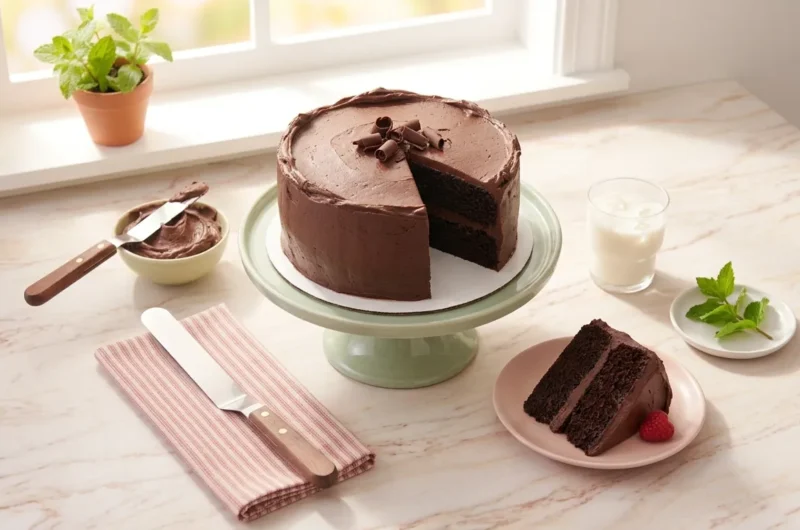
Portillo's Chocolate Cake
A copycat of the legendary Chicago restaurant chocolate cake dense, uniformly moist mayonnaise-based layers with thick chocolate frosting.
Prep time
25
minutesCooking time
32
minutesCool
1
hrTotal
2
hoursYield
12
slicesEasy-Medium
Ingredients
- For the Cake Layers
2 cups (240g) all-purpose flour
3/4 cup (75g) Dutch-process cocoa powder, sifted
2 cups (400g) granulated white sugar
1 1/2 teaspoons (9g) baking soda
1/2 teaspoon (2g) baking powder
1 teaspoon (6g) fine sea salt
1 cup (232g) full-fat commercial mayonnaise — Hellmann's or Duke's
2 large eggs, room temperature (100g)
2 teaspoons (10ml) pure vanilla extract
1 cup (240ml) hot brewed coffee, 190 to 212°F
1/2 cup (120ml) buttermilk, room temperature
- For the Chocolate Frosting
1 cup (226g) unsalted butter, room temperature
2/3 cup (67g) Dutch-process cocoa powder, sifted
4 cups (480g) powdered sugar, sifted
1/3 cup (80ml) heavy cream
1 teaspoon (5ml) pure vanilla extract
1/4 teaspoon (1.5g) fine sea salt
2 tablespoons (29g) full-fat commercial mayonnaise
Instructions
- Bloom the Cocoa
Bloom:
Whisk sifted cocoa with 1 cup hot coffee until smooth. Cool to warm room temp (~15 min). Preheat oven to 350°F. Grease two 9-inch pans and line bases with parchment.- Make the Batter
Dry & wet:
Whisk flour, sugar, baking soda, baking powder, salt. In mixer with paddle, combine mayonnaise + eggs 60 sec. Add vanilla, beat 10 sec.Combine:
Alternate flour mixture with cocoa-coffee and buttermilk flour, cocoa-coffee, flour, buttermilk low speed until just incorporated. Batter will be thin.Bake:
Divide between 2 pans (~620–640g each). Bake 350°F for 28–34 min. Internal temp 200–205°F. Toothpick moist crumbs.Cool:
15 min in pans, then release onto racks, peel parchment, cool completely 1.5 hours minimum.- Make the Frosting
Frosting:
Beat butter 3 min. Add cocoa low 1 min. Add powdered sugar in 3 additions. Add cream, vanilla, salt, 2 tbsp mayonnaise. Beat 2 min until stiff peak.- Assemble
Fill & crumb coat:
Place first layer on turntable. Spread 1–1.5 cups frosting on top. Add second layer. Thin crumb coat over exterior. Refrigerate 25 min.Final coat:
Apply thick exterior frosting (3/8–1/2 inch). Refrigerate 30 min before serving.
Step by Step Process
Bloom the Cocoa
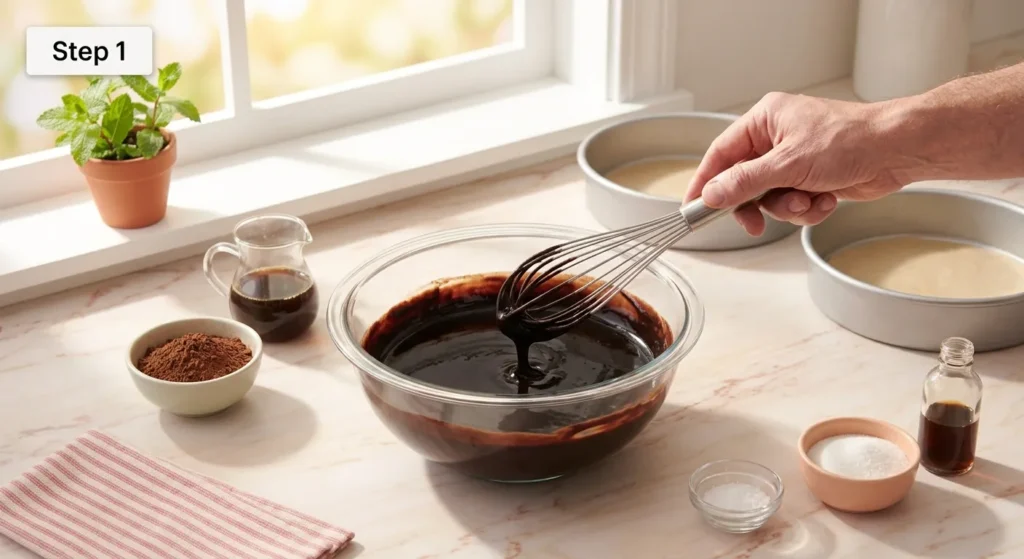
Step 1. Brew 1 cup of strong coffee at 190 to 212°F. In a large heatproof bowl, combine the sifted Dutch-process cocoa powder with the hot coffee and whisk vigorously until completely smooth. Set aside to cool to warm room temperature approximately 15 minutes. Preheat the oven to 350°F (177°C). Grease both 9-inch pans and line the bases with parchment circles.
Make the Batter
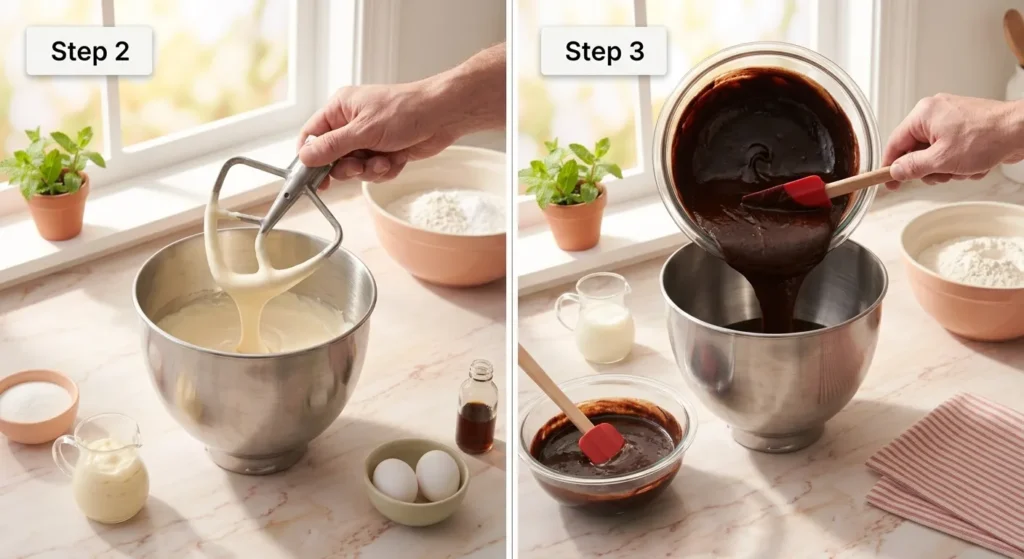
Step 2. Whisk together the flour, sugar, baking soda, baking powder, and salt in a large bowl until completely uniform. In the stand mixer bowl fitted with the paddle, combine the full-fat mayonnaise and eggs at medium-low speed for 60 seconds until smooth the mayonnaise’s existing emulsion incorporates the eggs quickly at this stage. Add the vanilla extract and beat for 10 seconds.
Step 3. Add the flour mixture in two additions alternating with the cooled cocoa-coffee bloom and the buttermilk flour, cocoa-coffee, flour, buttermilk mixing at low speed after each until just incorporated. The batter is done when completely smooth and no dry flour patches remain.
The batter produced by this formula is noticeably thinner than a standard creamed chocolate cake batter from the mayonnaise’s high oil content and the large volume of liquid from the coffee bloom and buttermilk. This thinness is correct the mayonnaise’s pre-emulsified oil produces a batter that appears thin but bakes into a denser, more uniformly moist crumb than a thick creamed batter precisely because the emulsified fat’s fine distribution throughout the thin batter produces more complete fat-starch contact during baking than a thick batter’s coarser fat distribution.
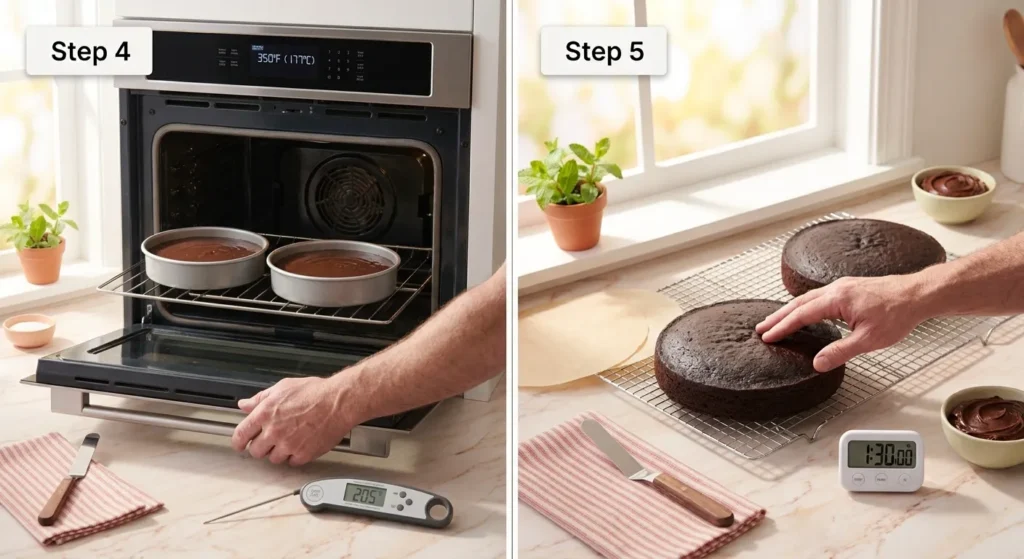
Step 4. Divide the batter equally between the two prepared 9-inch pans weigh for approximately equal portions at approximately 620 to 640g per pan. Bake at 350°F for 28 to 34 minutes until the toothpick shows moist crumbs and the internal temperature reads 200 to 205°F. The mayonnaise batter’s dense fat matrix conducts heat more slowly than a standard batter the internal temperature is the most reliable doneness indicator.
Step 5. Cool in the pans for 15 minutes. Release onto wire racks, peel parchment, and cool completely minimum 1.5 hours. The mayonnaise batter’s denser crumb requires longer cooling than a standard layer cake before it is firm enough for the frosting application warm mayonnaise-based cake layers are significantly more fragile than warm standard-batter layers from the higher fat content keeping the crumb soft at elevated temperatures.
Make the Chocolate Frosting
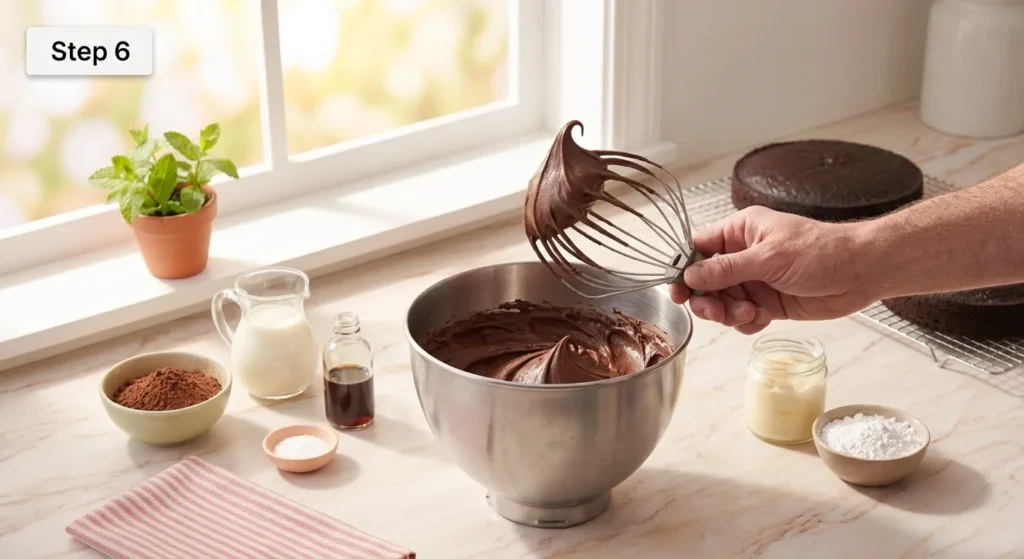
Step 6. Beat the room-temperature butter with the whisk attachment at high speed for 3 minutes until very pale. Add the sifted cocoa powder at low speed and beat for 1 minute until incorporated the cocoa will darken the butter immediately to a deep chocolate-brown. Add the sifted powdered sugar in three additions at low speed. Add the heavy cream, vanilla, salt, and the 2 tablespoons of mayonnaise. Increase to medium-high speed and beat for 2 full minutes until the frosting is smooth, dark, and holds a stiff peak.
Assemble and Frost
Step 7. Place the first cooled layer on a cake board on the turntable. Apply approximately 1 to 1.5 cups of chocolate frosting to the top of the first layer significantly more generous than a standard layer cake filling and spread evenly to the edge. The Portillo’s cake’s characteristic thick frosting layer between the cake layers is as important to the final eating experience as the crumb itself the thick filling provides the chocolate-to-cake ratio that produces the specific Portillo’s dessert experience in every forkful. Place the second layer on top, pressing gently. Apply a thin crumb coat over the full exterior. Refrigerate for 25 minutes until completely firm.
Step 8. Apply the final exterior coat of chocolate frosting generously over the chilled crumb coat Portillo’s cake’s signature exterior shows a thick, generous frosting coat rather than the thin, elegant coat of a fine-dining layer cake. Smooth with the offset spatula while rotating the turntable the Portillo’s aesthetic is clean but not fussily smooth, a generous application that communicates abundance rather than precision. Refrigerate for 30 minutes before serving.

Why Mayonnaise Produces Portillo's Signature Dense Crumb Where Sour Cream Produces Standard Chocolate Cake
The replacement of sour cream with full-fat commercial mayonnaise is not simply a fat substitution at equivalent volume it is a substitution of two fundamentally different fat delivery systems that produce categorically different fat distributions through the finished cake crumb, and this distribution difference is the physical mechanism responsible for every quality that distinguishes Portillo’s chocolate cake from a standard chocolate layer cake made with sour cream at the same fat content.
Sour cream at 20 percent fat contains the remaining 80 percent of its volume as water, protein, and lactic acid. When sour cream is incorporated into a cake batter through standard mixing, the fat phase distributed through the sour cream as a coarse emulsion of small fat droplets in the watery dairy matrix must be further redistributed through the batter during the mixing process. Standard mixing’s mechanical energy is insufficient to break the sour cream’s fat droplets to the sub-micron particle size needed for the most uniform fat distribution the fat remains in relatively large droplets that distribute unevenly through the batter, producing areas of fat-rich and fat-lean crumb at the microscopic scale. The water from sour cream’s 80 percent water fraction evaporates during baking, leaving these unevenly distributed fat droplets in a crumb that has dried around them producing the standard layer cake’s characteristic slightly open, slightly variable crumb where every bite is similar but not identical in moisture and richness.
Full-fat commercial mayonnaise at 70 to 80 percent oil presents the fat to the batter in a fundamentally different physical form. Industrial mayonnaise production uses high-shear emulsification equipment rotors spinning at thousands of RPM to break the oil phase into droplets of 1 to 5 micrometers in diameter, orders of magnitude smaller than what standard mixing achieves with sour cream, stabilised by the egg yolk’s lecithin into a permanent, stable emulsion that does not coalesce back into larger droplets during the gentle mixing required for cake batter preparation. When this pre-emulsified oil matrix enters the cake batter, the sub-micron oil droplets distribute through the batter’s aqueous phase without requiring the mixing energy that breaking larger fat droplets demands the lecithin-stabilised emulsion is already at the distribution fineness that standard mixing cannot produce from separate oil and egg additions.
During baking, this finer, more uniform fat distribution produces a crumb where every starch granule and protein strand in the full batter volume is surrounded by a thin, even coating of emulsified oil from the adjacent sub-micron droplets a fat-starch and fat-protein contact distribution that is measurably more complete and more uniform than sour cream’s coarser droplet distribution achieves. The result is a crumb where the fat plasticises the protein-starch matrix uniformly from edge to centre, preventing the tight, dry protein-on-protein contact that produces the cakey layer cake’s characteristic lightness, and producing instead the dense, uniformly moist, slightly fudge-adjacent crumb that Portillo’s cake fans describe as unlike any other chocolate cake they have eaten.
How Does Portillo's Chocolate Cake Compare to Related Famous Restaurant Chocolate Cakes?
| Attribute | Portillo's Chocolate Cake | Cheesecake Factory Godiva Chocolate Cake | Texas Roadhouse Chocolate Cake | Olive Garden Chocolate Lasagna | Junior's Cheesecake Chocolate Layer |
|---|---|---|---|---|---|
| Signature differentiator | Mayonnaise fat matrix; dense, uniformly moist crumb | Godiva chocolate; premium chocolate in layers | Six thin layers; ratio of frosting to cake | Layered dessert format; not a true layer cake | Cheesecake layer embedded in chocolate cake |
| Crumb density | Very dense; closest to fudge of any restaurant chocolate cake | Medium-dense | Medium; thin layers reduce perceived density | N/A; dessert format | Medium; cheesecake layer dominates texture |
| Frosting character | Thick, dense, high-cocoa American buttercream | Ganache and Godiva mousse layers | Standard American chocolate buttercream | Chocolate between pasta-style layers; not frosting | Cream cheese frosting over chocolate cake |
| Chocolate intensity | Very high; high cocoa ratio plus coffee bloom | Very high; Godiva premium chocolate | Medium; standard commercial cocoa | Medium | Medium; cheesecake dilutes chocolate |
| Cultural attachment | Chicago-area institution; near-cult status | Nationwide Cheesecake Factory brand association | Southern casual dining comfort food | Novelty dessert format | New York institution; Junior's brand |
| Copycat recipe attempts | Among the highest in American food media | High; Godiva association drives interest | Moderate | Low; format unusual | Moderate |
| Most distinctive element | Mayonnaise in both batter and frosting | Godiva chocolate brand association | Layer count; six layers | Format; lasagna format | Cheesecake embedded in layer cake |
What Variations Can You Make?
Portillo's Style Chocolate Peanut Butter Cake
Replace 1 cup of the chocolate frosting used as the layer filling with peanut butter frosting beat 1/2 cup (128g) of creamy commercial peanut butter with 1/2 cup (113g) of room-temperature butter, 2 cups (240g) of sifted powdered sugar, and 3 tablespoons (45ml) of heavy cream until smooth and spreadable. Apply the peanut butter frosting as the filling between the two cake layers and the standard chocolate frosting as the exterior coat. The peanut butter filling’s oleic acid fat richness against the dense mayonnaise chocolate crumb produces the same complementary fat-on-fat richness interaction documented in the chocolate peanut butter cupcakes both preparations work through the same principle that fat-rich fillings against fat-rich crumbs produce a combined richness that is greater than either component alone.
Dark Chocolate Portillo's Cake
Replace the Dutch-process cocoa with a combination of 1/2 cup (50g) of Dutch-process cocoa and 2 oz (57g) of melted 70 percent dark chocolate cooled and added to the batter with the mayonnaise in Step 2. The melted dark chocolate’s cocoa butter fat contributes an additional fat phase to the mayonnaise’s existing emulsified oil matrix both fat sources distribute through the batter’s aqueous phase during mixing, producing a combined fat distribution that is denser and more richly chocolate-flavored than either the mayonnaise-only or chocolate-only addition achieves independently. Increase the heavy cream in the frosting to 1/2 cup (120ml) to compensate for the cocoa butter’s additional fat making the frosting stiffer than the standard formula.
Portillo's Sheet Cake
Pour the full batter into a greased and parchment-lined 9×13-inch pan. Bake at 350°F for 35 to 42 minutes the deeper batter depth extends the baking time beyond the two-layer format. Allow to cool completely in the pan. Apply the full frosting quantity to the top surface only the sheet cake format’s single frosting surface receives all the frosting that the two-layer format distributes between layers and exterior, producing a thick, generous top coat that approximates the assembled two-layer cake’s total frosting proportion per serving. The sheet cake format serves 24 smaller squares versus the two-layer cake’s 12 larger slices appropriate for large gatherings where the full portion size of the standard format would be excessive per person.
Dietary Adjustments and Substitutions
Dairy-Free Version
Replace the buttermilk in the batter with full-fat oat milk combined with 1 1/2 teaspoons of apple cider vinegar allow to curdle for 5 minutes before using. Verify the mayonnaise brand is dairy-free standard commercial mayonnaise is dairy-free by formulation (Hellmann’s and Duke’s contain no dairy ingredients) but verify the specific product’s label for manufacturing facility allergen statements. For the frosting replace the butter with Miyoko’s Creamery dairy-free butter sticks at the same weight (226g) and the heavy cream with full-fat oat milk at the same volume (80ml). Use Vegenaise or Sir Kensington’s vegan mayonnaise at the same quantity in both the batter and the frosting.
Gluten-Free Version
Replace the all-purpose flour with a certified 1:1 gluten-free baking flour blend containing xanthan gum at exactly 240g. Increase the baking soda to 2 teaspoons (12g). The mayonnaise batter’s high fat content and the thin, fluid batter consistency produced by the hot coffee bloom together make this formula more successfully adaptable to gluten-free flour than a standard creamed chocolate cake the thin batter’s low viscosity allows the gluten-free flour’s xanthan gum to distribute uniformly through the batter without the resistance that a thicker creamed batter presents.
What Are the Most Common Problems When Making Portillo's Chocolate Cake?
| Problem | Most Likely Cause | Prevention or Fix |
|---|---|---|
| Result tastes like a good chocolate cake rather than specifically Portillo's | Sour cream or buttermilk substituted for the batter's mayonnaise — emulsification mechanism absent | The mayonnaise is non-negotiable for the Portillo's crumb character — use full-fat commercial Hellmann's or Duke's. The frosting's 2 tablespoons of mayonnaise are equally important and should not be omitted. |
| Cake layers too fragile to handle after cooling | Removed from pans before the mayonnaise crumb had cooled and firmed sufficiently | Cool in the pans for 15 full minutes — longer than a standard layer cake — before releasing. The high fat content keeps the crumb significantly softer at warm temperatures than a standard batter. Refrigerate on the wire rack for 20 minutes after releasing if still fragile. |
| Frosting grainy from cocoa | Cocoa not sifted before adding — starch particles re-aggregated in the fat phase | Always sift the cocoa powder before adding to the butter. If already made and grainy, pass the frosting through a fine mesh strainer and beat again for 1 minute — this resolves minor graininess but not severe clumping. |
| Batter separated when coffee bloom was added hot | Coffee bloom added while still too hot — cooked the mayonnaise emulsion and broke it | Allow the cocoa-coffee bloom to cool to warm room temperature — below 120°F — before adding to the mayonnaise-egg base. A broken emulsion batter bakes into a greasy, uneven crumb that cannot be corrected. |
| Layers uneven in height | Batter not weighed into the pans equally | Weigh each pan — approximately 620 to 640g per pan. Visual estimation produces 10 to 15 percent volume variation that produces visibly unequal layer heights and requires excessive leveling. |
How Do You Store Portillo's Chocolate Cake?
| Storage Method | Duration | Instructions |
|---|---|---|
| Refrigerated, assembled and frosted, covered loosely | Up to 5 days | The mayonnaise's stable emulsion preserves the crumb's moisture more effectively through refrigeration than standard batter formats — the emulsified fat does not separate or produce the stale, dried character that refrigerated standard layer cakes develop within 3 days. Bring to room temperature for 30 minutes before serving — cold mayonnaise-based crumb is firmer than room temperature and the chocolate frosting's dense fat phase suppresses aromatic volatility below 15°C. |
| Room temperature, under a cake dome — below 70°F only | Up to 3 days | The mayonnaise in the batter and frosting is a perishable ingredient — above 70°F the mayonnaise's emulsion can begin to break and the egg component can undergo bacterial growth. Store at room temperature only in a kitchen maintained below 70°F. Above 70°F, refrigerate without exception. |
| Frozen, individual slices wrapped in plastic wrap then foil | Up to 3 months | The mayonnaise batter's high emulsified fat content freezes and thaws with minimal textural change — the stable emulsion preserves the crumb's uniform fat distribution through the freeze-thaw cycle better than a standard batter whose coarser fat droplets separate and re-coalesce unevenly during thawing. Thaw at room temperature for 45 minutes to 1 hour. |
Scaling
| Servings | All-Purpose Flour | Sugar | Cocoa | Mayonnaise (batter) | Coffee | Butter (frosting) | Pan Size |
|---|---|---|---|---|---|---|---|
| 8 servings | 160g | 267g | 50g | 155g | 160ml | 150g | Two 8-inch pans |
| 12 servings (standard) | 240g | 400g | 75g | 232g | 240ml | 226g | Two 9-inch pans |
| 16 servings | 320g | 533g | 100g | 310g | 320ml | 300g | Three 9-inch pans |
Nutritional Information
Per serving: 1 slice approximately 155g including chocolate frosting layer and exterior, based on 12 slices. Values calculated using USDA FoodData Central reference data using full-fat Hellmann’s mayonnaise and Dutch-process cocoa.
| Nutrient | Per Serving | Nutrient | Per Serving |
|---|---|---|---|
| Calories | 588 kcal | Total carbohydrate | 78g |
| Total fat | 32g | Dietary fibre | 3.2g |
| Saturated fat | 14g | Total sugars | 60g |
| Cholesterol | 88mg | Protein | 5.2g |
| Sodium | 388mg | Iron | 3.2mg (18% DV) |
Frequently Asked Questions
Why does mayonnaise produce a denser, more uniformly moist crumb than sour cream at equivalent fat content?
Commercial mayonnaise’s industrial high-shear emulsification breaks the oil phase into sub-micron droplets of 1 to 5 micrometers stabilised by egg yolk lecithin into a permanent emulsion a fat distribution fineness that no standard mixing process achieves from separate oil and egg additions or from sour cream’s coarser emulsion. When this pre-emulsified fat enters the batter, the sub-micron droplets distribute uniformly through the aqueous phase without requiring the mixing energy that breaking larger droplets demands, producing a crumb where every starch granule and protein strand is surrounded by evenly distributed emulsified fat. This uniform fat-starch contact plasticises the protein-starch matrix from edge to centre, preventing the tight protein-on-protein contact that produces the standard layer cake’s lighter, slightly open crumb and producing instead the dense, uniformly moist character that defines Portillo’s result.
Why is Dutch-process cocoa specified rather than natural cocoa?
Commercial mayonnaise contains lemon juice or vinegar as an acidulant in its emulsion stabilisation system both contribute acidity to the batter when the mayonnaise is incorporated. Natural cocoa’s own significant acidity would add a third acid source to the batter’s leavening system, disrupting the calibrated acid-base balance between the baking soda and the batter’s acid components. Dutch-process cocoa’s alkali-neutralised pH produces no additional acid contribution, maintaining the leavening system’s calibrated balance with the mayonnaise’s acidulant content as the primary acid source for baking soda activation.
Why does the frosting include 2 tablespoons of mayonnaise alongside the standard butter and cream?
The mayonnaise’s lecithin in the frosting emulsifies the butter-cream interface into a more stable, more cohesive fat emulsion than the standard butter-powdered sugar-cream formula produces at the same quantities. At the Portillo’s frosting’s high cocoa-to-sugar ratio, standard chocolate buttercream develops graininess from cocoa starch particles re-aggregating in the fat phase the mayonnaise’s lecithin concentration is sufficient to coat these particles and prevent their re-aggregation, producing a smoother, denser, more cohesive frosting. The 2-tablespoon quantity is calibrated to the structural contribution threshold above 3 tablespoons the mayonnaise’s acidulant content begins perceptibly affecting the frosting’s flavor.
Is this an exact reproduction of Portillo's restaurant recipe?
No, Portillo’s has never publicly disclosed its exact recipe. This is a reverse-engineered copycat formula developed from reported ingredient lists in American food media, food science analysis of the cake’s sensory characteristics, and the documented mayonnaise-chocolate cake tradition in American baking that Portillo’s kitchen refined into its specific result. The formula produces a result that closely approximates the Portillo’s eating experience the dense, uniformly moist crumb, the intense chocolate character, the thick generous frosting but cannot be certified as identical to the commercial kitchen’s proprietary formula. Most Portillo’s fans who have tested this formula report it as the closest homemade approximation of the original they have achieved.
Portillo’s chocolate cake is a Chicago-area restaurant institution whose near-cult following in American food culture is produced by a specific fat delivery mechanism full-fat commercial mayonnaise whose industrial high-shear emulsification has already broken the oil phase into sub-micron lecithin-stabilised droplets before the batter is assembled, distributing fat through the batter’s aqueous phase at a fineness that no standard mixing of separate oil, egg, and dairy additions achieves producing a crumb where the uniform fat-starch contact plasticises the protein-starch matrix from every layer’s edge to its centre without variation, creating the dense, uniformly moist, fudge-adjacent chocolate crumb that distinguishes Portillo’s cake from every standard layer cake in the American casual dining landscape, amplified by the full cup of hot coffee blooming Dutch-process cocoa’s pyrazine and furanone aromatic compounds at the collection’s highest coffee-to-cocoa ratio, and completed by a thick, generous chocolate frosting whose own 2-tablespoon mayonnaise addition’s lecithin prevents the cocoa starch graininess that the high cocoa-to-sugar ratio would otherwise produce in a standard butter-cream-powdered sugar formula.
Table of Contents
Recent Recipes
American · Cakes Orange Pound Cake Recipe This orange pound cake recipe rubs the zest into the sugar before creaming. […]
Check Out..!
American · Layer Cakes Coconut and Carrot Cake Recipe Moist, oil-based spiced layer cake packed with freshly grated carrot and […]
Check Out..!
American Cakes Tandy Cake Recipe This Tandy cake recipe spreads peanut butter on the warm cake, then chills it before […]
Check Out..!
American Cakes Funnel Cake Fries Recipe This funnel cake fries recipe uses a thicker batter than classic funnel cake, piped […]
Check Out..!Recent Blogs
I’ve glazed our Amish apple cake too hot, too cold, and exactly right, and the difference is not small. The […]
Read Blog..!
I’ve pulled a sunken Amish Apple Cake out of my oven, and I know the exact sinking feeling that comes […]
Read Blog..!
A cup measures volume, not weight, so a cup of flour and a cup of sugar weigh completely different amounts. […]
Read Blog..!
Every pasta shape was designed to carry a certain kind of sauce. Thin strands suit light sauces that coat, wide […]
Read Blog..!
Every egg method, from a jammy boiled egg to a silky French omelet, comes down to one fact: the white […]
Read Blog..!