
American (Pennsylvania Dutch) · Fruit Cakes Amish Apple Cake Recipe A moist, oil-based spiced sheet cake made with pre-cooked diced […]
Check Out..!
American · Layer Cakes
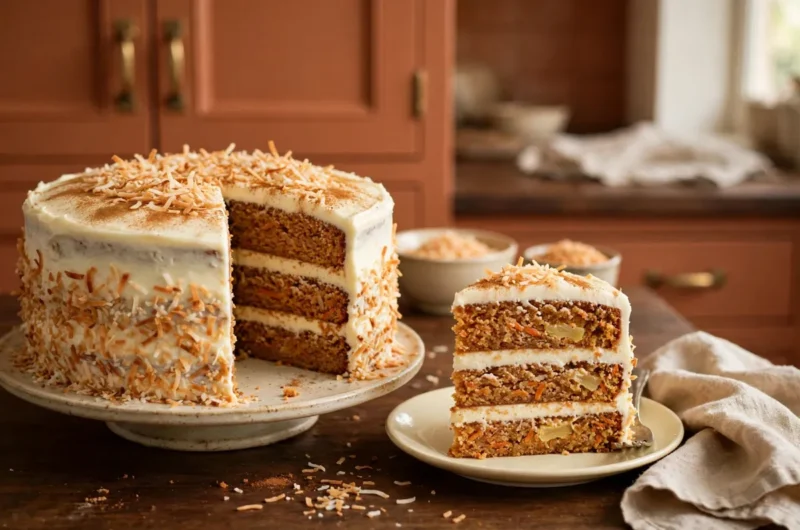
Coconut and Carrot Cake Recipe
Moist, oil-based spiced layer cake packed with freshly grated carrot and desiccated coconut, finished with a tangy coconut cream cheese frosting and a crown of golden toasted coconut flakes.
- Prep: 25 min
- Bake: 40 min
- Total: 65 min + 2 hrs cooling
- Servings: 16 slices
- Difficulty: Medium
- Dietary: Vegetarian
 Chef's review · Saba Aftab, Pastry Chef · Reviewed Nov 10, 2026
“Toast shredded coconut at 325°F for 8 minutes before folding into batter. Raw coconut's waxy lauric acid coating repels moisture absorption, leaving rubbery, waxy coconut pockets in the crumb rather than integrated, tender pieces.”
Coconut and carrot cake is a moist, oil-based spiced layer cake packed with freshly grated carrot and unsweetened desiccated coconut in the batter, finished with a tangy coconut cream cheese frosting and a crown of golden toasted coconut flakes. The oil base produces a crumb that stays tender for up to four days, and the beta-carotene in freshly grated carrot distributes more evenly through an oil-based batter than through any butter-based formula, producing a deeper orange colour and a more consistent carrot flavour in every slice.
What Is Coconut and Carrot Cake?
Coconut and carrot cake is a tropical variation of the American carrot cake, a baked good whose origins trace to medieval European carrot puddings in which carrots substituted for scarce and expensive sugar. A carrot-based baked pudding appears in the English collection A Book of Cookrye as early as 1591. Swiss and German communities refined the formula through the 18th and 19th centuries into Karottenkuchen, a lighter almond-and-carrot cake still produced in Swiss bakeries today.
The modern American carrot cake with cream cheese frosting took its definitive form in the 1970s and early 1980s. The Philadelphia Cream Cheese Company published a carrot cake recipe with cream cheese frosting in 1965, establishing the pairing that would become standard. Sheila Lukins and Julee Rosso cemented cream cheese frosted carrot cake as the definitive American version when they published their recipe in The Silver Palate Cookbook (1982), which remains the most cited American carrot cake source in culinary literature. Food Network listed cream cheese-frosted carrot cake as the fifth most significant food trend of the 1970s in their 2005 historical ranking.
Coconut entered the carrot cake formula through Caribbean and tropical American baking traditions, where desiccated coconut, coconut oil, and fresh coconut were standard pantry items used alongside root vegetables in both sweet and savoury baking. The combination of grated carrot and coconut in one batter was established in home baking literature by the 1980s, particularly across Caribbean communities in the United Kingdom and the United States.
What Equipment Do You Need?
- Two 8-inch (20 cm) round cake pans: Use light-coloured aluminum pans at least 2 inches deep for evenly baked layers. Dark pans can brown the edges too quickly.
- Box grater or food processor with grating disc: Use the large-hole setting to create evenly sized carrot pieces that retain moisture and texture in the cake.
- Two large mixing bowls: Use one for the dry ingredients and one for the wet ingredients. Choose bowls large enough to fold in the carrots, coconut, and walnuts without spilling.
- Stand mixer or hand mixer: Needed for beating the cream cheese frosting until smooth and fluffy. The cake batter itself can be mixed by hand.
- Small baking sheet: Useful for toasting the sweetened flaked coconut garnish.
- Offset spatula: Makes it easier to spread frosting evenly across the top and sides of the layered cake.
- Oven thermometer: Helps verify that your oven reaches the correct baking temperature, since home ovens can run hotter or cooler than the dial indicates.
What Ingredients Do You Need?
All ingredients at room temperature before mixing. Remove eggs from the refrigerator 60 minutes before baking. Cold eggs resist incorporation into the oil and produce a slightly separated batter.
For the Cake (two 8-inch layers)
| Ingredient | Volume | Weight |
|---|---|---|
| Vegetable oil | 1 cup | 200g |
| Granulated white sugar | 1 cup | 200g |
| Light brown sugar, packed | 1/2 cup | 107g |
| Large eggs, room temperature | 3 eggs | 150g |
| Pure vanilla extract | 2 tsp | 10ml |
| Freshly grated carrot, large holes | 3 cups loosely packed | 280g |
| Unsweetened desiccated coconut | 1 cup | 75g |
| All-purpose flour | 2 cups | 240g |
| Baking soda | 1 tsp | 5g |
| Baking powder | 1 tsp | 4g |
| Ground cinnamon | 2 tsp | 5g |
| Ground ginger | 1/2 tsp | 1.5g |
| Ground nutmeg | 1/4 tsp | 0.8g |
| Fine sea salt | 1 tsp | 6g |
| Chopped walnuts or pecans (optional) | 3/4 cup | 85g |
For the Coconut Cream Cheese Frosting
| Ingredient | Volume | Weight |
|---|---|---|
| Full-fat cream cheese, room temperature | 16 oz (2 blocks) | 450g |
| Unsalted butter, room temperature | 1/2 cup | 113g |
| Pure vanilla extract | 1 tsp | 5ml |
| Coconut extract | 1/2 tsp | 2.5ml |
| Powdered sugar, sifted | 4 cups | 480g |
For the Toasted Coconut Garnish
| Ingredient | Volume | Weight | Note |
|---|---|---|---|
| Sweetened flaked coconut | 1 1/2 cups | 120g | Large flakes at 10 to 20mm. The Maillard reaction in coconut begins at 140C (284F) rather than the standard 154C (310F) because coconut's medium-chain fatty acids lower the activation energy of browning. This is why coconut goes from golden to burnt in under 60 seconds when other nuts take 3 to 4 minutes. Watch continuously from minute 3 of toasting. |
Coconut and Carrot Cake
A moist, oil-based spiced layer cake packed with freshly grated carrot and unsweetened desiccated coconut, finished with tangy coconut cream cheese frosting and toasted coconut flakes.
Yield
16
SlicesPrep time
25
minutesBake
40
minutesCalories
528
kcalMedium
American
Total
185
minutesIngredients
- For the Cake
1 cup (200g) vegetable oil
1 cup (200g) granulated white sugar
1/2 cup (107g) light brown sugar, packed
3 large eggs, room temperature
2 tsp (10ml) pure vanilla extract
3 cups loosely packed (280g) freshly grated carrot
1 cup (75g) unsweetened desiccated coconut
2 cups (240g) all-purpose flour
1 tsp (5g) baking soda
1 tsp (4g) baking powder
2 tsp (5g) ground cinnamon
1/2 tsp (1.5g) ground ginger
1/4 tsp (0.8g) ground nutmeg
1 tsp (6g) fine sea salt
3/4 cup (85g) chopped walnuts or pecans (optional)
- For the Coconut Cream Cheese Frosting
16 oz (450g) full-fat cream cheese, room temperature
1/2 cup (113g) unsalted butter, room temperature
1 tsp (5ml) pure vanilla extract
1/2 tsp (2.5ml) coconut extract
4 cups (480g) powdered sugar, sifted
- For the Toasted Coconut Garnish
1 1/2 cups (120g) sweetened flaked coconut
Instructions
- Prepare
Toast Coconut & Drain Pineapple
Toast coconut at 325°F for 7–9 min (stir at 4 min). Cool. Increase oven to 350°F. Drain pineapple in a strainer for 10 min, then press once. Reserve juice for frosting if desired.
- Make the Batter
Whisk dry ingredients
Whisk oil, sugars, eggs, and vanilla. Fold in dry ingredients until just combined. Fold in carrots (8–10 strokes), then pineapple (5 strokes), then coconut and nuts (5 strokes).
- Bake
Divide batter among three greased, parchment-lined 8" pans (~480–490g each). Bake at 350°F for 30–36 min (internal temp 200–205°F). Cool in pans 15 min, then on racks completely (min. 1.5 hrs).
- Make the Frosting
Beat cream cheese until smooth. Beat in butter. Add powdered sugar gradually. Add vanilla, lemon juice, and salt. Beat 2 min until stiff and fluffy.
- Assemble the Cake
Layer cakes with ¾ cup frosting between each. Apply a thin crumb coat. Refrigerate 25 min. Apply final coat. Garnish with toasted coconut, nuts, and a light dusting of cinnamon.
Step by Step Process
Toast the Coconut and Drain the Pineapple
Step 1: Preheat the oven to 325°F (163°C). Spread the sweetened shredded coconut in a single, even layer on the parchment-lined baking sheet. Toast at 325°F for 7 to 9 minutes, stirring once at the 4-minute mark, until the coconut is uniformly golden-brown not pale and untoasted, not dark brown and bitter. Remove from the oven and allow to cool completely on the pan before adding to the batter. Increase the oven temperature to 350°F (177°C) for the cake layers.

Step 2: Place the drained crushed pineapple in the large fine mesh strainer set over a bowl. Allow to drain passively for a full 10 minutes do not press or squeeze. After 10 minutes press once firmly with the back of a spoon to express the remaining juice. Measure the drained weight 200g drained. The juice collected in the bowl can be reserved for the cream cheese frosting as a pineapple flavor accent or discarded. Our granny cake does the opposite and keeps the pineapple undrained, because its simpler batter needs that juice.
The 10-minute passive drain is the minimum required for meaningful bromelain reduction. Bromelain the cysteine protease enzyme in pineapple at approximately 0.5 to 2.0 percent of fresh pineapple by weight cleaves peptide bonds in protein chains at temperatures below 158°F. In an unbaked batter, bromelain from incompletely drained pineapple cleaves the gluten proteins’ glutenin and gliadin chains progressively during the mixing and resting period, reducing the gluten network’s strength before the oven’s heat deactivates bromelain at 158°F. A batter with active bromelain from undrained pineapple produces a cake with a structurally weakened crumb that crumbles around the pineapple pieces and cannot support the weight of two additional cake layers without compression.

Make the Cake Batter
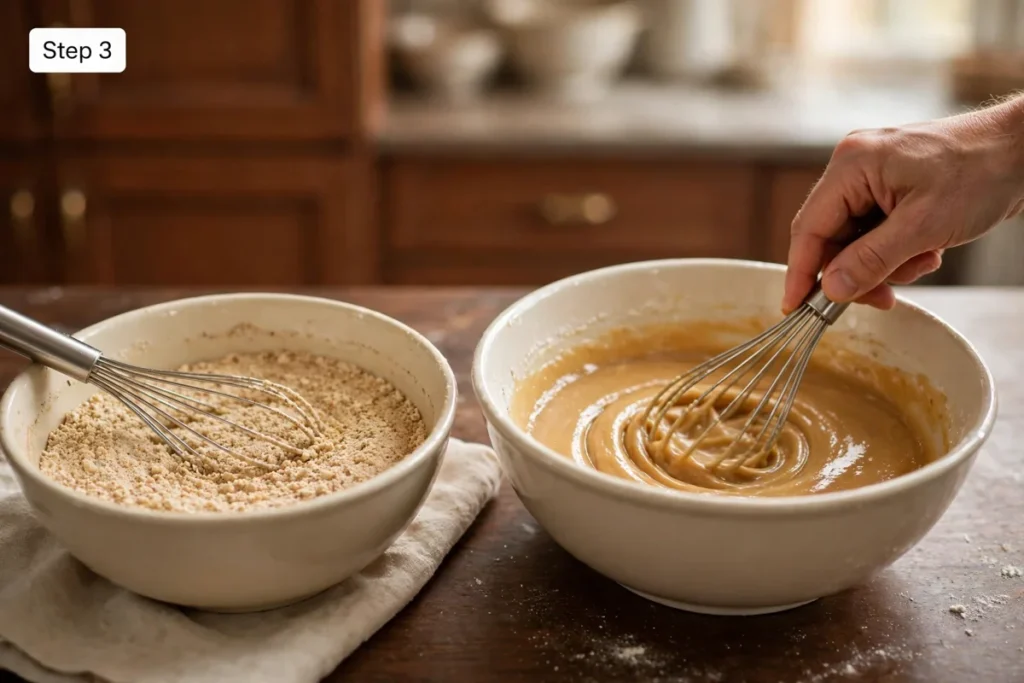
Step 3: Whisk together the flour, baking soda, baking powder, salt, cinnamon, ginger, nutmeg, and allspice in a medium bowl until completely uniform. In the large mixing bowl whisk together the vegetable oil, granulated sugar, and dark brown sugar for 60 seconds. Add the eggs one at a time, whisking 20 seconds after each. Add the vanilla extract and whisk for 10 seconds.
Step 4: Add the dry ingredient mixture to the wet ingredients in two additions, stirring with the rubber spatula after each until just incorporated stop mixing the moment no dry flour patches remain. The batter at this stage should be thick, slightly rough-textured, and fall slowly from the spatula.

Step 5: Add the freshly grated carrots and fold with the rubber spatula using 8 to 10 strokes distributing the carrot shreds evenly through the batter without overworking. Add the drained crushed pineapple and fold for 5 additional strokes. Add the toasted coconut and chopped nuts and fold for 5 final strokes. Stop mixing the moment all additions are evenly distributed.
This staged fold-in sequence carrot first, then pineapple, then coconut and nuts distributes the moisture-releasing carrot throughout the batter before the pineapple’s bromelain contacts the gluten network. By the time the pineapple is added the carrot’s moisture has already begun integrating with the batter, diluting the bromelain concentration through the full batter volume more quickly than adding pineapple to the unmixed batter, minimising the total bromelain exposure time before the batter reaches the oven.

Bake the Layers
Step 6: Grease all three 8-inch pans and line the bases with parchment circles. Divide the batter equally among the three pans weigh for approximately equal portions at approximately 480 to 490g per pan. The heavily loaded batter does not self-level spread it to the edges with the back of a spoon or offset spatula, pressing it into the pan corners.
Bake at 350°F for 30 to 36 minutes until a toothpick inserted into the centre comes out with moist crumbs and the internal temperature reads 200 to 205°F. The heavily loaded batter’s dense mass takes longer to heat through than a plain batter at equivalent depth do not judge doneness by surface appearance alone, as the top may appear fully baked while the interior is still setting.

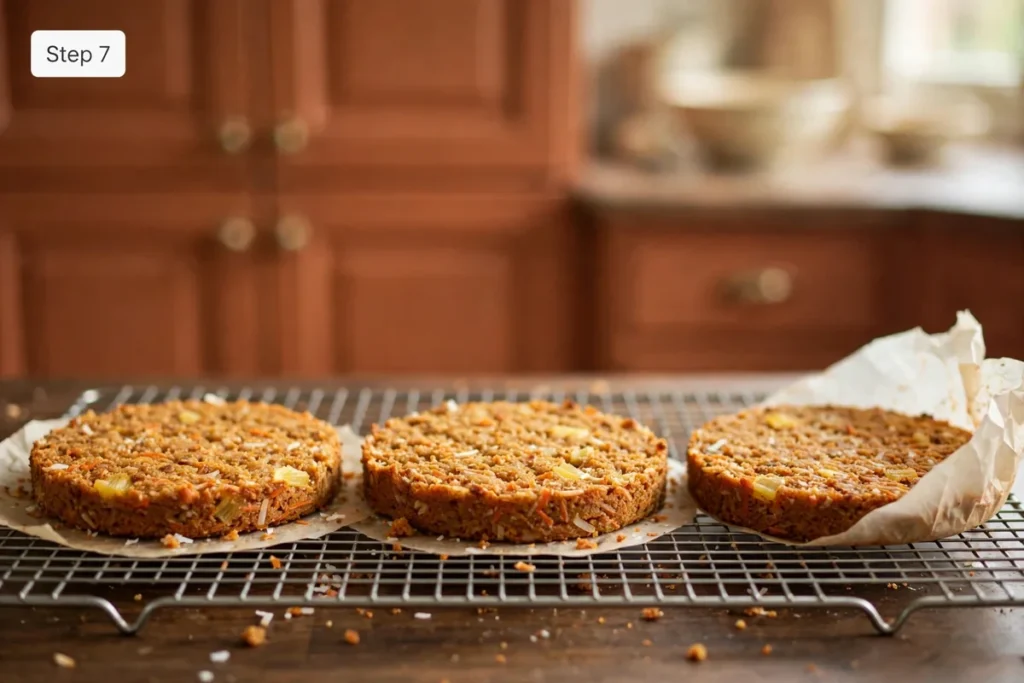
Step 7: Cool in the pans for 15 minutes longer than a standard layer cake because the heavy mix-ins make the layers more fragile when warm. Release onto a wire rack, peel the parchment, and cool completely minimum 1.5 hours before frosting. The layers must be completely cold before the cream cheese frosting is applied warm layers melt the frosting immediately on contact, producing a cream cheese puddle rather than a clean filling layer.
Make the Cream Cheese Frosting
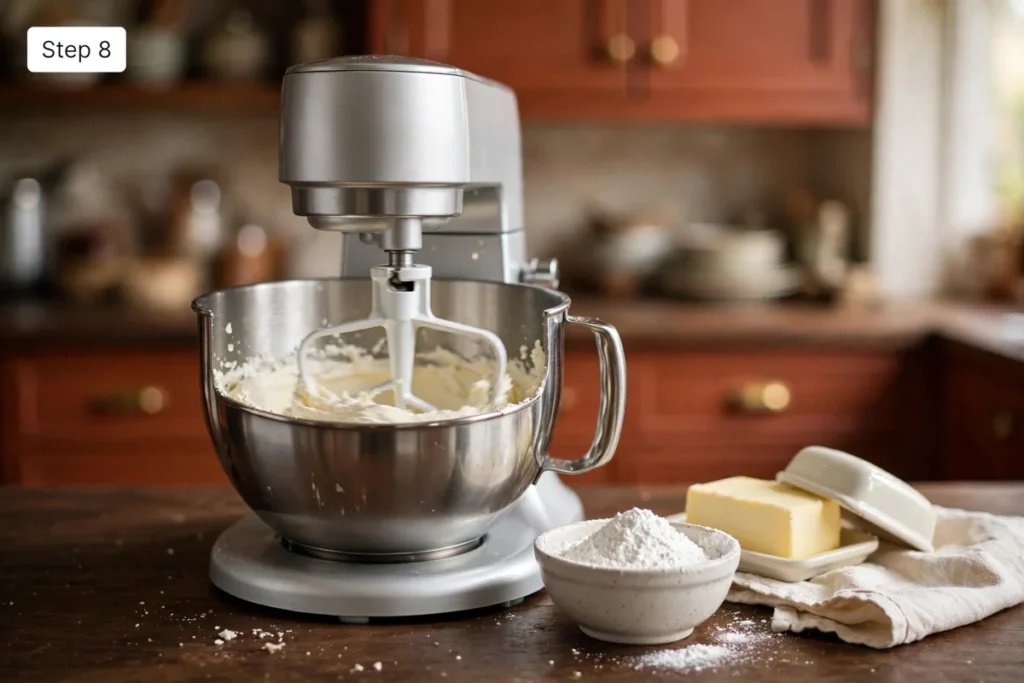
Step 8: Beat the room-temperature block cream cheese with the paddle attachment at medium speed for 2 minutes until completely smooth with no lumps the cream cheese must be beaten to complete smoothness before any other ingredient is added, because powdered sugar added to lumpy cream cheese traps the lumps permanently inside the sugar matrix. Add the room-temperature butter and beat for 1 additional minute until completely incorporated.
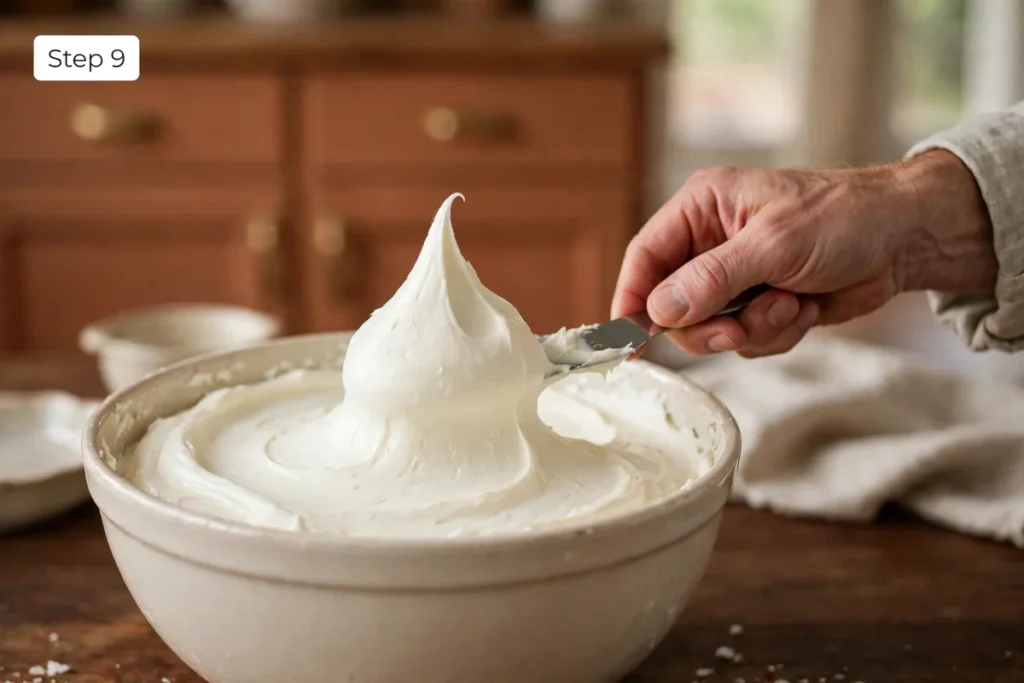
Step 9: Switch to the whisk attachment. Add the sifted powdered sugar in three additions at low speed, beating briefly after each. Add the vanilla extract, lemon juice, and salt. Increase to medium-high speed and beat for 2 full minutes until the frosting is smooth, very white, and holds a stiff peak. Taste the frosting should deliver a clean, sharp cream cheese tang amplified by the lemon juice, with balanced sweetness that does not overwhelm the dairy character.
Assemble and Frost
Step 10: Place the first cooled layer on a cake board on the turntable. Apply approximately 3/4 cup of cream cheese frosting to the top of the first layer and spread evenly to the edge with the large offset spatula. Place the second layer on top, pressing gently to level. Apply 3/4 cup of frosting to the second layer. Place the third layer on top, pressing gently. Apply a thin crumb coat of frosting over the full exterior top and sides. Refrigerate for 25 minutes until the crumb coat is completely firm.
The 25-minute crumb coat refrigeration is longer than the standard 20 minutes for layer cakes with buttercream crumb coats because cream cheese frosting’s softer consistency at room temperature requires the additional cold time to firm sufficiently for the final coat to apply without the crumb coat dragging into it.
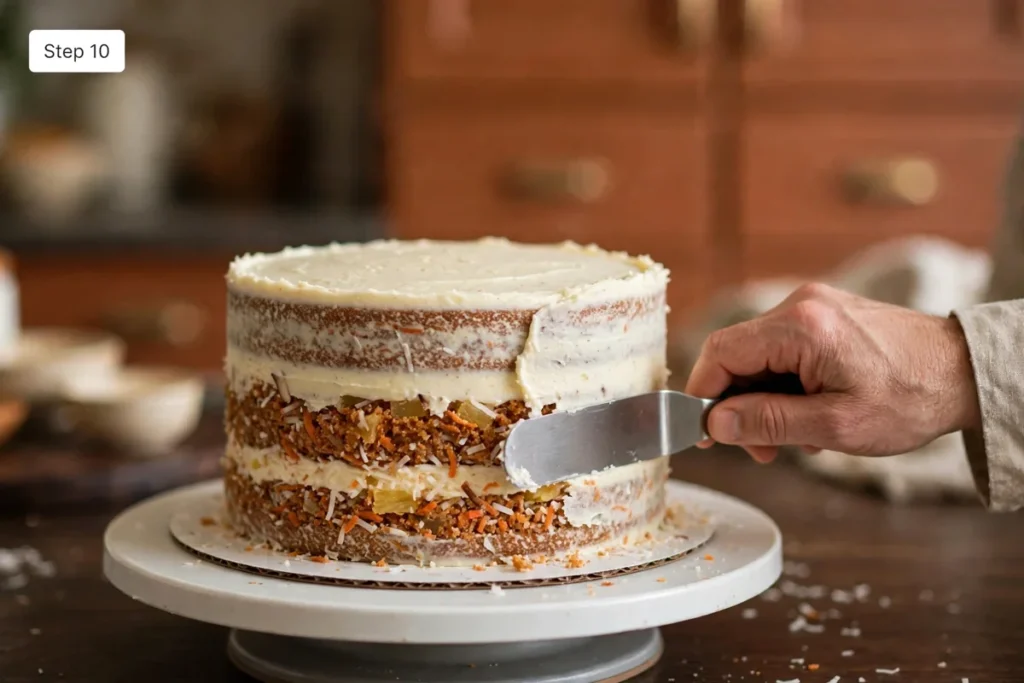
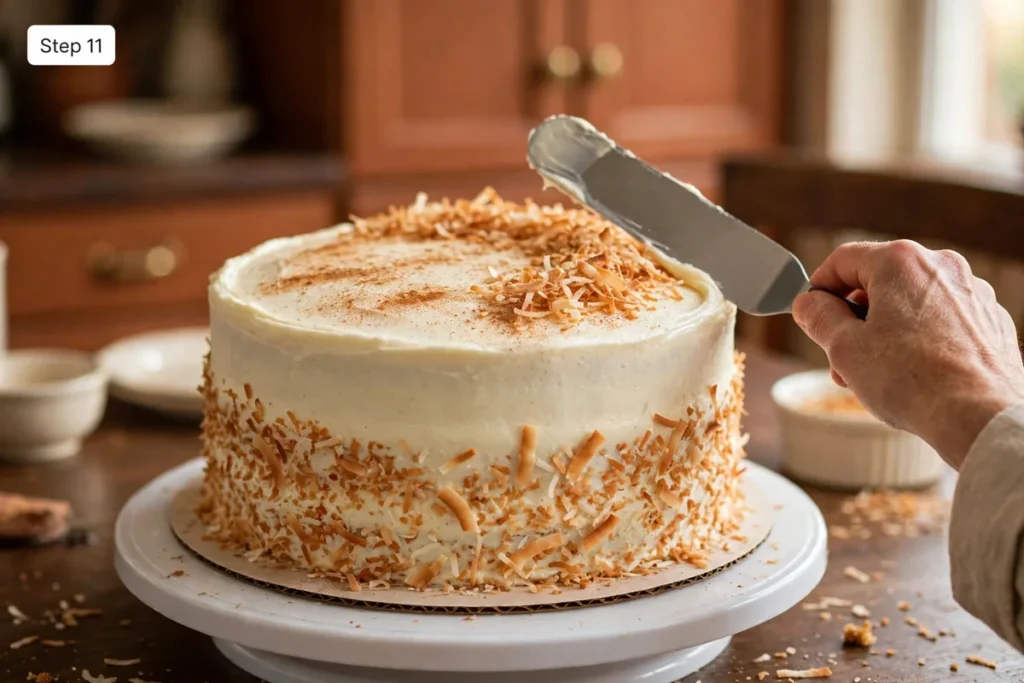
Step 11: Apply the final generous coat of cream cheese frosting over the chilled crumb coat top and sides. Smooth with the large offset spatula while rotating the turntable. The cream cheese frosting’s softness relative to buttercream requires a lighter, more confident touch than buttercream’s application pressing too firmly with the spatula drags the frosting rather than smoothing it.
For the garnish: press additional toasted coconut shreds into the frosted sides of the cake. Arrange a handful of toasted coconut on the top surface. Place walnut or pecan halves in a decorative ring on the top surface if desired. A light dusting of cinnamon over the top cream cheese surface provides the visual signal of the cake’s spice character before the first slice is cut.
Why Toasting Coconut Before Adding to Carrot Cake Batter Produces Integrated Rather Than Waxy Pieces
The difference in texture between raw coconut and toasted coconut embedded in a baked carrot cake crumb is not simply a flavor distinction it is a fundamentally different physical relationship between the coconut shred and the surrounding cake matrix, determined by the surface chemistry of the coconut’s dominant saturated fatty acid and how thermal processing changes that surface chemistry before baking.
Raw sweetened shredded coconut’s surface is dominated by lauric acid a 12-carbon saturated fatty acid that constitutes 45 to 52 percent of coconut fat by weight and is responsible for coconut oil’s waxy, solid-at-room-temperature character. At room temperature lauric acid’s melting point of 111°F means it exists as a solid crystalline fat coating on the surface of each coconut shred. This solid lauric acid surface is highly hydrophobic it repels water-based liquids through the same hydrophobe-water incompatibility that makes oil and water immiscible. When raw coconut shreds are folded into a water-phase cake batter, the solid lauric acid coating prevents the batter’s aqueous phase from wetting the coconut shred surface, leaving an intact hydrophobic barrier between the coconut and the surrounding batter.
During baking, the oven’s heat melts the lauric acid coating lauric acid liquefies above 111°F, well below the cake’s baking temperature and in an ideal scenario the melted lauric acid should integrate with the surrounding crumb. However, raw coconut added to a batter bakes with the lauric acid coating still intact through the early baking phase when the crumb structure is still being established, and when the coating finally melts at 111°F it finds a crumb matrix that has already partially set around the shred. The lauric acid’s hydrophobic liquid phase cannot wet the already-formed hydrophilic starch network around the shred it pools around the shred as a small fat pocket rather than integrating with the surrounding crumb, producing the waxy, isolated coconut piece that every raw-coconut carrot cake contains.
Toasting at 325°F for 8 minutes resolves this at the surface chemistry level before the coconut contacts the batter. At 325°F the lauric acid coating melts completely and redistributes through and across the coconut shred as a liquid as the shred cools after toasting, the lauric acid re-solidifies in a redistributed, thinner surface configuration rather than the thick, continuous coating of unprocessed raw coconut. The Maillard browning on the coconut shred’s surface also produces new amphiphilic aromatic compounds molecules with both hydrophilic and hydrophobic regions that partially bridge the coconut shred’s surface with the surrounding batter’s aqueous phase. When this pre-toasted coconut contacts the batter, the redistributed lauric acid surface is thin enough that the batter’s aqueous phase can partially wet the shred, and during baking the toasted coconut absorbs batter moisture and integrates with the forming crumb matrix rather than being encapsulated by an intact hydrophobic barrier.
How Does Coconut and Carrot Cake Compare to Related Loaded Carrot Cake Variations?
| Attribute | Coconut and Carrot Cake | Plain Carrot Cake | Carrot Cake With Pineapple Only | Hummingbird Cake | Morning Glory Muffins |
|---|---|---|---|---|---|
| Primary mix-ins | Grated carrot, toasted coconut, drained pineapple, nuts | Grated carrot, nuts optional | Grated carrot, drained pineapple, nuts | Banana, pineapple, pecans no carrot | Grated carrot, coconut, raisins, apple, nuts |
| Fat source | Vegetable oil 100% fat | Vegetable oil | Vegetable oil | Vegetable oil | Vegetable oil |
| Coconut toasting required | Yes mandatory | N/A | N/A | No no coconut | No small quantity |
| Pineapple draining required | Yes 10 full minutes | N/A | Yes 10 full minutes | Yes 10 full minutes | No small quantity, grated apple provides moisture |
| Frosting | Cream cheese mandatory | Cream cheese | Cream cheese | Cream cheese | None or cream cheese glaze |
| Moisture retention at room temperature | 5 to 6 days | 3 to 4 days | 4 to 5 days | 4 to 5 days | 3 to 4 days |
| Crumb texture | Dense, moist, heavily loaded distinct mix-in pieces | Dense, moist carrot threads visible | Dense, moist pineapple pieces visible | Dense, moist banana and pineapple dominant | Dense, compact mixed textures |
| Primary aromatic | Cinnamon-ginger-nutmeg plus toasted coconut δ-decalactone | Cinnamon-nutmeg plus carrot beta-carotene | Cinnamon-nutmeg plus pineapple ester | Banana isoamyl acetate plus pineapple | Cinnamon plus carrot plus apple malic acid |
| Most common occasion | American birthday, Easter, fall celebration | American birthday, Easter, everyday | American birthday, Easter | Southern American birthday, potluck | American breakfast, brunch, everyday |
What Variations Can You Make to Coconut and Carrot Cake?
Coconut Carrot Cake With Cream Cheese Swirl
Reserve 1/2 cup (113g) of the cream cheese frosting before assembly and beat it with 1 tablespoon of powdered sugar and 1 egg until smooth to produce a slightly looser cream cheese mixture. After pouring the batter into the prepared pans, drop spoonfuls of this mixture over the batter surface in each pan and draw a knife through in 3 to 4 figure-eight motions to produce a cream cheese swirl through the crumb. The cream cheese bakes into the cake during the standard bake time baking soda in the batter and the cream cheese’s own moisture interact to produce a slightly lighter, more open crumb at the swirl locations that contrasts the dense surrounding cake crumb, producing a visual and textural swirl pattern in the baked cross-section. The swirl version eliminates the need for the cream cheese frosting exterior it can be served as a glazed single-layer cake with the swirl as both the visual and flavor feature.
Chocolate Chip Coconut Carrot Cake
Add 3/4 cup (130g) of mini dark chocolate chips to the batter alongside the toasted coconut in Step 5. Toss the chips in 1 teaspoon of flour before folding in the flour coating raises surface friction and suspends the chips through the dense batter rather than allowing them to sink to the pan base during baking. The dark chocolate’s polyphenol bitterness against the warm spiced crumb and the tropical coconut-pineapple sweetness produces a complex sweet-bitter-spicy flavor interaction that most tasters describe as the most sophisticated variation of the coconut carrot cake family. Use a chocolate cream cheese frosting add 3 tablespoons (18g) of sifted Dutch-process cocoa powder to the standard frosting formula to reinforce the chocolate presence in the exterior.
Tropical Coconut Carrot Cake
Add 1/2 cup (75g) of dried mango pieces cut into 1/4-inch dice alongside the pineapple in Step 5. Replace the ground allspice with 1/4 teaspoon of ground cardamom. The mango’s dried lactone aromatic compounds particularly γ-decalactone complement the pineapple’s ethyl acetate and ethyl butanoate tropical esters, producing a combined tropical aromatic that amplifies the coconut’s own tropical character through shared aromatic family stacking. Add 1 tablespoon of fresh lime zest rubbed into the granulated sugar before adding the oil to the batter for a citrus-brightness component. The lime zest’s limonene and linalool distribute through the oil-sugar base in the same fat-phase integration mechanism documented in the chocolate orange cake.
Dietary Adjustments and Substitutions
Coconut Carrot Cake With Cream Cheese Swirl
Replace the all-purpose flour with a certified 1:1 gluten-free baking flour blend containing xanthan gum at exactly 300g. Increase the baking soda to 2 teaspoons (12g). The oil-based batter with its high moisture content from carrots, pineapple, and coconut is among the most successfully gluten-free-adaptable cake formats the mix-ins provide structural interest that compensates for any minor texture change from the gluten-free flour, and the xanthan gum’s binding function replaces the gluten network’s structural role adequately at this batter’s high moisture level.
Vegan Version
Replace the 4 eggs with 4 flax eggs 1 tablespoon (7g) of ground flaxseed combined with 3 tablespoons (45ml) of warm water per egg, rested for 5 minutes each. The flax egg’s mucilage polysaccharide gel partially replicates egg albumin’s binding function not identically, but adequately for a heavily loaded oil-based batter where the mix-ins themselves provide significant structural contribution. For the cream cheese frosting, replace the block cream cheese with Violife dairy-free cream cheese block at the same weight and the butter with Miyoko’s Creamery dairy-free butter at the same weight.
What Are the Most Common Problems When Making Coconut and Carrot Cake?
| Problem | Most Likely Cause | Prevention or Fix |
|---|---|---|
| Waxy, rubbery coconut pockets in the finished crumb | Raw coconut added without toasting lauric acid surface coating intact | Always toast coconut at 325°F for 7 to 9 minutes before folding in. If already baked with raw coconut, the texture cannot be corrected serve the cake with the explanation that the coconut flavor is correct even if the texture is slightly waxy. |
| Cake crumbles around pineapple pieces when sliced | Pineapple not drained for the full 10 minutes bromelain weakened the gluten network | Drain passively for 10 full minutes minimum and press once firmly at the end. The crumbled crumb in an already-baked cake cannot be corrected structurally but the assembled frosted cake holds together adequately for serving. |
| Cream cheese frosting too soft to hold between layers | Cream cheese or butter too warm, or reduced-fat cream cheese used | Always use full-fat block cream cheese at room temperature not straight from the refrigerator and not warm from a heated kitchen. If already too soft, refrigerate the frosting for 20 minutes and beat again briefly before applying. |
| Cake layers sank in the centre | Oven opened before 25 minutes, or batter over-mixed after flour addition gluten overdeveloped and trapped excessive leavening gas | Never open the oven before 25 minutes. Stop mixing immediately when no dry flour patches remain after each addition. A sunken layer can be leveled with a serrated knife the dense crumb conceals the leveling under the frosting. |
| Toasted coconut garnish fell off the frosted sides | Frosting had crusted before coconut was applied | Apply the side coconut garnish immediately after applying the final exterior coat while the frosting surface is still tacky. Work in sections frost one side, apply coconut, rotate, repeat. |
How Do You Store Coconut and Carrot Cake?
Coconut and carrot cake with cream cheese frosting must be refrigerated after the first day at room temperature because cream cheese is a perishable dairy product that begins to deteriorate above 21 degrees Celsius after 8 hours.
| Storage Method | Maximum Duration | Explanation |
|---|---|---|
| Refrigerated | assembled and frosted | covered loosely,Up to 6 days,The cream cheese frosting requires refrigeration cream cheese is a perishable dairy product that should not remain at room temperature for more than 2 hours. The oil-based crumb and the pineapple and coconut's combined hygroscopic moisture retention produce a cake that remains moist throughout the 6-day refrigeration window. Bring slices to room temperature for 20 minutes before serving cold cream cheese frosting is dense and the cold temperature suppresses the spice aromatics. |
| Room temperature, under a cake dome only if below 70°F | Up to 2 days | The cream cheese frosting's safety at room temperature is limited by temperature above 70°F the cream cheese undergoes bacterial growth that makes room-temperature storage unsafe beyond 2 hours. In a cool kitchen below 70°F the assembled cake can sit under a dome for up to 2 days. |
| Frozen, unfrosted layers individually wrapped | Up to 3 months | The oil-based crumb freezes and thaws without significant texture change. Wrap each completely cooled layer in plastic wrap then foil. Thaw at room temperature for 1 hour before frosting with freshly made cream cheese frosting frozen cream cheese frosting weeps liquid after thawing and cannot be re-beaten to the correct consistency. |
Scaling
| Servings | All-Purpose Flour | Vegetable Oil | Eggs | Grated Carrot | Toasted Coconut | Pan Format |
|---|---|---|---|---|---|---|
| 9 servings | 200g | 160ml | 3 eggs | 200g | 53g | Two 8-inch pans |
| 16 servings (standard) | 300g | 240ml | 4 eggs | 300g | 80g | Three 8-inch pans |
| 24 servings | 450g | 360ml | 6 eggs | 450g | 120g | Three 9-inch pans |
Nutritional Information
Per serving: 1 slice approximately 145g including cream cheese frosting, based on 16 slices. Values calculated using USDA FoodData Central reference data using full-fat block cream cheese and vegetable oil.
| Nutrient | Per Serving | Nutrient | Per Serving |
|---|---|---|---|
| Calories | 528 kcal | Total carbohydrate | 62g |
| Total fat | 30g | Dietary fibre | 2.2g |
| Saturated fat | 10g | Total sugars | 46g |
| Cholesterol | 82mg | Protein | 5.8g |
| Sodium | 348mg | Vitamin A | 3,240 IU (65% DV) |
Frequently Asked Questions About Coconut and Carrot Cake
Why must the coconut be toasted before being folded into the batter?
Raw coconut’s surface is coated with solid lauric acid a hydrophobic saturated fatty acid at 45 to 52 percent of coconut fat that repels the batter’s aqueous phase and prevents the coconut shred from integrating with the surrounding crumb during baking, producing isolated waxy pockets. Toasting at 325°F melts and redistributes the lauric acid coating into a thinner surface configuration and produces Maillard-browned amphiphilic aromatic compounds that partially bridge the coconut’s surface with the batter’s water phase allowing the toasted coconut to absorb batter moisture and integrate with the forming crumb matrix rather than remaining encapsulated inside an intact hydrophobic barrier.
Why does the pineapple require a full 10-minute drain rather than a brief press?
Bromelain the cysteine protease enzyme in crushed pineapple at approximately 0.5 to 2.0 percent by weight cleaves the gluten network’s glutenin and gliadin protein chains progressively from the moment pineapple contacts the batter until the oven’s heat deactivates it at 158°F. A brief 2 to 3 minute press removes surface-pooled juice only bromelain activity in the pineapple pieces continues releasing additional juice and active enzyme throughout the draining period. A full 10-minute passive drain followed by a firm press removes the majority of the active bromelain-carrying liquid, minimising the enzyme concentration in the batter and the duration of gluten cleavage before baking.
Why is full-fat block cream cheese specified rather than reduced-fat or tub-style?
Full-fat block cream cheese at 33 percent fat content produces a frosting whose fat-protein ratio provides the stiffness to support three heavy, densely loaded cake layers. Reduced-fat cream cheese at 16 to 20 percent fat contains proportionally more water, producing a frosting that is too soft to hold its shape between the layers’ weight. Tub-style cream cheese contains gums and stabilisers locust bean gum, carob bean gum that prevent the cream cheese from beating smooth and produce a slightly grainy, slightly gummy frosting texture that full-fat block cream cheese at the same beating time does not produce.
Can I make this as a single-layer 9x13-inch sheet cake rather than three 8-inch layers?
Yes the 9×13-inch format is a valid and simpler presentation of the same recipe. Pour the full batter into a greased and parchment-lined 9×13-inch pan and bake at 350°F for 45 to 55 minutes until the toothpick shows moist crumbs and the internal temperature reads 200 to 205°F. The increased batter depth in the 9×13-inch format relative to three divided pans extends baking time do not rely on timing alone. Cool completely in the pan before applying the cream cheese frosting directly to the top surface. Garnish with toasted coconut and walnut halves. The sheet cake format eliminates the layer assembly complexity at the cost of the dramatic cross-section visual that the three-layer format provides at slicing.
Table of Contents
Recent Recipes
American · Cakes Orange Pound Cake Recipe This orange pound cake recipe rubs the zest into the sugar before creaming. […]
Check Out..!
American Cakes Tandy Cake Recipe This Tandy cake recipe spreads peanut butter on the warm cake, then chills it before […]
Check Out..!
American · Cakes Portillo’s Chocolate Cake Recipe This Portillo’s chocolate cake recipe adds mayonnaise to the batter. Mayo is just […]
Check Out..!
American Cakes Funnel Cake Fries Recipe This funnel cake fries recipe uses a thicker batter than classic funnel cake, piped […]
Check Out..!Recent Blogs
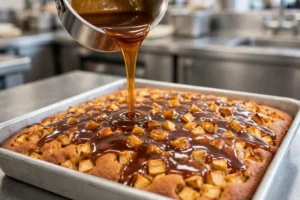
I’ve glazed our Amish apple cake too hot, too cold, and exactly right, and the difference is not small. The […]
Read Blog..!
I’ve pulled a sunken Amish Apple Cake out of my oven, and I know the exact sinking feeling that comes […]
Read Blog..!
A cup measures volume, not weight, so a cup of flour and a cup of sugar weigh completely different amounts. […]
Read Blog..!
Every pasta shape was designed to carry a certain kind of sauce. Thin strands suit light sauces that coat, wide […]
Read Blog..!
Every egg method, from a jammy boiled egg to a silky French omelet, comes down to one fact: the white […]
Read Blog..!Coconut and carrot cake is an American enriched layer cake in which the plain carrot cake formula is elevated through three simultaneous additions toasted shredded coconut whose pre-baking lauric acid surface redistribution at 325°F eliminates the hydrophobic barrier that raw coconut’s intact waxy coating maintains against the batter’s aqueous phase, crushed pineapple drained for a full 10 minutes to minimise the bromelain protease enzyme concentration that would progressively cleave the gluten network’s glutenin and gliadin chains during mixing, and the dual-sugar dark-brown-plus-granulated formula that delivers both caramelised molasses depth and structural sucrose in every bite producing a cake whose combined moisture retention mechanisms from the oil’s zero-water-evaporation fat, the pineapple’s retained juice, and the toasted coconut’s now-hydrophilic integrated surface together extend the room-temperature storage window to 5 to 6 days while the lemon-amplified cream cheese frosting’s lactic-citric acid combination provides the sharp dairy counterpoint that the dense, sweet, tropical-warm crumb requires to read as a complete, balanced eating experience rather than an overwhelmingly rich one.