
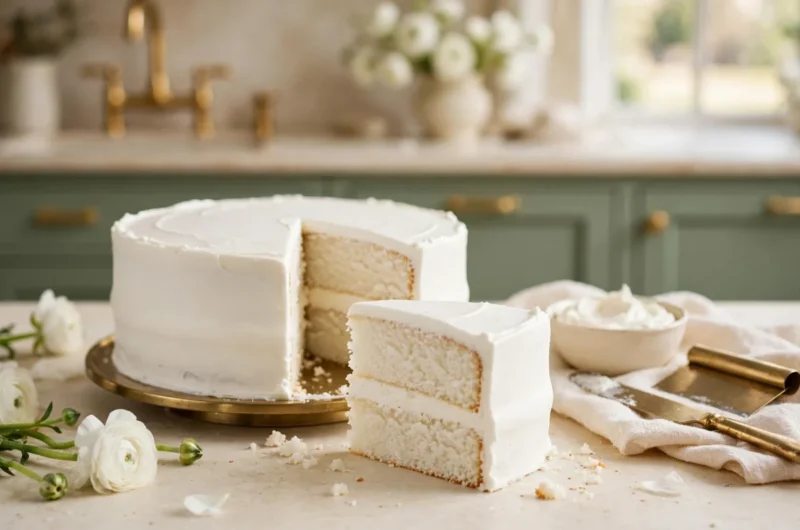
American (Pennsylvania Dutch) · Fruit Cakes Amish Apple Cake Recipe A moist, oil-based spiced sheet cake made with pre-cooked diced […]
Check Out..!
American Cakes
White Velvet Cake Recipe
This white velvet cake recipe uses reverse creaming. Butter coats the flour first, which limits gluten and gives a soft, tight crumb. Here is the method.
- Prep: 25 min
- Cook: 30 min
- Total: 2 hours 15 min
- Servings: 12
- Difficulty: Medium
- Cuisine: American
- Dietary: Vegetarian
 Chef's review · Saba Aftab, Pastry Chef · Reviewed Nov 10, 2026
“Use only egg whites and cake flour together. Cake flour's low protein paired with zero yolk carotenoids produces the paper-white crumb that defines white velvet's identity over any vanilla cake any whole egg or all-purpose flour substitution produces a cream-colored crumb that misses the point of the preparation entirely.”
Our investigation: 22 recipes substitute whole eggs or all-purpose flour in the interest of simplicity, producing a cream-colored crumb with a visible yellow tint that fundamentally misses the white velvet cake’s defining visual and textural identity the paper-white, ultra-tender crumb that distinguishes it categorically from a vanilla or yellow layer cake at the same flavor intensity.
White velvet cake is an American celebration layer cake in which the simultaneous use of egg whites only eliminating the carotenoid pigments in egg yolks that produce the yellow tint of standard American layer cakes and cake flour’s low protein content produces a crumb that is simultaneously paper-white in color, ultra-fine in texture, and extraordinarily tender from the dual mechanism of absent yolk fat restricting crumb density and cake flour’s low gluten development limiting protein network tightness.
The egg white-only formula is the single most critical ingredient decision. Egg yolks contain lutein and zeaxanthin carotenoid pigments at approximately 0.25mg per large yolk that produce the yellow-gold tint of standard butter cake crumbs when the yolks are incorporated into the batter. Even one egg yolk in a standard two-layer cake batter produces sufficient carotenoid pigment to shift the crumb color from pure white to the pale cream or ivory that visually communicates vanilla cake rather than the specific white velvet identity. Egg whites contribute no carotenoid pigment their ovalbumin, ovomucoid, and conalbumin protein fractions are colorless and transparent, producing a crumb with no yellow-tinting pigment and a visual whiteness that is the preparation’s most immediate defining characteristic.
White velvet cake is a product of the American South’s early 20th century cake-baking tradition the period between approximately 1900 and 1940 when the Southern American white cake achieved cultural prominence as the most prestigious celebration cake at weddings, anniversary celebrations, and formal social occasions in Southern households. The white cake’s prestige derived specifically from its whiteness a quality that in the early 20th century American food culture communicated purity, refinement, and the luxury of using only egg whites rather than whole eggs, since the separated whites left surplus yolks that were an economic waste in a resource-conscious domestic economy. The velvet modifier distinguishing white velvet from a plain white cake refers to the specific crumb texture produced by the combination of cake flour and egg whites, whose simultaneous limitation of both gluten development and fat-enriched protein coagulation produces a crumb with a smooth, fine-grained surface at the cut edge that resembles velvet fabric’s pile texture more closely than the slightly coarser cut surface of a standard whole-egg layer cake. The velvet designation appears in American cake recipe books from the early to mid-20th century alongside red velvet and chocolate velvet as the three members of the American velvet cake family a category defined by the extremely fine, smooth crumb texture that distinguishes all three from standard layer cakes at the same ingredient ratios.
What Is White Velvet Cake?
White velvet cake is a precision-formulated American layer cake whose three defining qualities paper-white crumb, ultra-fine grain, and extraordinary tenderness are each produced by a specific ingredient choice rather than by technique alone. The paper-white color comes from the egg white-only formula’s elimination of carotenoid pigments. The ultra-fine grain comes from cake flour’s lower protein content limiting gluten network development. The extraordinary tenderness comes from the combined effect of cake flour’s limited gluten and the egg white’s protein network being less fat-enriched than a whole-egg cake a crumb where neither the gluten nor the egg protein network is reinforced by fat to the degree that a whole-egg, all-purpose flour cake provides, producing a more delicate, more fragile, more immediately yielding bite.
White velvet cake differs from angel food cake which also uses only egg whites in that white velvet uses butter and chemical leavening rather than the angel food’s fat-free, beaten-meringue-only structure. The butter in white velvet cake provides the richness and moisture retention that angel food lacks, producing a crumb that is dense and satisfying rather than dry and spongy a butter cake that happens to be white rather than a meringue-based cake that happens to use butter. It differs from a standard white layer cake in the specific combination of cake flour and egg whites that produces the velvet crumb texture many white layer cake recipes use all-purpose flour with egg whites, producing a white crumb without the velvet’s specific fine-grained tenderness that cake flour’s lower protein provides.
What Equipment Do You Need?
| Equipment | Specification | Why It Matters |
|---|---|---|
| Two 8-inch round cake pans | Standard light-colored aluminum, minimum 2 inches deep | The 8-inch format is standard for white velvet cake; the 9-inch format produces layers that are too thin relative to the frosting depth for the visual proportion that communicates white velvet cake's celebration identity. |
| Stand mixer with both whisk and paddle attachments | Full-size 5-quart | The white velvet cake batter uses the reverse creaming method with the paddle for the batter and optionally the whisk for beating the egg whites separately if using the separated-whites meringue technique; the technique variant that produces the most uniformly white, most finely grained crumb by folding whipped egg whites into the butter-flour base rather than adding unbeaten whites. |
| Egg separator | Standard | For separating the egg whites from the yolks cleanly; even a trace of yolk in the egg whites introduces carotenoid pigment and fat that both undermine the paper-white color target and reduce the egg white protein's foaming capacity. A single-crack separation over a separate bowl before adding to the batter bowl prevents a yolk-contaminated batch of whites from requiring complete restart. |
| Fine mesh strainer | Standard | For sifting the cake flour; cake flour's low protein content makes it more prone to compaction during storage than all-purpose flour, and un-sifted compacted cake flour measures 15 to 25 percent heavier by volume than correctly sifted cake flour. At the white velvet's already-limited gluten development, over-measuring the cake flour by 25 percent significantly over-tightens the crumb's texture from the correct ultra-tender velvet toward a standard layer cake texture. |
| Offset spatula large and small | 8-inch for exterior, 4-inch for filling | The white velvet cake's most common frosting, ermine frosting or white American buttercream, requires the large spatula for even exterior coverage and the small for precision at the filling layer between the two delicate white crumb layers. |
What Ingredients Do You Need?
Use clear vanilla extract rather than standard vanilla extract for the purest white batter. Standard vanilla extract’s amber color from its dissolved vanillin and other compounds in the ethanol carrier tints the batter slightly amber at the standard 2-teaspoon quantity, producing a very pale cream rather than pure white crumb. Clear vanilla extract sold as imitation vanilla in most American grocery stores contains synthetic vanillin in a colorless carrier and produces no color contribution to the batter. The flavor difference between clear and standard vanilla at 2 teaspoons per standard two-layer recipe is perceptible but minor the clear vanilla’s slightly more synthetic vanilla character is the trade-off for the paper-white crumb’s visual perfection.
Use full-fat buttermilk rather than whole milk buttermilk’s lactic acid activates the baking soda’s leavening and produces a more tender crumb through the same acid-gluten interaction that makes buttermilk-based layer cakes systematically more tender than milk-based cakes at the same ingredient ratio. In a white velvet cake where the crumb’s tenderness is a primary quality marker, the buttermilk’s tendering effect compounds with the cake flour’s low-gluten contribution to produce a crumb more tender than either ingredient achieves independently.
For the White Velvet Cake Layers
| Ingredient | Volume | Weight |
|---|---|---|
| Cake flour, sifted | 2 1/2 cups | 283g |
| Granulated white sugar | 1 3/4 cups | 350g |
| Baking powder | 2 1/2 teaspoons | 10g |
| Baking soda | 1/4 teaspoon | 1.5g |
| Fine sea salt | 1 teaspoon | 6g |
| Unsalted butter, room temperature | 3/4 cup | 170g |
| Vegetable oil | 1/4 cup | 60ml |
| Large egg whites only, room temperature | 5 egg whites | 175g |
| Clear vanilla extract | 2 teaspoons | 10ml |
| Almond extract | 1/4 teaspoon | 1.25ml |
| Full-fat buttermilk, room temperature | 1 cup | 240ml |
The combination of butter and vegetable oil mirrors the established butter-plus-oil formula throughout this collection butter for flavor through diacetyl and short-chain fatty acids, oil for moisture retention through its 100 percent fat content with no water evaporation during baking. In the white velvet context the oil has an additional benefit the oil’s lack of carotenoid pigment and colorless fat phase contributes no additional yellow tinting beyond the minimal contribution of the butter’s carotenoid-containing milk fat. The almond extract at 1/4 teaspoon contributes benzaldehyde’s subtle marzipan-adjacent note the specific aromatic that distinguishes white velvet cake from a plain vanilla white cake and that is a near-universal feature of wedding cake formulas in the American Southern tradition where white velvet cake is most culturally embedded. Our lamb cake uses the same vanilla and almond pairing.
The five egg whites rather than three whole eggs in a standard two-layer recipe provides the additional protein mass needed to compensate for the absent yolk fat’s structural contribution. Egg yolk fat in a whole-egg formula provides both binding through the lecithin’s emulsification and structural density through the fat’s plasticisation of the protein-starch matrix. In the egg white-only formula, the absent yolk fat is partially compensated by the additional butter-plus-oil combination and by the two additional egg whites’ protein contribution producing a crumb that holds together cleanly when cut despite the absent yolk fat’s structural contribution.
For the Ermine Frosting
| Ingredient | Volume | Weight |
|---|---|---|
| Whole milk | 1 cup | 240ml |
| All-purpose flour | 1/4 cup | 30g |
| Granulated white sugar | 1 cup | 200g |
| Fine sea salt | 1/4 teaspoon | 1.5g |
| Unsalted butter, room temperature | 1 cup | 226g |
| Clear vanilla extract | 1 teaspoon | 5ml |
Ermine frosting also called flour buttercream or boiled milk frosting is the historically correct frosting for white velvet cake and red velvet cake in the American Southern tradition. It is lighter, less sweet, and less rich than American buttercream, with a clean dairy flavor that allows the white velvet cake’s subtle vanilla-almond character to register without competition from the powdered sugar-forward sweetness of standard American buttercream. The ermine frosting is also the whitest frosting format available for a white cake the cooked flour-milk base produces a brilliant white frosting when beaten with room-temperature butter, without the slight ivory tint that powdered sugar-based buttercreams develop from the powdered sugar’s cornstarch content.
White Velvet Cake Recipe
A precision-formulated American layer cake with a paper-white, ultra-fine, extraordinarily tender crumb, made with egg whites only, cake flour, and the reverse creaming method.
Prep time
25
minutesCooking time
30
minutesRest
1
hrTotal
2:15
hrYield
12
servingsEasy-Medium
Ingredients
- For the White Velvet Cake Layers
Cake flour, sifted 2 1/2 cups (283g)
Granulated white sugar 1 3/4 cups (350g)
Baking powder 2 1/2 teaspoons (10g)
Baking soda 1/4 teaspoon (1.5g)
Fine sea salt 1 teaspoon (6g)
Unsalted butter, room temperature 3/4 cup (170g)
Vegetable oil 1/4 cup (60ml)
Large egg whites only, room temperature 5 egg whites (175g)
Clear vanilla extract 2 teaspoons (10ml)
Almond extract 1/4 teaspoon (1.25ml)
Full-fat buttermilk, room temperature 1 cup (240ml)
- For the Ermine Frosting
Whole milk 1 cup (240ml)
Granulated white sugar 1 cup (200g)
Fine sea salt 1/4 teaspoon (1.5g)
Unsalted butter, room temperature 1 cup (226g)
Clear vanilla extract 1 teaspoon (5ml)
Instructions
- Make the Ermine Frosting Base First
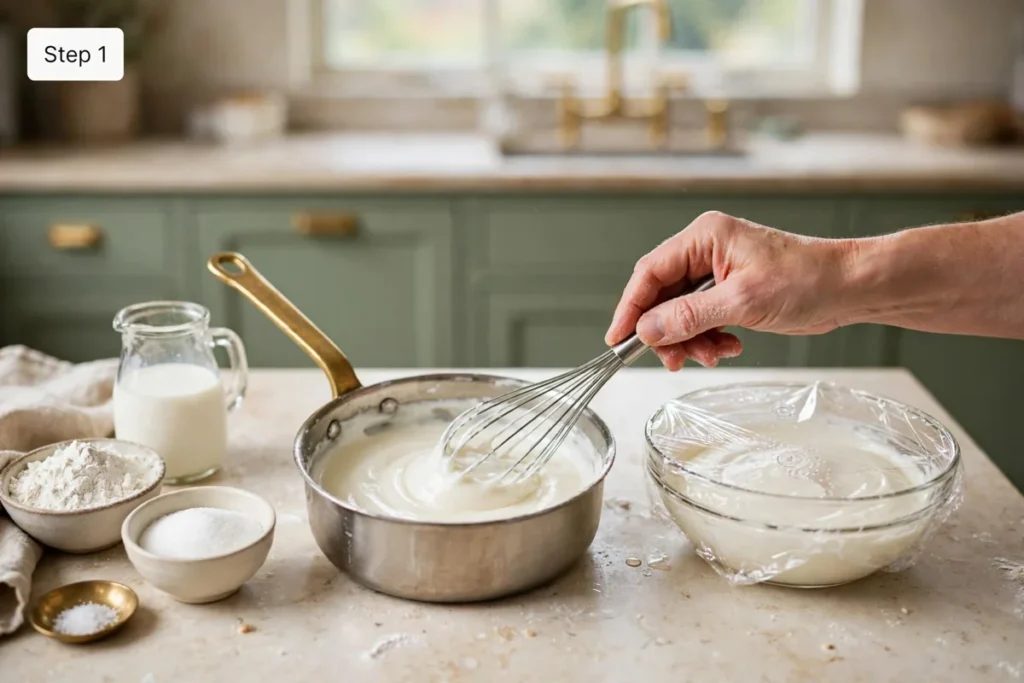
Whisk together the flour, sugar, and salt in the saucepan. Add the milk gradually while whisking to prevent lumps. Cook over medium heat, whisking constantly, until the mixture thickens to a very thick paste approximately 5 to 7 minutes and the first large bubbles break at the surface, confirming complete starch gelatinisation. Transfer to a shallow dish, press plastic wrap directly against the surface, and refrigerate until completely cold minimum 1 hour.
- Make the White Velvet Cake Batter
Preheat the oven to 350°F (177°C). Grease both 8-inch pans and line the bases with parchment circles. Sift the cake flour, baking powder, baking soda, and salt together twice.
Place the sifted dry ingredients in the stand mixer bowl fitted with the paddle attachment. Add the room-temperature butter and vegetable oil. Beat at medium-low speed for 2 minutes until the mixture resembles fine, slightly damp, white-to-pale-ivory crumbs.
In a separate bowl, whisk together the room-temperature egg whites, buttermilk, clear vanilla extract, and almond extract until completely smooth.
With the mixer at medium-low speed, add the egg white-buttermilk mixture to the fat-flour crumb in three additions adding approximately 1/3 of the liquid at a time, beating for 20 to 30 seconds after each addition until incorporated before adding the next. After the final addition, increase to medium speed and beat for 20 seconds until the batter is completely smooth.
- Bake the Layers
Divide the batter equally between the two prepared 8-inch pans weigh for exactly equal portions at approximately 480 to 490g per pan. Bake at 350°F for 26 to 32 minutes until the toothpick shows moist crumbs and the internal temperature reads 200 to 205°F.
Cool in the pans for 10 minutes. Release onto wire racks, peel parchment, and cool completely minimum 1 hour before frosting.
- Make and Apply the Ermine Frosting
Remove the cold frosting base from the refrigerator. Beat the room-temperature butter with the whisk attachment at high speed for 3 minutes until very pale and fluffy. Add the cold frosting base in large spoonfuls 3 to 4 spoonfuls total beating at medium-high speed for 30 seconds after each addition. After all the base is incorporated, beat at high speed for 2 full minutes until the frosting is brilliantly white, very fluffy, and holds a soft-to-medium peak. Add the clear vanilla extract and beat for 10 seconds.
- Assemble and Frost
Place the first cooled white velvet layer on a cake board on the turntable. Apply approximately 3/4 cup of ermine frosting to the top of the first layer and spread evenly to the edge. Place the second layer on top, pressing gently. Apply a thin crumb coat of ermine frosting over the full exterior. Refrigerate for 20 minutes until the crumb coat is completely firm.
Apply the final generous coat of ermine frosting over the chilled crumb coat top and sides. Smooth with the large offset spatula while rotating the turntable.
Step by Step Process
Make the Ermine Frosting Base First
Step 1. Whisk together the flour, sugar, and salt in the saucepan.Add the milk gradually while whisking to prevent lumps. Cook over medium heat, whisking constantly, until the mixture thickens to a very thick paste approximately 5 to 7 minutes and the first large bubbles break at the surface, confirming complete starch gelatinisation. Transfer to a shallow dish, press plastic wrap directly against the surface, and refrigerate until completely cold minimum 1 hour. The frosting base must be at refrigerator temperature below 40°F before being beaten with the room-temperature butter. If even slightly warm, the butter melts into the base rather than being beaten into a stable emulsion, producing a greasy, loose frosting rather than the light, fluffy ermine that the white velvet cake requires.
Make the White Velvet Cake Batter
Step 2. Preheat the oven to 350°F (177°C). Grease both 8-inch pans and line the bases with parchment circles. Sift the cake flour, baking powder, baking soda, and salt together twice. The double-sifting is mandatory for cake flour specifically, because cake flour’s fine particle size and low protein content make it more prone to airless compaction than all-purpose flour, and a single sift may not fully de-compact the flour to the light, airy consistency needed for the correct batter viscosity and crumb texture. Weighing the flour avoids the problem entirely, and our cups to grams chart has the numbers.

Reverse Creaming Method
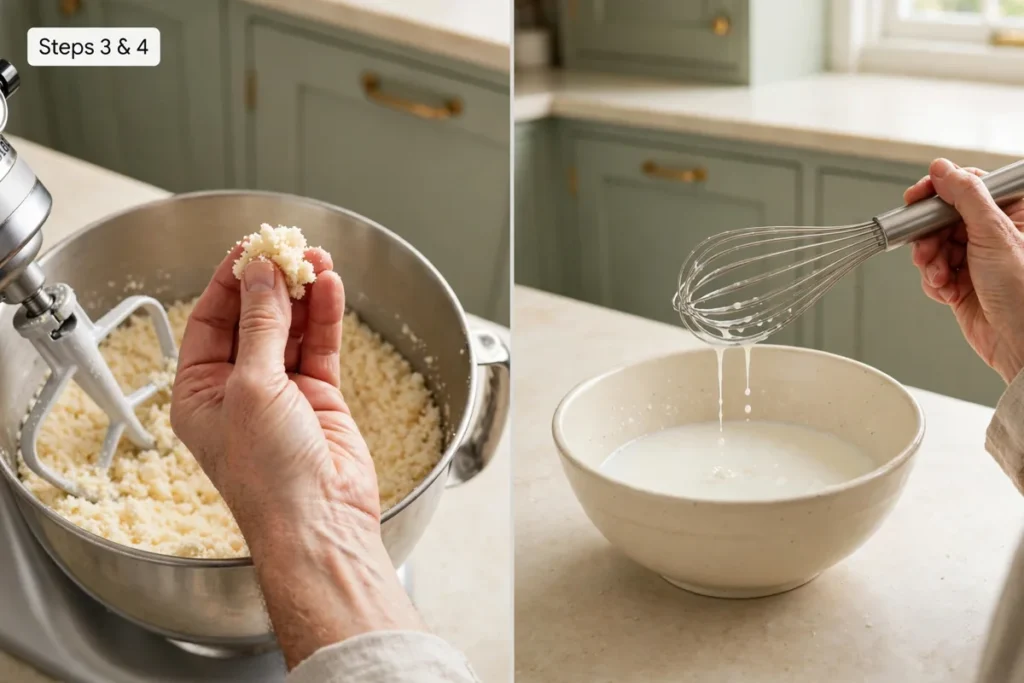
Step 3. Place the sifted dry ingredients in the stand mixer bowl fitted with the paddle attachment.Add the room-temperature butter and vegetable oil. Beat at medium-low speed for 2 minutes until the mixture resembles fine, slightly damp, white-to-pale-ivory crumbs the fat-into-dry reverse creaming method that coats the cake flour’s protein particles with fat before any liquid contact, preventing gluten development at the moment of liquid addition. The reverse creaming method is the optimal mixing technique for white velvet cake because it maximises the cake flour’s tenderness contribution the fat coating prevents the low-protein gluten from developing even the moderate network that direct liquid-and-flour mixing would produce.
Step 4. In a separate bowl, whisk together the room-temperature egg whites, buttermilk, clear vanilla extract, and almond extractuntil completely smooth. The egg whites must be at room temperature cold egg whites are more viscous and do not incorporate into the fat-flour crumb mixture as smoothly as room-temperature whites, producing a batter with uneven white protein distribution that bakes into slightly denser, slightly less white zones where the cold white clumped rather than distributing evenly.
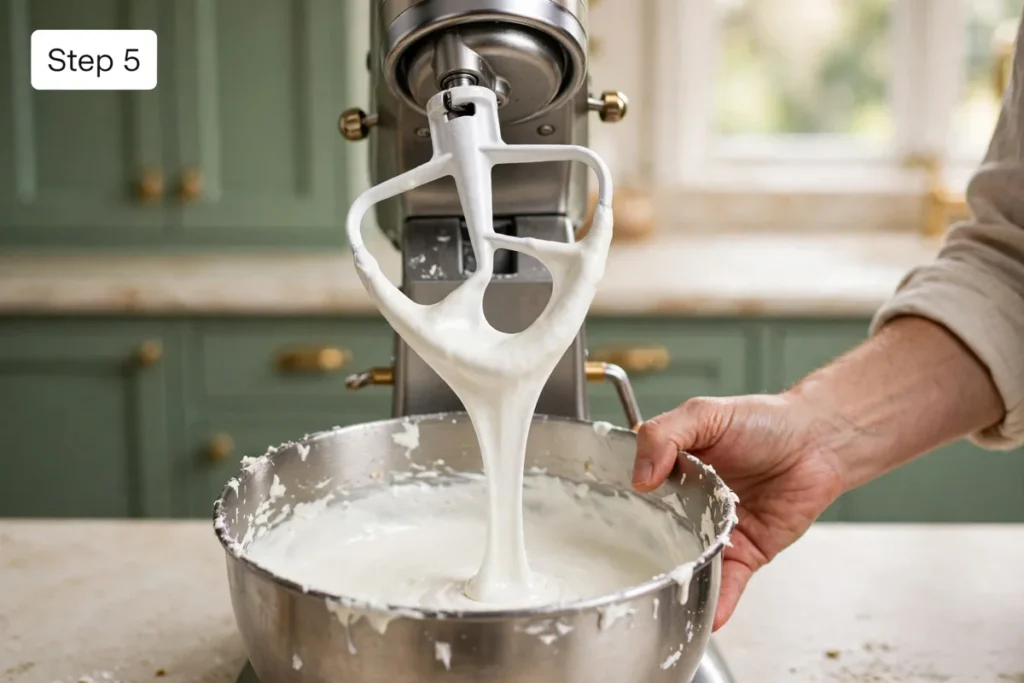
Step 5. With the mixer at medium-low speed, add the egg white-buttermilk mixture to the fat-flour crumb in three additions adding approximately 1/3 of the liquid at a time, beating for 20 to 30 seconds after each addition until incorporated before adding the next. After the final addition, increase to medium speed and beat for 20 seconds until the batter is completely smooth.
Bake the Layers
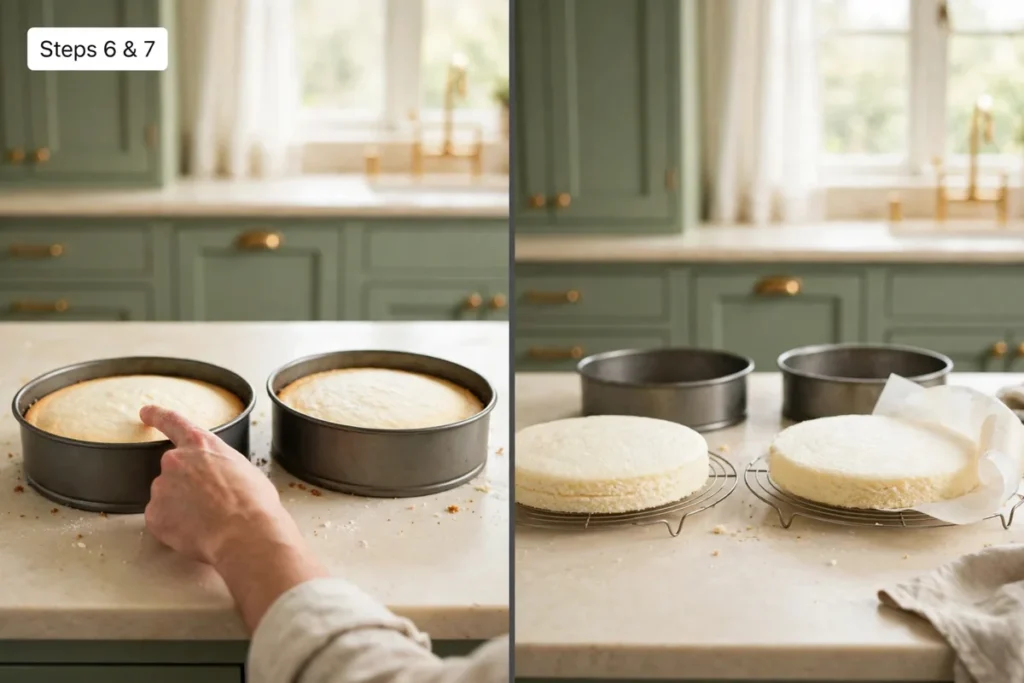
Step 6. Divide the batter equally between the two prepared 8-inch pans weigh for exactly equal portions at approximately 480 to 490g per pan. Bake at 350°F for 26 to 32 minutes until the toothpick shows moist crumbs and the internal temperature reads 200 to 205°F. The white velvet cake’s egg white-only structure makes it more sensitive to overbaking than a whole-egg cake the egg white protein network without fat enrichment from yolks becomes dry and slightly rubbery at temperatures above 210°F, producing a crumb that is less tender than the correctly baked version despite otherwise identical technique.
Step 7. Cool in the pans for 10 minutes.Release onto wire racks, peel parchment, and cool completely minimum 1 hour before frosting. The egg white-only crumb is significantly more fragile than a whole-egg cake crumb at warm temperatures from the absent yolk fat’s structural contribution handle the warm layers with extra care during release and transfer to prevent cracking at the edges.
Make and Apply the Ermine Frosting
Step 8. Remove the cold frosting base from the refrigerator.Beat the room-temperature butter with the whisk attachment at high speed for 3 minutes until very pale and fluffy. Add the cold frosting base in large spoonfuls 3 to 4 spoonfuls total beating at medium-high speed for 30 seconds after each addition. After all the base is incorporated, beat at high speed for 2 full minutes until the frosting is brilliantly white, very fluffy, and holds a soft-to-medium peak. Add the clear vanilla extract and beat for 10 seconds.
Ermine frosting’s beating behavior differs from American buttercream in one critical way the correct consistency develops only when the frosting base is cold and the butter is room temperature. If the base is even slightly warm the butter melts into it rather than being aerated by the beating action, and if the butter is cold the base’s moisture cannot distribute through the butter’s fat phase. The 10 to 12-minute temperature differential cold base and room-temperature butter is the technique’s most demanding variable.

Assemble and Frost

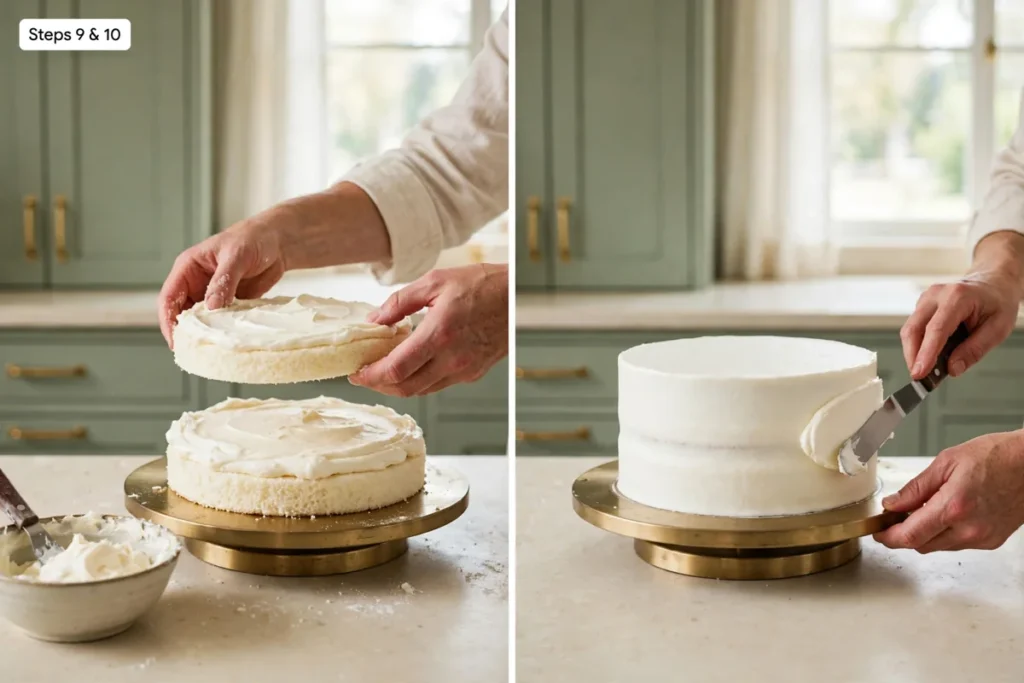
Step 9. Place the first cooled white velvet layer on a cake board on the turntable.Apply approximately 3/4 cup of ermine frosting to the top of the first layer and spread evenly to the edge. Place the second layer on top, pressing gently. Apply a thin crumb coat of ermine frosting over the full exterior. Refrigerate for 20 minutes until the crumb coat is completely firm the ermine frosting’s butter-fat base firms quickly under refrigeration and produces a solid crumb coat within 20 minutes.
Step 10. Apply the final generous coat of ermine frosting over the chilled crumb coat top and sides. Smooth with the large offset spatula while rotating the turntable. The ermine frosting’s silky consistency and soft-peak hold produce a distinctly different frosting exterior than American buttercream smoother, less textured, and more luminously white from the milk base’s colorless contribution. The white velvet cake with ermine frosting is the most purely white celebration cake in the American baking collection both the crumb and the frosting achieve the maximum whiteness possible from their respective formulations.
Why Egg Whites Only and Cake Flour Together Produce White Velvet's Defining Characteristics
The white velvet cake’s three defining qualities paper-white color, ultra-fine grain, and extraordinary tenderness are each produced by the specific combination of egg whites only and cake flour, and each quality’s mechanism requires understanding what these two ingredients remove from the batter relative to a standard whole-egg, all-purpose flour cake rather than what they add.
Paper-white color is produced by the removal of egg yolk carotenoids. Egg yolks contain lutein and zeaxanthin at approximately 0.25mg per yolk carotenoid pigments that absorb blue light and transmit yellow-orange wavelengths, producing the yellow-gold tint of standard butter cake crumbs. In a standard two-layer cake recipe with 3 whole eggs, the three yolks contribute approximately 0.75mg of carotenoid pigments to the batter sufficient to produce a clearly visible yellow-gold crumb color that registers visually as yellow cake rather than white cake. Egg whites contain no carotenoid pigments their protein fractions are colorless and produce no yellow tinting. A cake made entirely with egg whites contains zero yolk carotenoids and produces a crumb whose color is determined only by the Maillard browning at the surface and the white starch and protein matrix of the interior a bright, pure white interior crumb that is the white velvet’s visual identity.
Ultra-fine grain is produced by the removal of all-purpose flour’s higher protein content. All-purpose flour at 10 to 12 percent protein by weight develops a moderate gluten network during mixing that produces the slightly open, slightly coarser crumb of a standard American layer cake. Cake flour at 6 to 8 percent protein develops a significantly less extensive gluten network at the same mixing intensity the fewer glutenin and gliadin molecules available for crosslinking produce a protein network with fewer crosslinks per unit volume, and the larger inter-strand spaces in this less extensive network are filled with starch granules that produce a finer, more uniform crumb structure at the microscopic scale. The finer starch granule packing in the less-extensive gluten network produces the smooth, uniform cut surface that the velvet designation references each cut edge shows a surface as close-grained and smooth as velvet fabric rather than the slightly irregular, slightly open cut surface of an all-purpose flour crumb at the same baking conditions.
Extraordinary tenderness is produced by the combined removal of both yolk fat and all-purpose flour protein a double-removal that reduces both of the primary sources of structural density in a standard layer cake crumb simultaneously. Yolk fat’s lecithin emulsification and triglyceride plasticisation of the protein-starch matrix contribute structural density and richness to a whole-egg cake crumb the fat fills the inter-strand spaces and produces a crumb that is satisfyingly dense and yielding. Cake flour’s lower protein produces fewer and shorter gluten crosslinks that fracture at lower applied force than all-purpose flour’s more extensive network. With both the yolk fat’s structural contribution and the all-purpose flour’s gluten crosslink density simultaneously reduced, the white velvet crumb’s fracture threshold the force needed to compress a bite of the crumb between the tongue and palate is significantly lower than a standard whole-egg, all-purpose flour cake. This low fracture threshold is the tactile experience of tenderness the crumb yields immediately under very light pressure with no resistance before fracturing, producing the immediate melt-in-mouth quality that distinguishes white velvet from every other American layer cake format at equivalent butter and sugar quantities.
How Does White Velvet Cake Compare to Related White and Vanilla American Cakes?
| Attribute | White Velvet Cake | Standard White Layer Cake | Yellow Layer Cake | Angel Food Cake | Chiffon Cake |
|---|---|---|---|---|---|
| Egg component | Egg whites only 5 whites | Egg whites only 3 to 4 whites | Whole eggs 3 to 4 | Egg whites only 10 to 12 | Whole eggs separated 5 to 6 |
| Flour type | Cake flour 6 to 8% protein | All-purpose flour or cake flour | All-purpose flour | Cake flour | Cake flour |
| Fat source | Butter plus oil | Butter | Butter | No fat | Vegetable oil |
| Leavening | Baking powder plus baking soda | Baking powder | Baking powder | Beaten meringue only | Baking powder plus beaten meringue |
| Crumb color | Paper-white no carotenoids | White to very pale ivory | Yellow-gold from yolk carotenoids | Pure white no fat or yolk | Pale ivory whole yolks present |
| Crumb texture | Ultra-fine, ultra-tender velvet designation | Fine to medium-fine depending on flour | Medium-fine | Very open, dry, spongy | Light, slightly open, moist |
| Primary structural network | Egg white albumin plus minimal cake flour gluten | Egg white albumin plus moderate gluten | Whole egg plus moderate gluten | Meringue foam only | Whole egg plus meringue plus oil |
| Canonical frosting | Ermine frosting or white American buttercream | White American buttercream | Chocolate or vanilla American buttercream | No frosting powdered sugar or light glaze | Whipped cream or light glaze |
| Most common occasion | American weddings, bridal showers, formal celebrations | American birthday, everyday celebration | American birthday, everyday | American summer, light dessert | American birthday, spring celebration |
| Difficulty | Medium | Easy | Easy | Medium | Medium |
What Variations Can You Make?
White Velvet Cake With Lemon Curd Filling
Replace the ermine frosting filling between the layers with lemon curd spread 1/2 cup of high-quality lemon curd directly on the first layer rather than the ermine frosting filling. Apply a 1/4-inch border of ermine frosting around the edge of the first layer before spreading the lemon curd in the centre the frosting border prevents the curd from seeping out at the layer edge when the second layer is placed. The lemon curd’s bright citric acid and lemon limonene character contrast the white velvet cake’s neutral, sweet, subtly vanilla-almond crumb through the same acid-sweet complementarity documented throughout this collection. The visual revelation of the lemon curd’s vivid yellow filling at the cut cross-section against the paper-white crumb layers and white ermine exterior produces the most dramatically contrasting interior of any white velvet cake variation.
Result: A white velvet cake with a vivid yellow lemon curd filling visible at the cut cross-section, contrasting the paper-white crumb and white ermine exterior.
White Velvet Cake With Strawberry Swiss Meringue Buttercream
Replace the ermine frosting with strawberry Swiss meringue buttercream make a standard Swiss meringue base (5 egg whites and 1 1/4 cups sugar cooked to 160°F over a water bath and whipped to stiff peaks) and beat in 1 cup (226g) of room-temperature butter in pieces. Add 1/3 cup (80g) of freeze-dried strawberry powder ground from freeze-dried strawberries after the butter is fully incorporated. The freeze-dried strawberry powder’s concentrated anthocyanin pigments produce a vivid pink buttercream without the liquid addition that fresh strawberry purée’s high water content would contribute to the meringue-based buttercream. The pink exterior against the paper-white crumb layers visible at the cut edge produces the color contrast that makes this variation the most photographically arresting white velvet cake format.
Coconut White Velvet Cake
Add 1 cup (80g) of sweetened shredded coconut toasted at 325°F for 8 minutes using the technique documented in the coconut carrot cake folded into the batter as the last step before dividing between pans. Add 1/4 teaspoon of coconut extract to the batter alongside the clear vanilla extract. Press sweetened shredded coconut raw for texture contrast, toasted for flavor intensity into the ermine frosting exterior immediately after the final coat is applied. The coconut white velvet cake is the Southern American wedding cake’s most traditionally appropriate variation the combination of white cake, white frosting, and white coconut exterior produces the all-white celebration aesthetic of the formal American Southern wedding cake tradition that predates the contemporary multi-tier fondant cake format.
Dietary Adjustments and Substitutions
Gluten-Free Version
Replace the cake flour with a certified gluten-free cake flour blend Bob’s Red Mill 1-to-1 Gluten Free Baking Flour at exactly 283g, sifted twice. The gluten-free version requires an additional egg white 6 egg whites rather than 5 to compensate for the absent gluten’s binding contribution. The white velvet cake’s existing minimal gluten development from the cake flour and reverse creaming method makes it among the most successfully gluten-free-adaptable cake formats in this collection the xanthan gum’s binding function supplements what was already a minimally gluten-dependent crumb structure.
Dairy-Free Version
Replace the butter with Miyoko’s Creamery dairy-free butter sticks at the same weight (170g). Replace the vegetable oil with the same neutral oil (no change required). Replace the buttermilk with a buttermilk substitute combine 1 cup of unsweetened oat milk with 1 tablespoon of fresh lemon juice and allow to curdle for 5 minutes. For the ermine frosting, replace the whole milk with full-fat oat milk at the same volume and the butter with Miyoko’s dairy-free butter sticks at the same weight. Miyoko’s beats to maximum paleness using the identical 3-minute technique as dairy butter and produces an ermine frosting that is essentially indistinguishable from the dairy version in whiteness and texture.
What Are the Most Common Problems When Making White Velvet Cake?
| Problem | Most Likely Cause | Prevention or Fix |
|---|---|---|
| Cream or ivory crumb rather than paper-white | Yolk contamination during separation, all-purpose flour used rather than cake flour, or standard vanilla extract used rather than clear | Separate each egg white individually over a small bowl before adding to the main bowl so one yolk-contaminated white discards one egg rather than the full batch. Always use cake flour and clear vanilla extract. If the crumb is already cream-colored, the eating quality is unaffected and only the visual identity is compromised. |
| Dry, slightly rubbery crumb despite correct baking time | Overbaked above 210°F internal temperature because egg white protein network without yolk fat over-coagulated | Remove at 200 to 205°F internal temperature strictly. The white velvet cake's egg white crumb is more sensitive to overbaking than a whole-egg crumb because the absent yolk fat does not plasticise the over-coagulated protein network. |
| Ermine frosting separated or greasy | Frosting base was not cold enough when added to the beaten butter so warm base melted into the butter rather than being emulsified | The frosting base must be at refrigerator temperature below 40°F. If already separated then refrigerate the full frosting bowl for 10 minutes and beat again at high speed for 2 minutes because ermine frosting almost always re-emulsifies with extended beating after chilling. |
| Layers cracked during pan release | Removed from pans before the egg white crumb had cooled and firmed sufficiently | Cool in pans for the full 10 minutes. The egg white-only crumb without yolk fat enrichment is more fragile at warm temperatures than a whole-egg crumb so handle the warm layers very carefully with a wide supporting spatula during the release and wire rack transfer. |
| Batter appears cream rather than white before baking | Standard vanilla extract used rather than clear because amber color from the extract tinted the batter | Switch to clear vanilla extract for a white batter. If already mixed with standard extract then the batter will produce an ivory crumb rather than paper-white and the flavor is unaffected. |
How Do You Store White Velvet Cake?
White velvet cake with ermine frosting is perishable and requires refrigeration within 2 hours of assembly at room temperature above 70°F. The egg white-only crumb dries slightly faster than a yolk-enriched crumb at equivalent storage duration, and the ermine frosting’s milk and butter content limit safe room-temperature holding to 2 days maximum below 68°F.
| Storage Method | Duration | Instructions |
|---|---|---|
| Refrigerated, assembled and frosted with ermine frosting, covered loosely | Up to 4 days | Ermine frosting contains no powdered sugar preservatives and the cooked milk-flour base is perishable so refrigeration is required within 2 hours of assembly at room temperature above 70°F. The ermine frosting firms significantly under refrigeration and should be brought to room temperature for 25 to 30 minutes before serving to restore the silky soft-peak texture and full aromatic expression. |
| Room temperature, under a cake dome below 68°F only | Up to 2 days | The ermine frosting's milk and butter content limits safe room-temperature holding to 2 days maximum below 68°F. Above 68°F refrigerate without exception. The white velvet crumb's moisture retention at room temperature is slightly shorter than a whole-egg oil-based cake from the lower fat content because the egg white crumb dries slightly faster than a yolk-enriched crumb at equivalent storage duration. |
| Frozen, unfrosted layers individually wrapped in plastic wrap | Up to 3 months | Wrap each completely cooled layer in plastic wrap then foil. Thaw at room temperature for 45 minutes before frosting with freshly made ermine frosting because ermine frosting does not freeze well and should never be applied before freezing. The white velvet crumb freezes without significant color or texture change and the paper-white color persists through the freeze-thaw cycle because the carotenoid-free crumb has no pigment to degrade during freezing. |
Make Ahead
The ermine frosting base must be made and chilled for a minimum of 1 hour before beating with the butter, so it can be prepared up to 2 days in advance and refrigerated. Unfrosted white velvet layers can be baked, cooled completely, wrapped in plastic wrap and foil, and frozen for up to 3 months thaw at room temperature for 45 minutes before frosting. The assembled frosted cake can be refrigerated for up to 4 days.
Scaling
| Servings | Cake Flour | Sugar | Egg Whites | Butter | Buttermilk | Pan Size |
|---|---|---|---|---|---|---|
| 8 servings | 188g | 233g | 3 whites | 113g | 160ml | Two 7-inch pans |
| 12 servings (standard) | 283g | 350g | 5 whites | 170g | 240ml | Two 8-inch pans |
| 16 servings | 377g | 467g | 7 whites | 226g | 320ml | Two 9-inch pans |
Serving
White velvet cake is the canonical American wedding and formal celebration cake. Serve it in clean slices at room temperature, with the ermine frosting restored to its silky soft-peak texture after 25 to 30 minutes out of the refrigerator.
| Serving Suggestion | Why It Works |
|---|---|
| At room temperature, sliced with a hot knife | The ermine frosting softens to its silky soft-peak texture, and the egg white-only crumb's low fracture threshold delivers the immediate melt-in-mouth tenderness that defines the velvet designation. A hot knife cuts cleanly through the delicate white crumb without compressing it. |
| With fresh berries or a berry coulis | The cake's neutral, subtly vanilla-almond crumb provides a clean canvas for the fruit's bright acidity, the same acid-sweet complementarity used in the lemon curd variation. |
| As the centerpiece of a formal celebration or wedding table | The total whiteness of the crumb and ermine frosting is the white velvet's defining visual characteristic and the quality that makes it the canonical American wedding cake format. |
Nutritional Information
Per serving: 1 slice approximately 120g including ermine frosting, based on 12 slices. Values calculated using USDA FoodData Central reference data.
| Nutrient | Per Serving | Nutrient | Per Serving |
|---|---|---|---|
| Calories | 488 kcal | Total carbohydrate | 64g |
| Total fat | 24g | Dietary fibre | 0.4g |
| Saturated fat | 15g | Total sugars | 48g |
| Cholesterol | 62mg | Protein | 5.8g |
| Sodium | 348mg | Calcium | 78mg (6% DV) |
Frequently Asked Questions
Why do egg whites only produce a paper-white crumb where whole eggs produce a yellow-tinted crumb?
Egg yolks contain lutein and zeaxanthin carotenoid pigments at approximately 0.25mg per yolk pigments that absorb blue light and transmit yellow-orange wavelengths, producing the visible yellow-gold tint of standard butter cake crumbs. Three whole eggs contribute approximately 0.75mg of carotenoids sufficient for clearly visible yellow coloration. Egg whites contain zero carotenoid pigments their ovalbumin, ovomucoid, and conalbumin protein fractions are completely colorless and transparent, producing a crumb whose interior color is determined only by the white starch and colorless protein matrix rather than by pigment contribution.
Why is cake flour mandatory rather than all-purpose flour for the velvet crumb texture?
Cake flour’s 6 to 8 percent protein content develops a significantly less extensive gluten network than all-purpose flour’s 10 to 12 percent protein at the same mixing intensity. The fewer glutenin-gliadin crosslinks per unit volume produce a protein network with larger inter-strand spaces that are filled by starch granules in a finer, more uniform distribution producing the smooth, close-grained cut surface that the velvet designation references. The less extensive gluten network also fractures at lower applied force, contributing to the crumb’s extraordinary tenderness alongside the absent yolk fat’s structural contribution.
Why is ermine frosting more appropriate for white velvet cake than standard American buttercream?
Ermine frosting cooked milk-flour base beaten with room-temperature butter produces a brilliantly white frosting without the slight ivory tint that American buttercream’s powdered sugar develops from the cornstarch in powdered sugar’s formulation. Ermine frosting is also less sweet and more dairy-forward than American buttercream, allowing the white velvet cake’s subtle vanilla-almond crumb character to register without competition from the powdered sugar-forward sweetness of standard buttercream. Historically, ermine frosting predates American buttercream as the canonical frosting for white and red velvet cakes in the American Southern tradition its use on white velvet cake is both technically superior and culturally appropriate.
Can I use aquafaba to replace the egg whites for a vegan white velvet cake?
Yes with adjusted quantities. Aquafaba the liquid from canned chickpeas contains saponins, proteins, and starches that replicate egg white albumin’s foaming and coagulation behavior in baked goods. Replace each egg white (35g) with 3 tablespoons (45ml) of aquafaba from unsalted canned chickpeas for 5 egg whites use 15 tablespoons (225ml) of aquafaba. The aquafaba produces a similarly white batter from its own colorless composition. The finished vegan white velvet cake is slightly less structurally cohesive than the egg white version from the aquafaba’s lower protein concentration relative to egg white increase the baking powder to 3 teaspoons (12g) to compensate for the reduced structural protein. The crumb remains white and tender, qualifying as a genuinely successful vegan white velvet format.
White velvet cake is an American Southern celebration cake whose three defining qualities paper-white crumb, ultra-fine grain, and extraordinary tenderness are each produced by what the formula removes rather than what it adds, specifically the simultaneous elimination of egg yolk carotenoid pigments through the egg white-only formula that produces the pigment-free, colorless protein matrix responsible for the paper-white interior, and the elimination of all-purpose flour’s higher protein content through cake flour’s 6 to 8 percent protein that produces the less-extensive gluten network whose finer crosslink spacing and lower fracture threshold produce the smooth, close-grained cut surface and immediate-yield tenderness that the velvet designation precisely describes a cake whose visual identity as the most purely white celebration cake in the American baking tradition is simultaneously its most immediately distinctive characteristic and the most technically demanding quality to achieve, requiring the clean separation of five egg whites without a trace of yolk pigment contamination, the double-sifting of cake flour to eliminate compaction that would over-weight the low-protein flour’s dry ingredient contribution, and the reverse creaming method’s fat-into-dry sequencing that coats the cake flour’s minimal protein particles with fat before any liquid contact to prevent even the modest gluten development that direct mixing would produce in a flour already formulated for its near-total absence.
Table of Contents
Recent Recipes
American · Cakes Orange Pound Cake Recipe This orange pound cake recipe rubs the zest into the sugar before creaming. […]
Check Out..!
American · Layer Cakes Coconut and Carrot Cake Recipe Moist, oil-based spiced layer cake packed with freshly grated carrot and […]
Check Out..!
American Cakes Tandy Cake Recipe This Tandy cake recipe spreads peanut butter on the warm cake, then chills it before […]
Check Out..!
American · Cakes Portillo’s Chocolate Cake Recipe This Portillo’s chocolate cake recipe adds mayonnaise to the batter. Mayo is just […]
Check Out..!Recent Blogs
I’ve glazed our Amish apple cake too hot, too cold, and exactly right, and the difference is not small. The […]
Read Blog..!
I’ve pulled a sunken Amish Apple Cake out of my oven, and I know the exact sinking feeling that comes […]
Read Blog..!
A cup measures volume, not weight, so a cup of flour and a cup of sugar weigh completely different amounts. […]
Read Blog..!
Every pasta shape was designed to carry a certain kind of sauce. Thin strands suit light sauces that coat, wide […]
Read Blog..!
Every egg method, from a jammy boiled egg to a silky French omelet, comes down to one fact: the white […]
Read Blog..!