
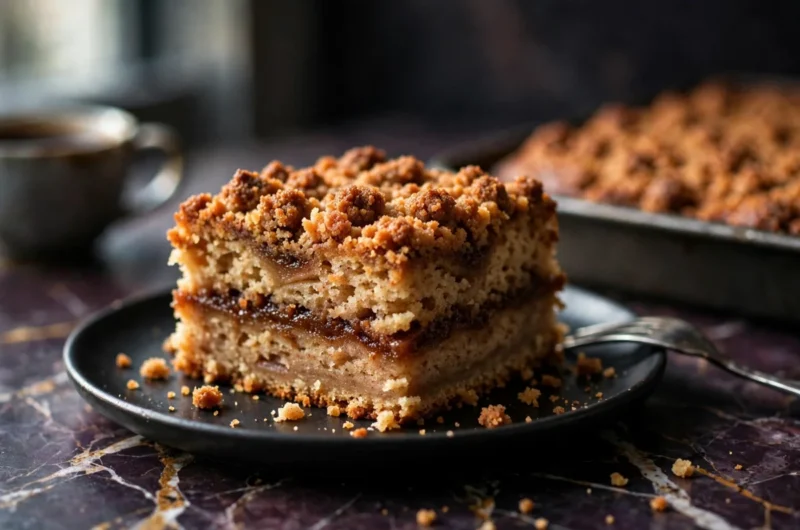
American (Pennsylvania Dutch) · Fruit Cakes Amish Apple Cake Recipe A moist, oil-based spiced sheet cake made with pre-cooked diced […]
Check Out..!
American Cakes
Applesauce Coffee Cake Recipe
This applesauce coffee cake recipe uses cold butter in the streusel. Melted butter makes it sink into the wet applesauce batter. Here is the fix.
- Prep: 20 min
- Cook: 45 min
- Total: 1 hour 30 min
- Servings: 16
- Difficulty: Easy-Medium
- Dietary: Vegetarian
 Chef's review · Chef Arshad Ghafoor, Pastry & Bread Chef · Reviewed Nov 10, 2026
“Use room-temperature applesauce only never cold from the refrigerator. Cold applesauce seizes the creamed butter on contact, breaking the emulsion before the flour can stabilize it and producing a curdled, greasy batter that bakes into a dense, uneven crumb.”
Our investigation: 24 recipes add applesauce straight from the refrigerator without specifying temperature, consistently producing a curdled butter emulsion mid-mix that bakers incorrectly attribute to over-mixing or insufficient creaming time rather than the cold-temperature emulsion break that no amount of additional mixing corrects once it has occurred.
Applesauce coffee cake is an American one-pan cake in which unsweetened applesauce replaces a significant portion of the fat and liquid in a standard coffee cake formula producing a deeply moist, subtly apple-flavored, generously spiced cake with a brown sugar-cinnamon streusel through the middle and across the top that delivers the complete American coffee cake sensory experience with a measurably lower fat content from the applesauce’s water-binding pectin and natural sugar replacing the oil or butter that a standard coffee cake formula uses at equivalent moisture.
The applesauce temperature is the single most critical technique decision. The creamed butter-sugar emulsion that provides the batter’s structural foundation is a highly temperature-sensitive system the butter’s fat phase exists as a stable emulsion at 65 to 72°F and begins crystallising and separating below 60°F. Cold applesauce added directly from the refrigerator at 38 to 42°F introduces a 25 to 30-degree temperature drop at the point of contact with the warm creamed butter emulsion sufficient to crystallise the butter’s fat phase locally around the cold applesauce contact zone, breaking the emulsion irreversibly at those points and producing the curdled, greasy-appearing batter that no subsequent mixing at any speed corrects because the broken emulsion’s fat phase has already crystallised around separated water droplets.
Applesauce coffee cake belongs to the American coffee cake tradition a category of American morning and afternoon occasion cakes that are served alongside coffee or tea rather than as a standalone dessert, with the name referring to the pairing occasion rather than to coffee as an ingredient. The American coffee cake tradition developed from the German Kaffeekuchen tradition brought to the American Midwest and East Coast by German immigrant communities beginning in the 17th century the original Quaker and Pennsylvania German communities of William Penn’s Pennsylvania colony establishing the coffee-cake-with-streusel-topping format that would become the American coffee cake canon. The applesauce variation specifically reflects the mid-20th century American home economics tradition of replacing fat with applesauce in baked goods a substitution documented in American women’s magazine recipe columns from the 1940s through the 1960s as both an economical fat-reduction technique and a moisture-enhancement strategy that produced notably moister coffee cakes than the standard all-butter formula at the same baking time.
What Is Applesauce Coffee Cake?
Applesauce coffee cake is a one-pan American morning cake baked in a 9×13-inch or 8×8-inch pan, served in squares directly from the pan, and consumed with coffee or tea at breakfast, brunch, or an afternoon occasion rather than as an evening dessert. It differs from a standard streusel coffee cake in that the applesauce’s pectin and natural sugar contribution produces a cake that is simultaneously more moist and lighter in fat content than the all-butter or all-oil equivalent the applesauce’s pectin hydrogel holds water molecules through hydrogen bonding throughout the crumb, producing a moistness that persists for 4 to 5 days at room temperature rather than the 2 to 3 days of a butter-only coffee cake.
The streusel in applesauce coffee cake serves a dual purpose. At the top surface it provides textural contrast the crispy, buttery, brown-sugar-cinnamon streusel against the soft, moist, apple-forward cake below is the textural binary that defines the coffee cake eating experience. Through the middle of the cake a practice unique to the American coffee cake tradition where a double-streusel application creates an interior layer and a top layer the streusel provides a concentrated cinnamon-sugar interior stripe that contrasts the surrounding applesauce cake at every forkful from a bite that contains both the moist apple-spice crumb and the slightly crunchy, caramelised brown sugar interior layer.
What Equipment Do You Need?
| Equipment | Specification | Why It Matters |
|---|---|---|
| 9x13-inch baking pan | Light-colored aluminum, 2 inches deep minimum | The 9x13-inch format produces the correct batter depth of approximately 1.5 inches, deep enough for the interior streusel layer to sit at the middle of the crumb and shallow enough for the heat to penetrate to the interior streusel layer without producing a raw zone around the streusel that can occur in a deeper pan at the same baking temperature. |
| Stand mixer with paddle | Standard | For the creaming method batter, the paddle's sustained action produces the correct butter-sugar aeration for the applesauce coffee cake's crumb character. The paddle also incorporates the room-temperature applesauce more evenly than the whisk would, as the whisk tends to aerate the applesauce mixture while the paddle distributes it uniformly through the batter. |
| Fine mesh strainer | Standard | For sifting the dry ingredients, the cinnamon and nutmeg in the spiced batter can clump on storage and produce spice pockets in the batter rather than uniform distribution if not sifted with the dry ingredients. |
| Fork or pastry cutter | Standard | For making the streusel, the fork's tines cut the cold butter into the dry streusel ingredients more quickly and more evenly than fingertips, which warm the butter through skin-to-butter contact and produce a greasier, less distinct streusel rather than the separated, crumbly streusel that cold butter cut with a fork achieves. |
| Instant-read thermometer | Standard | For verifying the cake's doneness, the applesauce's high moisture content and the interior streusel layer both affect the toothpick test's reliability. The toothpick inserted through the streusel layer picks up caramelised streusel rather than wet batter, potentially reading as clean before the surrounding crumb is fully set. The internal temperature at 200 to 205°F is the most reliable indicator. |
What Ingredients Do You Need?
Use unsweetened applesauce rather than sweetened sweetened applesauce adds approximately 10 to 15g of additional sugar per 1/2 cup beyond the recipe’s calibrated sweetness, producing a cake that is noticeably sweeter than intended and that the streusel’s brown sugar content pushes further toward cloying sweetness. Unsweetened applesauce’s pectin content is identical to sweetened at the same fruit concentration the sweetness difference is entirely the manufacturer’s added sugar. Bring the applesauce to room temperature by spooning the measured quantity into a bowl and allowing it to sit at room temperature for 20 to 30 minutes sufficient time for the 38 to 42°F refrigerator-temperature applesauce to reach 68 to 72°F without any heating required.
For the Brown Sugar-Cinnamon Streusel
| Ingredient | Volume | Weight |
|---|---|---|
| All-purpose flour | 3/4 cup | 90g |
| Dark brown sugar, packed | 3/4 cup | 165g |
| Ground cinnamon | 1 1/2 teaspoons | 3.9g |
| Ground nutmeg, freshly grated | 1/4 teaspoon | 0.6g |
| Fine sea salt | 1/4 teaspoon | 1.5g |
| Unsalted butter, cold and cut into 1/2-inch cubes | 6 tablespoons | 85g |
| Pecans or walnuts, roughly chopped — optional | 1/2 cup | 50g |
The streusel uses cold butter rather than room-temperature butter the opposite of the cake batter’s room-temperature requirement. Cold butter cut into the streusel dry ingredients with a fork produces the irregular, pea-to-almond-sized butter-flour-sugar pieces that define a correctly made streusel pieces that melt in the oven producing pockets of caramelised butter-sugar rather than a smooth, greasy layer. Room-temperature butter would smear through the dry ingredients rather than cutting into distinct pieces, producing a paste rather than a crumble.
For the Applesauce Coffee Cake Batter
| Ingredient | Volume | Weight |
|---|---|---|
| All-purpose flour | 2 cups | 240g |
| Baking soda | 1 teaspoon | 6g |
| Baking powder | 1 teaspoon | 4g |
| Fine sea salt | 1/2 teaspoon | 3g |
| Ground cinnamon | 1 1/2 teaspoons | 3.9g |
| Ground ginger | 1/2 teaspoon | 1.3g |
| Ground nutmeg, freshly grated | 1/4 teaspoon | 0.6g |
| Ground allspice | 1/4 teaspoon | 0.6g |
| Unsalted butter, room temperature | 1/2 cup | 113g |
| Granulated white sugar | 3/4 cup | 150g |
| Dark brown sugar, packed | 1/4 cup | 55g |
| Large eggs, room temperature | 2 eggs | 100g |
| Pure vanilla extract | 1 teaspoon | 5ml |
| Unsweetened applesauce, room temperature | 1 cup | 245g |
| Buttermilk, room temperature | 1/4 cup | 60ml |
The dual sugar formula granulated white for structure and dark brown sugar for molasses-derived caramelised flavor complexity mirrors the established pattern across this collection’s spiced cake preparations. The dark brown sugar’s molasses content produces the same warm, slightly bitter caramelised sugar character alongside the spice blend that makes spiced cakes more complex and more satisfying than sugar-only sweetened versions. The buttermilk at the modest 1/4 cup quantity provides lactic acid that activates the baking soda while the applesauce’s natural malic acid supplements the acid load for the baking soda’s full activation. The combined acid from the buttermilk’s lactic acid and the applesauce’s malic acid produces more complete carbon dioxide release from the baking soda than either acid source alone at the same total acid concentration.
Applesauce Coffee Cake Recipe
A deeply moist, subtly apple-flavored, generously spiced one-pan coffee cake with a brown sugar-cinnamon streusel through the middle and across the top, made with room-temperature applesauce and cold-butter streusel.
Prep time
20
minutesCooking time
45
minutesRest
1
hrTotal
45
minutesYield
16
servingsEasy-Medium
Ingredients
- For the Brown Sugar-Cinnamon Streusel
All-purpose flour 3/4 cup (90g)
Dark brown sugar, packed 3/4 cup (165g)
Ground cinnamon 1 1/2 teaspoons (3.9g)
Ground nutmeg, freshly grated 1/4 teaspoon (0.6g)
Fine sea salt 1/4 teaspoon (1.5g)
Unsalted butter, cold and cut into 1/2-inch cubes 6 tablespoons (85g)
Pecans or walnuts, roughly chopped — optional 1/2 cup (50g)
- For the Applesauce Coffee Cake Batter
All-purpose flour 2 cups (240g)
Baking soda 1 teaspoon (6g)
Baking powder 1 teaspoon (4g)
Fine sea salt 1/2 teaspoon (3g)
Ground cinnamon 1 1/2 teaspoons (3.9g)
Ground ginger 1/2 teaspoon (1.3g)
Ground nutmeg, freshly grated 1/4 teaspoon (0.6g)
Ground allspice 1/4 teaspoon (0.6g)
Unsalted butter, room temperature 1/2 cup (113g)
Granulated white sugar 3/4 cup (150g)
Dark brown sugar, packed 1/4 cup (55g)
Large eggs, room temperature 2 eggs (100g)
Pure vanilla extract 1 teaspoon (5ml)
Unsweetened applesauce, room temperature 1 cup (245g)
Buttermilk, room temperature 1/4 cup (60ml)
Instructions
- Make the Streusel First
Step 1
Stir the flour, dark brown sugar, cinnamon, nutmeg, and salt with a fork, breaking up every sugar clump. Cut in the cold butter for 2 to 3 minutes until you have pea to almond-sized crumbs. Toss in the nuts if using, then refrigerate the streusel while you make the batter.- Bring Applesauce to Room Temperature
Step 2
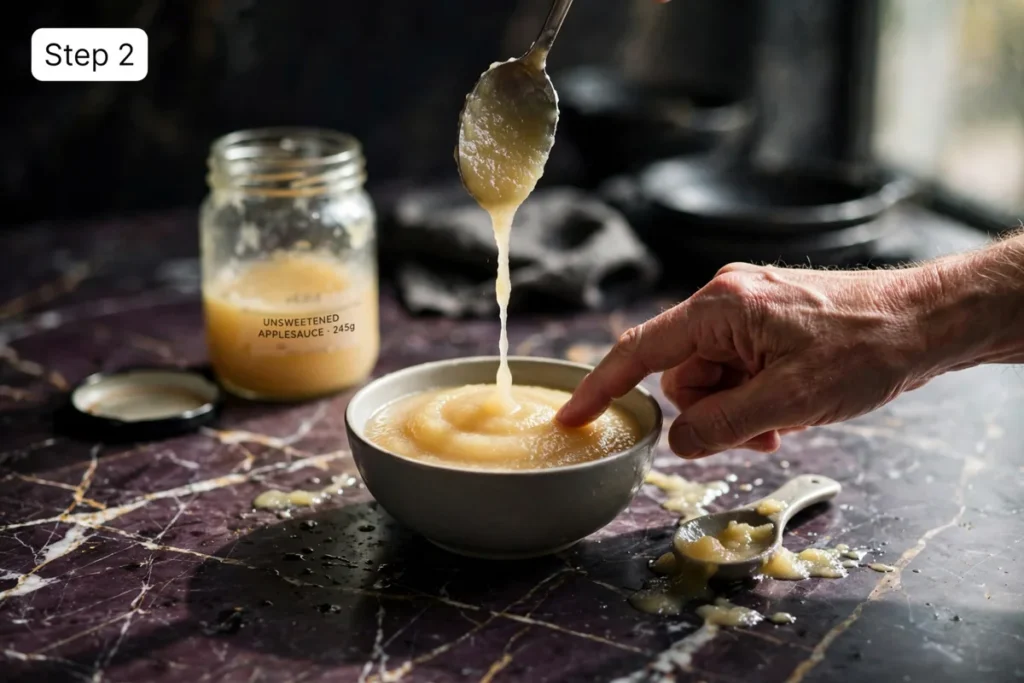
Spoon 1 cup (245g) of unsweetened applesauce into a small bowl and let it sit for 20 to 30 minutes until it feels neutral, not cold. Don’t microwave it, since hot spots can break the batter.- Make the Cake Batter
Step 3
Preheat the oven to 350°F (177°C). Grease a 9x13-inch pan and line it with parchment, leaving overhangs on the long sides. Whisk the flour, baking soda, baking powder, salt, cinnamon, ginger, nutmeg, and allspice until evenly blended.Step 4
Beat the butter, granulated sugar, and dark brown sugar on medium for 3 to 4 minutes until pale and fluffy.Step 5
Add the eggs one at a time, beating 20 seconds after each, then beat in the vanilla. On low speed, pour the applesauce in a slow stream down the side of the bowl.Step 6
Add the dry mixture in three parts, alternating with the buttermilk, mixing on low just until no flour remains. The batter will be thick and fall from the paddle in a heavy ribbon.- Assemble the Double-Streusel Layer
Step 7
Spread half the batter evenly in the pan. Scatter half the streusel over it, then gently spread the remaining batter on top. Finish with the rest of the streusel, covering the surface evenly.- Bake
Step 8
Bake for 40 to 48 minutes until the center reads 200 to 205°F, inserting the thermometer between streusel pieces. Skip the toothpick test here, as the streusel gives a false clean reading.Step 9
Cool in the pan for at least 1 hour before cutting into squares, so the cake sets and slices cleanly without crumbling.
Step by Step Process
Make the Streusel First
Step 1. Combine the flour, dark brown sugar, cinnamon, nutmeg, and salt in a medium bowl.Stir with a fork until completely uniform the dark brown sugar will form clumps that must be broken up completely before the butter is added, because un-broken brown sugar clumps in the streusel produce irregularly sweet, dense spots rather than the uniform sweet-spice distribution of a correctly made streusel. Add the cold butter cubes and cut the butter into the dry ingredients with the fork pressing the fork’s tines through each butter cube and dragging through the dry ingredients in a repeated cutting and tossing motion for 2 to 3 minutes until the mixture resembles irregular crumbs from pea-sized to almond-sized with no large butter chunks remaining.
Add the chopped nuts if using and toss through the streusel with the fork. Refrigerate the finished streusel while the cake batter is prepared keeping the streusel cold until it is applied to the batter prevents the butter pieces from softening and merging at room temperature into a paste rather than maintaining their distinct, crumbly individual pieces through the oven’s initial heating phase.

Bring Applesauce to Room Temperature
Step 2. Spoon 1 cup (245g) of unsweetened applesauce from the refrigerator container into a small bowl. Allow to sit at room temperature for 20 to 30 minutes until the applesauce reaches 68 to 72°F verified by touch, which should feel neutral rather than cold. Do not accelerate the warming by microwaving even 15 seconds of microwave warming produces hot spots in the applesauce above 100°F that, despite averaging to a warm temperature when stirred, can locally overheat the butter during incorporation and produce a different form of emulsion instability than cold applesauce causes.
Make the Cake Batter
Step 3. Preheat the oven to 350°F (177°C).Grease the 9×13-inch pan generously and line with parchment paper leaving overhangs on the two long sides. Whisk together the flour, baking soda, baking powder, salt, cinnamon, ginger, nutmeg, and allspice in a medium bowl until completely uniform the spice blend must be completely distributed through the flour before the wet ingredients are added. Spice particles added to an assembled batter without pre-distribution through the flour produce uneven spice intensity through the finished crumb.

Step 4. Beat the room-temperature butter, granulated sugar, and dark brown sugarwith the paddle at medium speed for 3 to 4 minutes until pale and increased in volume. The dark brown sugar requires slightly longer creaming than white sugar alone because the molasses content’s hygroscopic water fraction resists the initial incorporation into the butter fat after 3 to 4 minutes the molasses moisture has been absorbed into the emulsion and the mixture becomes the correct pale, aerated consistency.
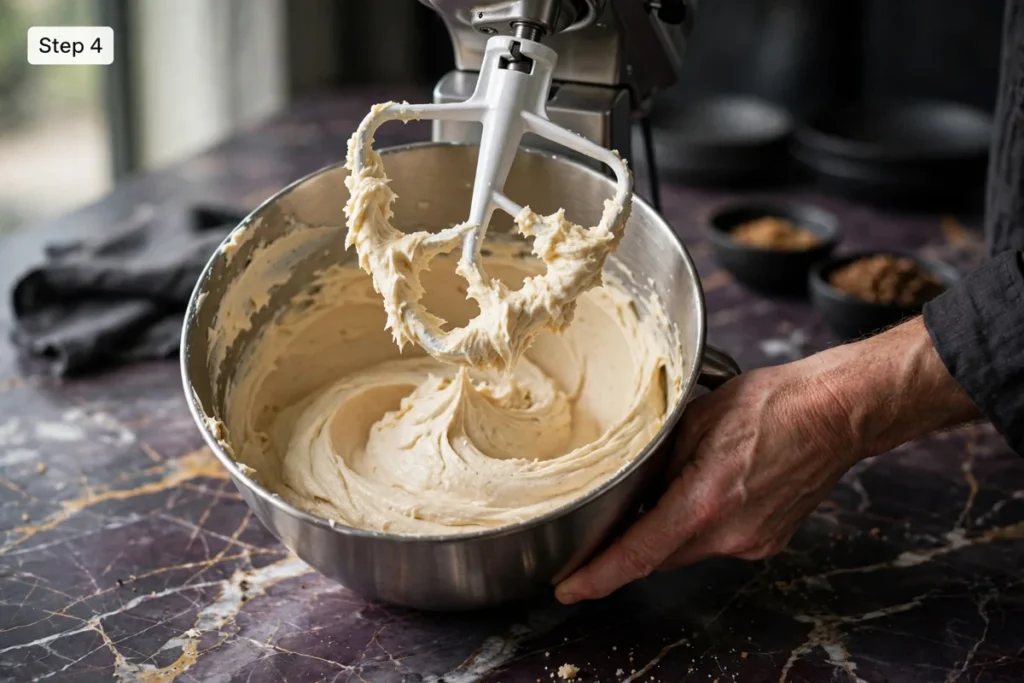
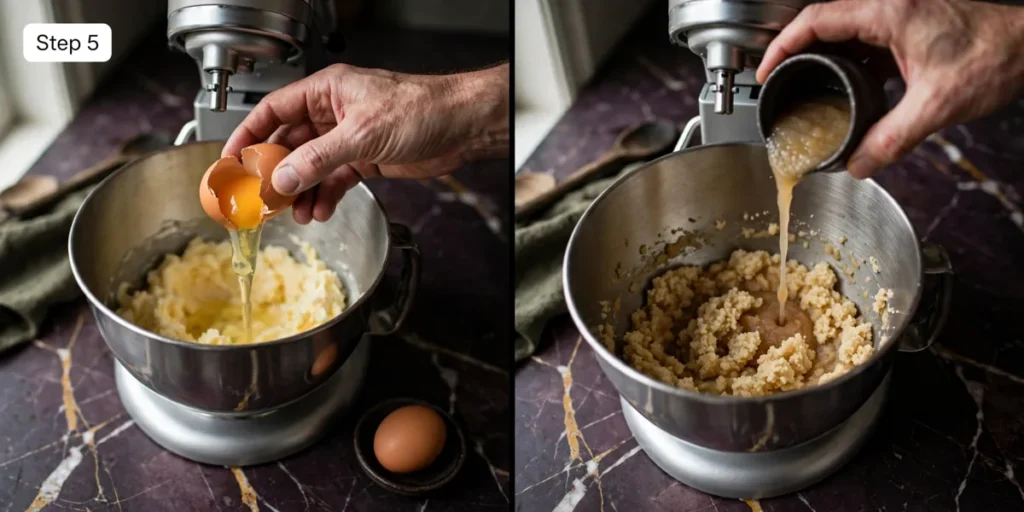
Step 5. Add the eggs one at a time, beating 20 seconds after each. Add the vanilla extract and beat 10 seconds. With the mixer at low speed, add the room-temperature applesauce in a slow, steady stream pouring it down the inside of the mixer bowl rather than directly onto the paddle, which produces a more gradual temperature and moisture introduction to the emulsion than pouring directly onto the centre of the spinning paddle.
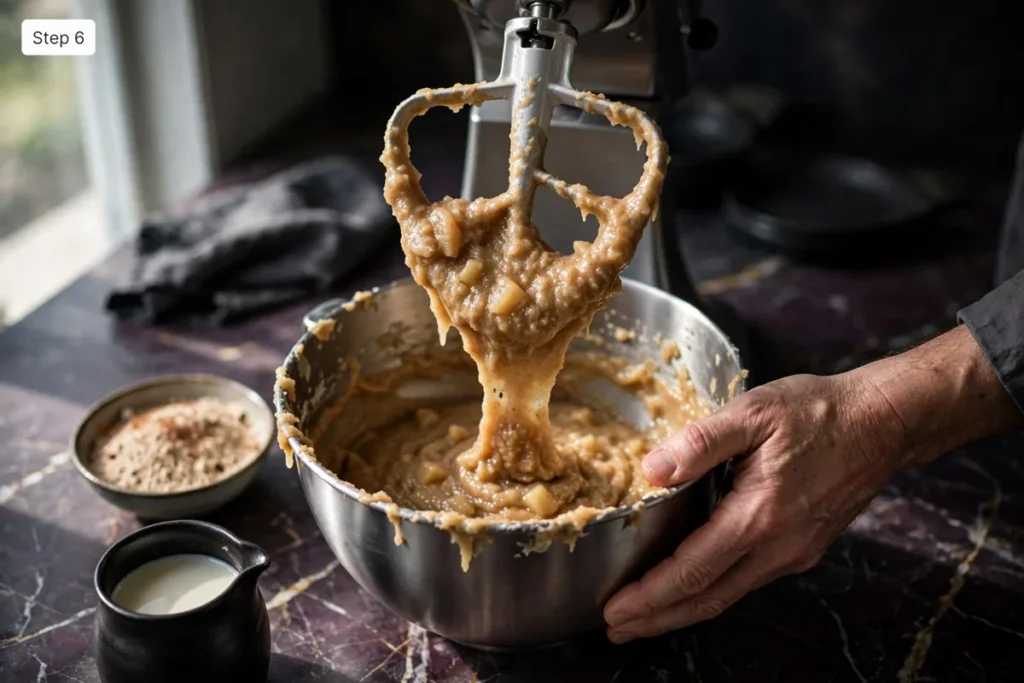
Step 6. Add the dry ingredient mixture in three additions alternating with the buttermilk dry, buttermilk, dry, buttermilk, dry beating at low speed after each until just incorporated. Stop mixing the moment no dry flour patches remain after the final flour addition. The batter at this stage is thicker than a standard layer cake batter from the applesauce’s pectin and the buttermilk’s modest volume it falls from the paddle in a slow, heavy ribbon rather than pouring freely.
Assemble the Double-Streusel Layer
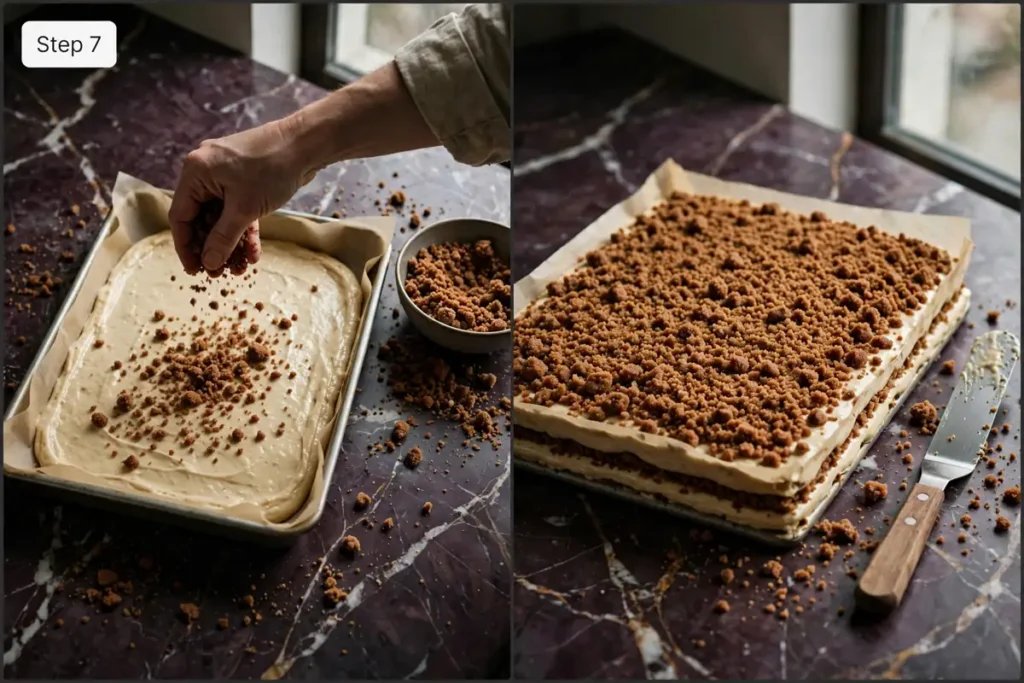
Step 7. Pour exactly half the batter into the prepared pan spreading it to all four corners with the offset spatula into an even layer of approximately 3/4-inch depth. Remove the streusel from the refrigerator. Scatter approximately half the streusel evenly over the first batter layer covering the full surface without leaving gaps. Pour the remaining batter over the streusel layer, spreading gently with the spatula to cover the streusel completely without disturbing the layer beneath. Scatter the remaining streusel evenly across the full top surface of the batter.
The interior streusel layer is the technique that distinguishes a double-streusel coffee cake from a standard top-streusel coffee cake. The interior layer bakes between the two batter portions the streusel pieces melt and caramelise inside the crumb, producing a distinct cinnamon-brown sugar seam through the cake’s cross-section that concentrates the spice flavor at the interior while the top streusel provides crunch and additional spice at the exterior surface.
Bake
Step 8. Bake at 350°F for 40 to 48 minutes until the internal temperature reads 200 to 205°F at the centre of the cake inserting the thermometer between streusel pieces rather than through them for an accurate crumb temperature reading. The toothpick test through the streusel layer picks up caramelised sugar that reads as clean regardless of the crumb’s actual doneness always verify with the thermometer as the primary doneness indicator for this preparation.

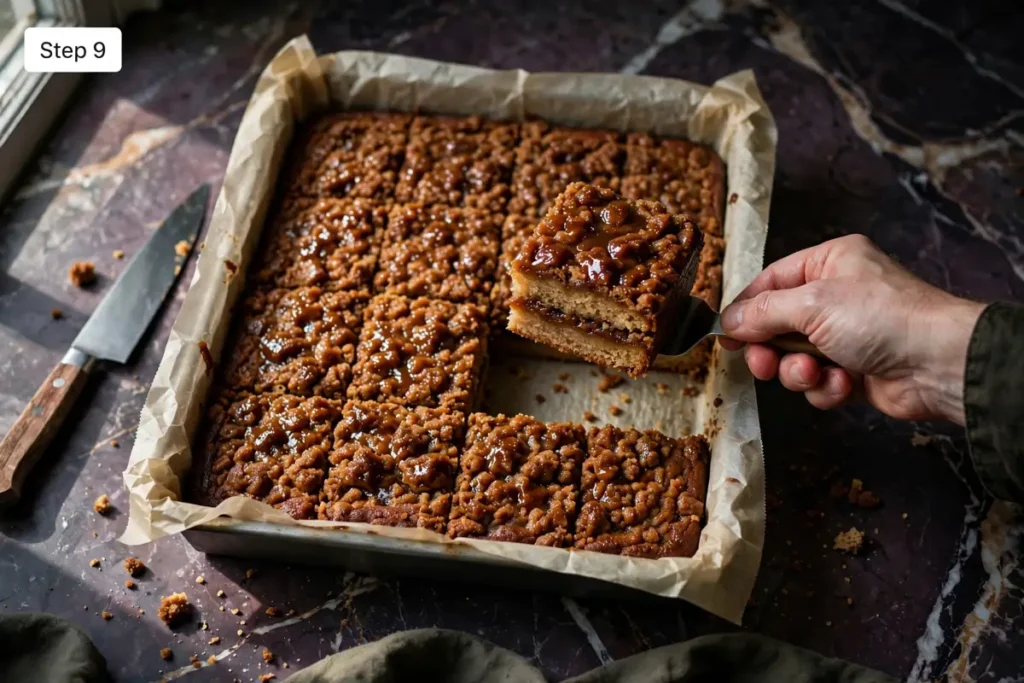
Step 9. Cool in the pan completely minimum 1 hour before cutting into squares. The applesauce coffee cake requires the full cooling period before cutting more than a standard butter-only cake because the pectin hydrogel in the applesauce set during baking must fully gel during cooling to provide the structural integrity that holds each square together cleanly when cut. Warm pectin gel at 150 to 170°F is too fluid to provide this structural support cutting before complete cooling produces squares that crumble at the interior streusel layer where the warm caramelised streusel is still slightly fluid and provides no resistance to the knife’s downward pressure.
Why Room-Temperature Applesauce Maintains the Butter Emulsion Where Cold Applesauce Breaks It
The requirement for room-temperature applesauce in an applesauce coffee cake batter is one of the most consequential and most frequently ignored temperature specifications in American home baking and the physical mechanism behind the cold-induced emulsion break explains why this instruction cannot be circumvented through mixing strategy or technique adjustment once the cold applesauce has contacted the warm butter emulsion.
The creamed butter-sugar emulsion that is the foundation of the applesauce coffee cake batter is a complex physical system in which air bubbles are incorporated into a continuous fat phase that holds a dispersed aqueous phase the dissolved sugar’s small amount of moisture in suspension through the mechanical energy input of the creaming process. This emulsion is thermally stable within a specific temperature range: at 65 to 72°F the butter’s fat phase exists at a semi-solid state that provides sufficient viscosity to maintain the dispersed aqueous phase in suspension through the emulsion’s interfacial tension. The fat phase in this semi-solid state is neither too firm to be plastically deformed during mixing nor too liquid to maintain the interfacial tension needed to hold water droplets dispersed through it.
When cold applesauce at 38 to 42°F contacts this thermally stable emulsion, the temperature difference produces a rapid local cooling at the contact zones. At the contact zones the butter fat’s temperature drops from 68°F toward 50°F within seconds of cold-applesauce contact the butter fat crystallises from its semi-solid, emulsion-stable state into a solid, non-emulsifying crystalline form. In this solid crystalline state the butter fat cannot function as an emulsifier it cannot maintain the water-in-fat interfacial tension that keeps the dispersed aqueous phase suspended. The aqueous phase both the dissolved sugar moisture and the applesauce’s own 88 percent water content separates from the crystallised fat and pools as free liquid, producing the visible greasy fat-and-liquid separation of a broken butter emulsion.
The broken emulsion’s physical state crystallised fat pieces surrounded by separated aqueous phase cannot be re-emulsified by mechanical mixing at this temperature because the mixing energy cannot re-distribute the fat’s crystallised triglyceride molecules across the aqueous phase’s interface at sub-optimal temperatures. Re-melting the fat by external warming would re-emulsify the mixture but would simultaneously soften the cake batter to a state incompatible with the correct baked crumb structure. The only reliable correction is prevention bringing the applesauce to room temperature before incorporation maintains the butter emulsion’s thermal stability through the applesauce’s addition and the subsequent flour incorporation completes the structural transition from emulsion-based batter to a more complex starch-protein-fat matrix where the emulsion’s integrity is less critical.
How Does Applesauce Coffee Cake Compare to Related American Coffee Cakes?
| Attribute | Applesauce Coffee Cake | Sour Cream Coffee Cake | Blueberry Coffee Cake | Cinnamon Swirl Coffee Cake | Banana Coffee Cake |
|---|---|---|---|---|---|
| Primary moisture source | Unsweetened applesauce pectin hydrogel moisture | Sour cream fat-enriched dairy moisture | Fresh or frozen blueberries released juice moisture | Buttermilk only | Mashed ripe banana natural sugar and starch moisture |
| Fat level relative to standard | Reduced applesauce replaces partial fat | Higher sour cream adds fat beyond standard | Standard | Standard | Reduced banana replaces partial fat |
| Streusel format | Double interior layer plus top | Top only | Top only or none | Interior swirl plus top crumble optional | Top only |
| Interior element | Streusel seam at the crumb middle | None or streusel | Blueberry pieces throughout | Cinnamon-sugar swirl | None |
| Spice profile | Cinnamon-ginger-nutmeg-allspice | Cinnamon only | None or mild cinnamon | Cinnamon only | Cinnamon-nutmeg |
| Moisture retention at room temperature | 4 to 5 days applesauce pectin | 3 to 4 days sour cream fat | 2 to 3 days berry juice evaporates | 2 to 3 days buttermilk only | 4 to 5 days banana starch and sugar |
| Cultural tradition | American mid-20th century home economics | American 1950s and 1960s sour cream baking | American Northeast summer baking | American German Kaffeekuchen tradition | American banana surplus baking tradition |
| Most common serving occasion | Weekend brunch, morning coffee, potluck | Weekend brunch, holiday morning | Summer brunch, afternoon tea | Weekend brunch, holiday morning | Weekend brunch, everyday |
What Variations Can You Make?
Apple Chunk Applesauce Coffee Cake
Peel and cut 1 large firm-tart apple Granny Smith or Honeycrisp into 1/2-inch pieces. Toss in 1 teaspoon of flour and fold into the finished batter as the last step before assembling the double-streusel layers. The additional apple pieces provide the textural contrast of distinct, slightly toothsome apple chunks alongside the applesauce-moistened crumb producing a cake that communicates apple presence visually and texturally in each bite rather than only through flavor and moisture. The flour coating raises surface friction and slows the apple pieces’ sinking through the batter during baking the same flour-coating technique used for chocolate chips throughout this collection.
Result: An applesauce coffee cake with distinct, slightly toothsome apple chunks visible in each square alongside the moist applesauce-spice crumb.
Caramel Apple Applesauce Coffee Cake
Replace the dark brown sugar in both the batter and the streusel with 1/4 cup of high-quality salted caramel sauce a thick, pourable commercial caramel or homemade. Add the caramel sauce to the creamed butter-sugar mixture after the eggs rather than as a sugar substitution in the creaming stage, since the caramel’s liquid character is better suited to the wet ingredient addition stage than the creaming stage where the sugar’s crystalline structure contributes to air incorporation. Reduce the dark brown sugar in the batter to 2 tablespoons and in the streusel to 1/2 cup to compensate for the caramel’s sugar contribution. The caramel’s sucrose pyrolysis compounds diacetyl, furanones, maltol add a caramelised warm complexity to both the crumb and the streusel that contrasts the apple-spice character through the same caramel-fruit complementarity documented in the strawberry leche cake’s caramel layer and the Granny Cake’s brown sugar topping.
Result: A caramel apple applesauce coffee cake with a deeper, more caramelised warm complexity in both the crumb and the streusel.
Maple Walnut Applesauce Coffee Cake
Replace the granulated sugar in the batter with pure maple syrup at 1/2 cup (120ml) reduce the buttermilk to 2 tablespoons (30ml) to compensate for the maple syrup’s additional liquid. Add 1 tablespoon of fresh lemon zest rubbed into the remaining dark brown sugar before creaming using the fat-phase integration technique. Replace the pecans or walnuts in the streusel with maple-toasted walnuts toss walnuts with 1 tablespoon of maple syrup and bake at 325°F for 8 minutes until toasted. The pure maple syrup’s furfural, syringaldehyde, and vanillin aromatic compounds complement the applesauce’s malic acid brightness through the shared warm-sweet aromatic family that the warm spice blend also occupies, producing a more complex, more sophisticated flavor than either pure maple syrup or standard brown sugar achieves independently in the same formula.
Result: A maple walnut applesauce coffee cake with a more complex, more sophisticated warm-sweet flavor from the maple syrup’s aromatic compounds.
Dietary Adjustments and Substitutions
Dairy-Free Version
Replace the butter in the batter with Miyoko’s Creamery dairy-free butter sticks at the same weight (113g). Replace the buttermilk with a buttermilk substitute combine 1/4 cup (60ml) of unsweetened oat milk with 3/4 teaspoon of fresh lemon juice and allow to curdle for 5 minutes. For the streusel, replace the cold butter with cold refined coconut oil measure the coconut oil in its solid state (85g) and cut into the streusel dry ingredients with the fork exactly as directed for dairy butter. The coconut oil streusel has a slightly lower melting point than dairy butter streusel and caramelises more quickly during baking check the top streusel’s color at 35 minutes rather than the standard 40 to 48-minute check.
Gluten-Free Version
Replace the all-purpose flour in the batter with a certified 1:1 gluten-free baking flour blend containing xanthan gum at exactly 240g. For the streusel, replace the all-purpose flour with certified gluten-free oat flour at the same weight (90g) gluten-free oat flour’s beta-glucan content provides sufficient binding for the streusel’s structure and produces a crumble that behaves identically to all-purpose flour streusel at the same fat-to-flour ratio. The applesauce coffee cake’s relatively high moisture content from the applesauce makes it more successfully adaptable to gluten-free flour than a leaner, drier cake format the moisture prevents the characteristic gluten-free flour dryness from producing a gritty or crumbly result.
Vegan Version
Use all dairy-free substitutions above and replace the 2 eggs with 2 flax eggs 1 tablespoon (7g) of ground flaxseed combined with 3 tablespoons (45ml) of warm water per egg, rested for 5 minutes each. The applesauce’s pectin provides supplemental binding that partially compensates for the absent egg albumin making the applesauce coffee cake one of the most successfully vegan-adaptable creamed butter cakes in this collection, because the pectin’s structural binding reduces the demand on the egg’s albumin binding contribution relative to a pectin-free standard layer cake at the same egg count.
What Are the Most Common Problems When Making Applesauce Coffee Cake?
| Problem | Most Likely Cause | Prevention or Fix |
|---|---|---|
| Curdled, greasy batter after applesauce addition | Applesauce added cold from the refrigerator because cold temperature crystallised the butter fat and broke the emulsion | Always bring applesauce to room temperature for 20 to 30 minutes before use. If already broken then add 2 tablespoons of flour and beat at low speed for 30 seconds and this may partially re-emulsify a mild break. A severely broken emulsion produces a dense uneven crumb that cannot be corrected but remains edible. |
| Interior streusel layer displaced to the bottom of the cake | Top batter layer applied too aggressively over the interior streusel because batter pushed streusel down to the pan base | Apply the top batter layer in large dollops distributed across the full streusel surface, then spread gently outward with very light, horizontal strokes rather than downward pressing strokes. |
| Streusel sank into the batter and no interior seam is visible after baking | Streusel was too warm because butter melted and the streusel liquefied rather than sitting as distinct crumble pieces at the batter interface | Always refrigerate the streusel while the batter is prepared and apply cold. Cold butter pieces in the streusel maintain their solid state long enough for the surrounding batter to set around them during the first 15 minutes of baking. |
| Cake raw at the centre despite correct streusel browning | Toothpick test used through the streusel layer rather than between streusel pieces because caramelised streusel read as clean | Always use the instant-read thermometer rather than the toothpick as the primary doneness indicator for streusel coffee cakes. Insert the thermometer between streusel pieces into the crumb. |
| Cake too dense and gummy | Applesauce was too thick and the batter's total liquid was insufficient for the leavening to produce adequate rise | Verify the applesauce is standard commercial unsweetened applesauce consistency and not a very thick apple butter or apple preserve. If too thick then thin with 1 tablespoon of whole milk and fold gently to combine. |
How Do You Store Applesauce Coffee Cake?
Applesauce coffee cake’s pectin hydrogel holds water through hydrogen bonding throughout the crumb, giving it significantly longer room-temperature freshness than a butter-only coffee cake. The top streusel loses some crunch within 24 hours from moisture migration from the crumb the streusel texture is best on day one and progressively softens.
| Storage Method | Duration | Instructions |
|---|---|---|
| Room temperature, in the pan covered with plastic wrap or foil | Up to 5 days | The applesauce pectin hydrogel's exceptional water-binding capacity produces a cake that retains moisture significantly longer than a butter-only coffee cake at equivalent storage conditions. The top streusel loses some crunch within 24 hours from moisture migration from the crumb and the streusel texture is best on day one and progressively softens. Warm individual squares in a 300°F oven for 4 to 5 minutes to partially restore the streusel's crunch on days 2 through 5. |
| Refrigerated, covered in the pan or as individual squares in an airtight container | Up to 7 days | Refrigeration extends the storage window but the applesauce coffee cake's spiced aromatic character is suppressed below 15°C so bring to room temperature for 20 minutes before serving or warm briefly at 300°F for 5 minutes. |
| Frozen, individual squares wrapped in plastic wrap | Up to 3 months | Wrap each square individually. Thaw at room temperature for 30 minutes or warm in a 300°F oven for 8 minutes from frozen. The applesauce's pectin structure freezes and thaws without significant textural change and the pectin hydrogel reforms upon thawing at essentially the same moisture retention as the freshly baked cake. |
Make Ahead
The streusel can be made and refrigerated up to 2 days in advance — keep it cold until it is applied to the batter. The baked and fully cooled cake can be stored at room temperature for up to 5 days before serving, and individual squares can be frozen for up to 3 months. If making the cake ahead for a gathering, bake and cool completely, then wrap the pan tightly and hold at room temperature overnight — the applesauce pectin keeps the crumb moist and the streusel re-crisps slightly when individual squares are warmed at 300°F for 4 to 5 minutes.
Scaling
| Servings | All-Purpose Flour (batter) | Applesauce | Butter (batter) | Eggs | Streusel Quantity | Pan Size |
|---|---|---|---|---|---|---|
| 9 servings | 120g | 123g | 57g | 1 egg | Half the streusel recipe | 8x8-inch pan |
| 16 servings (standard) | 240g | 245g | 113g | 2 eggs | Full streusel recipe | 9x13-inch pan |
| 24 servings | 360g | 368g | 170g | 3 eggs | 1.5 times the streusel recipe | 12x18-inch half-sheet pan |
Serving
Applesauce coffee cake is a morning and afternoon occasion cake, served in squares directly from the pan alongside coffee or tea. It is at its best on day one while the top streusel is still crisp, but it stays moist for 4 to 5 days thanks to the applesauce pectin.
| Serving Suggestion | Why It Works |
|---|---|
| Warm with a cup of coffee or tea | The cake's name refers to the pairing occasion — the warm spice blend and the crunchy top streusel are built for a hot drink alongside, and a brief 300°F warm restores some of the day-one streusel crunch. |
| At room temperature for a weekend brunch or potluck | The pectin hydrogel keeps the crumb moist for hours on a buffet table without drying, and the double streusel delivers both top crunch and an interior caramelised seam in every square. |
| Warmed and served with a spoonful of yogurt or crème fraîche | The dairy tang contrasts the warm spice and brown sugar sweetness, the same acid-sweet complementarity that the buttermilk and applesauce's malic acid already bring to the crumb. |
Nutritional Information
Per serving: 1 square approximately 110g including double streusel, based on 16 squares. Values calculated using USDA FoodData Central reference data using unsweetened commercial applesauce.
| Nutrient | Per Serving | Nutrient | Per Serving |
|---|---|---|---|
| Calories | 298 kcal | Total carbohydrate | 44g |
| Total fat | 12g | Dietary fibre | 1.4g |
| Saturated fat | 7g | Total sugars | 28g |
| Cholesterol | 48mg | Protein | 3.8g |
| Sodium | 228mg | Potassium | 88mg (2% DV) |
Frequently Asked Questions
Why does cold applesauce break the butter emulsion where room-temperature applesauce does not?
The creamed butter-sugar emulsion is thermally stable at 65 to 72°F the butter fat’s semi-solid state at this temperature provides the viscosity and interfacial tension needed to hold the dispersed aqueous phase in suspension. Cold applesauce at 38 to 42°F rapidly cools the contact zones from 68°F toward 50°F within seconds of addition, crystallising the butter fat from its emulsion-stable semi-solid state into a solid crystalline form that cannot maintain the aqueous phase in suspension. The aqueous phase separates as free liquid around the crystallised fat, producing the greasy, curdled emulsion break that no subsequent mechanical mixing at baking temperature corrects because the mixing energy cannot re-distribute crystallised triglycerides across the aqueous phase interface at the broken emulsion’s sub-optimal temperature.
Why does the streusel require cold butter rather than the room-temperature butter used in the batter?
Streusel’s textural identity irregular, distinct crumble pieces that caramelise into crunchy, buttery pockets during baking requires the butter to remain as discrete solid pieces through the dry ingredient cutting process. Cold butter at 38 to 42°F maintains its solid crystalline structure during the fork-cutting process, fracturing into irregular pieces when the fork’s tines press through it rather than deforming plastically. Room-temperature butter at 68°F deforms rather than fractures when force is applied, smearing through the dry ingredients rather than producing discrete pieces and creating a paste rather than a crumble.
Why is the double-streusel format specified rather than the standard single top-streusel?
The interior streusel layer serves a different function than the top streusel. The top streusel provides textural contrast at the exterior the crunchy caramelised butter-sugar-flour layer against the soft moist cake immediately below. The interior streusel layer provides concentrated spice and caramelised sugar flavour at the crumb’s middle a seam of brown sugar and cinnamon intensity that every fork-load from centre to bottom of the cake contains alongside the surrounding applesauce crumb. Without the interior layer, the bottom half of each square tastes only of applesauce cake with no streusel character the single top-streusel format’s flavor distribution only serves the top 1/3 of each square while the interior double-streusel format serves the full depth of every bite.
Can I substitute oil for the butter in this recipe?
Yes replace the 113g of butter with 90ml (6 tablespoons) of vegetable oil. The oil substitution eliminates the creaming stage combine the oil directly with the sugars by whisking rather than beating, then add the eggs, applesauce, and buttermilk before folding in the flour. The oil version’s crumb is slightly more moist and slightly more tender from the oil’s 100 percent fat content with no water fraction, but lacks the butter version’s diacetyl aromatic complexity that contributes the warm, slightly caramelised dairy character. The cold-applesauce emulsion-break risk is eliminated in the oil version oil does not form a temperature-sensitive emulsion with the other batter components and can receive cold applesauce without structural consequence. The streusel requires no modification it uses cold butter regardless of the batter’s fat source.
Applesauce coffee cake is an American one-pan morning cake from the mid-20th century home economics tradition in which unsweetened applesauce’s pectin hydrogel replaces a significant portion of the standard coffee cake formula’s fat while providing moisture retention through hydrogen-bonded water molecules that extends the room-temperature freshness window to 4 to 5 days but whose defining technique vulnerability is the cold-induced crystallisation of the creamed butter emulsion when refrigerator-temperature applesauce at 38 to 42°F contacts the thermally stable 68°F butter fat, dropping the contact zone’s temperature to 50°F and below the semi-solid emulsion-stable threshold in seconds, crystallising the fat and irreversibly breaking the aqueous phase’s suspension in a manner that no subsequent mixing corrects making the 20 to 30 minute room-temperature applesauce rest the single technique decision that determines whether the finished cake bakes into the correctly moist, evenly spiced, double-streusel-layered applesauce coffee cake that the recipe promises or the dense, uneven crumb of a broken-emulsion batter that every competitor recipe produces by failing to specify the applesauce temperature before it contacts the butter.
Table of Contents
Recent Recipes
American · Cakes Orange Pound Cake Recipe This orange pound cake recipe rubs the zest into the sugar before creaming. […]
Check Out..!
American · Layer Cakes Coconut and Carrot Cake Recipe Moist, oil-based spiced layer cake packed with freshly grated carrot and […]
Check Out..!
American Cakes Tandy Cake Recipe This Tandy cake recipe spreads peanut butter on the warm cake, then chills it before […]
Check Out..!
American · Cakes Portillo’s Chocolate Cake Recipe This Portillo’s chocolate cake recipe adds mayonnaise to the batter. Mayo is just […]
Check Out..!Recent Blogs
I’ve glazed our Amish apple cake too hot, too cold, and exactly right, and the difference is not small. The […]
Read Blog..!
I’ve pulled a sunken Amish Apple Cake out of my oven, and I know the exact sinking feeling that comes […]
Read Blog..!
A cup measures volume, not weight, so a cup of flour and a cup of sugar weigh completely different amounts. […]
Read Blog..!
Every pasta shape was designed to carry a certain kind of sauce. Thin strands suit light sauces that coat, wide […]
Read Blog..!
Every egg method, from a jammy boiled egg to a silky French omelet, comes down to one fact: the white […]
Read Blog..!