American · Bread Cloverleaf Rolls Recipe Three equal balls of buttery yeasted dough proofed together in a single muffin cup […]
Check Out..!Cloverleaf Rolls Recipe
Three equal balls of buttery yeasted dough proofed together in a single muffin cup fuse at their contact points and bake into one roll with three rounded domes. The three equal ball sizes are the single most critical shaping decision, and a digital scale at the dividing stage is what guarantees a symmetrical cloverleaf.
- Prep: 25 min
- Cook: 18 min
- Total: 2 hr 30 min
- Servings: 12 rolls
- Difficulty: Easy-Medium
- Dietary: Vegetarian
Cloverleaf rolls are classic American enriched dinner rolls in which three equal balls of buttery yeasted dough are placed in a single muffin cup and proofed together, causing the three balls to fuse at their contact points during the final rise and bake into a single roll with three distinct rounded domes that together form the three-leaf clover silhouette. The result is simultaneously the most visually charming bread format in the American holiday table tradition and structurally the most pull-apart-friendly, because the three balls’ fusion is partial rather than complete and each lobe separates cleanly with a gentle pull.
The three equal ball sizes are the single most critical shaping decision. Three balls of unequal size proof and bake into domes of unequal height, producing an asymmetric roll that reads as a failed cloverleaf rather than the symmetrical three-lobed silhouette that the format is named for. A digital scale used to divide each dough piece into three equal weight portions, typically 19 grams each, produces consistent ball sizes that proof and bake into symmetrical lobes across all 12 rolls.
Cloverleaf rolls appear in American cookbook literature from the late 19th and early 20th centuries, documented in the 1896 Boston Cooking School Cook Book by Fannie Merritt Farmer, one of the most influential American cookbooks in history, where the format is described among the standard dinner roll shapes for a formal American table setting. The cloverleaf format became strongly associated with American holiday table culture, including Thanksgiving and Christmas dinners, Easter brunches, and formal American dinner parties, through the mid-20th century women’s magazine and community cookbook tradition that established the dinner roll basket as a standard element of American holiday meal presentation. The three-ball muffin cup technique is the defining American home baking approach to the cloverleaf. Professional bakeries sometimes achieve the three-lobe effect through a single dough piece that is scored or twisted, but the three-ball muffin cup method produces more reliable symmetry for home bakers without specialist shaping experience.
What Is a Cloverleaf Roll?
A cloverleaf roll is a shaped American dinner roll, a category that includes Parker House rolls, potato rolls, and knot rolls, characterised entirely by its distinctive three-lobed shape rather than by any unique ingredient or technique beyond the shaping method itself. The dough is a standard enriched American dinner roll formula, with butter, milk, eggs, and a moderate sugar level that produces a golden crust with a slightly sweet, rich interior crumb, and the visual distinctiveness is produced entirely by the three-ball muffin cup assembly.
The three-ball structure provides a practical advantage beyond visual appeal. Each roll’s three distinct lobes create a dramatically increased surface-area-to-volume ratio relative to a single-ball dinner roll of the same total dough weight. More surface area relative to volume means more crust exposure per gram of crumb, so the cloverleaf roll has significantly more golden, Maillard-browned crust character per bite than a smooth single-ball roll, contributing a higher ratio of crust flavor compounds to interior crumb compounds. The individual balls’ contact points bake into slightly softer, slightly paler zones between the lobes, the natural result of the two dough surfaces contacting each other and blocking airflow, providing a textural variation between the golden-domed lobe tops and the soft pull-apart interiors at the lobe connections.
What Equipment Do You Need?
| Equipment | Specification | Why It Matters |
|---|---|---|
| Standard 12-cup muffin tin | Non-stick | The defining equipment element. Each cup provides the circular boundary that prevents the three proofing balls from spreading outward rather than fusing upward, and the cup's rounded base produces the correct roll height and base shape. Without the muffin tin the three balls would proof into a flat cluster rather than a domed cloverleaf shape. |
| Stand mixer with dough hook | Standard | For kneading the enriched dough to the smooth, windowpane-passing stage. |
| Digital scale | 1g resolution | For dividing the dough into 36 equal small balls, 3 per roll across 12 rolls, with the precision that produces the symmetrical three-lobe cloverleaf shape. |
| Pastry brush | Silicone | For buttering the muffin cups before shaping and for brushing the baked rolls with melted butter immediately after they leave the oven. The post-bake butter application produces the glossy, rich surface finish of a classic American dinner roll. |
What Ingredients Do You Need?
Use whole milk warmed to 105 to 110°F for yeast activation warm enough to wake the yeast without killing it. A moderate enrichment level less butter than brioche, more than a lean dinner roll produces the correct balance of tender crumb richness and structural integrity for a roll that must hold its three-lobe shape during proofing and baking without collapsing into a flat mass.
For the Cloverleaf Roll Dough
| Ingredient | Volume | Weight |
|---|---|---|
| Whole milk, warmed to 105 to 110°F | 3/4 cup | 180ml |
| Active dry yeast | 2 1/4 teaspoons (1 packet) | 7g |
| Granulated white sugar | 3 tablespoons | 38g |
| All-purpose flour | 3 cups | 360g |
| Fine sea salt | 1 teaspoon | 6g |
| Large egg, room temperature | 1 egg | 50g |
| Unsalted butter, room temperature | 4 tablespoons | 57g |
For the Finish
| Ingredient | Notes |
|---|---|
| Unsalted butter, melted 2 tablespoons | For brushing the muffin cups before shaping and for brushing the rolls immediately after baking. Brushing the hot rolls with butter gives them their soft, glossy, golden finish. |
| Flaky sea salt | Optional a pinch scattered over each roll immediately after the post-bake butter brush. |
Cloverleaf Rolls
Classic American enriched dinner rolls made by placing three equal balls of buttery yeasted dough in each muffin cup, proofing them until they fuse, and baking them into one roll with three symmetrical domes, finished with melted butter.
25
minutes18
minutes2 hr 30
minutes12
rollsIngredients
- For the Cloverleaf Roll Dough
3/4 cup (180ml) whole milk, warmed to 105 to 110°F
2 1/4 teaspoons (7g, 1 packet) active dry yeast
3 tablespoons (38g) granulated white sugar
3 cups (360g) all-purpose flour
1 teaspoon (6g) fine sea salt
1 large egg, room temperature (50g)
4 tablespoons (57g) unsalted butter, room temperature
- For the Finish
2 tablespoons unsalted butter, melted, for brushing the muffin cups and the baked rolls
Flaky sea salt, optional, a pinch per roll
Instructions
- Make and Proof the Dough
Proof the yeast and knead.
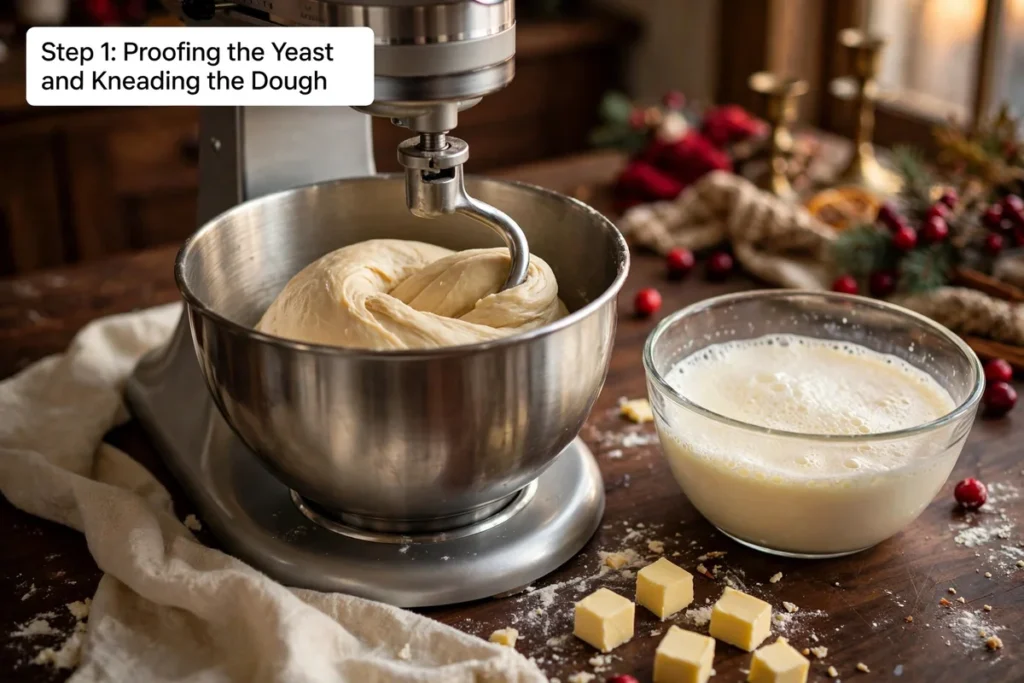
Proof the yeast in the warm milk with 1 tablespoon of the sugar for 5 to 8 minutes until foamy. Add the remaining sugar, the flour, salt, and egg. Knead with the dough hook at medium speed for 5 minutes. Add the butter cubes one at a time and knead 5 additional minutes until smooth and the windowpane test passes.Proof the dough.
Cover and proof at room temperature for 1 to 1.5 hours until doubled. Brush the muffin tin cups generously with melted butter.- Shape the Cloverleaf Rolls
Divide and roll the balls.
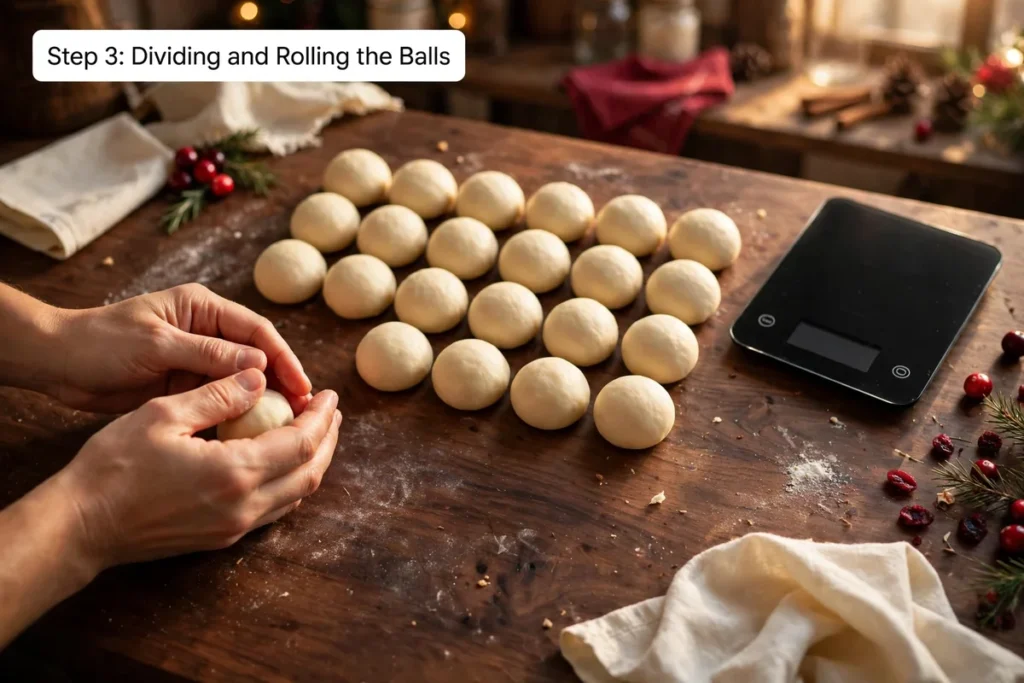
Turn the risen dough onto a lightly floured surface. Divide into 12 equal portions with the digital scale, about 58g each. Divide each portion into 3 equal pieces, about 19g each. Roll each small piece into a smooth, tight ball between your palm and the work surface.Fill the muffin cups.
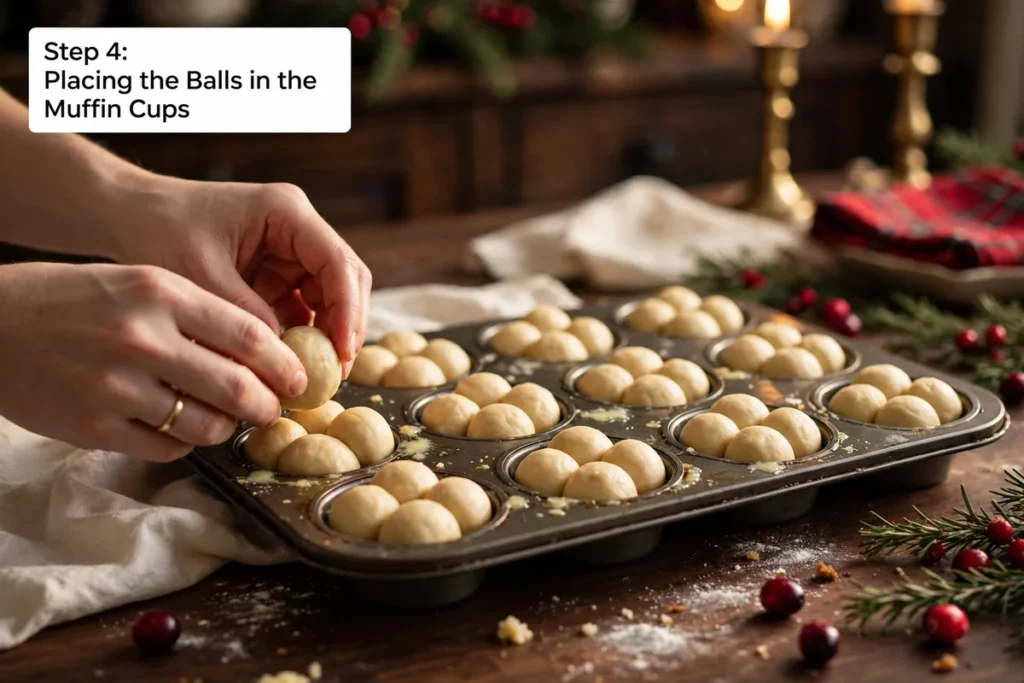
Place 3 balls seam-side down in each buttered muffin cup. The three balls should touch each other at their sides but not be compressed.Final proof.
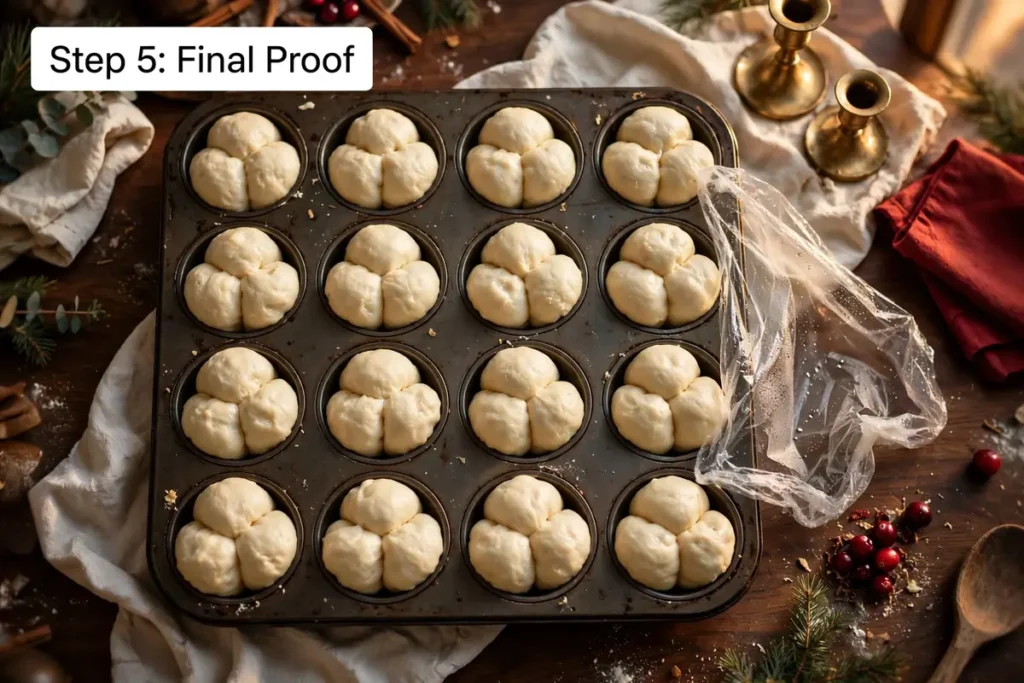
Cover the tin loosely with plastic wrap and proof at room temperature for 45 to 60 minutes until the three balls in each cup have fused at their contact points and extend above the rim as a three-lobed dome.- Bake and Finish
Preheat oven to 375°F (190°C). Bake 16 to 20 minutes until deeply golden at the lobe tops and baked through at the connections (the last areas to bake). Brush generously with melted butter immediately while still in the tin.
Cool in the tin for 5 minutes before unmoulding. Serve directly from the tin for the most impressive table presentation.
How Do You Make Cloverleaf Rolls Step by Step?
Make and Proof the Dough
Step 1. Proof the yeast in the warm milk with 1 tablespoon of the sugar for 5 to 8 minutes until foamy. Add the remaining sugar, the flour, salt, and egg. Knead with the dough hook at medium speed for 5 minutes. Add the butter cubes one at a time and continue kneading for 5 additional minutes until smooth and the windowpane test passes.

Step 2. Cover and proof at room temperature for 1 to 1.5 hours until doubled. Brush the muffin tin cups generously with melted butter.

Shape the Cloverleaf Rolls
Step 3. Turn the risen dough onto a lightly floured surface. Divide it into 12 equal portions using the digital scale, approximately 58g each. Divide each 58g portion into 3 equal pieces, approximately 19g each. Roll each small piece into a smooth, tight ball between the palm and the work surface. The rolling motion creates surface tension that produces a smooth, taut ball that holds its spherical shape during proofing rather than spreading flat.

Step 4. Place 3 balls seam-side down into each buttered muffin cup. The three balls should sit side by side touching each other but not compressed. They need sufficient contact area to fuse during proofing but sufficient individual volume to dome upward independently during baking.

Step 5. Cover the tin loosely with plastic wrap and proof at room temperature for 45 to 60 minutes until the three balls in each cup have risen to meet each other’s sides more fully, fused at their contact points, and extended above the muffin cup rim. Each cup now shows a three-lobed cloverleaf dome rising above the tin.

Bake and Finish
Step 6. Preheat the oven to 375°F (190°C). Bake for 16 to 20 minutes until deeply golden-brown at the lobe tops and baked through at the lobe connection points. The connections are the last areas to fully bake because they receive less direct oven heat. Brush generously with melted butter immediately upon removal from the oven, while the rolls are still in the tin and before unmoulding.

Step 7. Allow the rolls to cool in the tin for 5 minutes before unmoulding. Transfer to a wire rack or serve directly from the tin for the most impressive table presentation, since the muffin tin displayed at a holiday table communicates the rolls’ freshly baked status more effectively than a transferred basket.

Why Three Equal Balls Produce a Symmetrical Cloverleaf Where Unequal Balls Do Not
The symmetry of the finished cloverleaf roll is determined at the moment of the three-ball assembly in the muffin cup, not during baking. This is because the proofing and baking behavior of each ball is governed by its mass. A larger ball contains more yeast-generated carbon dioxide and more water vapor pressure during baking, proofing and rising to a greater height than a smaller ball at the same proof time and oven temperature. Three equal-mass balls generate equal internal pressure, proof to equal heights, and bake to equal dome heights, producing the three-lobed symmetry of the cloverleaf silhouette. A 25 percent mass difference between the largest and smallest ball produces a visible lobe height difference that most observers immediately register as asymmetric, because the visual expectation of three equal lobes is so strongly associated with the cloverleaf format that any asymmetry reads as a shaping error rather than as individual character.
How Do Cloverleaf Rolls Compare to Related Dinner Rolls?
| Attribute | Cloverleaf Rolls | Parker House Rolls | Potato Rolls | Brioche Rolls | Hawaiian Rolls |
|---|---|---|---|---|---|
| Shaping method | 3 balls in muffin cup, fused during proof | Single folded piece, half-moon fold with butter inside the fold | Single ball or oval, no special shaping | Single ball | Single ball, very soft and slightly sweet |
| Visual identity | Three-lobe cloverleaf dome | Folded, hinged roll with a defined crease | Smooth round | Smooth round, very pale golden | Smooth round, very pale and shiny |
| Enrichment level | Moderate | Moderate, with extra butter in the fold | High, potato adds richness | Very high, 50 percent butter of flour weight | High, pineapple juice, egg, and sugar |
| Primary texture | Soft interior, golden domed surface, pull-apart at the lobe connections | Soft interior, hinged structure that folds open | Very soft, slightly moist from potato starch | Extremely soft, very rich, buttery | Extremely soft, slightly sweet, pillowy |
| Cultural occasion | American holiday, Thanksgiving, Christmas, Easter | American fine dining, steakhouse tradition | American everyday and holiday | French, everyday luxury | American everyday, Hawaiian BBQ |
| Post-bake butter | Yes, defines the finish | Yes, standard | Optional | No | No |
What Variations Can You Make?
Herb Butter Cloverleaf Rolls
Brush each roll immediately after baking with herb butter, made from 2 tablespoons of melted unsalted butter combined with 1 teaspoon of finely chopped fresh rosemary, 1 teaspoon of fresh thyme, and 1 small garlic clove minced and briefly sautéed in the butter. The herb butter’s allicin from the garlic, thymol and carvacrol from the thyme, and camphor from the rosemary distribute through the crust as the butter absorbs into the hot roll surface, producing a savoury, aromatic dinner roll appropriate alongside roasted meats and vegetable dishes rather than the plain buttered version’s more neutral pairing versatility.
Whole Wheat Cloverleaf Rolls
Replace 1 cup (120g) of the all-purpose flour with 1 cup (120g) of whole wheat flour, maintaining the remaining 2 cups of all-purpose. Increase the milk by 2 tablespoons (30ml) to compensate for the whole wheat flour’s higher liquid absorption from its bran content. The whole wheat’s bran particles interrupt the gluten network slightly, producing a slightly denser, more textured roll with a nuttier, more complex flour flavor than the all-purpose version, which suits a health-forward holiday table where the whole grain character matches the occasion.
What Are the Most Common Problems?
| Problem | Most Likely Cause | Prevention or Fix |
|---|---|---|
| Asymmetric lobes with unequal dome heights | Three balls were unequal in size | Always weigh the three balls per portion with a digital scale. Visual estimation produces consistent 20 to 30 percent size variation that shows up as visibly asymmetric lobes. |
| Lobes separated rather than fused, with gaps between them after baking | Under-proofed, so the three balls did not fuse completely during proofing | Extend the final proof until the three balls visibly touch and merge at their sides with no gap between them before baking. |
| Rolls stuck to the muffin cups | Cups not generously buttered | Brush the cups generously, because a thin butter coat is insufficient. If a roll sticks, run a thin knife around its edge and lift gently. |
| Pale, under-browned lobe tops | Oven temperature too low, or a dark tin that absorbed the heat that should have gone to the tops | Use the specified 375°F and a standard light-colored muffin tin. Increase to 390°F for the final 3 minutes if the tops remain pale after 20 minutes. |
How Do You Store Cloverleaf Rolls?
| Storage Method | Duration | Instructions |
|---|---|---|
| Room temperature, in a covered container or bread bag | Up to 2 days | Cover immediately after the post-bake butter has set to prevent drying. Rewarm in a 325°F oven for 5 minutes to restore the butter-softened exterior. |
| Frozen, individually in plastic wrap | Up to 2 months | Freeze after complete cooling. Thaw at room temperature for 30 minutes, or rewarm from frozen in a 350°F oven for 8 minutes. |
Scaling
| Rolls | All-Purpose Flour | Milk | Butter (dough) | Eggs | Yield |
|---|---|---|---|---|---|
| 6 rolls | 180g | 90ml | 28g | 1 egg | 1 muffin tin, half filled |
| 12 rolls (standard) | 360g | 180ml | 57g | 1 egg | 1 full muffin tin |
| 24 rolls | 720g | 360ml | 114g | 2 eggs | 2 muffin tins |
Nutritional Information
Per serving: 1 roll approximately 60g including post-bake butter, based on 12 rolls. Values calculated using USDA FoodData Central reference data.
| Nutrient | Per Serving | Nutrient | Per Serving |
|---|---|---|---|
| Calories | 188 kcal | Total carbohydrate | 28g |
| Total fat | 6g | Dietary fibre | 1g |
| Saturated fat | 3.5g | Total sugars | 4g |
| Cholesterol | 32mg | Protein | 5.2g |
| Sodium | 198mg | Iron | 1.8mg (10% DV) |
Frequently Asked Questions
Each ball’s dome height during proofing and baking is determined by its mass — a larger ball contains more active yeast cells producing more carbon dioxide gas and more water vapor generating internal pressure during baking, proofing and doming to a greater height than a smaller ball at the same proof time and temperature. Three equal-mass balls generate equal internal expansion pressure, proof to equal heights, and bake to equal dome heights. A 25 percent mass difference between the largest and smallest ball produces a visible lobe height difference that reads immediately as asymmetric — symmetry requires equal mass, which requires a digital scale.
The hot crust soaks up the melted butter, which softens the top, adds flavor, and gives the rolls a glossy finish. Brush them as soon as they come out of the oven, while they’re still in the tin. For a deeper golden color, you can also brush the rolls with 1 egg beaten with 1 tablespoon of milk just before baking.
Yes — two make-ahead approaches work. After shaping the three balls into the buttered muffin cups, cover tightly with plastic wrap and refrigerate immediately before the final proof. The cold temperature slows yeast activity to near zero and holds the shaped rolls overnight. The next morning remove from the refrigerator, allow to proof at room temperature for 1 to 1.5 hours — longer than the standard final proof because the cold dough must warm before it can proof — until the lobes have risen above the tin rim and fused, then bake as directed. Alternatively, bake the rolls completely the night before and reheat in a 325°F oven for 5 to 8 minutes immediately before serving.
The muffin cup’s circular boundary prevents the three proofing balls from spreading outward during the final proof — without the cup’s walls the balls would proof into a flat, wide cluster rather than rising upward to form domed lobes. The cup constrains the dough’s lateral expansion, directing the proofing gas pressure upward into the dome shape that produces the three-lobe cloverleaf silhouette. The cup’s rounded base also produces the roll’s characteristic straight sides and domed top profile that distinguishes cloverleaf rolls from the free-form, irregular-shaped rolls baked on an unconstrained flat sheet.
Cloverleaf rolls are classic American enriched dinner rolls whose three-lobe silhouette, first documented in Fannie Merritt Farmer’s 1896 Boston Cooking School Cook Book and established as a fixture of the American holiday dinner table through the mid-20th century community cookbook and women’s magazine tradition, is produced by placing three precisely equal-weight balls of buttery yeasted dough into a single buttered muffin cup and proofing them together until the balls fuse at their contact points and extend above the cup rim as three distinct domes that constitute the cloverleaf’s characteristic symmetrical visual, a symmetry that equal mass alone guarantees because each ball’s dome height is determined by its internal yeast population and water vapor pressure, which scale directly with the dough mass. That makes the digital scale at the dividing stage the most consequential equipment choice in the recipe.

Table of Contents
Recent Recipes
American · Bread Coffee Cake Bread Recipe An American yeasted sweet bread in which an enriched dough is filled with […]
Check Out..!Recent Blogs
I’ve glazed our Amish apple cake too hot, too cold, and exactly right, and the difference is not small. The […]
Read Blog..!I’ve pulled a sunken Amish Apple Cake out of my oven, and I know the exact sinking feeling that comes […]
Read Blog..!A cup measures volume, not weight, so a cup of flour and a cup of sugar weigh completely different amounts. […]
Read Blog..!Every pasta shape was designed to carry a certain kind of sauce. Thin strands suit light sauces that coat, wide […]
Read Blog..!Every egg method, from a jammy boiled egg to a silky French omelet, comes down to one fact: the white […]
Read Blog..!