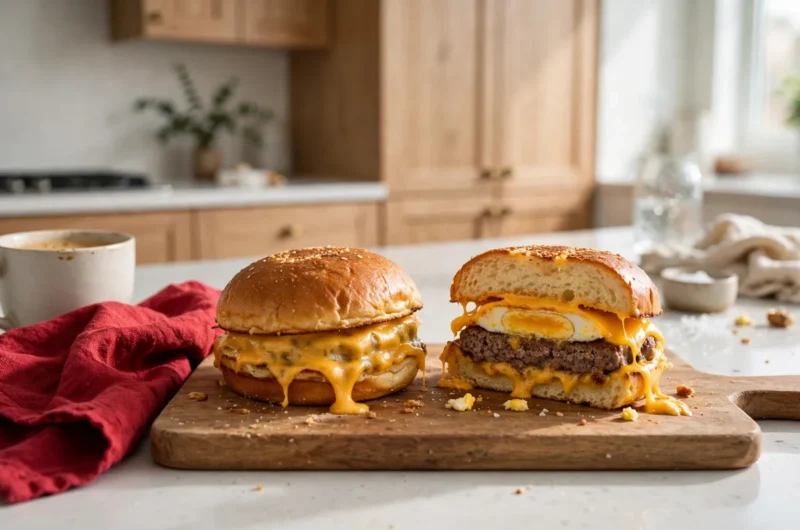
At Recipe Journalist, we research recipes so you do not have to guess. This Wendy’s breakfast sandwiches recipe is a home copycat built around one decision: steam the egg in a ring mold so it cooks into a thick, tender round that fits the bun. Do that and you get a hot, cheesy, well-built sandwich in 45 minutes, with the make-ahead and freezer options a drive-through order never gives you.
Here is the reasoning. Egg whites begin to set near 144°F (62°C) and yolks near 149°F (65°C), and the egg turns rubbery above about 185°F (85°C). Steam heats gently and evenly, so the egg sets without browning or toughening.
This is an independent copycat, not Wendy’s official recipe, and it is not affiliated with or endorsed by Wendy’s. Wendy’s brought breakfast back nationwide on March 2, 2020, with sandwiches on croissants, biscuits and buns, each built on a fresh-cracked egg, cheese, and breakfast meat. This copycat follows the classic sausage, egg and cheese sandwich.
What Is a Wendy's Breakfast Sandwich?
A Wendy’s breakfast sandwich is a hot sandwich of egg, melted cheese, and breakfast meat on a toasted bun, croissant, or English muffin. This copycat uses a toasted brioche-style bun, a steamed round egg, American cheese, and sausage or bacon. Here is how it differs from similar sandwiches:
- Egg McMuffin style: uses an English muffin and Canadian bacon.
- Diner breakfast sandwich: often uses a fried egg with a runny yolk, which is messier.
- Breakfast burrito: uses scrambled egg wrapped in a tortilla.
- Frozen breakfast sandwich: is assembled in a factory and reheated, usually with a drier egg.
Which Bun or Bread Works Best?
Use a brioche-style bun, a croissant, or an English muffin. Wendy’s serves the classic sandwich on a plain toasted bun; brioche is the richer home version, and it is what this recipe is written for. Brioche holds butter and toasts golden, and its sweetness balances salty sausage. Croissants are flakier and buttery but crush easily, and English muffins give the most crunch and nooks.
How Do You Get the Egg Round and Fluffy?
Use a greased 3 1/2-inch ring mold or a mason jar lid ring in a nonstick skillet. Add a splash of water and cover the pan, and the steam sets the top without flipping. The ring shapes the egg to fit the bun, and steam keeps it tender.
Which Cheese Melts Best?
Use classic American cheese slices. They contain emulsifying salts, which keep the cheese smooth when melted, so it drapes over the egg without turning oily. Sharp cheddar tastes stronger but melts less smoothly.
Can You Make These Ahead?
Yes. Wrap cooled sandwiches in parchment and foil, refrigerate up to 3 days or freeze up to 1 month, and reheat in the oven or microwave.
What Equipment Do You Need?
- Nonstick skillet with lid: 10-inch or 12-inch, for steaming the eggs.
- Egg ring molds: 3 1/2-inch, or mason jar lid rings.
- Second skillet or griddle: for sausage and toasting buns.
- Mixing bowl and fork: for seasoning the sausage.
- Kitchen scale: for even 3 oz (85g) patties.
- Thin spatula: for flipping patties and lifting eggs.
- Instant-read thermometer: confirms 160°F (71°C) in the sausage.
- Parchment and foil: for make-ahead wrapping.
What Ingredients Do You Need?
Use large eggs at room temperature, and cheese slices straight from the refrigerator, because they stay neat when placed on the hot egg. Soften the butter for the buns so it spreads without tearing them. Use halal-certified American cheese.
For the Sausage Patties
For the Sandwiches
Step by Step Process
Make the Sausage Patties
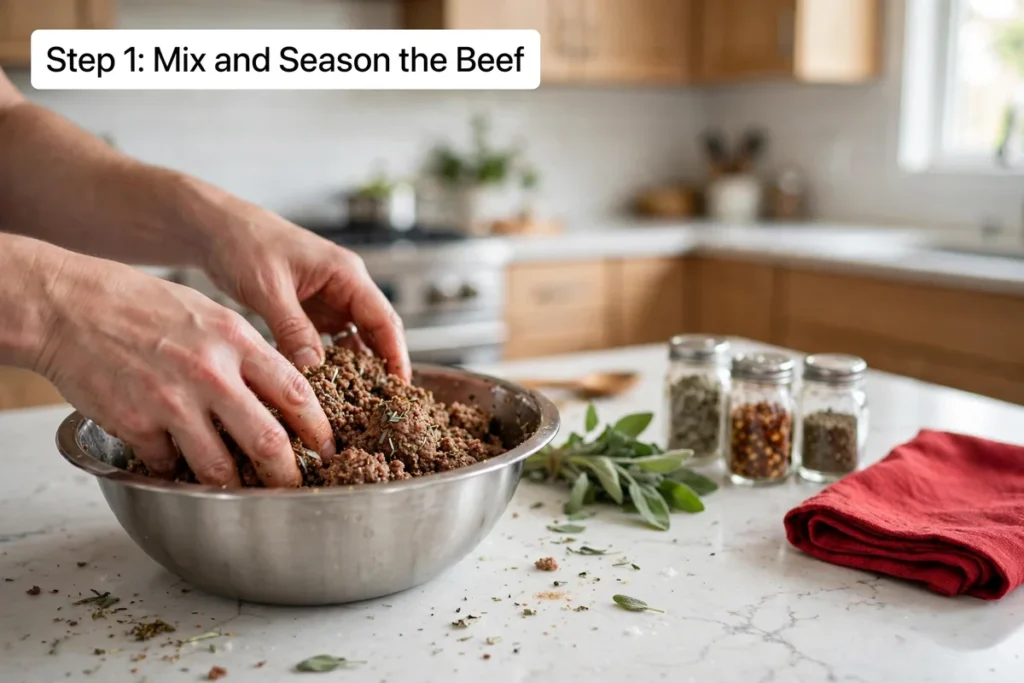
Step 1. Mix the beaf, salt, sage, pepper, paprika, garlic powder, and maple syrup with your hands for 30 seconds, only until tacky. Salt dissolves the muscle protein myosin, which binds the meat, but extra mixing makes the patties tight and rubbery. Keep the beaf cold, since warm fat smears and runs out in the pan.
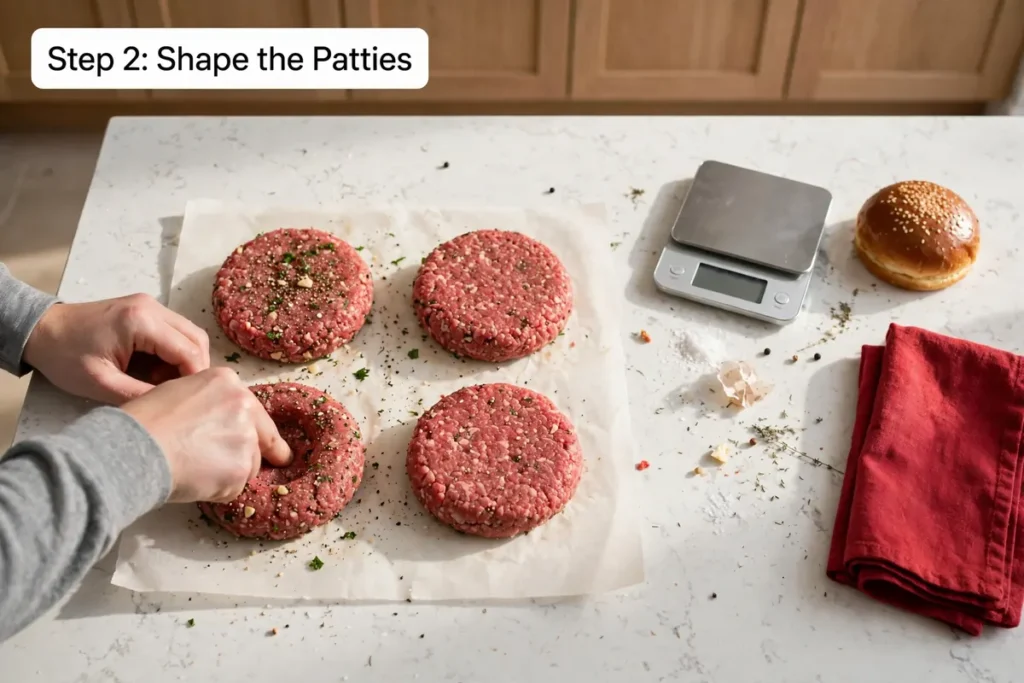
Step 2. Divide into 4 portions of 3 oz (85g). Press each into a disc about 4 inches wide and 1/2 inch thick, a little wider than the bun, then dimple the center. Patties shrink about 10 to 15 percent as they cook and the middle puffs, so the extra width and the dimple keep them flat and bun-sized. Chill 15 minutes.
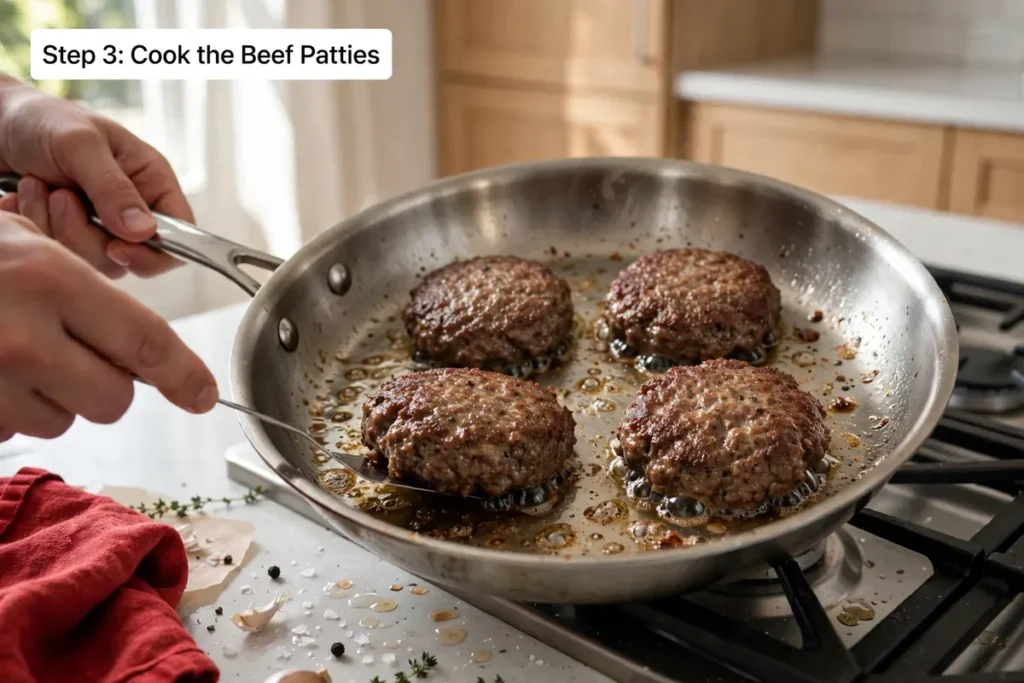
Step 3. Heat a skillet over medium heat for 2 minutes and add 1 teaspoon of oil. Cook the patties 4 minutes without moving, until the underside is deep brown. Browning is the Maillard reaction, where amino acids and sugars react above about 300°F (150°C) to create savory flavor, and it needs steady contact. Flip and cook 3 to 4 minutes more until the center reads 160°F (71°C). Ground beef is safe at that temperature.
Toast the Buns
Step 4. Split the buns and spread the cut sides with softened butter. Toast them cut-side down in a skillet over medium heat for 1 to 2 minutes until golden. Butter on the cut surface fries it into a thin crisp layer that blocks moisture from the egg and cheese, which keeps the bun from turning soggy. Brown sugars and milk solids in the bread also caramelize for flavor.
Steam the Eggs
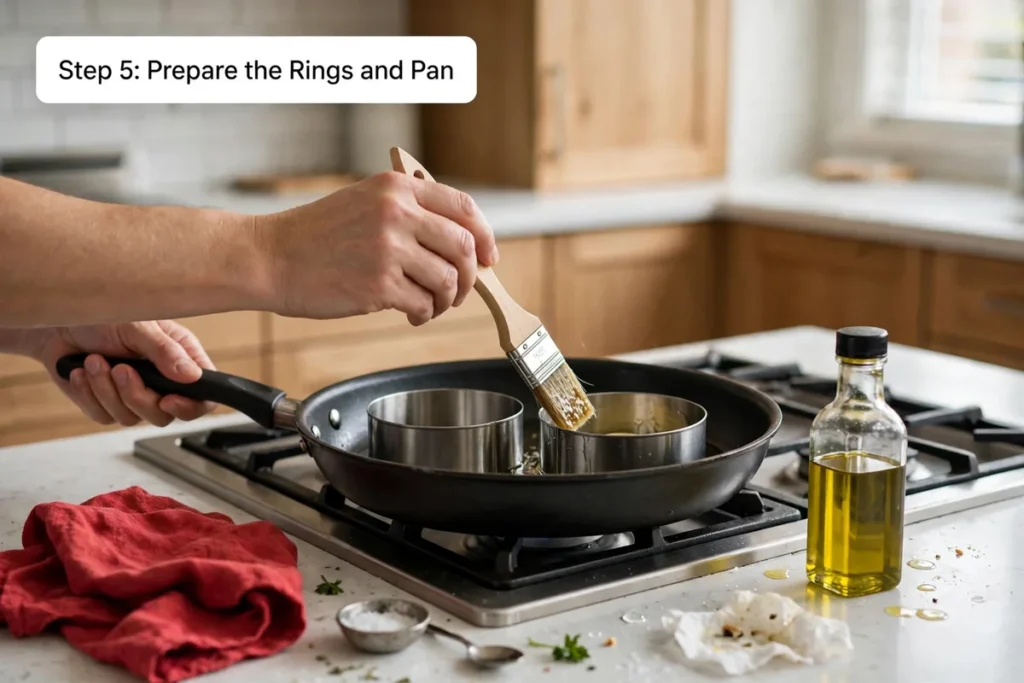
Step 5. Wipe the nonstick skillet, set it over medium-low heat, and brush the inside of the ring molds and the pan with oil or butter. Place the rings in the pan. Medium-low heat is gentle enough to set the egg without browning the bottom, and grease keeps the egg from sticking to the ring.
Step 6. Crack one egg into each ring and break the yolk gently with a fork. Season with salt and pepper. Add 1 teaspoon of water to the pan beside each ring, cover with the lid, and cook 3 to 4 minutes. The water turns to steam under the lid and heats the top of the egg gently, so the egg sets through without flipping. Broken yolk gives a fully cooked, tender egg that holds its shape in a sandwich.
Step 7. Place a slice of American cheese on each egg during the last 30 seconds, then re-cover the pan. The leftover steam melts the cheese without a separate step, and emulsifying salts in American cheese keep it smooth. Run a thin knife around each ring to release the egg.
Assemble and Serve
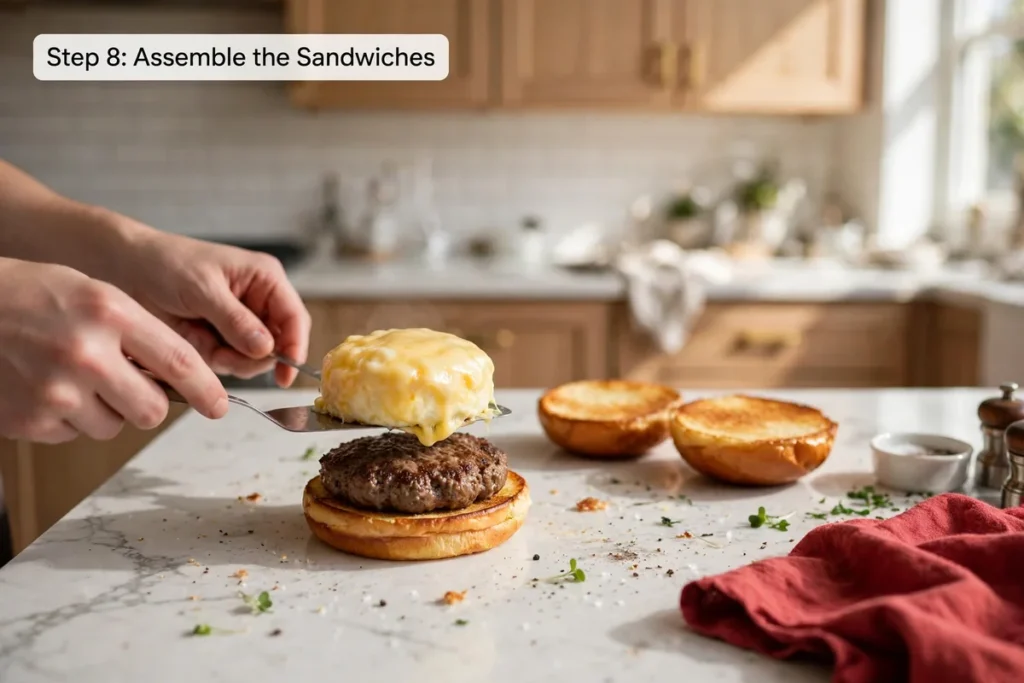
Step 8. Build in this order: bottom bun, sausage patty, egg and cheese, optional bacon, top bun. Press down gently. Put the heat-holding ingredients together so the melted cheese bonds the layers, and keep the bun on the outside so it stays crisp. Serve right away.
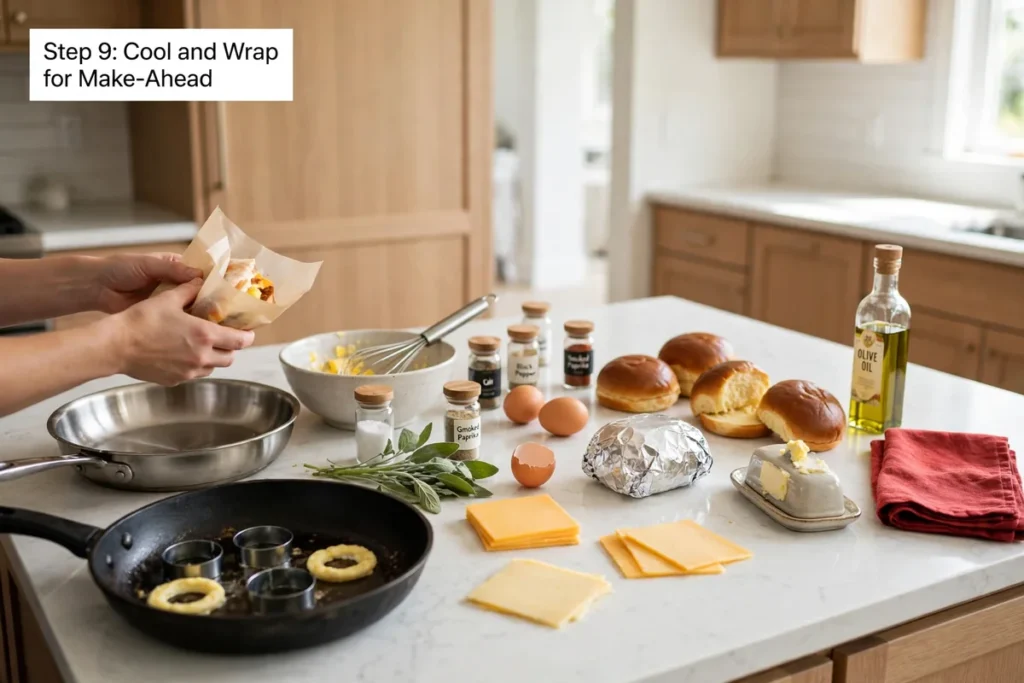
Step 9. To make ahead, cool the sandwiches for 10 minutes, wrap each in parchment, then foil, and refrigerate up to 3 days or freeze up to 1 month. Cooling first avoids trapped steam, which makes the bun soggy.
Why Does Steaming the Egg Make a Better Sandwich?
Four points explain the method.
Gentle heat sets the egg tender. Whites bond near 144°F (62°C) and yolks near 149°F (65°C). Steam holds the egg close to those temperatures, so the proteins form a soft network.
Overcooking squeezes out water. Above about 185°F (85°C), proteins tighten and push water out, called syneresis, which makes a rubbery egg and a wet bun.
A ring controls shape and height. The mold forces the egg to rise instead of spreading, so it fits the bun.
Emulsifiers keep cheese smooth. American cheese contains emulsifying salts, so it melts into a uniform layer instead of separating into oil.
The order follows: gentle steam, cheese on top at the end, and a buttered bun that blocks moisture.
How Does the Copycat Compare to Other Breakfast Sandwiches?
The copycat trades a few extra minutes for better texture and full ingredient control.
What Variations Can You Make?
Bacon, Egg, and Cheese
Skip the sausage and use 2 slices of halal beef bacon or turkey bacon per sandwich. Bake the beef bacon at 400°F (204°C) for 12 to 15 minutes on a rack, since the rack lets fat drip away and the slices cook flat.
Croissant Sandwich
Use butter croissants, split and warmed at 350°F (177°C) for 5 minutes. Skip the buttered toasting, since croissants carry their own butter. Handle them gently so the layers do not crush.
Spicy Sausage Sandwich
Add 1/2 teaspoon of cayenne and 1/2 teaspoon of red pepper flakes to the patties, plus pepper jack cheese. Capsaicin dissolves in fat, so the heat spreads through the patty.
Turkey Sausage Sandwich
Use 12 oz (340g) of ground turkey thigh with 1 tablespoon of olive oil. Cook to 165°F (74°C), since poultry has a higher safe temperature.
Biscuit Sandwich
Use split buttermilk biscuits, warmed 5 minutes at 350°F. Biscuits are crumbly, so assemble gently and skip the butter on the cut sides.
Dietary Adjustments and Substitutions
Dairy-Free Version
Use dairy-free cheese and a dairy-free bun, with oil instead of butter.
Gluten-Free Version
Use gluten-free buns and check the sausage seasoning for added wheat. The patties use no breadcrumbs.
Lower-Calorie Version
Use turkey sausage, one slice of reduced-fat cheese, and an English muffin. Drop the butter on the bun.
Higher-Protein Version
Add a second egg or an extra patty, and use egg whites for part of the egg.
Why Is My Breakfast Sandwich Soggy, Rubbery, or Bland?
Soggy buns are an assembly and moisture problem, and rubbery eggs are a heat problem.
How Do You Store, Freeze, and Reheat Them?
Serve alongside a One Skillet Breakfast Casserole or use the Breakfast Sausage Patties.
Scaling
Cook the sausage and eggs in batches, since a crowded pan steams them.
Nutritional Information
Per serving: 1 sandwich with sausage. Estimates based on USDA FoodData Central values.
Frequently Asked Questions