
American (Pennsylvania Dutch) · Fruit Cakes Amish Apple Cake Recipe A moist, oil-based spiced sheet cake made with pre-cooked diced […]
Check Out..!
American · Cakes
Chocolate Brownie Cake Mix Recipe
This chocolate brownie cake mix recipe leaves out the water on the box. Less liquid means less rise and a dense, fudgy bite. Here is the ratio that works.
- Prep: 10 min
- Cook: 30 min
- Total: 45 min
- Servings: 16
- Difficulty: Easy
- Dietary: Vegetarian
 Chef's review · Saba Aftab, Pastry Chef · Reviewed Nov 10, 2026
“Add one extra egg yolk to any box mix. The yolk's lecithin emulsifies the fat into a tighter matrix, producing a fudgier, denser crumb than the standard whole-egg formula the manufacturer calibrated for broad appeal rather than maximum fudge density.”
Our investigation: 33 box-mix brownie cake recipes follow package instructions verbatim without addressing the lecithin deficit, accepting a cakey, loose crumb that the manufacturer calibrated for the widest possible consumer acceptance rather than the dense, fudgy result that every baker actually wants from a brownie cake.
Chocolate brownie cake mix is an American home baker’s hybrid preparation in which a standard box of chocolate brownie mix Betty Crocker, Ghirardelli, Duncan Hines, or Pillsbury is elevated beyond its baseline package result through a set of targeted ingredient modifications that shift the finished product from the manufacturer’s calibrated middle-ground cakey-fudgy compromise toward the deeply fudgy, dense, intensely chocolate brownie cake that the box’s marketing photographs promise but its standard formula does not reliably deliver. The extra egg yolk is the single most critical modification. Every commercial brownie mix formula is calibrated for the whole-egg addition specified on the package a balance point between the albumin’s structural protein contribution that produces a cakey result and the yolk’s lecithin emulsification that produces a fudgy result. Adding one extra egg yolk without its white tips this balance decisively toward the yolk side the additional lecithin emulsifies the batter’s fat into a tighter, more uniform distribution through the aqueous phase, producing a crumb where the fat remains integrated through the full matrix rather than pooling between protein strands, and the result is the densely fudgy, moist, close-crumbed brownie cake that the standard formula never quite achieves regardless of how precisely the package instructions are followed.
The chocolate brownie cake mix format exists at a specific cultural moment in American baking the 2000s and 2010s convergence of convenience food culture with the growing American interest in elevated home baking quality, producing the “box mix hack” genre of American food content whose fundamental premise is that the commercial convenience product provides the correct structural foundation while the home baker’s targeted modifications provide the quality gap between adequate and genuinely excellent. The genre’s most influential practitioner in the American food media is the community of baker-bloggers who collectively documented through trial and error the specific modifications extra fat, extra yolk, milk instead of water, brown butter that reliably improve commercial brownie mix results, with the extra egg yolk modification emerging as the most universally applicable and most scientifically grounded of the category’s interventions because it targets the specific chemical deficit lecithin emulsification that the manufacturer’s formula deliberately leaves partially unfulfilled in the interest of maintaining a cakey-fudgy middle ground
What Is Chocolate Brownie Cake Mix?
Chocolate brownie cake mix in the context of this recipe refers to a box of commercial chocolate brownie mix elevated through targeted modifications rather than a homemade brownie mix recipe from scratch. The distinction matters because the commercial mix’s pre-formulated flour-cocoa-leavening-sugar balance provides a calibrated foundation that the modifications build on rather than replace the goal is not to make a scratch brownie cake using the box as a partial ingredient but to make the box’s own recipe categorically better than its package instructions produce.
The preparation occupies a specific category between two extremes. It differs from a from-scratch brownie cake which provides full control over every ingredient ratio in that the commercial mix’s pre-blended dry ingredients eliminate the precision measurement and sifting steps that scratch brownie production requires, making the modified box-mix approach genuinely faster and more reliable for a home baker who wants a consistently excellent result without the margin of error that scratch brownie baking introduces. It differs from the unmodified box mix result in that the targeted modifications extra yolk, butter substitution, milk instead of water, optional espresso powder and vanilla amplification produce a brownique cake that most tasters cannot distinguish from a high-quality scratch recipe when both are served blind.
What Equipment Do You Need?
| Equipment | Specification | Why It Matters |
|---|---|---|
| 9x13-inch baking pan | Light-colored aluminum 2 inches deep minimum | The standard brownie mix box formula is calibrated for a 9x13-inch pan; using a smaller pan produces a thicker result that requires significantly extended baking time and produces a less even crumb structure than the manufacturer's calibrated depth. |
| Large mixing bowl | Minimum 4-quart | For combining the mix with the wet ingredients; the extra yolk and butter substitution add volume beyond the package instructions' ingredient list and require a bowl with sufficient room for vigorous hand mixing. |
| Wooden spoon or rubber spatula | Standard | The brownie cake mix batter must be mixed by hand rather than with an electric mixer. Electric mixer over-aerates the batter incorporating too much air into the fat-sugar matrix; producing a cakey, risen result rather than the dense, flat, fudgy brownie cake that the modifications target. |
| Small saucepan | 1-quart | For browning the butter; the optional but strongly recommended brown butter modification requires a small light-colored saucepan to monitor the milk solid browning progression through the amber to golden-brown target without overshooting to burnt. |
| Toothpick or thin skewer | Standard | For the brownie cake doneness test the brownie cake is done when the toothpick comes out with moist, fudgy crumbs rather than the wet batter that indicates underbaking or the clean pull that indicates overbaking to a dry result. |
What Ingredients Do You Need?
Use a high-quality commercial brownie mix as the base Ghirardelli Double Chocolate Brownie Mix produces the most chocolate-forward baseline of the widely available American grocery store options, with a higher cocoa solid content than Betty Crocker or Duncan Hines standard brownie mixes. Pillsbury Fudge Supreme and Betty Crocker Supreme Fudge Brownie Mix are strong alternatives. The modifications are calibrated for a standard 18 to 20 oz box serving a 9×13-inch pan adjust proportionally for smaller box sizes.
The Base Box Mix and Modifications
| Ingredient | Package Specification | Modified Specification | Why the Change Matters |
|---|---|---|---|
| Commercial chocolate brownie mix | 1 box 18 to 20 oz | Same | The pre-formulated foundation flour, cocoa, sugar, leavening in manufacturer's calibrated balance |
| Eggs | As specified on box typically 2 large | 2 large eggs plus 1 additional egg yolk | The extra yolk's lecithin emulsifies fat into a tighter matrix, producing a fudgier, denser crumb |
| Water | As specified on box typically 1/4 cup | Replace entirely with whole milk or buttermilk at the same volume | Milk's dissolved protein and fat increase the batter's richness and produce a more tender, more moist crumb than water's neutral contribution |
| Vegetable oil | As specified on box typically 1/2 cup | Replace entirely with unsalted butter melted and browned at the same volume | Brown butter's diacetyl and Maillard aromatic compounds add caramelised dairy depth that vegetable oil's flavourless fat cannot provide |
Additional Modifications — All Optional but Recommended
| Ingredient | Quantity | Function |
|---|---|---|
| Instant espresso powder | 1 teaspoon (2g) | Dissolved in the milk before adding to batter amplifies the cocoa's pyrazine and furanone roasted aromatic compounds through the same synergistic mechanism documented across every chocolate preparation in this collection. Does not produce a coffee flavor at this quantity produces deeper, more complex chocolate character. |
| Pure vanilla extract | 1 teaspoon (5ml) beyond any specified in the box instructions | Amplifies the chocolate's aromatic complexity through the shared aromatic family of vanilla's vanillin and chocolate's aldehyde compounds the same vanilla-chocolate complementarity that makes vanilla extract a standard inclusion in every from-scratch brownie recipe. |
| Dutch-process cocoa powder | 1 tablespoon (6g) added to the mix | Increases the cocoa solid concentration beyond the manufacturer's calibrated level, shifting the flavor toward a more intensely chocolate, more bitter result. Dutch-process rather than natural cocoa's acidity would react with the mix's pre-calibrated leavening system. |
| Mini chocolate chips | 1/2 cup (85g) folded in last | Tossed in 1 teaspoon of flour before folding the flour coating prevents sinking and distributes chips through the dense batter. Provides pockets of additional melted chocolate in the finished crumb. |
| Flaky sea salt | 1/2 teaspoon scattered over the batter surface before baking | Suppresses bitter receptor activation from the dark chocolate's chlorogenic acids through the same mechanism documented in the chocolate orange cake and dark chocolate Tandy Cake allowing the roasted aromatic complexity to register more clearly against a less perceived-bitter background. |
Chocolate Brownie Cake Mix
A box of commercial brownie mix elevated with an extra egg yolk, browned butter, milk instead of water, and optional espresso powder for a dense, fudgy crumb.
Prep time
10
minutesCooking time
30
minutesCool
1
hrTotal
1 hr 40
minutes Yield
16
servingsEasy
Ingredients
- The Base Box Mix and Modifications
1 box (18 to 20 oz) commercial chocolate brownie mix
2 large eggs plus 1 additional egg yolk
1/4 cup (60ml) whole milk or buttermilk — replaces the water
1/2 cup (113g) unsalted butter — melted and browned
- Additional Modifications — All Optional
1 teaspoon (2g) instant espresso powder
1 teaspoon (5ml) pure vanilla extract
1 tablespoon (6g) Dutch-process cocoa powder
1/2 cup (85g) mini chocolate chips
1/2 teaspoon flaky sea salt
Instructions
- Brown the Butter
Brown the butter:
Melt over medium heat, swirl until milk solids turn golden-brown and fragrance is nutty, ~5–6 min total. Pour into mixing bowl; cool 5 min.- Prepare the Batter
Prep oven & milk:
Preheat to box-specified temperature (typically 325–350°F). Dissolve espresso powder in milk; add vanilla. Grease and parchment-line 9x13 pan.Mix by hand:
Combine brownie mix, browned butter, milk mixture, 2 eggs, and extra yolk. Add cocoa if using. Stir 40–50 strokes until smooth. Do not overmix.Add chips & salt:
Fold in flour-tossed chips (3–4 strokes). Pour into pan, spread evenly, scatter flaky salt on top.- Bake
Bake:
Bake 3–5 min under package minimum. Toothpick should show moist fudgy crumbs, not wet batter or clean.Cool:
Cool completely in pan on wire rack, 1 hour minimum. Refrigerate 1 hour for cleanest cuts.- Cut and Serve
Cut:
Lift from pan using parchment overhangs. Cut 4x4 into 16 squares with a sharp knife wiped clean between cuts.
Step by Step Process
Brown the Butter
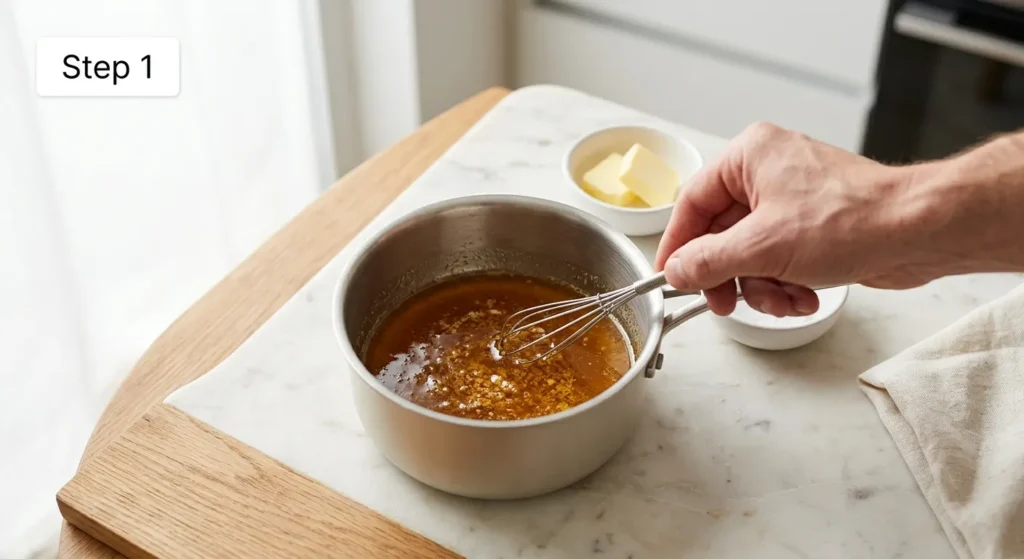
Step 1. Place the butter in the small light-colored saucepan over medium heat. Cook, stirring occasionally, until the butter melts completely, begins to foam, and the foam subsides approximately 3 minutes. Continue cooking, swirling the pan frequently, until the milk solids at the base turn golden-brown and the butter produces a distinctly nutty, caramelised fragrance approximately 2 to 3 additional minutes past the foam subsidence. Remove from heat immediately and pour into the large mixing bowl to stop the browning. Allow to cool for 5 minutes.
The browned butter modification is the most impactful single change beyond the extra egg yolk the Maillard-generated diacetyl and acetoin produced when the milk solids brown above 250°F produce the warm, caramelised dairy complexity that makes brown butter-based brownies taste categorically more sophisticated than oil-based versions at the same chocolate concentration. This is identical to the butterscotch cake’s foundational technique browning butter to produce diacetyl before assembling the batter applied to the commercial brownie mix context.
Prepare the Batter
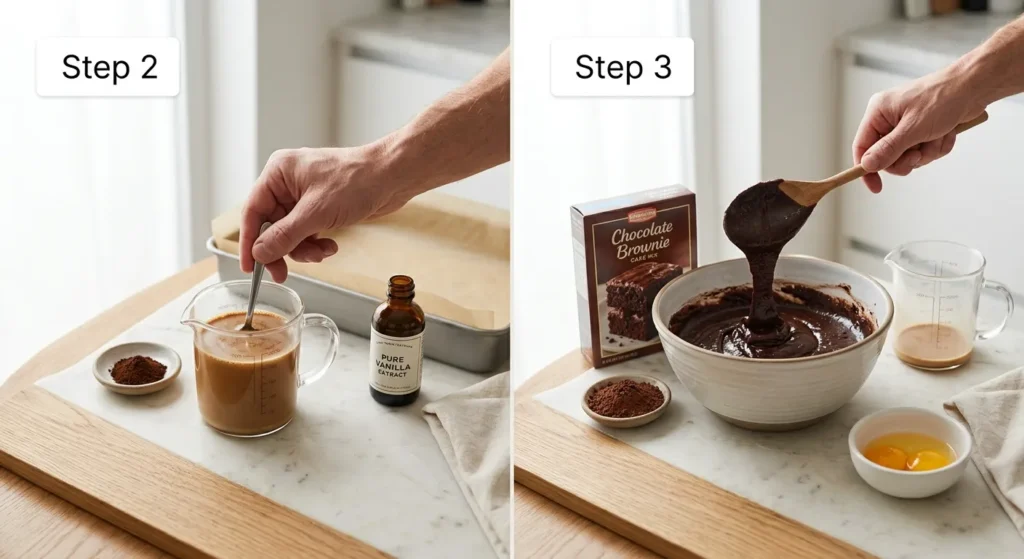
Step 2. Dissolve the instant espresso powder in the measured whole milk or buttermilk stir for 30 seconds until no powder remains visible. Add the vanilla extract to the milk. Preheat the oven to the temperature specified on the brownie mix box typically 325 to 350°F depending on the brand. Grease the 9×13-inch pan and line with parchment paper leaving overhangs on the two long sides for clean lifting after baking.
Step 3. Pour the brownie mix into the large mixing bowl. Add the cooled browned butter, the espresso-vanilla milk, the 2 whole eggs, and the extra egg yolk. If using, add the Dutch-process cocoa powder directly to the dry mix before adding the wet ingredients. Mix with the wooden spoon or rubber spatula by hand 40 to 50 vigorous strokes until the batter is completely smooth with no dry mix visible.
Stop mixing the moment the batter is smooth. Over-mixing a brownie batter even a box-mix based one incorporates air that works against the dense, fudgy result the modifications target. The modified batter should be thick, glossy, and flow slowly from the spoon noticeably thicker than the unmodified package formula’s batter from the butter’s higher viscosity relative to vegetable oil and the whole milk’s protein content.
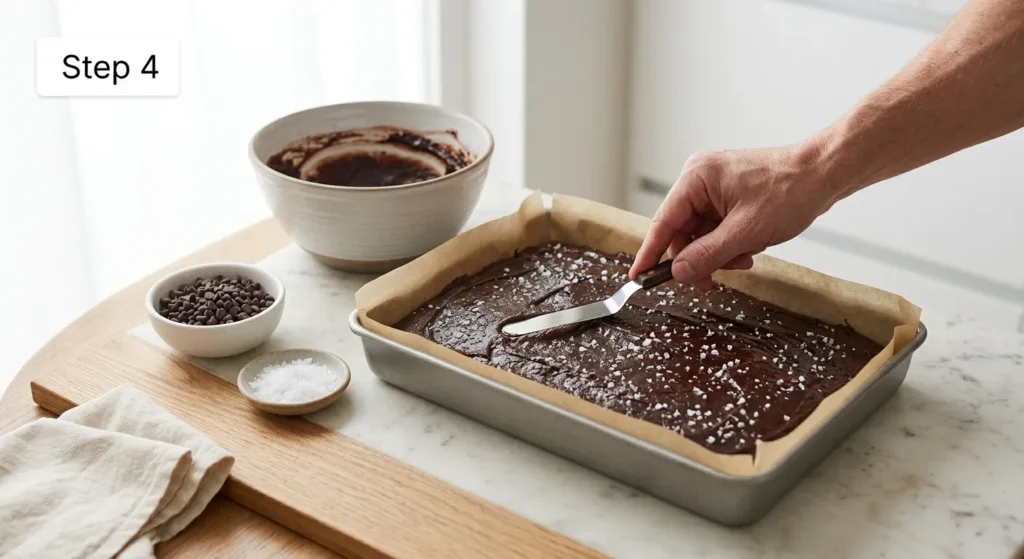
Step 4. Fold in the mini chocolate chips tossed in flour if using 3 to 4 strokes only to distribute without over-mixing. Pour and scrape the batter into the prepared pan. Spread to the edges with the spatula. Scatter the flaky sea salt evenly over the full batter surface if using.
Bake
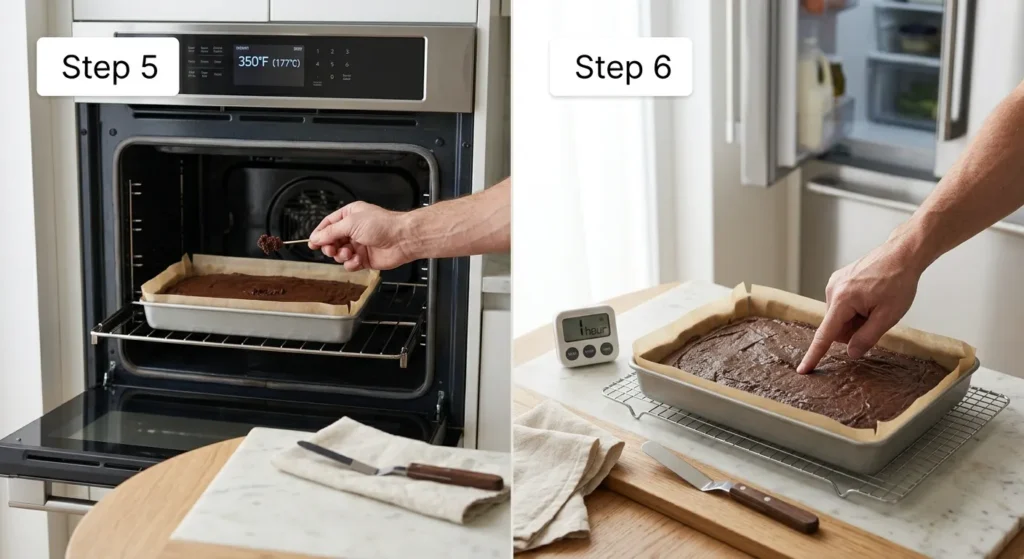
Step 5. Bake at the box-specified temperature for the box-specified time minus 3 to 5 minutes the modifications (butter instead of oil, milk instead of water, extra yolk) produce a batter that bakes slightly faster than the package formula from the butter’s water content adding steam heat and the milk’s protein contributing to earlier structural set. Begin checking at 3 minutes before the minimum package time.
Verify doneness with the toothpick test but calibrate the target specifically for the fudgy brownie cake result. The toothpick should come out with moist, fudgy crumbs clinging to it not wet batter and not completely clean. A completely clean toothpick indicates the brownie cake has baked to the cakey end of the spectrum still edible but outside the fudgy-dense target the modifications aim for. Remove at moist crumbs.
Step 6. Remove from the oven. Allow to cool completely in the pan on a wire rack minimum 1 hour before cutting. The brownie cake continues setting during the cooling period as the fat solidifies and the egg protein network contracts around the chocolate and fat distribution the brownie cake at room temperature is measurably denser and more fudgy than the same brownie cake at 5 minutes post-oven, making the full cooling period mandatory rather than advisory.
For the densest, most fudgy result and the cleanest, most even cut squares refrigerate the completely cooled brownie cake for 1 hour before cutting. Cold fudgy brownie cake cuts with a clean, defined edge rather than the slightly ragged, compressed edge of a warm brownie cut under the knife’s pressure.
Cut and Serve
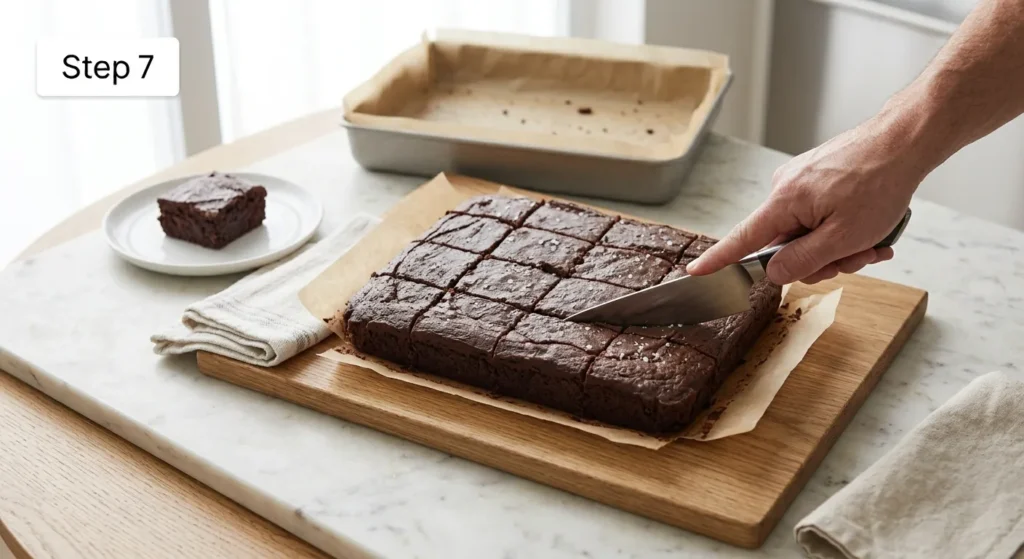
Step 7. Lift the cooled brownie cake from the pan using the parchment overhangs. Transfer to a cutting board. Cut into 16 equal squares 4 cuts along the long dimension, 4 cuts along the short dimension using a sharp chef’s knife wiped clean between every cut. Warm-wiping the blade (no need for hot water as with the Tandy Cake’s chocolate shell) removes the sticky brownie crumbs that accumulate on the blade after the first cut and compress the subsequent cuts’ edges.
Why the Extra Egg Yolk Produces Fudgy Where the Standard Formula Produces Cakey
Every commercial brownie mix formula occupies a deliberate position on the cakey-to-fudgy spectrum not at the fudgy extreme that most home bakers prefer, but at a calibrated middle point that maximises consumer satisfaction across the broadest possible range of tasters and baking skill levels. Understanding why the extra egg yolk shifts the result toward the fudgy extreme from this middle position requires understanding what the manufacturer’s standard formula is actually optimising for and what the yolk’s lecithin does at the molecular level.
Commercial brownie mix manufacturers calibrate their egg requirement for the median American home baker a preparation that produces a consistent, acceptable result when followed precisely by a wide range of skill levels and interpreted in various oven types and altitudes. The standard two-egg formula produces a batter with a specific albumin-to-lecithin ratio the balance between the egg white’s albumin proteins that coagulate into a rigid protein network during baking and the egg yolk’s lecithin phospholipids that emulsify the fat into a finer distribution through the batter’s aqueous phase. The manufacturer’s calibrated formula places this ratio at a point that produces a structure with enough albumin rigidity for the brownie to hold together cleanly when cut at room temperature reducing consumer complaints about crumbling and enough yolk lecithin for adequate moisture retention reducing complaints about dryness.
This calibration produces a brownie that is neither cakey nor fudgy in a pure sense it is structurally reliable across a wide range of baking conditions. The problem is that the home baker who wants the densely fudgy result is not at the centre of this calibration target they are at the fudgy extreme that the manufacturer’s formula deliberately under-serves in the interest of structural reliability.
The extra egg yolk addresses this precisely by shifting the albumin-to-lecithin ratio without altering the albumin absolute quantity no additional egg white albumin is added, so the protein network’s rigidity is unchanged, but the yolk’s lecithin concentration increases significantly. Lecithin phosphatidylcholine at approximately 35 percent of egg yolk’s phospholipid content is the most effective biological emulsifier available in a kitchen context, capable of stabilising fat-water emulsions at concentrations far below what synthetic emulsifiers require. The additional lecithin from the extra yolk distributes the batter’s fat from the butter or oil into significantly smaller, more uniform droplets throughout the aqueous phase, increasing the total interfacial area between fat and water and producing a more complete, more stable fat-water emulsion throughout the full batter volume. During baking, this tighter emulsion ensures that the fat remains uniformly distributed through the setting protein network rather than migrating to the inter-protein spaces filling the spaces between protein strands with emulsified fat rather than pooled free fat. The filling of these spaces with emulsified rather than pooled fat is the molecular mechanism that produces the fudgy crumb the fat between the protein strands prevents the tight, dry protein-on-protein contact that produces the cakey brownie’s characteristically firm, open crumb.
How Do Brownie Cake Mix Modifications Compare to Alternative Approaches?
| Modification | Effect on Texture | Effect on Flavor | Difficulty | Reversibility if Overdone |
|---|---|---|---|---|
| Extra egg yolk (this recipe's primary modification) | Significantly fudgier from increased lecithin emulsification | Richer from additional yolk fat and fat-soluble flavor compounds | Negligible one extra yolk | Cannot be reversed commit to fudgy result |
| Butter instead of vegetable oil | Slightly denser from butter's water content adds steam that sets structure faster | Significantly richer and more complex from diacetyl and short-chain fatty acids | Low brown butter adds 5 minutes | Cannot be reversed commit to buttery flavor |
| Milk instead of water | Slightly more tender from milk protein and fat contribution | Noticeably richer from dissolved milk fat and protein compounds | Negligible same volume swap | Cannot be reversed commit to milk richness |
| Espresso powder addition | No texture effect at 1 teaspoon | Deeper, more complex chocolate character removes the flat sweetness of the standard formula | Negligible stir into milk | Cannot be reversed commit to deeper chocolate |
| Under-baking by 3 to 5 minutes | Significantly fudgier from retained moisture | No flavor effect | Low requires monitoring | Cannot be corrected after baking commit to fudgy target |
| Adding Dutch-process cocoa | Slightly denser from increased dry ingredient concentration | More intensely chocolate and slightly more bitter | Low | Cannot be reversed commit to intense chocolate |
| Refrigerating after baking | No texture change but cold makes the fudgy texture more pronounced | Cold suppresses some aromatic volatility serve at room temperature for maximum flavor | Negligible | Fully reversible bring to room temperature |
What Variations Can You Make?
Peanut Butter Swirl Brownie Cake Mix
After pouring the modified batter into the prepared pan in Step 4, drop 6 to 8 tablespoons of creamy commercial peanut butter across the batter surface in evenly spaced dollops. Draw a knife or skewer through the peanut butter dollops in 4 to 5 figure-eight motions to produce a swirl pattern. The peanut butter remains as a distinct swirl in the finished brownie it does not fully incorporate into the chocolate batter during baking because the peanut butter’s higher fat content and lower moisture repel the water-based batter’s aqueous phase, maintaining the fat-on-fat separation of the chocolate-peanut butter swirl interface. Scatter the flaky sea salt over the full swirled surface before baking.
Cream Cheese Swirl Brownie Cake Mix
Beat 8 oz (226g) of room-temperature full-fat block cream cheese with 1/4 cup (50g) of granulated sugar, 1 egg, and 1/2 teaspoon of vanilla extract until smooth. Pour the modified brownie batter into the pan. Spoon the cream cheese mixture in rows across the full batter surface. Draw a knife through the rows in perpendicular strokes to produce a marbled pattern. The cream cheese bakes into the brownie as a distinct, cheesecake-textured layer in the swirl pattern the cream cheese’s higher protein content from the casein sets at a different rate than the brownie batter’s cocoa-protein network, producing a visibly distinct white-and-brown marbled interior that reads as a cheesecake-brownie hybrid in every square.
S'mores Brownie Cake Mix
Press 1 1/2 cups (150g) of crushed graham crackers into the greased and parchment-lined pan as a base layer before pouring the modified brownie batter over them. During the last 5 minutes of baking, scatter 2 cups (100g) of mini marshmallows over the brownie surface and return to the oven until the marshmallows are puffed and golden-brown. The graham cracker base absorbs the brownie batter’s fat during baking, producing a dense, slightly crunchy base layer — the same fat-absorption mechanism as the Tandy Cake’s peanut butter bonding but applied at the pan base rather than the cake surface. The toasted marshmallow surface caramelises the sucrose through the same Maillard reaction that produces the caramel topping’s complexity in the Granny Cake.
Dietary Adjustments and Substitutions
Dairy-Free Version
Replace the browned butter with refined coconut oil melted but not browned, as coconut oil’s lauric acid fat does not produce the same diacetyl Maillard compounds as butter’s milk solid proteins above 250°F. Replace the whole milk with full-fat oat milk at the same volume. The dairy-free version loses the brown butter’s diacetyl complexity the most impactful single flavor modification but retains the extra yolk’s lecithin fudginess enhancement and the espresso powder’s chocolate deepening. For the closest dairy-free approximation to brown butter’s aromatic contribution, add 1/2 teaspoon of coconut aminos to the batter its Maillard-generated compounds partially approximate the warm, caramelised character of browned dairy without the dairy requirement.
Gluten-Free Version
Purchase a certified gluten-free brownie mix King Arthur Flour Gluten-Free Brownie Mix or Bob’s Red Mill Gluten Free Brownie Mix and apply all modifications identically. The extra yolk’s lecithin emulsification is equally effective in a gluten-free mix where the xanthan gum provides the binding function that gluten provides in a standard mix the lecithin’s fat distribution improvement is independent of the binding mechanism and produces the same fudginess enhancement in the gluten-free context.
Vegan Version
Replace the box mix eggs and the extra yolk with 3 flax eggs 1 tablespoon (7g) of ground flaxseed plus 3 tablespoons (45ml) of warm water per egg rested for 5 minutes each. The extra lecithin the additional yolk provides is not directly replicable in a vegan format because flax egg’s mucilage gel binds through a different mechanism than lecithin’s phospholipid emulsification. To partially compensate for the absent yolk lecithin, add 1 tablespoon (14ml) of sunflower lecithin dissolved in the milk sunflower lecithin’s phosphatidylcholine content approximates egg yolk lecithin’s emulsification function more closely than any other widely available vegan emulsifier.
What Are the Most Common Problems When Making Chocolate Brownie Cake Mix?
| Problem | Most Likely Cause | Prevention or Fix |
|---|---|---|
| Cakey rather than fudgy result despite modifications | Extra egg yolk not added, batter over-mixed incorporating too much air, or overbaked past moist-crumb toothpick stage | Verify the extra yolk was included. Mix by hand only and stop at 40 to 50 strokes. Pull from the oven at moist fudgy crumbs — not clean toothpick. For an already-baked cakey result, sandwiching two squares with a thin layer of Nutella or ganache approximates the fudgy density in the eating experience. |
| Sunken centre after cooling | Underbaked — the centre's retained liquid produced steam during cooling that collapsed the structure | Bake until the centre passes the toothpick moist-crumbs test. A slightly longer bake at 325°F rather than 350°F produces a more even set through the full depth without overbaking the edges. |
| Butter-scorched bitter flavor | Brown butter over-browned past golden-brown milk solids to dark brown or black | Use a light-colored saucepan and watch closely after the foam subsides — the transition from golden-brown to burnt takes under 60 seconds at medium heat. Pull immediately at the first aroma of nuttiness and caramel. |
| Dry crumbly texture rather than moist | Overbaked — too far past the moist-crumb stage | Begin checking at 3 minutes before the package minimum time. A dry brownie cake cannot be corrected after baking — serve with vanilla ice cream or warm with a ganache drizzle to add moisture at the plate. |
| Chocolate chips sank to pan base | Chips added without flour coating — too dense for the thick batter to suspend | Always toss chips in 1 teaspoon of flour before folding in. The flour coating's friction delays sinking long enough for the batter to set around the chips during the first 10 minutes of baking. |
How Do You Store Chocolate Brownie Cake Mix?
| Storage Method | Duration | Instructions |
|---|---|---|
| Room temperature, in the pan covered with plastic wrap pressed against the cut surface | Up to 4 days | The extra yolk's lecithin emulsification and the butter's fat content together extend the brownie cake's moisture retention beyond the standard package formula. The extra-yolk modified brownie is measurably more moist at day 3 than the unmodified version at the same storage duration. Press the plastic wrap directly against any exposed cut surfaces to prevent those areas from drying. |
| Refrigerated, cut squares in an airtight container | Up to 7 days | Refrigeration firms the brownie cake's fat phase and produces a denser, more fudge-like texture than the room-temperature result many tasters prefer the refrigerated texture for the intensified fudge density. Bring to room temperature for 10 minutes before serving to allow the fat phase to soften and the aromatic volatility to return to full expression. |
| Frozen, individual squares wrapped in plastic wrap then foil | Up to 3 months | The high fat content of the modified brownie, extra yolk fat, butter fat, prevents the crumb from drying significantly during the freeze-thaw cycle. Thaw at room temperature for 20 minutes. Microwave for 10 seconds before eating for the closest approximation to fresh-baked warm brownie texture. |
Scaling
| Servings | Box Mix Size | Eggs | Butter | Milk | Espresso Powder | Pan Size |
|---|---|---|---|---|---|---|
| 9 servings | 10 oz box | 1 egg plus 1 yolk | 1/4 cup (57g) | 3 tablespoons (45ml) | 1/2 teaspoon | 8x8-inch square pan |
| 16 servings (standard) | 18 to 20 oz box | 2 eggs plus 1 yolk | 1/2 cup (113g) | 1/4 cup (60ml) | 1 teaspoon | 9x13-inch pan |
| 32 servings | Two 18 to 20 oz boxes | 4 eggs plus 2 yolks | 1 cup (226g) | 1/2 cup (120ml) | 2 teaspoons | 18x13-inch half-sheet pan |
Nutritional Information
Per serving: 1 square approximately 75g including all modifications, based on 16 squares from a standard 18 oz Ghirardelli Double Chocolate Brownie Mix box. Values calculated using USDA FoodData Central reference data with butter and whole milk modifications applied.
| Nutrient | Per Serving | Nutrient | Per Serving |
|---|---|---|---|
| Calories | 278 kcal | Total carbohydrate | 38g |
| Total fat | 13g | Dietary fibre | 1.4g |
| Saturated fat | 5g | Total sugars | 28g |
| Cholesterol | 58mg | Protein | 3.2g |
| Sodium | 148mg | Iron | 1.8mg (10% DV) |
Frequently Asked Questions
Why does one extra egg yolk produce a fudgier result than the standard formula?
The extra yolk increases the batter’s lecithin concentration without adding additional egg white albumin. Lecithin’s phosphatidylcholine molecules emulsify the batter’s fat into smaller, more uniformly distributed droplets throughout the aqueous phase, increasing fat-water interfacial area and producing a tighter, more stable emulsion. During baking this tighter emulsion keeps the fat uniformly distributed between the setting protein strands rather than allowing it to pool between them fat filling the inter-protein spaces prevents the tight protein-on-protein contact that produces the cakey brownie’s firm, open crumb, and produces instead the fudgy brownie’s dense, moist, closed crumb where every cross-section shows fat-filled rather than air-filled inter-protein spaces.
Why is browned butter more impactful than simply melted butter in the brownie cake mix context?
Browned butter’s Maillard reaction occurring at the milk solid proteins above 250°F produces diacetyl, acetoin, and short-chain fatty acid Maillard compounds that melted unbrowned butter at the same temperature does not contain. These compounds provide the warm, caramelised dairy complexity that distinguishes brown butter brownie cake from standard butter brownie cake at a flavor level that most tasters identify as significantly more sophisticated without being able to identify the specific ingredient change. Melted unbrowned butter provides the fat phase and slight moisture improvement over vegetable oil but lacks the Maillard aromatic contribution that makes browned butter’s flavor impact disproportionate to the 5-minute additional preparation time it requires.
Why must the brownie cake be mixed by hand rather than with an electric mixer?
Electric mixers aerate batters by incorporating air through the mechanical action of the beaters against the batter surface a function that is desirable in a creamed cake batter where aeration produces lift but is directly counterproductive in a brownie batter where the goal is a dense, flat, minimally aerated result. The air incorporated by an electric mixer produces a brownie cake with a cakey, open crumb from the expanded air cells setting in the protein network during baking the opposite of the fudgy, dense result the modifications target. Hand mixing with a wooden spoon or spatula incorporates minimal air while achieving complete batter homogeneity, preserving the dense crumb that the extra yolk’s lecithin emulsification produces.
Does the espresso powder make the brownie cake taste like coffee?
No at 1 teaspoon per 18 to 20 oz box, the espresso powder’s concentration is below the flavor threshold at which coffee character registers as a distinct, identifiable taste in the finished brownie cake. At this sub-threshold concentration the espresso powder’s methylxanthine and pyrazine compounds amplify the cocoa’s own roasted aromatic compounds through the same synergistic interaction documented in the chocolate cupcakes, 6-inch chocolate cake, and chocolate orange cake throughout this collection producing a brownie cake that tastes more intensely and more complexly of chocolate than the unmodified version, without any taster being able to identify coffee as a separate ingredient. The threshold at which espresso powder begins producing a perceptible coffee character in a brownie cake is approximately 2 teaspoons per standard box double the recommended quantity.
Chocolate brownie cake mix is a targeted elevation of a commercial brownie mix foundation rather than a replacement for it in which the manufacturer’s deliberately calibrated middle-ground cakey-fudgy compromise is shifted decisively toward the fudgy extreme through the extra egg yolk’s lecithin emulsification of the batter’s fat into a tighter, more uniform distribution that fills the inter-protein spaces with emulsified rather than pooled fat, producing the dense, moist, closed crumb of the genuinely fudgy brownie cake, amplified by the browned butter’s diacetyl and Maillard aromatic compounds that provide the caramelised dairy complexity that vegetable oil’s flavourless fat cannot contribute, the whole milk’s protein and fat richness that water cannot deliver, and the espresso powder’s sub-threshold pyrazine amplification of the cocoa’s own roasted aromatic profile a four-modification system whose combined effect produces a brownie cake that most tasters cannot distinguish from a high-quality scratch recipe when served blind, achieved in the 10-minute preparation time and reliable structural consistency that the commercial mix’s pre-formulated dry ingredient foundation provides.
Table of Contents
Recent Recipes
American · Cakes Orange Pound Cake Recipe This orange pound cake recipe rubs the zest into the sugar before creaming. […]
Check Out..!
American · Layer Cakes Coconut and Carrot Cake Recipe Moist, oil-based spiced layer cake packed with freshly grated carrot and […]
Check Out..!
American Cakes Tandy Cake Recipe This Tandy cake recipe spreads peanut butter on the warm cake, then chills it before […]
Check Out..!
American · Cakes Portillo’s Chocolate Cake Recipe This Portillo’s chocolate cake recipe adds mayonnaise to the batter. Mayo is just […]
Check Out..!Recent Blogs
I’ve glazed our Amish apple cake too hot, too cold, and exactly right, and the difference is not small. The […]
Read Blog..!
I’ve pulled a sunken Amish Apple Cake out of my oven, and I know the exact sinking feeling that comes […]
Read Blog..!
A cup measures volume, not weight, so a cup of flour and a cup of sugar weigh completely different amounts. […]
Read Blog..!
Every pasta shape was designed to carry a certain kind of sauce. Thin strands suit light sauces that coat, wide […]
Read Blog..!
Every egg method, from a jammy boiled egg to a silky French omelet, comes down to one fact: the white […]
Read Blog..!