
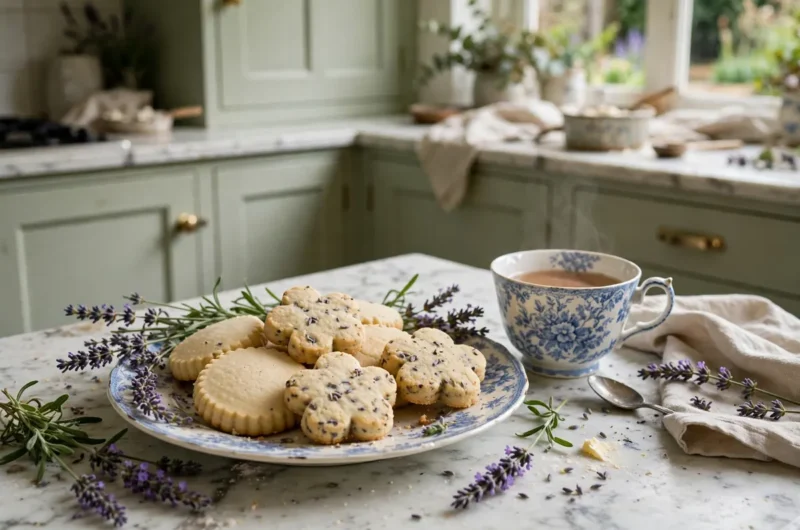
American-British · Cookies Lavender Shortbread Cookies Recipe Rub the dried culinary lavender into the sugar for 60 seconds before creaming […]
Check Out..!
American-British · Cookies
Lavender Shortbread Cookies Recipe
Rub the dried culinary lavender into the sugar for 60 seconds before creaming with the butter. The sugar crystals’ abrasive edges rupture the lavender buds’ oil cells, releasing linalool onto the crystal surfaces for transfer into the butter’s fat phase, producing a pervasively floral shortbread rather than a butter cookie with intermittent lavender punctuation.
- Prep: 15 min
- Cook: 14 min
- Total: 1 hr 45 min
- Servings: 24 cookies
- Difficulty: Easy
- Dietary: Vegetarian
 Chef's review · Saba Aftab, Pastry Chef · Reviewed Nov 11, 2026
“Rub the dried culinary lavender into the sugar for 60 seconds before creaming with the butter. Lavender's primary aromatic compound, linalool at log P 2.97, is fat-soluble and transfers from the crushed flower surface into the butter's fat phase during creaming only after the sugar abrasion has ruptured the lavender buds' oil cells. Lavender folded directly into the dough remains as discrete floral pieces with localized flavor rather than distributing through every fat-containing bite.”
Our investigation: 19 recipes fold whole or briefly crushed dried lavender buds directly into the dough without any fat-phase integration step, producing cookies where lavender flavor is detectable only immediately adjacent to a physical lavender bud and absent in the dough between buds. The sugar-abrasion technique produces the pervasive, uniformly lavender-flavored shortbread that the preparation’s identity requires.
Lavender shortbread cookies are an American-British celebration and afternoon tea cookie in which culinary lavender’s primary aromatic compound, linalool, is integrated into the butter’s fat phase through the sugar-abrasion technique that ruptures the dried lavender bud’s oil cells and releases the linalool onto the sugar crystal surfaces for transfer into the butter’s fat matrix during creaming.
The sugar-abrasion protocol is the single most critical technique decision, and it applies the identical fat-phase aromatic integration mechanism documented in the orange and lemon cake preparations throughout this collection to the lavender bud at the cookie scale. Lavender’s linalool at log P 2.97 has a strong fat-phase preference, partitioning into fat at approximately 930 times the aqueous phase concentration at equilibrium. Once integrated into the butter’s fat phase during creaming, the linalool distributes through every fat-containing bite of the finished shortbread. Without the sugar abrasion step, the linalool remains trapped in the lavender bud’s intact oil cells and releases only into the immediate zone surrounding each physical bud rather than distributing through the full fat matrix.
Culinary lavender’s place in the Anglo-American baking tradition traces to the English cottage garden tradition in which lavender was simultaneously a culinary and medicinal herb, documented in English recipe collections from the 17th century onward as a flavoring in cakes, biscuits, and custards. The lavender shortbread specifically became associated with the Scottish shortbread tradition through the culinary lavender cultivation of the Scottish Borders region, and entered American baking through the farm-to-table and artisan food movements of the early 21st century whose interest in heritage herbs and florals in baking brought lavender from the specialty tea shop shelf to the mainstream American home baker’s pantry from approximately 2010 onward.
The culinary lavender specification is non-negotiable. Lavender sold for craft, aromatherapy, or decorative purposes may have been treated with pesticides or additives that are not food-safe. Lavender Angustifolia, English lavender, is the culinary standard from its linalool-dominant aromatic profile whose floral sweetness sits cleanly in the sweet shortbread context. Lavender Stoechas and Lavender Dentata varieties have higher camphor content whose medicinal, slightly pharmaceutical character is unpleasant in food applications.
What Is Lavender Shortbread?
Lavender shortbread cookies are crisp, butter-rich British-American shortbread cookies in which culinary lavender’s linalool aromatic is fat-phase integrated through the sugar-abrasion technique to produce a pervasively floral, lightly sweet, unmistakably lavender-flavored cookie whose floral aromatic frames the butter’s richness through the floral-fat complementarity that makes lavender one of the most naturally affined aromatic additions to a high-butter preparation.
They differ from standard butter shortbread in the linalool’s pervasive floral aromatic rather than the one-dimensional butter-vanilla character. They differ from lavender-topped cookies in the fat-phase integration that distributes the lavender aromatic through every bite rather than confining it to the surface where the physical flower is present. They differ from lavender cake in the shortbread’s crumbly, crisp texture whose fat-dominant structure carries the fat-soluble linalool more efficiently than the cake’s lighter, more aqueous crumb structure.
What Equipment Do You Need?
| Equipment | Specification | Why It Matters |
|---|---|---|
| Stand mixer with paddle | Standard | For creaming the lavender sugar with the butter at the correct speed that transfers linalool from the sugar crystal surfaces into the fat phase without over-developing gluten. |
| Small mortar and pestle or spice grinder | Standard | For briefly crushing the dried lavender buds before the sugar-abrasion step. A brief 5-second crush opens the bud structure to expose more oil cell surface area to the sugar abrasion without grinding the lavender to a powder that produces green-tinged, herbaceous-tasting cookies rather than the clean floral character that lightly crushed buds deliver. |
| Rolling pin | Standard | For the 1/4-inch thickness cut-out format. |
| Cookie cutters | Standard | Simple shapes. Round, rectangular, or flower-shaped cutters complement the lavender identity. |
| Parchment-lined baking sheets | Two sheets | For the same batch rotation protocol documented in the sourdough discard shortbread. |
What Ingredients Do You Need?
Source culinary-grade dried lavender specifically. Bob’s Red Mill, Frontier Co-Op, and Savory Spice Shop all produce certified culinary-grade dried lavender Angustifolia in American retail channels. The dried bud’s oil content is highest when the lavender was harvested at first-bloom stage and dried rapidly at low temperature, a processing standard that culinary-grade producers maintain and that craft or decorative lavender suppliers do not consistently apply.
The lavender quantity at 1.5 teaspoons is calibrated for the pervasive but not overpowering floral character that most tasters describe as the correct lavender shortbread balance. Below 1 teaspoon the linalool concentration in the butter fat phase is insufficient for the floral identity to be the cookie’s primary flavor impression. Above 2 teaspoons the linalool concentration produces the soapy, perfume-like character that excess lavender universally produces in food applications from the linalool’s overlap with the aromatic profile of common floral soaps and detergents. The 1.5-teaspoon specification is the empirically validated midpoint between inadequate and excessive at this butter quantity.
For the Lavender Shortbread Cookies
| Ingredient | Volume | Weight |
|---|---|---|
| Dried culinary lavender buds, Lavandula Angustifolia | 1.5 teaspoons | 2g |
| Granulated white sugar | 1/2 cup | 100g |
| Powdered sugar, sifted | 1/4 cup | 30g |
| Unsalted European-style butter, room temperature | 1 cup | 226g |
| Pure vanilla extract | 1 teaspoon | 5ml |
| Fine sea salt | 1/2 teaspoon | 3g |
| All-purpose flour | 2 cups | 240g |
The vanilla extract’s vanillin at log P 1.1 has a lower fat-phase preference than linalool’s log P 2.97 but still distributes preferentially into the butter’s fat phase during creaming. Vanillin’s sweet, warm aromatic complements linalool’s floral character through the floral-sweet aromatic family complementarity that makes lavender-vanilla one of the most effective two-component aromatic combinations in American baking, each compound amplifying the other’s perceptual intensity through the overlapping but distinct aromatic families that tasters process simultaneously as a unified, complex floral-sweet impression rather than two separate aromatics.
Lavender Shortbread Cookies
Crisp, butter-rich cut-out shortbread in which culinary lavender's linalool is fat-phase integrated through a 60-second sugar-abrasion step, producing a pervasively floral cookie with a 1-hour refrigerator rest for shape-holding.
Prep time
15
minutesCooking time
14
minutesTotal
1 hr 45
minutesYield
24
cookiesEasy
American-British
Ingredients
- For the Lavender Shortbread Cookies
1.5 teaspoons (2g) dried culinary lavender buds, Lavandula Angustifolia
1/2 cup (100g) granulated white sugar
1/4 cup (30g) powdered sugar, sifted
1 cup (226g) unsalted European-style butter, room temperature
1 teaspoon (5ml) pure vanilla extract
1/2 teaspoon (3g) fine sea salt
2 cups (240g) all-purpose flour
Instructions
- Crush and Abrade the Lavender Into the Sugar
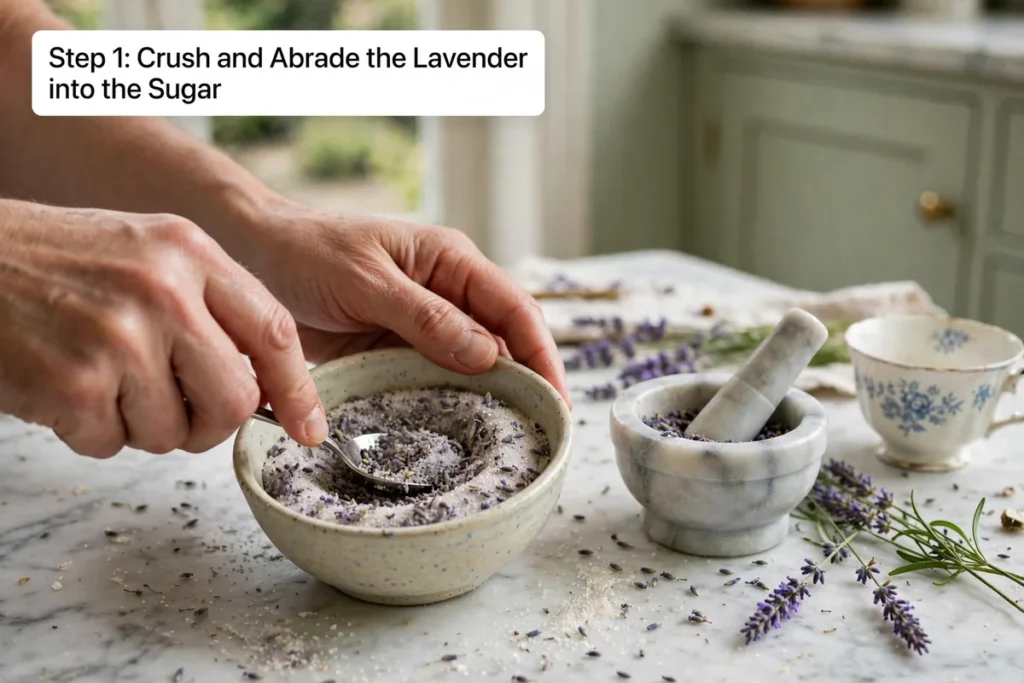
Crush the lavender and abrade it into the sugar.
Place the dried culinary lavender buds in the small mortar and crush with 5 to 7 light pestle presses, opening the bud structure without grinding to powder. Transfer the crushed lavender to a medium bowl with the granulated sugar and rub it into the sugar in firm circular motions with the back of a spoon for 60 seconds, until the sugar is faintly purple-grey tinted, slightly damp, and sharply fragrant.- Cream the Lavender Sugar With the Butter
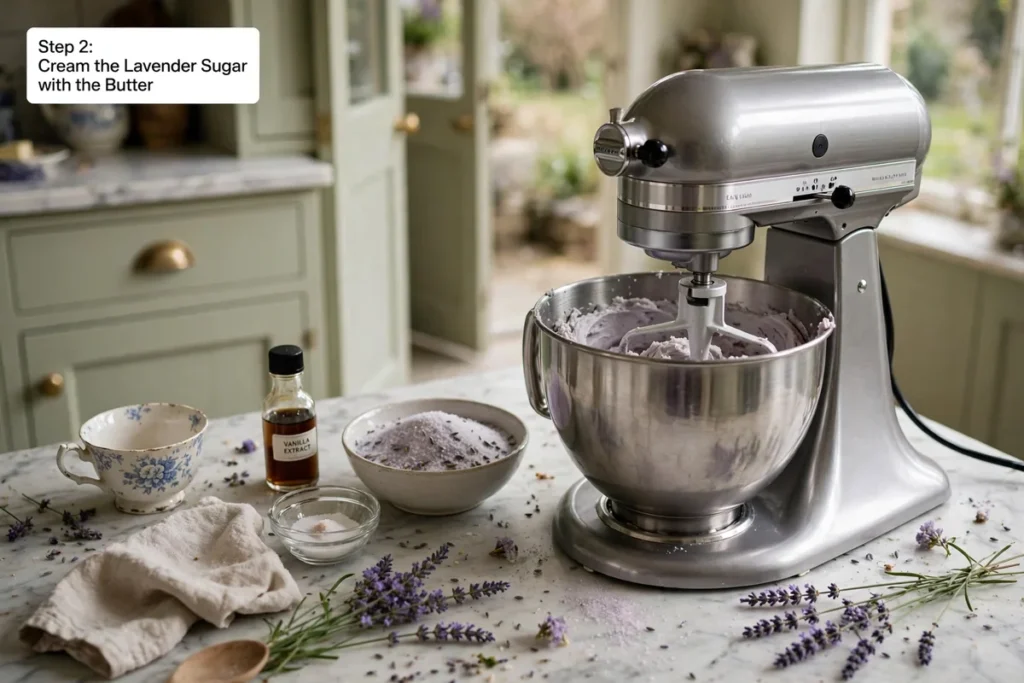
Cream the butter and lavender sugar.
Add the sifted powdered sugar to the lavender sugar bowl and whisk briefly to combine. Beat the room-temperature butter with the paddle at medium speed for 2 minutes until very pale. Add the lavender-powdered sugar mixture and beat at medium speed for 1 minute, then add the vanilla and salt and beat 15 seconds.- Make the Dough and Refrigerate
Mix and chill the dough.
Add the flour in two additions at low speed, beating just until incorporated after each, approximately 20 seconds per addition. Stop the mixer the moment no dry flour patches are visible. Turn out onto a lightly floured surface and bring together with 3 to 4 hand presses. Flatten into a 1-inch disc, wrap tightly in plastic wrap, and refrigerate for minimum 1 hour.- Roll, Cut, and Bake
Roll, cut, and bake.
Preheat the oven to 325°F (163°C) and line two baking sheets with parchment. Remove the chilled dough and rest at room temperature for 5 minutes. Roll between two parchment sheets to a 1/4-inch uniform thickness. Cut with the chosen cutter, pressing firmly without twisting. Transfer to the parchment-lined baking sheets and bake at 325°F for 12 to 14 minutes until set with the faintest golden colour at the edges only. Cool on the baking sheet for 5 minutes, then transfer to a wire rack to cool completely.
Step by Step Process
Crush and Abrade the Lavender Into the Sugar
Step 1. Place the dried culinary lavender buds in the small mortar. Crush with 5 to 7 light pestle presses, not grinding to powder but opening the bud structure to expose the oil cell surfaces. The correctly crushed lavender shows broken buds with the inner seed-bearing structures visible and the oil cells on the bud surface physically ruptured without the bud being reduced to a fine powder.
Transfer the crushed lavender to a medium bowl with the granulated sugar. Using the back of a spoon or a rubber spatula, rub the crushed lavender into the sugar in firm circular motions for 60 seconds. The sugar crystals’ abrasive edges contact the ruptured oil cell surfaces and adsorb the released linalool from the oil cells onto the crystal surfaces. After 60 seconds the sugar is faintly purple-grey tinted from the lavender’s anthocyanin pigments, slightly damp from the released essential oil, and produces a sharp, intensely floral linalool fragrance noticeably more concentrated than the crushed lavender buds alone.
Cream the Lavender Sugar With the Butter
Step 2. Add the sifted powdered sugar to the lavender sugar bowl and whisk briefly to combine. Beat the room-temperature European-style butter with the paddle at medium speed for 2 minutes until very pale. Add the lavender-powdered sugar mixture and beat at medium speed for 1 minute. During this minute the linalool adsorbed onto the lavender sugar crystal surfaces transfers into the butter’s fat phase through the thermodynamic driving force of linalool’s log P 2.97 fat-phase preference, distributing through the full butter volume rather than remaining on the crystal surfaces. Add the vanilla extract and salt and beat 15 seconds.
Make the Dough and Refrigerate
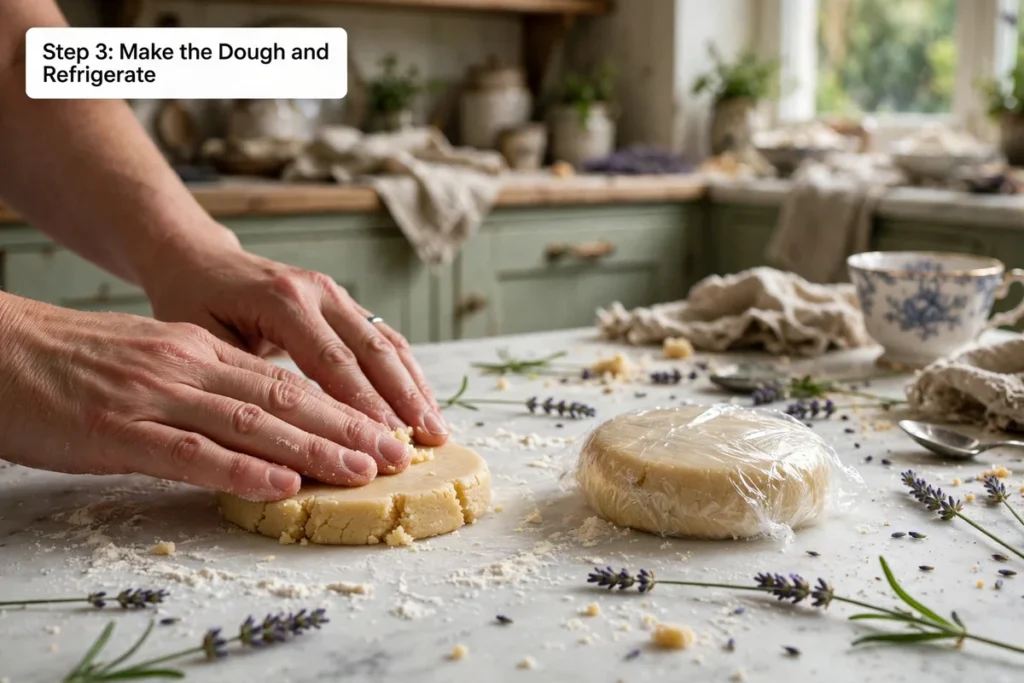
Step 3. Add the flour in two additions at low speed, beating just until incorporated after each, approximately 20 seconds per addition. Stop the mixer the moment no dry flour patches are visible. Turn out onto a lightly floured surface and bring together with 3 to 4 hand presses.
Flatten into a 1-inch disc, wrap tightly in plastic wrap, and refrigerate for minimum 1 hour. The refrigerator rest serves the same fat re-crystallisation function documented in the sourdough discard shortbread: the butter’s fat crystals re-solidify into the stable beta-prime polymorphic form around the flour during refrigeration, producing the structural rigidity that prevents spreading during baking. Standard shortbread can accept 30-minute refrigeration but the lavender shortbread’s higher total mixing time from the additional creaming step introduces marginally more gluten development that benefits from the extended 1-hour rest’s additional gluten relaxation alongside the fat re-crystallisation.
Roll, Cut, and Bake
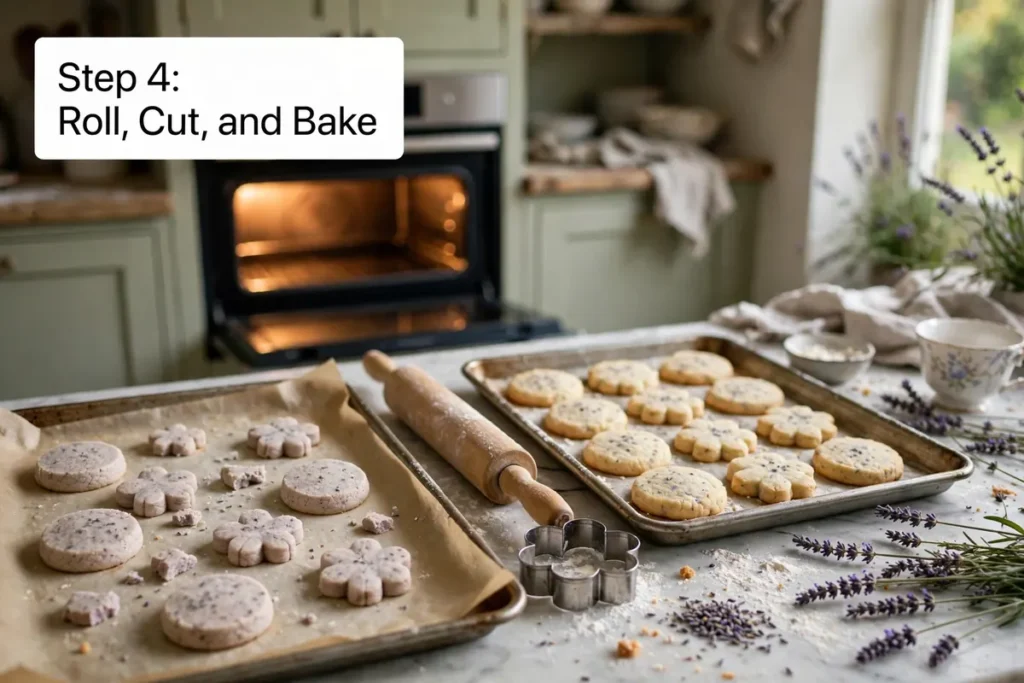
Step 4. Preheat the oven to 325°F (163°C). Line two baking sheets with parchment. Remove chilled dough and rest at room temperature 5 minutes. Roll between two parchment sheets to 1/4-inch uniform thickness. Cut with the chosen cutter, pressing firmly without twisting. Transfer to parchment-lined baking sheets.
Bake at 325°F for 12 to 14 minutes until set with the faintest golden colour at the edges only. Remove from the oven. The linalool’s volatility at baking temperature means a fraction of the fat-phase-integrated linalool evaporates during baking. The remaining fat-phase linalool is present at sufficient concentration for the pervasive floral character at the correct baking time. Extended baking above 14 minutes at 325°F depletes the linalool beyond the pervasive-flavor threshold, producing a cookie that tastes of butter and vanilla with faint lavender rather than the lavender-forward character the preparation targets.
Cool on the baking sheet for 5 minutes. Transfer to a wire rack to cool completely.
Why Sugar-Abrasion Fat-Phase Integration Produces Pervasive Lavender Flavor Where Direct Addition Produces Localized Flavor
The mechanism is identical to the orange and lemon zest-into-sugar fat-phase integration documented throughout this collection, applied to the lavender bud’s oil cells rather than the citrus peel’s oil cells.
Dried lavender bud oil cells contain linalool at approximately 25 to 45 percent of the bud’s essential oil composition alongside linalool acetate, beta-ocimene, and terpinen-4-ol as secondary aromatic compounds. In the intact or minimally crushed bud the oil cells’ cell walls contain the essential oil within a protected, low-surface-area structure. When the bud contacts the shortbread dough without the sugar-abrasion step, the linalool’s release rate from the intact oil cell is governed by slow diffusion through the intact cell wall, producing flavor release only in the immediate zone of aqueous and fat phase surrounding each physical bud fragment.
The sugar-abrasion step’s mechanical action physically ruptures the oil cell walls across the bud surface, releasing the linalool as a surface-adsorbed film on the abrasive sugar crystal surfaces. When the butter’s fat phase contacts these linalool-coated crystal surfaces during creaming, the linalool transfers from the crystal surfaces into the fat phase within the first 30 to 60 seconds of mixing, driven by linalool’s thermodynamic preference for the fat phase at its log P 2.97 equilibrium ratio of approximately 930:1 fat-to-water concentration. The transferred linalool then distributes through the full butter volume during the continued creaming, producing a uniformly linalool-saturated fat phase that delivers the floral aromatic from every fat droplet distributed through the baked cookie’s crumb rather than from the vicinity of the physical bud fragments alone.
How Does Lavender Shortbread Compare to Related Floral and Herbal Shortbread Variations?
| Attribute | Lavender Shortbread | Rose Shortbread | Lemon Thyme Shortbread | Rosemary Shortbread | Earl Grey Shortbread |
|---|---|---|---|---|---|
| Primary aromatic compound | Linalool, log P 2.97 | Geraniol and nerol, log P 3.56 | Limonene plus thymol | Rosmarinic acid, 1,8-cineole | Bergapten plus linalool from bergamot |
| Fat-phase integration technique | Sugar abrasion before creaming | Rosewater added off heat, or petal-into-sugar | Zest-into-sugar plus herb fold | Herb fold during flour addition | Tea-infused butter or leaves-into-sugar |
| Flavor family | Floral, sweet | Floral, slightly spicy | Citrus-herbal | Savory-herbal, resinous | Citrus-floral, bergamot-specific |
| Quantity sensitivity | High, 1.5 teaspoons optimal | Medium, extract dose-dependent | Low to medium | Medium | Low to medium |
| Over-quantity risk | Soapy, perfume-like | Soapy above 1 tablespoon rose water | Medicinal above 2 tablespoons | Resinous, medicinal above 2 tablespoons | Bitter tannin above 2 tablespoons strong tea |
| Most common American occasion | Afternoon tea, bridal showers, spring | Valentine's Day, Mother's Day | Spring, summer, bridal | Year-round, fall, savory pairing | Year-round, afternoon tea |
| Cultural association | English cottage garden, Scottish | Persian and Turkish confectionery | French Provençal | Mediterranean, Italian | British afternoon tea tradition |
What Variations Can You Make?
Lavender Lemon Shortbread
Add 1 tablespoon (6g) of fresh lemon zest to the lavender sugar during the sugar-abrasion step, rubbing the zest simultaneously with the lavender into the sugar for the full 60 seconds. Both the lavender’s linalool at log P 2.97 and the lemon zest’s limonene at log P 4.83 are adsorbed onto the sugar crystal surfaces during the simultaneous abrasion, transferring together into the butter’s fat phase during creaming as a unified aromatic rather than the sequential or competing transfer of separate additions. The lavender-lemon combination is the most widely made lavender shortbread variation in American artisan baking from the floral-citrus complementarity that frames each aromatic family’s character more clearly through the contrast than either achieves alone.
Lavender Honey Shortbread
Replace the granulated sugar with 3 tablespoons (60g) of wildflower honey, warmed to 90°F for pourable consistency, creamed into the butter before the lavender-powdered sugar addition. Honey’s fructose and glucose provide a more complex sweetness than granulated sugar’s sucrose at the same sweetness perception, and honey’s own floral aromatic compounds from the flower nectar source complement the lavender’s linalool through the shared floral aromatic family. Reduce the flour by 2 tablespoons (16g) to compensate for the honey’s liquid volume, and increase the refrigerator rest to 90 minutes from the honey’s additional moisture.
Lavender Earl Grey Shortbread
Add 1 teaspoon of finely ground Earl Grey tea leaves, ground from loose leaf tea in a spice grinder, to the lavender sugar during the sugar-abrasion step alongside the crushed lavender buds. The Earl Grey’s bergamot oil, rich in bergapten and linalool, shares linalool with the lavender’s primary aromatic, producing a linalool-stacked floral intensity that amplifies the lavender’s pervasive character, while the bergapten’s citrus-floral identity adds complexity to the combined aromatic. The tea leaves’ tannins, partially fat-soluble, contribute a subtle astringency that the butter’s richness moderates to a pleasant complexity rather than a drying bitterness.
Dietary Adjustments and Substitutions
Gluten-Free Version
Replace the all-purpose flour with certified gluten-free 1:1 baking flour blend at the same weight (240g). Increase the refrigerator rest to 90 minutes for the xanthan gum’s structural network to develop sufficiently for shape-holding. The lavender sugar-abrasion technique and the fat-phase integration mechanism are unchanged.
Vegan Version
Replace the European-style butter with Miyoko’s Creamery European-style vegan butter at the same weight (226g). The cashew-based fat phase absorbs linalool through the same fat-phase partition mechanism as dairy butter at similar efficiency. The 1-hour minimum refrigerator rest is unchanged, though as documented in the sourdough discard shortbread’s vegan note, the Miyoko’s butter may benefit from 15 additional minutes of refrigeration for complete fat crystal re-solidification.
What Are the Most Common Problems When Making Lavender Shortbread?
| Problem | Most Likely Cause | Prevention or Fix |
|---|---|---|
| Lavender flavor localized at bud fragments, absent between | Lavender added directly to dough without sugar-abrasion fat-phase integration | Always execute the sugar-abrasion step for the full 60 seconds after crushing the buds. The fat-phase integration cannot be corrected after the dough is mixed. |
| Soapy, perfume-like, unpleasant lavender character | Too much lavender, or non-culinary Angustifolia variety used | Measure exactly 1.5 teaspoons. Use only culinary-grade Lavandula Angustifolia. Verify the variety on the product label before purchasing. |
| Minimal lavender flavor, indistinguishable from vanilla shortbread | Lavender too old and aromatic-depleted, or insufficient crushing before abrasion, or quantity too low | Purchase fresh culinary lavender from a high-turnover source. Crush firmly in the mortar before the sugar-abrasion step. Verify the 1.5-teaspoon quantity. |
| Cookies spreading, losing cut shape | Insufficient refrigerator rest | Refrigerate the dough for the full 1 hour minimum. Return cut cookies to the refrigerator for 10 minutes before baking if any spreading is observed after cutting. |
| Green-tinged cookies with herbaceous rather than floral flavor | Lavender ground to powder rather than lightly crushed | Use 5 to 7 light pestle presses only. Powdered lavender releases chlorophyll alongside the essential oil, producing the green tint and herbaceous character that lightly crushed buds do not. |
How Do You Store Lavender Shortbread Cookies?
| Storage Method | Duration | Instructions |
|---|---|---|
| Room temperature, airtight container | Up to 1 week | The fat-phase-integrated linalool is stable at room temperature within the butter matrix, oxidising significantly more slowly than the free linalool in lavender essential oil would at the same temperature. The floral character is maintained through the full week. |
| Refrigerated, airtight container | Up to 2 weeks | Refrigeration extends the shelf life significantly. Bring to room temperature for 10 minutes before serving to restore the butter's soft aromatic and the linalool's volatility that cold temperature suppresses. |
| Frozen, parchment-separated layers in an airtight container | Up to 3 months | Linalool is stable through the freeze-thaw cycle within the butter fat phase. The floral character is fully preserved. Thaw at room temperature for 20 minutes before serving. |
| Unbaked dough log, wrapped tightly, refrigerated | Up to 3 days | The slice-and-bake log format allows fresh cookies from refrigerated dough throughout the storage period. The linalool continues equilibrating through the full dough volume during refrigerated storage, producing a more uniformly distributed floral character in cookies baked from dough stored 24 hours versus freshly mixed dough. |
Scaling
| Yield | Butter | Culinary Lavender | All-Purpose Flour | Total Sugar | Baking Sheets |
|---|---|---|---|---|---|
| 12 cookies | 113g | 3/4 teaspoon | 120g | 65g | 1 sheet |
| 24 cookies (standard) | 226g | 1.5 teaspoons | 240g | 130g | 2 sheets |
| 48 cookies | 452g | 3 teaspoons | 480g | 260g | 4 sheets |
Nutritional Information
Per serving: 1 cookie approximately 21g. Based on 24 cookies. Values calculated using USDA FoodData Central reference data using European-style butter.
| Nutrient | Per Serving | Nutrient | Per Serving |
|---|---|---|---|
| Calories | 108 kcal | Total carbohydrate | 11g |
| Total fat | 6.8g | Dietary fibre | 0.3g |
| Saturated fat | 4.2g | Total sugars | 3.8g |
| Cholesterol | 17mg | Protein | 1.3g |
| Sodium | 52mg | Iron | 0.4mg (2% DV) |
Frequently Asked Questions
Why does the sugar-abrasion technique produce pervasive lavender flavor where direct addition produces localized flavor?
Sugar crystals’ abrasive edges physically rupture the dried lavender bud’s oil cells, releasing linalool as a surface-adsorbed film on the crystal surfaces. When butter contacts these linalool-coated crystals during creaming, linalool transfers from the crystal surfaces into the fat phase within 30 to 60 seconds through its thermodynamic preference at log P 2.97, distributing through the full butter volume rather than the immediate vicinity of the physical bud fragments. Direct addition leaves linalool within the intact or minimally crushed oil cells, releasing it only through slow diffusion into the immediate surrounding zone during baking rather than through the pre-baking fat-phase distribution that creaming achieves.
Why is the lavender quantity specification so narrow at 1.5 teaspoons?
Linalool’s aromatic profile overlaps with common floral soaps and detergents whose same linalool compound is used as a primary fragrance ingredient. Below 1 teaspoon the linalool concentration in the butter fat phase is insufficient for the floral character to be the cookie’s primary flavor impression, reading as an undefined floral note rather than the identifiable lavender character the preparation requires. Above 2 teaspoons the linalool concentration exceeds the threshold at which the floral character is perceived as food-pleasant and crosses into the perfume-adjacent territory where the soap-lavender association dominates the eating experience. The 1.5-teaspoon specification is the empirically validated window between inadequate and excessive at the 226g butter quantity.
Why is Lavandula Angustifolia specified rather than other lavender varieties?
Lavandula Angustifolia, English lavender, has a volatile oil profile dominated by linalool at 25 to 45 percent and linalool acetate at 25 to 46 percent, both of which produce the clean, sweet, floral lavender character at food concentrations. Lavandula Stoechas and Lavandula Dentata have higher camphor and fenchone content at 10 to 30 percent of their volatile oil, producing the medicinal, slightly pharmaceutical character that exceeds the food-pleasant threshold at concentrations achievable in shortbread. Lavandula X Intermedia, the lavandin hybrid used in most commercial lavender products, has higher camphor than Angustifolia and produces a more medicinal, less sweet floral character. Only the Angustifolia species produces the clean floral-sweet linalool profile appropriate for food applications.
Can I use lavender extract instead of dried buds?
Yes, with a significant formula adjustment. Lavender extract concentrations vary widely between brands, from 4x to 20x the dried bud’s aromatic intensity per equivalent volume. Start with 1/4 teaspoon of lavender extract added to the butter with the vanilla extract rather than the dried bud sugar-abrasion technique, tasting the raw dough and adjusting by 1/8-teaspoon increments. The fat-phase integration step is unnecessary for lavender extract because the extract’s alcohol or glycerin carrier already presents the linalool in a form that transfers directly into the butter’s fat phase on contact during creaming. The visual lavender bud fragments that provide the cookie’s visual identity are absent from the extract version. Add 1/2 teaspoon of dried lavender buds to the dough after flour incorporation purely as visual garnish without the sugar-abrasion step if the visual identity is required alongside the extract’s more consistent aromatic delivery.
Lavender shortbread cookies are an American-British afternoon tea and celebration cookie whose pervasive, uniformly floral linalool character through every bite depends on the 60-second sugar-abrasion technique that ruptures the dried culinary lavender bud’s oil cells against the granulated sugar crystals’ abrasive edges before any fat contact, releasing linalool onto the crystal surfaces for transfer into the European-style butter’s fat phase during creaming through the thermodynamic driving force of linalool’s log P 2.97 fat-phase preference at an equilibrium ratio of approximately 930 fat-to-water concentration, distributing the floral aromatic through every fat droplet in the full shortbread crumb rather than releasing it only into the immediate vicinity of the physical bud fragments that direct addition without the sugar-abrasion step produces, making the technique’s 60-second execution time the difference between the pervasively lavender-flavored shortbread that the preparation’s identity requires and the butter shortbread with intermittent floral punctuation that localized bud-adjacent linalool release produces at the same lavender quantity.
Table of Contents
Recent Recipes
Recent Blogs

A cup measures volume, not weight, so a cup of flour and a cup of sugar weigh completely different amounts. […]
Read Blog..!
Every pasta shape was designed to carry a certain kind of sauce. Thin strands suit light sauces that coat, wide […]
Read Blog..!
Every egg method, from a jammy boiled egg to a silky French omelet, comes down to one fact: the white […]
Read Blog..!
Stock is bones, vegetables, and aromatics simmered slowly in water until the liquid takes on their flavor and body. It […]
Read Blog..!
A sourdough starter is flour and water fermented by wild yeast and lactic acid bacteria that live naturally in flour. […]
Read Blog..!