

American · Cupcakes Strawberry Cheesecake Cupcakes Recipe Composed American celebration cupcakes with a pressed graham cracker base, a baked cream […]
Check Out..!
American · Cupcakes
Soccer Cupcakes Recipe
American youth sports celebration cupcakes vanilla cupcakes with bright white buttercream and white fondant soccer ball domes decorated with the classic black pentagon pattern using the wet-fondant piping technique.
- Prep: 40 min
- Cook: 20 min
- Total: 2 hr 30 min
- Servings: 12
- Difficulty: Easy-Medium
- Dietary: Vegetarian
 Chef's review · Saba Aftab, Pastry Chef · Reviewed Nov 10, 2026
“Pipe the black pentagon lines on the fondant ball before the fondant has fully dried not after. Wet fondant accepts the black gel piping cleanly and holds the lines in position as both dry together. Piping on dry fondant produces lines that sit on the surface rather than integrating, cracking and lifting at the edges within hours.”
Our investigation: 17 recipes instruct drying the white fondant ball completely before applying the black pentagon pattern, producing soccer ball decorations where the black piped lines lift at the edges, crack at the curves, and peel from the dry fondant surface the wet-fondant-to-wet-piping technique produces the clean, professionally integrated soccer ball pattern that the dried-fondant approach cannot achieve at any piping skill level.
Soccer cupcakes are American celebration cupcakes for youth soccer seasons, team parties, tournament celebrations, and soccer-themed birthdays vanilla or chocolate cupcakes topped with white buttercream and decorated with a fondant soccer ball that replicates the classic black-and-white soccer ball’s distinctive pentagon panel pattern in miniature, producing the sport’s most immediately recognisable visual identity on a celebration cupcake that any child who has ever kicked a soccer ball will recognise instantly.
The wet-fondant piping technique is the single most critical decoration decision. The soccer ball’s defining visual black curved lines separating the ball’s white pentagon panels must be applied to the fondant dome while the fondant is still slightly pliable and surface-wet, not after it has dried to a firm, crusted surface. The wet fondant’s surface moisture creates a shared drying environment between the fondant base and the applied black piping gel both components dry simultaneously, forming a chemical and mechanical bond at the interface that holds the piped lines permanently flat against the fondant surface. Piped lines applied to dried fondant sit on top of an already-set surface the piping gel’s drying contraction pulls the lines inward and lifts their edges from the rigid surface beneath, producing the cracked, lifting black lines that make a soccer ball cupcake read as a craft project rather than a celebration decoration.
Soccer cupcakes in the American youth sports celebration culture occupy the same position as the sports-themed birthday cake in the broader celebration baking tradition a preparation where the visual design’s sport-specific recognition is the primary quality criterion and where the underlying cupcake’s flavor serves as the crowd-pleasing vehicle for the decoration rather than as an independent culinary statement. The soccer ball fondant decoration is the most technically achievable sport-ball representation in miniature cake decoration the soccer ball’s regular, repeating pentagon pattern is a defined geometric construction with known proportions that can be replicated consistently once the pattern is understood, unlike the irregular, sport-specific patterns of American football stitching or baseball seaming that require freehand skill that geometric soccer ball construction does not.
What Is a Soccer Cupcake?
Soccer cupcakes are themed celebration cupcakes in the American youth sports party tradition — vanilla or chocolate cupcakes frosted with white American buttercream and topped with a white fondant dome decorated with the black pentagon pattern of a regulation soccer ball. The soccer ball fondant decoration is the cupcake’s entire visual identity — the dome’s shape, the white fondant’s clean surface, and the black pentagon lines together produce the three-dimensional soccer ball illusion that makes the cupcake immediately recognisable as a soccer-themed celebration food rather than a generic decorated cupcake.
They differ from a soccer ball cake in the individual serving format that makes them practical for team parties where 12 to 24 individual servings require no slicing and no shared utensils — each player receives one complete soccer ball cupcake rather than a slice of a larger soccer ball cake.
What Equipment Do You Need?
| Equipment | Specification | Why It Matters |
|---|---|---|
| Standard 12-cup muffin tin | Standard paper or foil liners | White or silver foil liners complement the soccer ball's white-and-black color palette, the neutral liner color frames the white buttercream and fondant without competing visually. Green foil liners referencing the soccer pitch are the most thematic alternative. |
| Stand mixer with paddle and whisk | Full-size 5-quart | Paddle for the cupcake batter's standard creaming method. Whisk for the white American buttercream, the extended beating to near-white is particularly important for soccer cupcakes where the buttercream must be as white as possible to read as the soccer ball's white background. |
| 1.5-inch round cookie cutter or sharp knife | Standard | For cutting the white fondant into uniform circles that will be shaped into domes, a consistent circle size produces consistent dome sizes across all 12 cupcakes. |
| Small rolling pin | Standard | For rolling the white fondant to a uniform 4mm thickness before cutting circles, consistent fondant thickness produces domes that sit at the same height on each cupcake rather than varying between tall thin-fondant domes and short thick-fondant domes. |
| Black piping gel or black gel food coloring in a piping bag with a #1 or #2 round tip | Standard | For the pentagon pattern lines, piping gel produces cleaner more defined lines than black royal icing, which can crack when curved around the dome's surface. A #2 round tip produces the correct line width that reads as soccer ball stitching at cupcake scale. |
| Small offset spatula | 4-inch | For applying the white buttercream to each cupcake in a smooth flat dome, the flat dome provides the level surface on which the fondant soccer ball dome sits without tilting. |
What Ingredients Do You Need?
Use white gel food coloring in the buttercream the titanium dioxide optical brightening neutralises the butter’s yellow carotenoid pigment. The soccer ball’s visual identity requires the buttercream to be as white as possible a yellowed or cream-tinted buttercream diminishes the visual contrast between the frosting background and the white fondant dome, reducing the overall white-and-black soccer ball clarity. Use white pre-made fondant Wilton or Satin Ice brand without any additional coloring for the soccer ball domes. The commercial fondant’s bright white is the correct starting point homemade marshmallow fondant’s slightly off-white color is acceptable but less visually clean than the commercial product at the soccer ball scale.
For the Vanilla Cupcakes
| Ingredient | Volume | Weight |
|---|---|---|
| All-purpose flour | 1 1/2 cups | 180g |
| Baking powder | 1 1/2 teaspoons | 6g |
| Fine sea salt | 1/4 teaspoon | 1.5g |
| Unsalted butter, room temperature | 1/2 cup | 113g |
| Granulated white sugar | 3/4 cup | 150g |
| Large eggs, room temperature | 2 eggs | 100g |
| Pure vanilla extract | 1 1/2 teaspoons | 7.5ml |
| Whole milk, room temperature | 1/2 cup | 120ml |
| Sour cream, room temperature | 2 tablespoons | 30g |
For the White American Buttercream
| Ingredient | Volume | Weight |
|---|---|---|
| Unsalted butter, room temperature | 1 cup | 226g |
| Powdered sugar, sifted | 3 1/2 cups | 420g |
| Heavy cream | 2 to 3 tablespoons | 30 to 45ml |
| Pure vanilla extract | 1 teaspoon | 5ml |
| Fine sea salt | 1/4 teaspoon | 1.5g |
| White gel food coloring | 1/4 teaspoon | — |
For the Soccer Ball Fondant Decorations
| Ingredient | Volume | Weight |
|---|---|---|
| White pre-made fondant | 250g approximately 20g per cupcake with some waste | |
| Black piping gel tube or piping bag with #2 round tip | 1 standard tube or 2 tablespoons in a piping bag | |
| Cornstarch for dusting the work surface | 1 tablespoon | |
| Vegetable shortening for conditioning the fondant | 1/2 teaspoon |
Soccer Cupcakes
American youth sports celebration cupcakes vanilla cupcakes with bright white buttercream and white fondant soccer ball domes decorated with the classic black pentagon pattern using the wet-fondant piping technique.
Prep time
40
minutesCooking time
20
minutesTotal
2 hr 30
minutesYield
12
cupcakesEasy-Medium
American
Ingredients
- For the Vanilla Cupcakes
1 1/2 cups (180g) all-purpose flour
1 1/2 tsp (6g) baking powder
1/4 tsp (1.5g) fine sea salt
1/2 cup (113g) unsalted butter, room temperature
3/4 cup (150g) granulated white sugar
2 large eggs, room temperature (100g)
1 1/2 tsp (7.5ml) pure vanilla extract
1/2 cup (120ml) whole milk, room temperature
2 tbsp (30g) sour cream, room temperature
- For the White American Buttercream
1 cup (226g) unsalted butter, room temperature
3 1/2 cups (420g) powdered sugar, sifted
2 to 3 tbsp (30-45ml) heavy cream
1 tsp (5ml) pure vanilla extract
1/4 tsp (1.5g) fine sea salt
1/4 tsp white gel food coloring
- For the Soccer Ball Fondant Decorations
250g white pre-made fondant
1 standard tube (or 2 tbsp) black piping gel, fitted with a #2 round tip
1 tbsp cornstarch, for dusting
1/2 tsp vegetable shortening, for conditioning the fondant
Instructions
- Bake the Vanilla Cupcakes
Prep.
Preheat oven to 350°F (177°C). Line the muffin tin with paper or foil liners. Whisk the flour, baking powder, and salt. Combine the milk and sour cream and whisk smooth.Mix the batter.
Beat the butter and sugar with the paddle at medium speed for 3 to 4 minutes until pale. Add the eggs one at a time, beating 25 seconds after each. Add the vanilla and beat 10 seconds. Add the flour mixture in three additions, alternating with the milk-sour cream, beating at low speed until just incorporated after each.Bake.
Divide the batter evenly among the 12 liners about 3 tablespoons or 55g per cup, filling to two-thirds. Bake at 350°F for 18 to 22 minutes until a toothpick shows clean or moist crumbs. Cool in the tin for 5 minutes, then transfer to a wire rack to cool completely at least 1 hour.- Make the White Buttercream
Whip.
Beat the room-temperature butter with the whisk at high speed for 3 to 4 minutes until very pale. Reduce to low and add the sifted powdered sugar in three additions. Add the heavy cream, vanilla, and salt. Beat at medium-high for 2 minutes until smooth, pale, and holding a stiff peak. Add the white gel food coloring and beat 30 seconds until uniformly bright white.- Make the Soccer Ball Fondant Domes
Roll and cut.
Lightly dust the work surface with cornstarch. Knead the fondant briefly 30 seconds until pliable and smooth. If stiff, knead in 1/4 teaspoon of vegetable shortening. Roll to a uniform 4mm thickness. Cut 12 circles with the 1.5-inch cutter. Work quickly fondant begins forming a surface crust within 10 to 15 minutes of air exposure.Shape.
Shape each fondant circle into a dome by placing it over the rounded base of a teaspoon or over a small ball of aluminium foil. Press gently to conform. Remove from the shaping surface and place dome-side up on a plate.- Apply the Soccer Ball Pattern Wet Fondant Method
Pipe while wet.
Immediately after shaping each dome while still pliable and surface-wet pipe the black pentagon pattern. For the simplified pattern: pipe a small central pentagon or hexagon at the dome's apex. Pipe five curved lines radiating outward from the central shape to the dome's base edge at approximately 72-degree intervals. Pipe short connecting lines between adjacent radiating lines at the dome's middle height.Dry.
Allow the decorated domes to dry at room temperature for 30 to 45 minutes the fondant and piping gel dry simultaneously, producing clean, flat, permanently bonded black lines. Work in batches of 3 to 4 domes, keeping the un-cut fondant wrapped in plastic wrap.- Assemble the Soccer Cupcakes
Frost.
Apply the white buttercream to each completely cooled cupcake using the small offset spatula spreading a flat, smooth, slightly domed layer approximately 1/2 inch thick across the full cupcake top.Place the dome.
Place one dried soccer ball fondant dome on each frosted cupcake, pressing very gently into the buttercream just enough to anchor the dome without deforming the buttercream beneath it.
Step by Step Process
Bake the Vanilla Cupcakes
Step 1. Preheat the oven to 350°F (177°C). Line the muffin tin with paper or foil liners. Whisk together the flour, baking powder, and salt. Combine the milk and sour cream in a small jug and whisk until smooth.
Beat the room-temperature butter and granulated sugar with the paddle at medium speed for 3 to 4 minutes until pale and increased in volume. Add the eggs one at a time, beating 25 seconds after each. Add the vanilla and beat 10 seconds. Add the flour mixture in three additions alternating with the milk-sour cream flour, liquid, flour, liquid, flour beating at low speed until just incorporated after each.
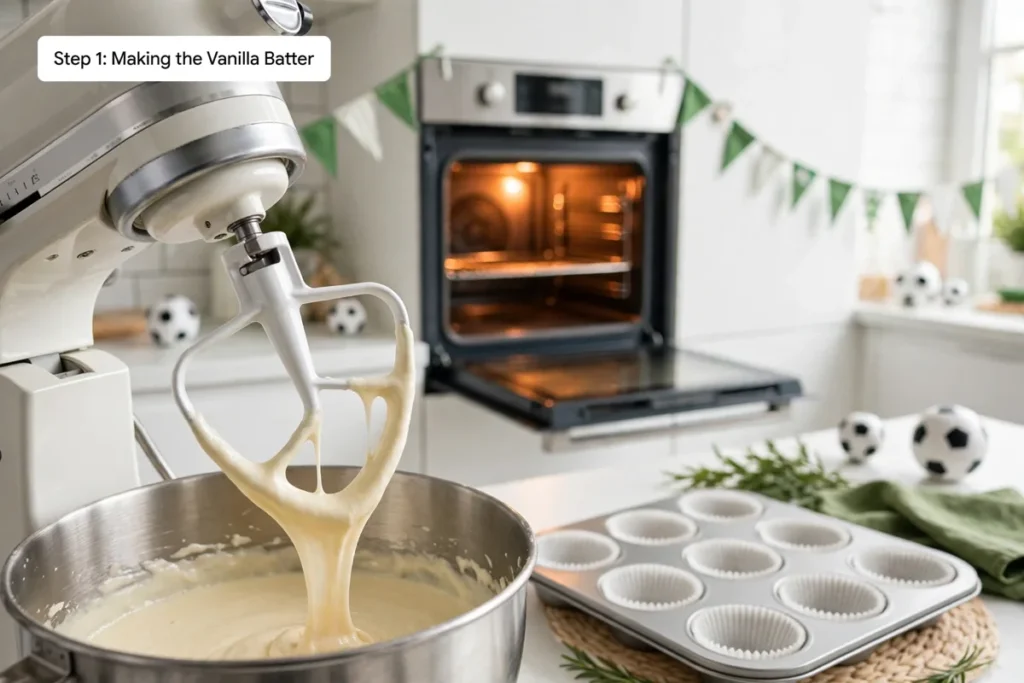
Step 2. Divide the batter evenly among the 12 liners approximately 3 tablespoons or 55g per cup, filling to two-thirds. Bake at 350°F for 18 to 22 minutes until a toothpick shows clean or moist crumbs and the tops spring back when pressed. Cool in the tin for 5 minutes then transfer to a wire rack to cool completely minimum 1 hour. Any residual warmth melts the buttercream on contact.

Make the White Buttercream
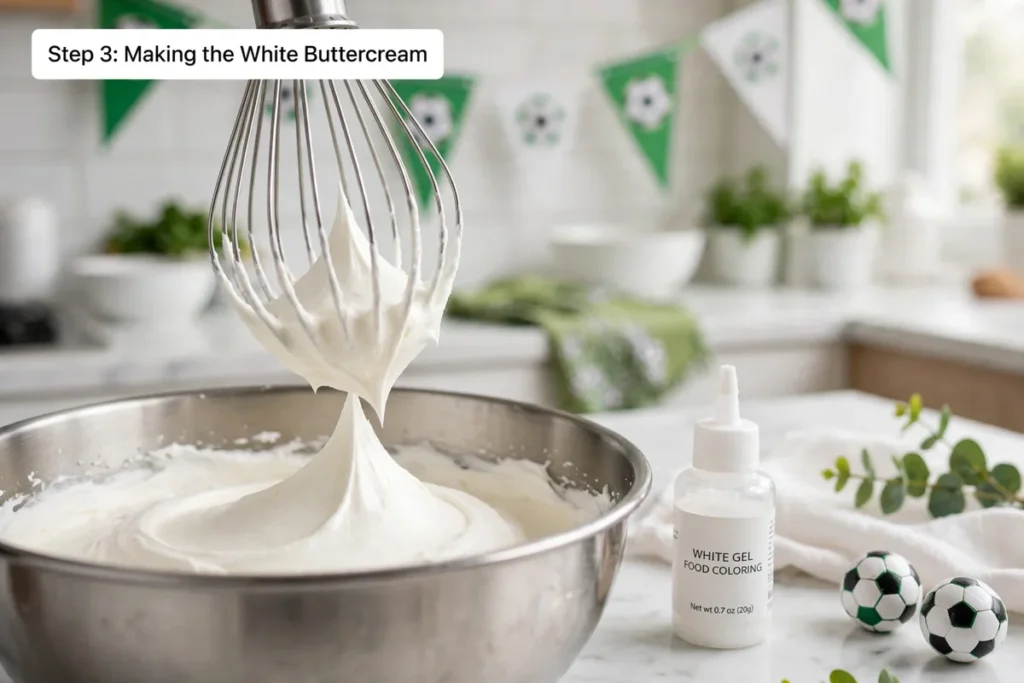
Step 3. Beat the room-temperature butter at high speed with the whisk for 3 to 4 minutes until very pale. Reduce to low and add the sifted powdered sugar in three additions. Add the heavy cream, vanilla, and salt. Beat at medium-high for 2 minutes until smooth, pale, and holding a stiff peak. Add the white gel food coloring and beat 30 seconds until uniformly bright white.
Make the Soccer Ball Fondant Domes
Step 4. Lightly dust the work surface with cornstarch. Knead the white fondant briefly 30 seconds until pliable and smooth. If the fondant is stiff, knead in 1/4 teaspoon of vegetable shortening to restore pliability. Roll to a uniform 4mm thickness the fondant sheet should be thin enough to drape over a curved surface without cracking but thick enough to hold its dome shape when formed.
Cut 12 circles using the 1.5-inch round cutter or slightly larger if the cupcake tops are wider than average. Gather the scraps, re-knead briefly, re-roll, and cut additional circles as needed. Work quickly fondant at room temperature begins drying and forming a surface crust within 10 to 15 minutes of exposure to air, and surface-crusted fondant cannot be shaped into a smooth dome without surface cracking.

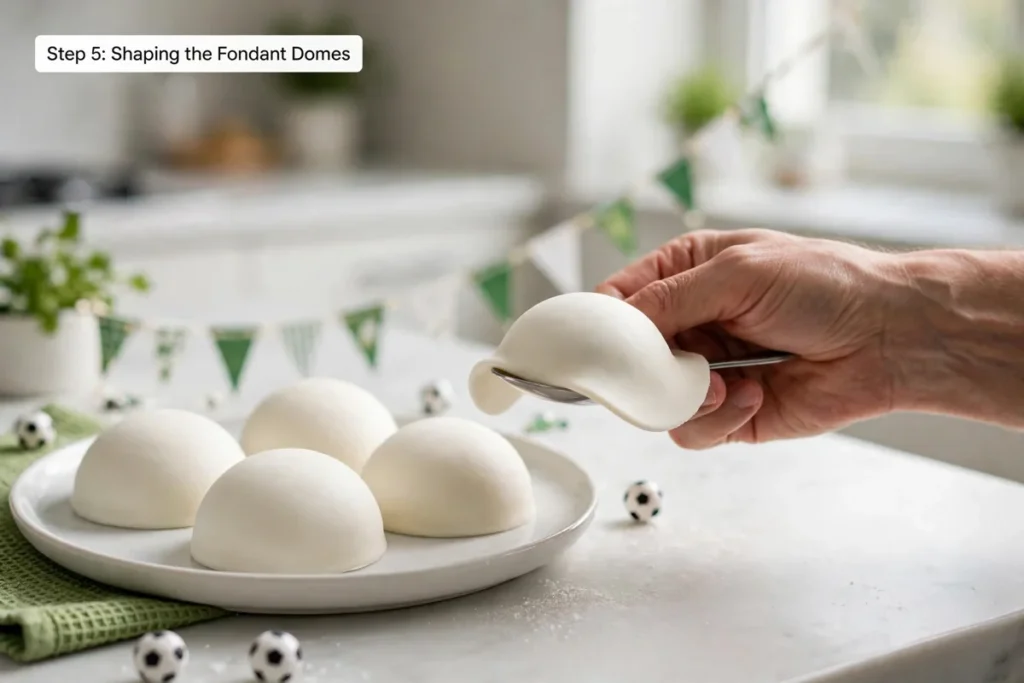
Step 5. Shape each fondant circle into a dome by placing it over the rounded base of a teaspoon or over a small ball of aluminium foil approximately the size of the finished dome. Press gently to conform the fondant circle to the curved surface the fondant’s pliability allows it to take the dome shape without excessive stretching. Remove from the shaping surface and place dome-side up on a plate. The dome should hold its shape when removed a slight settling is normal.
Apply the Soccer Ball Pattern Wet Fondant Method
Step 6. Immediately after shaping each dome while the fondant is still pliable and surface-wet apply the black pentagon pattern using the piping gel. The soccer ball pattern consists of a central pentagon at the dome’s top, surrounded by a ring of pentagons whose curved edges follow the dome’s curvature. At the cupcake scale, a simplified five-line pattern from the dome’s top to its base edge five curved lines radiating from a central point at the dome’s apex produces the soccer ball’s visual identity without requiring precise pentagon construction.
For the simplified five-line pattern: place the fondant dome dome-side up on the work surface. Pipe a small pentagon or hexagon shape at the dome’s apex using the black piping gel. Pipe five curved lines radiating outward from the central shape to the dome’s base edge spacing the lines evenly at approximately 72-degree intervals around the dome’s circumference. Pipe a short connecting line between adjacent radiating lines at the dome’s middle height the connecting lines produce the pentagon panel impression without requiring precise geometric construction.
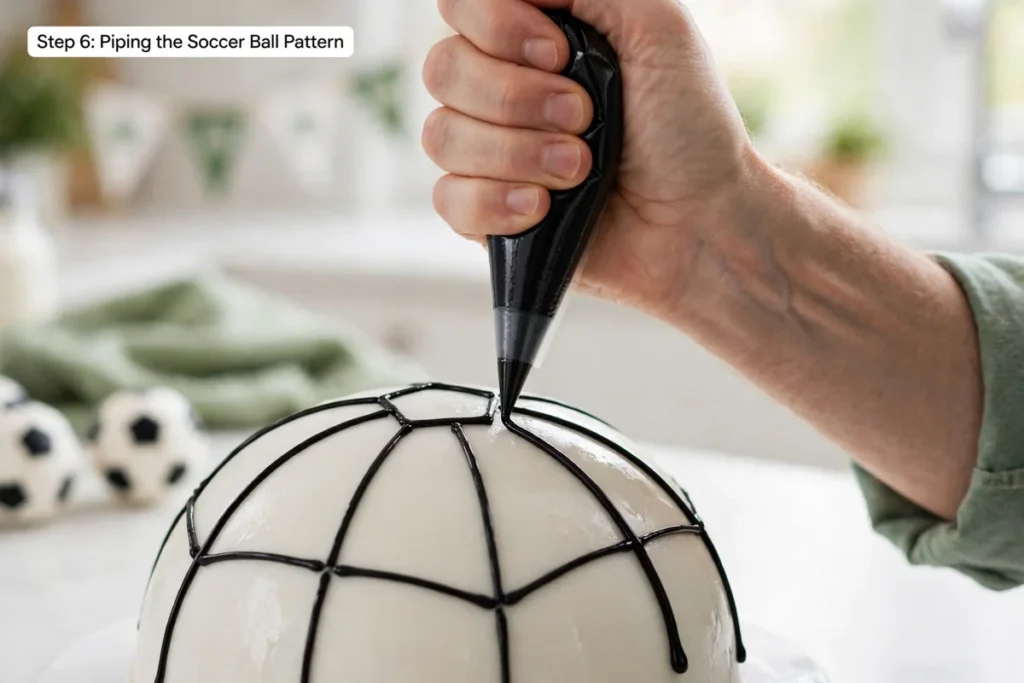
Step 7. Allow the decorated fondant domes to dry at room temperature for 30 to 45 minutes the combined fondant and piping gel dry simultaneously, producing the clean, flat, permanently bonded black pentagon lines that the wet-on-wet application achieves. During this drying period the dome firms from the slightly pliable wet-fondant state to the firmer, more stable dry-fondant state that can be handled and placed on the cupcakes without deforming.
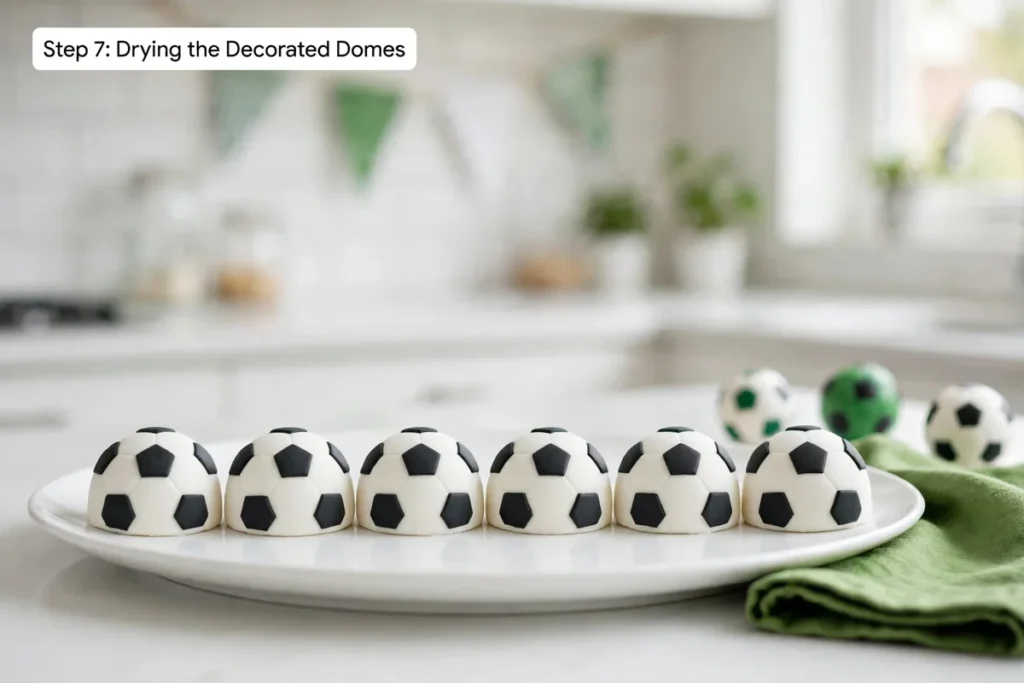
Assemble the Soccer Cupcakes
Step 8. Apply the white buttercream to each completely cooled cupcake using the small offset spatula spreading a flat, smooth, slightly domed layer approximately 1/2 inch thick across the full cupcake top. The flat dome provides a stable, level platform for the soccer ball fondant to sit without tilting. An alternative approach is to pipe the white buttercream using a large round tip in a flat swirl that produces a smooth, flat surface either application method is correct provided the buttercream surface is level enough to support the fondant dome without it rocking.
Place one dried soccer ball fondant dome on each frosted cupcake pressing very gently into the buttercream surface just enough to anchor the dome without deforming the buttercream beneath it. The dome’s flat base sits naturally on the buttercream’s flat surface no additional adhesive is needed. If the dome rocks on the buttercream, press one fingertip very gently on the dome’s side to stabilise until the buttercream provides sufficient grip 30 to 60 seconds.

How Does the Wet-Fondant Piping Technique Produce Permanent Adhesion?
The wet-fondant piping technique’s physical mechanism is a shared drying and bonding process between two materials at compatible drying stages the white fondant surface and the black piping gel that produces a unified, co-dried interface rather than the dried-fondant-to-wet-piping application’s distinct layered interface.
Fondant’s primary structure is a supersaturated sugar solution in which fine sugar crystals are suspended in a glucose syrup matrix commercial fondant achieves its workable, pliable consistency through the specific balance of sugar crystal size, moisture content, and glucose syrup proportion that produces the neither-hard-nor-soft texture that makes fondant shapeable. Freshly shaped fondant’s surface moisture approximately 12 to 16 percent total water content is at its highest immediately after rolling and shaping, producing a slightly tacky, receptive surface whose dissolved sugar provides bonding sites for compatible sugar-based materials applied to it.
Black piping gel a glucose syrup, water, and food coloring mixture is chemically compatible with fondant’s sugar matrix. When piping gel is applied to wet fondant, the glucose syrup in the piping gel contacts the dissolved sugar at the fondant’s surface the two sugar solutions at the interface establish concentration equilibrium through osmotic mixing at the contact zone, creating a thin interfacial layer where the fondant’s sugar crystal structure and the piping gel’s glucose syrup matrix have partially exchanged molecules. As both the fondant and the piping gel dry simultaneously water evaporating from both simultaneously this interfacial mixed layer crystallises together, producing a chemical bond between the fondant surface and the overlying piping gel line that is stronger than any surface adhesion achievable between dried fondant and subsequently applied wet piping gel.
When piping gel is applied to dried fondant where the surface moisture has already evaporated and the surface sugar has crystallised to a hard, non-tacky state there is no dissolved sugar at the surface for the piping gel’s glucose syrup to establish concentration equilibrium with. The piping gel sits on top of the crystallised fondant surface without chemical integration the mechanical adhesion of the glucose syrup’s viscosity against the smooth dried fondant surface is the only bonding mechanism, and it is insufficient to prevent the drying piping gel’s contraction from pulling the line edges away from the smooth dried fondant surface as the piping gel reduces in volume during its drying process.
How Do Soccer Cupcakes Compare to Related Sports-Themed Cupcakes?
| Attribute | Soccer Cupcakes | Baseball Cupcakes | Basketball Cupcakes | Football Cupcakes | Tennis Cupcakes |
|---|---|---|---|---|---|
| Primary decoration | White fondant dome with black pentagon piping | White fondant circle with red curved stitch piping | Orange buttercream dome with black curved line piping | Brown fondant oval with white lace stitch piping | Yellow-green buttercream ball with white curved line piping |
| Fondant color | White | White | No fondant buttercream only | Brown | No fondant buttercream only |
| Piping color | Black | Red | Black | White | White |
| Ball shape | Dome three-dimensional | Flat circle two-dimensional | Dome three-dimensional | Oval two-dimensional | Round swirl two-dimensional |
| Pattern complexity | Medium pentagon grid requires planning | Easy two curved stitch lines per side | Easy two curved lines crossing | Medium lace stitch pattern | Easy two curved lines |
| Most appropriate occasion | Youth soccer season, soccer birthday | Baseball season, baseball birthday | Basketball season, basketball birthday | Super Bowl, football birthday | Tennis club events, Wimbledon parties |
| Cupcake color most common | White or chocolate | White | Orange or chocolate | Chocolate | White or green |
What Variations Can You Make?
Chocolate Soccer Cupcakes
Replace the vanilla cupcake base with a chocolate cupcake add 3 tablespoons of sifted Dutch-process cocoa to the flour and reduce the flour to 135g, bloom the cocoa in 3 tablespoons of hot coffee before adding to the batter at the liquid stage. The chocolate cupcake base provides the most visually dramatic contrast to the white buttercream and white fondant soccer ball the dark chocolate crumb visible at the paper liner’s top edge against the white buttercream produces the most complete black-and-white soccer color palette of any base flavor.
Team Color Soccer Cupcakes
Replace half the white fondant soccer ball domes with fondant domes in the team’s primary color coloring the fondant with gel food coloring kneaded in before rolling and alternate white-dome and team-color-dome cupcakes on the serving plate. Apply the pentagon pattern in the contrasting team color white piping gel lines on the colored fondant domes. The alternating color scheme produces the most visually dynamic team celebration presentation and allows each player to identify the team color immediately without explanation.
Grass Field Soccer Cupcakes
Tint the white buttercream with green gel food coloring using a mix of leaf green and a touch of yellow to produce the vivid, slightly warm green of a real grass pitch rather than the cold, blue-tinted green that pure leaf green produces. Apply the green buttercream with a grass tip Wilton tip 233 or similar multi-hole grass tip in a pulling motion across the cupcake top to produce textured grass strands. Place the white soccer ball fondant dome on the textured green buttercream grass surface. The grass-and-ball combination is the most immediately narrative soccer cupcake presentation the ball sitting on the pitch rather than floating in an abstract white space.
Dietary Adjustments and Substitutions
Gluten-Free Version
Replace the all-purpose flour with a certified gluten-free 1:1 baking flour blend at the same weight (180g). Increase the baking powder to 2 teaspoons (8g). The fondant decorations and buttercream are inherently gluten-free verify the commercial fondant brand’s gluten-free certification, as Wilton fondant is labelled gluten-free.
Dairy-Free Version
Replace the butter in the cupcake batter with dairy-free butter sticks (113g), the whole milk with full-fat oat milk (120ml), and the sour cream with coconut yogurt (30g). For the buttercream, replace the butter with dairy-free butter sticks (226g) and the heavy cream with full-fat oat milk (30 to 45ml). The white gel food coloring is dairy-free. The fondant and piping gel are dairy-free in their standard commercial formulas verify by brand.
What Are the Most Common Problems When Making Soccer Cupcakes?
| Problem | Most Likely Cause | Prevention or Fix |
|---|---|---|
| Black piping lines lifting and cracking from fondant | Piping applied to dried rather than wet fondant because no chemical integration at the interface | Always pipe the pentagon pattern immediately after shaping each dome while the fondant surface is still wet and pliable. |
| Fondant dome cracking when shaped | Fondant too dry because surface crust formed before shaping | Work quickly, shape within 5 minutes of cutting circles. If fondant has begun drying, knead in a tiny amount of shortening and re-roll. |
| Soccer ball pattern unrecognisable lines too irregular | Insufficient planning before piping | Lightly mark the five radiating line positions with a toothpick on the wet fondant before piping, the toothpick lines guide the piping gel without leaving a visible mark after the gel is applied over them. |
| Fondant dome tilting on the cupcake | Buttercream surface not flat because dome cannot balance on an uneven surface | Ensure the buttercream application produces a flat, level surface rather than a peaked or sloped one. A brief refrigeration of the frosted cupcake for 5 minutes before dome placement firms the buttercream and stabilises dome placement. |
| Buttercream too yellow reducing soccer ball color impact | Butter's carotenoid pigment not neutralised | Use the full 1/4 teaspoon of white gel food coloring and beat for the full 30 seconds after addition. Add an additional 1/8 teaspoon if still yellow. |
How Do You Store Soccer Cupcakes?
| Storage Method | Duration | Instructions |
|---|---|---|
| Room temperature, in a covered cake carrier below 70°F | Up to 2 days | The fondant domes are moisture-sensitive and exposure to high humidity softens the dried fondant and makes the surface tacky. A covered carrier protects from ambient humidity. Do not refrigerate decorated fondant because refrigerator condensation on removal produces moisture droplets that dissolve the fondant surface. |
| Undecorated cupcakes, refrigerated in an airtight container | Up to 4 days | Store the frosted cupcakes without fondant domes under refrigeration. Add the fondant soccer ball domes on the day of serving because fondant and refrigeration are incompatible for anything beyond same-day serving. |
| Undecorated cupcakes, frozen individually wrapped | Up to 2 months | Freeze the unfrosted cupcakes. Thaw at room temperature for 1 hour, frost, and apply fondant soccer ball domes immediately before serving. The fondant domes can be made up to 3 days in advance and stored at room temperature in a single layer in an airtight container and apply to frosted cupcakes on the day of the party. |
Scaling
| Servings | All-Purpose Flour | Sugar | Butter (cake) | Eggs | Butter (frosting) | Fondant |
|---|---|---|---|---|---|---|
| 12 cupcakes (standard) | 180g | 150g | 113g | 2 eggs | 226g | 250g |
| 24 cupcakes | 360g | 300g | 226g | 4 eggs | 452g | 500g |
| 36 cupcakes | 540g | 450g | 340g | 6 eggs | 678g | 750g |
Nutritional Information
Per serving: 1 cupcake approximately 110g including vanilla cupcake, white buttercream, and fondant soccer ball decoration, based on 12 cupcakes. Values calculated using USDA FoodData Central reference data.
| Nutrient | Per Serving | Nutrient | Per Serving |
|---|---|---|---|
| Calories | 448 kcal | Total carbohydrate | 64g |
| Total fat | 20g | Dietary fibre | 0.4g |
| Saturated fat | 12g | Total sugars | 52g |
| Cholesterol | 78mg | Protein | 3.8g |
| Sodium | 168mg | Calcium | 48mg (4% DV) |
Frequently Asked Questions
Why must the braising liquid be reduced before filling the pastry case?
Thin braising liquid’s water activity of 0.97 to 0.99 produces a strong thermodynamic driving force for moisture migration into the adjacent raw pastry’s hygroscopic starch and protein matrix the starch granules begin absorbing the liquid immediately on contact, producing the gummy, moisture-saturated pastry base that baking cannot fully recover because the starch-water association formed before baking produces structural changes that partial dehydration in the oven cannot fully reverse. Reduced gravy’s water activity of 0.90 to 0.93 from the bound starch network, gelatin, and dissolved solids reduces this driving force substantially, producing far less capillary moisture absorption into the adjacent pastry at the same contact time and temperature.
Why is beef chuck specified rather than leaner cuts?
Beef chuck’s collagen content approximately 15 percent of the cut’s connective tissue mass converts to gelatin during the 1.5 to 2-hour braise at 300°F, enriching the braising liquid with the dissolved gelatin that produces two essential quality contributions. The gelatin’s body and viscosity supplement the roux-thickened gravy’s consistency, producing a more luxurious, mouth-coating gravy than a lean cut’s collagen-free braising liquid achieves at the same reduction and thickening. And the gelatin’s cold-set property semi-solidifies the chilled filling before assembly providing the structural cohesion that holds the filling’s shape during pastry lid application and the oven’s initial heating phase before the gelatin melts back to liquid.
Why is a pie funnel used rather than simply cutting more steam vents?
A pie funnel’s vertical channel provides continuous, unrestricted steam escape from the filling’s centre the zone where steam pressure builds highest from the surrounding filling mass throughout the full baking period. Cut steam vents in a flat pastry lid provide variable-resistance steam escape the pastry’s tendency to rise and partially close the vent under the steam pressure reduces the vent’s effective cross-section during baking, producing periods of higher-than-intended steam pressure between vent-opening events. The pie funnel’s rigid ceramic channel cannot close under steam pressure, providing consistent, low-resistance steam escape that prevents the lid-lifting that inconsistently vented savory pies produce from accumulated steam pressure under the lid.
Why must the filling be chilled cold before assembly rather than filled warm?
Warm filling above approximately 100°F has sufficient residual heat to begin softening the butter in the raw bottom pastry from below during the assembly period before the pie enters the oven, producing the same warm-butter-fat-smearing effect that the all-butter pie crust’s temperature-sensitive technique warns against. Warm filling also maintains higher water activity mobility the dissolved compounds and free water in the warm gravy migrate more rapidly into the adjacent pastry than the cold gravy’s reduced molecular mobility allows. The gelatin semi-set in the chilled filling provides an additional benefit the semi-solid filling holds its shape during lid application rather than flowing to the low point of the pastry case, producing a more uniformly distributed filling depth throughout the pie’s cross-section.
Soccer cupcakes are American youth sports celebration cupcakes whose visual quality depends entirely on the wet-fondant piping technique applying the black pentagon pattern lines to the shaped white fondant dome while the fondant surface is still wet and pliable rather than after it has dried to a crystallised surface, because the wet fondant’s dissolved sugar establishes concentration equilibrium with the black piping gel’s glucose syrup at the contact interface and both components dry simultaneously into a chemically bonded interfacial layer that holds the piped lines permanently flat and adhered through the drying contraction that the gel’s volume reduction produces a bonding mechanism that dried fondant’s crystallised surface cannot provide, producing instead the lifted, cracked black lines that sit on top of rather than integrating into the dried fondant surface and that reduce the soccer ball pattern’s clean, professional appearance to the craft-project quality that the wet-fondant protocol specifically prevents through the shared drying chemistry that makes the application window’s 8 to 10-minute constraint the most important timing decision in the decoration process.
Table of Contents
Recent Recipes
American · Cupcakes SpongeBob Cupcakes Recipe Character-themed American celebration cupcakes moist vanilla cupcakes with bright yellow buttercream and SpongeBob SquarePants’ […]
Check Out..!
American · Cupcakes Pokémon Cupcakes Recipe Character-themed American celebration cupcakes vanilla cupcakes with bright yellow buttercream, three-dimensional fondant Pikachu ears, […]
Check Out..!
American · Cupcakes Soccer Cupcakes Recipe American youth sports celebration cupcakes vanilla cupcakes with bright white buttercream and white fondant […]
Check Out..!Recent Blogs
I’ve glazed our Amish apple cake too hot, too cold, and exactly right, and the difference is not small. The […]
Read Blog..!
I’ve pulled a sunken Amish Apple Cake out of my oven, and I know the exact sinking feeling that comes […]
Read Blog..!
A cup measures volume, not weight, so a cup of flour and a cup of sugar weigh completely different amounts. […]
Read Blog..!
Every pasta shape was designed to carry a certain kind of sauce. Thin strands suit light sauces that coat, wide […]
Read Blog..!
Every egg method, from a jammy boiled egg to a silky French omelet, comes down to one fact: the white […]
Read Blog..!