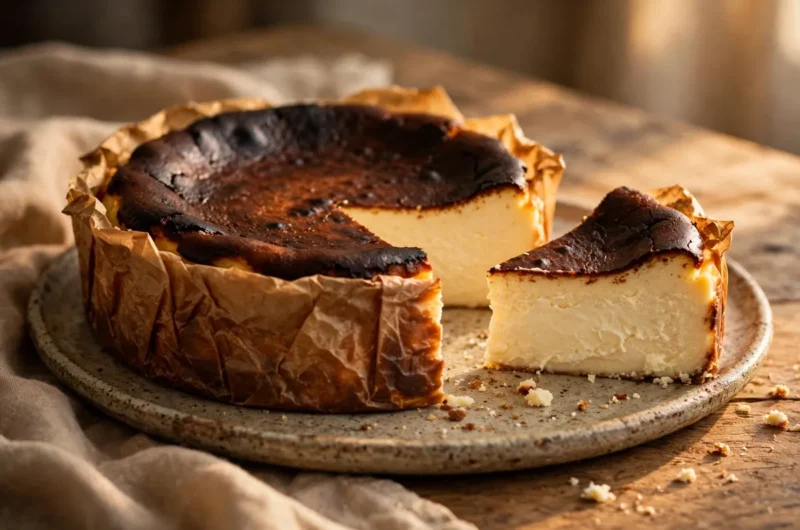
Basque cheesecake, La Tarta de Queso de La Viña, named for the pintxos bar La Viña in San Sebastián’s Parte Vieja old quarter where chef Santiago Rivera created the preparation in 1990, is a crustless, deliberately burnt-topped cheesecake baked at extreme heat to produce a deeply caramelised, almost scorched exterior over a creamy, barely-set, custard-soft interior that no other cheesecake format replicates because no other cheesecake format deliberately pursues the burnt exterior as its primary visual and flavor quality.
The 450°F baking temperature is the single most critical technique decision and the single most counterintuitive one for any baker whose cheesecake experience has been organised around preventing cracks, preventing browning, and achieving uniform set throughout. At 450°F the cheesecake’s exterior reaches the caramelisation and Maillard browning thresholds rapidly: the cream cheese’s lactose caramelises, the egg proteins at the surface undergo advanced Maillard browning, and the cream’s fat phase undergoes partial oxidation, producing the deep amber-to-near-black exterior whose bitter, complex, caramelised character contrasts the sweet, rich, barely-set interior in every bite. The interior, insulated from the extreme exterior temperature by the cream cheese’s thermal mass and the exterior crust’s set protein layer, bakes to only 155 to 160°F at the centre, the soft, trembling, barely-set custard that flows slightly when cut rather than holding a rigid shape.
La Viña bar’s Basque cheesecake was unknown outside San Sebastián’s pintxos culture until the mid-2010s, when Spanish food writers and subsequently international food media including Bon Appétit’s influential 2021 feature brought the preparation to global attention as the anti-cheesecake cheesecake, the preparation that violated every conventional cheesecake rule deliberately and produced a result that most tasters immediately described as superior to any cheesecake they had encountered in the conventional format. The preparation’s global popularity accelerated through the pandemic baking period of 2020 to 2021, when its minimal ingredients, no-crust requirement, no-water-bath technique, and no-crack outcome made it simultaneously the most impressive and the most accessible cheesecake any home baker could produce: the recipe where breaking the rules was not only permitted but mandatory.
What Is Basque Cheesecake?
Basque cheesecake is a crustless, intentionally burnt Spanish cheesecake in which a simple batter of cream cheese, eggs, sugar, cream, and a minimal quantity of flour bakes at extreme heat (450°F) for 50 to 60 minutes to produce a deeply caramelised, slightly charred exterior and a soft, barely-set, custard-like interior that flows gently when sliced rather than holding a clean, rigid shape.
It differs from New York cheesecake in every quality target: where New York cheesecake pursues a crack-free, uniformly pale, firmly set result, the Basque cheesecake pursues a cracked, deeply browned, barely-set result. It differs from Japanese cheesecake in that the Basque preparation uses no whipped egg whites, no water bath, and no delicate handling; it is the most robust, most forgiving, most deliberately imprecise cheesecake in the global cheesecake tradition.
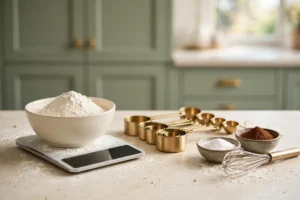
What Equipment Do You Need?
What Ingredients Do You Need?
Use full-fat block cream cheese at room temperature (Philadelphia brand or equivalent). The cream cheese must be at a genuine room temperature of 65 to 68°F rather than simply removed from the refrigerator 10 minutes before use; cold cream cheese produces a lumpy batter whose lumps survive the low-speed mixing and produce visible cream cheese pieces through the finished cheesecake. Use heavy cream rather than whipping cream; the higher fat content produces the richer, more luxurious interior texture that the Basque cheesecake’s minimal flour formula requires for structural support.
For the Basque Cheesecake
The 2 tablespoons of flour, a quantity so minimal that most cheesecake recipes do not include flour at all, serves a specific structural function in the Basque cheesecake that is different from flour’s role in a standard cheesecake. At this quantity the flour does not thicken the batter or produce a cakey texture; it provides just enough starch to prevent the extreme oven temperature’s rapid exterior heat from causing the batter to completely liquify and spread before the exterior protein network sets, while leaving the interior soft enough to maintain the barely-set custard character. A flour-free Basque cheesecake at 450°F produces an exterior that sets correctly but an interior that liquifies completely and produces a runny, un-sliceable result at room temperature.
Step by Step Process
Prepare the Pan
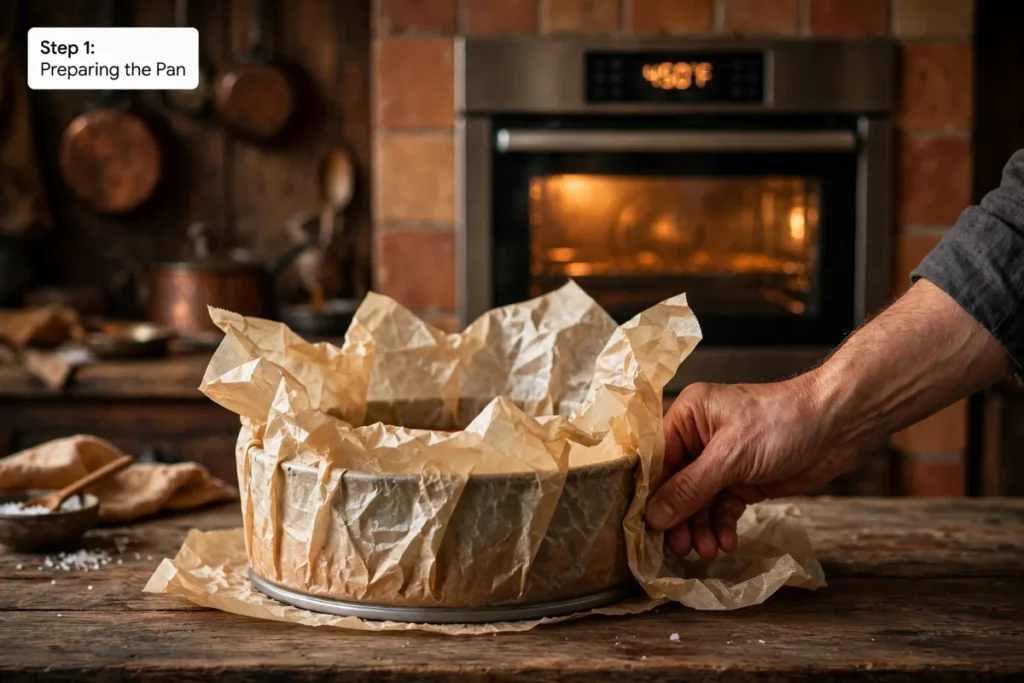
Step 1. Preheat the oven to 450°F (232°C); allow a minimum of 20 minutes for the oven to reach and stabilise at this temperature. An under-temperature oven at the time the cheesecake enters produces insufficient initial surface heat for the caramelisation to begin rapidly, producing a paler, less caramelised exterior than the full 450°F achieves from the first minute of baking.
Take two large sheets of parchment paper, each approximately 16 inches square. Crumple each sheet deliberately into a ball, then unfold; the crumpling relaxes the parchment’s stiffness and makes it conform to the pan’s curves without tearing. Press the first parchment sheet into the 8-inch pan, pressing it against the base and sides and allowing the excess to extend 2 to 3 inches above the pan’s rim. Press the second sheet perpendicular to the first; the two sheets together cover the full interior surface with the overlapping sheets’ combined height extending above the rim.
Make the Batter
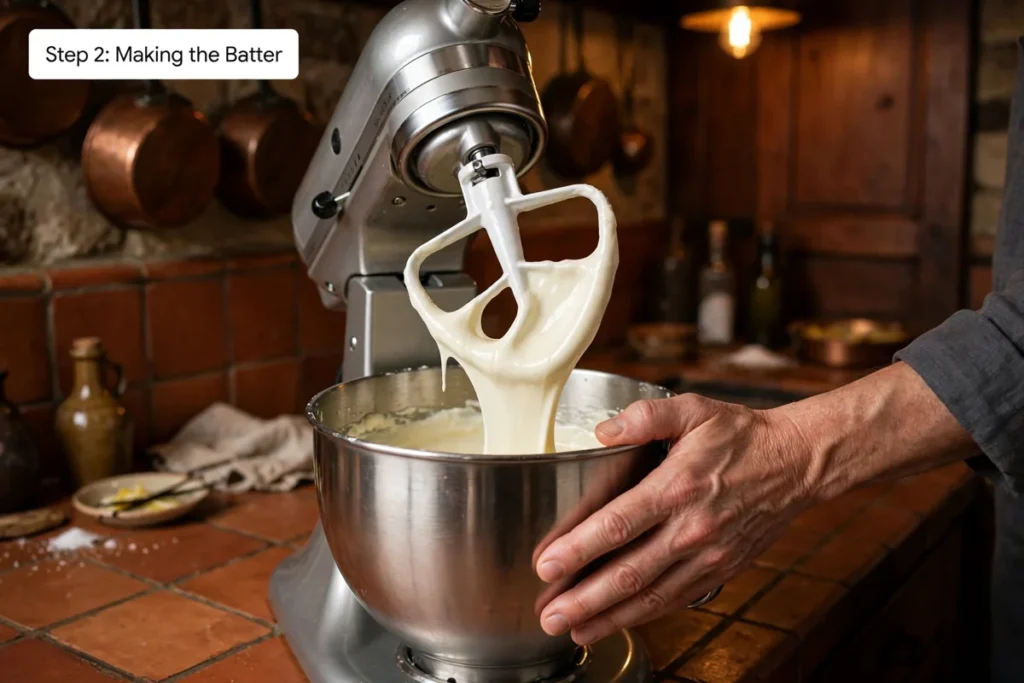
Step 2. Beat the room-temperature block cream cheese with the paddle at low speed for 2 full minutes until completely smooth with no lumps. The low speed is deliberate throughout the entire batter assembly; the Basque cheesecake’s interior texture depends on minimal air incorporation, and medium or high speed beating produces an over-aerated batter whose air bubbles expand during baking to produce a souffléd, cracked rise rather than the dense, custard-smooth interior.
Add the granulated sugar and beat at low speed for 1 minute until completely combined and the sugar has fully dissolved into the cream cheese.
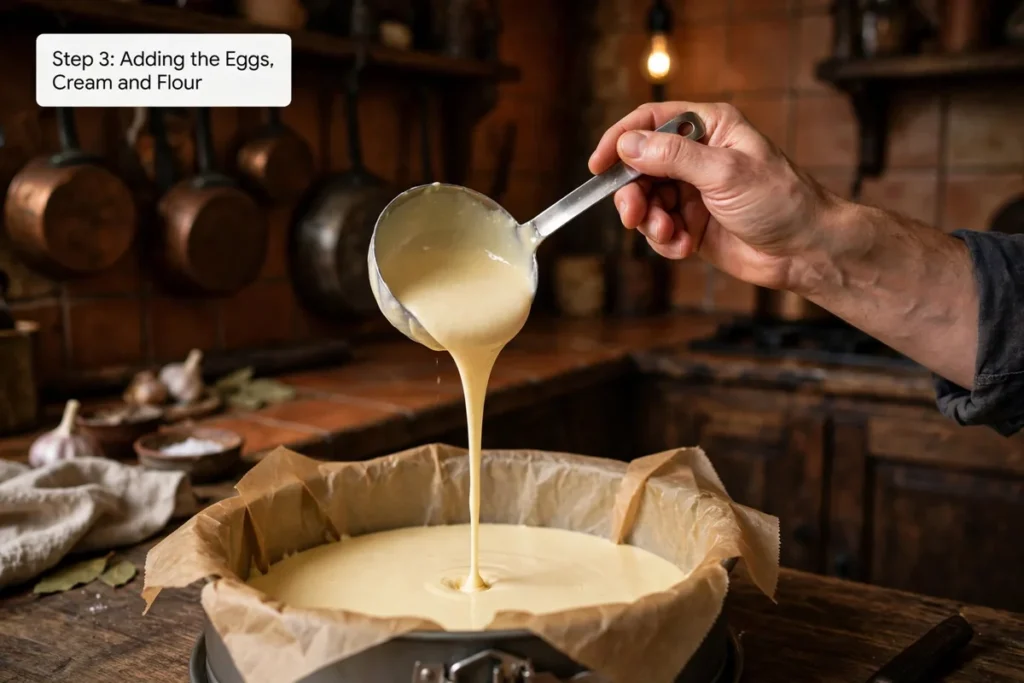
Step 3. Add the eggs one at a time, beating at low speed for 20 seconds after each, the minimum mixing time needed for each egg to fully incorporate without the additional air that longer beating would introduce. Add the vanilla extract and salt, beating 10 seconds.
Add the heavy cream in a slow, steady stream at low speed, pouring down the inside of the bowl rather than directly onto the batter. Beat for 20 seconds until the cream is completely incorporated. Sift the flour directly into the batter and beat at low speed for 15 seconds until no dry flour patches remain.
The finished batter is completely smooth, thin (significantly thinner than a standard cheesecake batter from the high cream-to-cheese ratio), and pours freely from a ladle. The thinness is correct and expected.
Bake the Basque Cheesecake
Step 4. Pour the batter into the parchment-lined pan; it fills to approximately 1 inch below the parchment collar’s top. Place on the centre rack of the fully preheated 450°F oven.
Bake at 450°F for 50 to 60 minutes. The Basque cheesecake passes through three visible stages during baking. In the first 20 minutes the batter rises significantly and the exterior begins browning rapidly. Between 20 and 40 minutes the exterior darkens progressively from golden-brown to deep amber to the near-black caramelised surface that is the preparation’s defining visual. In the final 10 to 20 minutes the visible surface is very dark, deeply caramelised and potentially alarming to any baker unfamiliar with the preparation, while the cheesecake’s interior, visible at the centre’s trembling jiggle, remains soft and barely set.
Do not open the oven before 45 minutes; the temperature drop from early oven opening collapses the risen cheesecake before the exterior protein network has set sufficiently to support the structure.
Step 5. Remove from the oven. The cheesecake will have risen significantly during baking; it deflates and settles during cooling, which is expected and correct. The settling produces the characteristic slightly sunken centre and the slightly wrinkled surface that, combined with the very dark exterior, constitutes the Basque cheesecake’s authentic appearance. Cool completely in the pan at room temperature, minimum 1 hour, then refrigerate for minimum 3 hours, preferably overnight.
Unmould and Serve
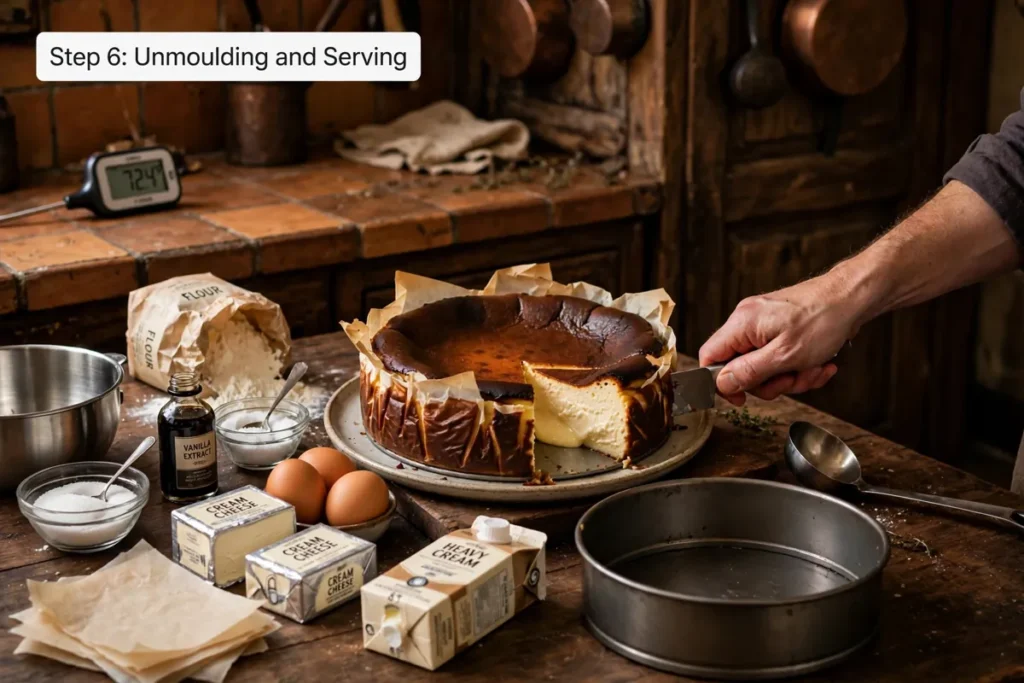
Step 6. Remove from the refrigerator 30 minutes before serving; the Basque cheesecake is best served at cool room temperature rather than cold, where the interior’s barely-set custard character is at its most yielding and the vanilla and cream cheese flavor compounds are at their fullest volatile expression. Lift the cheesecake from the pan using the parchment collar overhang, placing on a serving plate and peeling the parchment away from the exterior sides. The parchment’s wrinkle impressions on the exterior surface are visible and correct; they are the preparation’s authentic visual signature rather than a flaw to be smoothed.
Slice with a sharp, warm knife, dipping the knife in hot water and drying between cuts. Each slice reveals the two-zone cross-section: the very dark, slightly charred exterior giving way to the pale, almost liquid, barely-set ivory interior.
Why 450°F Produces the Two-Zone Structure Where Lower Temperatures Produce Uniform Set
The Basque cheesecake’s defining two-zone structure (deeply caramelised exterior surrounding barely-set interior) is a direct consequence of the extreme baking temperature’s interaction with the cheesecake’s thermal mass and the cream cheese matrix’s specific heat transfer properties.
At 450°F the oven’s radiant and convective heat produces a surface temperature at the exposed cheesecake top of approximately 380 to 420°F within the first 10 minutes of baking, well above the lactose caramelisation threshold of 330°F and the advanced Maillard browning threshold for the cream cheese’s casein proteins and lactose of approximately 280 to 300°F. The exterior 5 to 8mm of the cheesecake batter reaches these temperatures rapidly and undergoes the caramelisation and Maillard reactions that produce the deeply flavored, complex, bitter-sweet exterior crust. The egg proteins in this exterior zone fully coagulate above 165°F, setting the exterior’s structure while the interior is still far below this threshold.
The cheesecake’s interior, insulated from the extreme surface temperature by the set exterior protein layer and the cream cheese matrix’s relatively low thermal conductivity, heats far more slowly than the exterior. At the 50 to 60-minute baking time, the interior’s centre reaches only 155 to 160°F, just above the egg protein’s soft-set threshold of 149°F. At this temperature the yolk proteins have partially coagulated into a soft, barely-set gel that yields under gentle pressure but holds its shape at room temperature, the custard-soft interior whose contrast with the set exterior produces the Basque cheesecake’s defining two-zone eating experience.
At 400°F the surface temperature rise is significantly slower; the exterior reaches the caramelisation threshold later and the extended baking time needed for even the pale browning allows the interior to heat to 170 to 180°F before the exterior achieves meaningful caramelisation. At 170 to 180°F the interior egg proteins are fully coagulated into a firm, clean-cutting gel, producing a uniformly set cheesecake without the soft interior zone. The lower temperature’s longer baking time simultaneously produces less caramelisation and more interior setting, eliminating both of the preparation’s defining qualities simultaneously.
How Does Basque Cheesecake Compare to Related Cheesecake Formats?
What Variations Can You Make?
Chocolate Basque Cheesecake
Add 3 oz (85g) of melted dark chocolate (70 percent), cooled to room temperature, to the batter after the eggs are incorporated and before the cream is added. Add 1 tablespoon of sifted Dutch-process cocoa powder alongside the flour. The dark chocolate’s cocoa butter integrates into the cream cheese’s fat phase during the low-speed mixing, distributing the chocolate’s polyphenol complexity through the full batter volume. The chocolate Basque cheesecake’s two-zone cross-section shows a near-black exterior over a dark chocolate barely-set interior, the most dramatically monochromatic cross-section of any cheesecake variation.
Lemon Basque Cheesecake
Add 2 tablespoons (12g) of fresh lemon zest rubbed into the granulated sugar before adding to the cream cheese, the fat-phase limonene integration technique applied at the cheesecake scale. Add 2 tablespoons (30ml) of fresh lemon juice alongside the heavy cream. The lemon’s citric acid slightly accelerates the cream cheese’s surface caramelisation at 450°F; the acidic environment promotes the Maillard reaction between the cream cheese’s casein proteins and lactose at the exterior surface, producing a slightly deeper caramelisation than the standard formula at the same baking temperature and time.
Matcha Basque Cheesecake
Whisk 2 tablespoons (10g) of ceremonial-grade matcha powder with 2 tablespoons of the heavy cream until completely smooth before adding to the batter. The matcha’s fat-soluble chlorophyll and catechin compounds distribute through the cream’s fat phase during mixing, producing a vivid green interior against the standard dark caramelised exterior. The matcha’s slight bitterness complements the caramelised exterior’s bitter complexity through the same bitter-bitter stacking documented in the dark chocolate and espresso combinations throughout this collection; both compounds activate overlapping but distinct TAS2R bitter receptor pathways that produce additive rather than competing bitterness perceptions.
Dietary Adjustments and Substitutions
Gluten-Free Version
Replace the 2 tablespoons of all-purpose flour with 2 tablespoons (16g) of certified gluten-free sweet rice flour (mochiko). The sweet rice flour’s waxy starch provides the same minimal structural support as the all-purpose flour without any detectable flavor contribution at this quantity. The Basque cheesecake is one of the most easily gluten-free-adapted cheesecake formats; the flour’s minimal structural role makes the substitution essentially invisible in both texture and flavor.
Lighter Version
Reduce the heavy cream to 1/2 cup (120ml) and replace the remaining 1/2 cup with full-fat sour cream at the same volume. The sour cream’s lactic acid provides a slight tang that the heavy cream-only formula does not have, and the lower fat content produces a slightly firmer but still barely-set interior at the same baking temperature and time. Not a dairy-free substitution; a flavor variation that adds complexity without significantly reducing the preparation’s richness.
What Are the Most Common Problems When Making Basque Cheesecake?
How Do You Store Basque Cheesecake?
Scaling
Nutritional Information
Per serving: 1 slice approximately 130g, based on 8 slices. Values calculated using USDA FoodData Central reference data using full-fat cream cheese and heavy cream.
Frequently Asked Questions
Basque cheesecake is La Viña bar chef Santiago Rivera’s 1990 San Sebastián creation, the preparation that violated every conventional cheesecake rule deliberately and produced a result that most tasters immediately describe as the most interesting cheesecake they have encountered, whose deeply caramelised, near-black exterior over a barely-set, custard-soft ivory interior depends entirely on the 450°F baking temperature that brings the exterior surface to caramelisation and Maillard browning thresholds within the first 10 minutes while the cream cheese matrix’s low thermal conductivity insulates the interior to only 155 to 160°F at the 50 to 60-minute mark, producing the two-zone structure that lower temperatures eliminate by allowing the interior to fully set before the exterior achieves meaningful caramelisation, making 450°F not merely a temperature specification but the physical mechanism on which the preparation’s entire identity as the anti-cheesecake cheesecake depends.