American (Pennsylvania Dutch) · Fruit Cakes Amish Apple Cake Recipe A moist, oil-based spiced sheet cake made with pre-cooked diced […]
Check Out..!Lemon Mousse Recipe
This lemon mousse recipe starts with a lemon curd chilled until cold. Warm curd melts the whipped cream, and raw juice can curdle it. See why.
- Prep: 30 min
- Chill: 2 hours
- Total: 2 hours 30 min
- Servings: 6
- Difficulty: Easy-Medium
- Dietary: Vegetarian
Chef's review · Saba Aftab, Pastry Chef · Reviewed Nov 10, 2026“Dissolve the gelatin in the curd the moment it comes off the heat, then let the curd cool to room temperature before the cream goes in. Gelatin added to cooled curd never fully melts, and the mousse weeps by morning. Curd folded in warm melts the cream and leaves you with a dense, flat mousse.”
Our investigation: Most recipes we compared skip gelatin entirely or fold the cream into warm curd. Without gelatin, the mousse starts releasing liquid after a few hours in the fridge. With warm curd, the cream collapses before the mousse ever sets.
Lemon mousse is a cold-set citrus dessert in which fresh lemon curd, cooked from egg yolks, sugar, lemon juice, and butter, is lightened with whipped cream folded in after cooling, producing a dessert that is simultaneously more intensely lemon-flavoured than any whipped cream dessert and significantly lighter in texture than lemon curd eaten alone. Unlike chocolate mousse, which sets through cocoa butter crystallisation without any additional setting agent, lemon mousse requires either gelatin or the natural pectin and egg protein structure of a well-made lemon curd to hold its shape at refrigerator temperature, the lemon curd base provides both the flavour and the structural backbone that the whipped cream foam alone cannot supply.
The lemon variety and the freshness of the juice determine the flavour ceiling of the finished mousse. Fresh lemon juice contains citric acid at approximately 5 to 6 percent by weight alongside malic acid, ascorbic acid, and more than 20 volatile aromatic compounds including limonene, citral, and linalool that together produce the full, rounded lemon character that bottled juice cannot replicate because pasteurisation degrades citral, the primary aldehyde responsible for the bright, sharp lemon note, within weeks of processing. Eureka lemons, the standard supermarket variety available year-round in the United States, produce a reliably acidic, clean-flavoured curd. Meyer lemons, available from November through March, contain less citric acid and more sugars than Eureka lemons, producing a softer, more floral, less tart mousse suited to tasters who find standard lemon desserts too sharp.
What Is Lemon Mousse?
Lemon mousse is a two-component cold dessert: a cooked lemon curd base that provides flavour, acidity, and partial structural support, and whipped cream folded into the cooled curd to provide aeration and lightness. The ratio of curd to cream determines the character of the finished mousse, a higher curd proportion produces a more intensely lemon-flavoured, denser mousse that slices cleanly, while a higher cream proportion produces a lighter, more delicately flavoured mousse closer in texture to a whipped cream parfait.
The lemon curd must be fully cooked and cooled to room temperature before the whipped cream is folded in. Warm curd melts the fat globule walls of the whipped cream foam on contact, collapsing the air bubbles before the mousse is portioned and refrigerated. Fully cooled curd at room temperature, not cold from the refrigerator, which makes it too stiff to fold without deflating the cream, folds smoothly into the cream without melting it, producing a uniform, airy mousse that sets to the correct consistency during refrigeration.
A small quantity of gelatin bloomed and melted into the warm curd before cooling provides additional structural stability, producing a mousse that holds a clean spoon impression and does not weep liquid at the surface after 24 hours of refrigeration. Without gelatin the mousse is still structurally sound for the first 4 to 6 hours but begins softening and releasing liquid at the surface, syneresis, after overnight refrigeration as the egg protein network in the curd contracts and expels water. The gelatin quantity in this recipe is small enough that the finished mousse does not have a perceptible gelatin texture, it tastes and feels like lemon curd lightened with cream rather than a set gelatin dessert.
What Equipment Do You Need?
A medium heavy-bottomed saucepan, a fine mesh strainer, a stand or hand mixer for the whipped cream, and six serving glasses or ramekins are the core equipment.
| Equipment | Specification | Why It Matters |
|---|---|---|
| Medium heavy bottomed saucepan | 2 quart, stainless or enamelled | The lemon curd cooks over direct medium heat and requires a heavy bottom to distribute heat evenly and prevent the egg yolks from scrambling at hot spots on the pan base. Thin pans produce scrambled egg spots in the curd that the straining step cannot fully remove. |
| Fine mesh strainer | Standard | For straining the finished curd immediately after cooking to remove any cooked egg pieces, lemon zest solids, and chalazae. A strained curd produces a perfectly smooth mousse base. An unstrained curd produces occasional textural irregularities in the finished mousse. |
| Microplane zester | Fine grating surface | For zesting lemons directly over the saucepan before juicing. The essential oil spray released during zesting, which contains a significant proportion of the peel's limonene, falls into the curd ingredients rather than evaporating on a counter surface. |
| Instant read thermometer | Any model | The lemon curd is correctly cooked when it reaches 170 to 175°F (77 to 79°C). Below this temperature the egg yolk proteins have not fully set and the curd will not thicken to the correct consistency during cooling. Above 185°F the yolks begin scrambling. |
| Stand mixer or hand mixer | Whisk attachment | For whipping the heavy cream to firm peaks. Cold cream and a cold bowl produce the largest, most stable foam volume in the shortest time. |
| Six serving glasses or ramekins | 6 oz each approximately | Individual vessels allow the mousse to be portioned directly after assembly and presented at the table without additional plating. |
What Ingredients Do You Need?
Use freshly squeezed lemon juice only. Zest the lemons directly over the saucepan before juicing so the essential oil spray released during grating falls into the curd base. All butter at room temperature for the curd, cold butter added to hot curd lowers the temperature too rapidly before the butter can emulsify smoothly into the egg sugar juice base.
For the Lemon Curd Base
| Ingredient | Volume | Weight |
|---|---|---|
| Fresh lemon zest, from approximately 3 large lemons | 2 tablespoons | 12g |
| Freshly squeezed lemon juice, from approximately 4 large lemons | 1/2 cup | 120ml |
| Granulated white sugar | 3/4 cup | 150g |
| Large egg yolks | 5 yolks | 90g |
| Large eggs, whole | 2 eggs | 100g |
| Unsalted butter, room temperature, cut into 1/2 inch cubes | 6 tablespoons | 85g |
| Fine sea salt | 1/8 teaspoon | 0.8g |
| Powdered gelatin | 1 teaspoon | 3g |
| Cold water, for blooming gelatin | 1 tablespoon | 15ml |
For the Whipped Cream
| Ingredient | Volume | Weight |
|---|---|---|
| Heavy whipping cream, cold | 1 1/4 cups | 300ml |
| Powdered sugar, sifted | 2 tablespoons | 15g |
| Pure vanilla extract | 1/2 teaspoon | 2.5ml |
Optional Garnish
| Ingredient | Volume | Weight |
|---|---|---|
| Heavy whipping cream, cold, for topping | 1/4 cup | 60ml |
| Fresh lemon zest curls or thin lemon slices | As needed | |
| Fresh raspberries or blueberries | As needed |
Lemon Mousse
A cold set citrus dessert built on a cooked lemon curd of egg yolks, whole eggs, fresh lemon juice and zest, sugar, and butter, stabilised with a small quantity of gelatin and lightened with whipped cream folded in after the curd has cooled to room temperature.
30
minutes2
hr2.30
hr6
servingsIngredients
- For the Lemon Curd Base
Fresh lemon zest, from approximately 3 large lemons, 2 tablespoons (12g)
Freshly squeezed lemon juice, from approximately 4 large lemons, 1/2 cup (120ml)
Granulated white sugar, 3/4 cup (150g)
Large egg yolks, 5 yolks (90g)
Large eggs, whole, 2 eggs (100g)
Unsalted butter, room temperature, cut into 1/2 inch cubes, 6 tablespoons (85g)
Fine sea salt, 1/8 teaspoon (0.8g)
Powdered gelatin, 1 teaspoon (3g)
Cold water, for blooming gelatin, 1 tablespoon (15ml)
- For the Whipped Cream
Heavy whipping cream, cold, 1 1/4 cups (300ml)
Powdered sugar, sifted, 2 tablespoons (15g)
Pure vanilla extract, 1/2 teaspoon (2.5ml)
- For the Optional Garnish
Heavy whipping cream, cold, for topping, 1/4 cup (60ml)
Fresh lemon zest curls or thin lemon slices, as needed
Fresh raspberries or blueberries, as needed
Instructions
- Bloom Gelatin
Sprinkle the powdered gelatin over the 1 tablespoon of cold water in a small bowl. Stir once and allow to sit undisturbed for 5 minutes until the gelatin has absorbed the water and formed a firm, opaque gel.
- Cook the Lemon Curd
Combine the lemon zest, lemon juice, granulated sugar, egg yolks, whole eggs, and salt in the heavy bottomed saucepan. Whisk together until completely smooth and uniform before placing the pan on the heat.
Cook over medium heat, stirring constantly with a rubber spatula or wooden spoon, until the curd thickens enough to coat the back of the spoon and the thermometer reads 170 to 175°F (77 to 79°C), approximately 8 to 12 minutes. Do not allow the curd to boil.
Remove the pan from heat immediately. Add the bloomed gelatin to the hot curd and stir until the gelatin is completely dissolved, approximately 30 seconds of stirring. The residual heat of the curd is sufficient to melt the gelatin without returning the pan to the stovetop.
Add the room temperature butter pieces to the hot curd a few pieces at a time, stirring after each addition until each piece is fully melted and incorporated before adding the next. Strain the finished curd immediately through the fine mesh strainer into a clean bowl, pressing with a spatula to push the curd through while leaving any cooked egg solids and zest pieces behind.
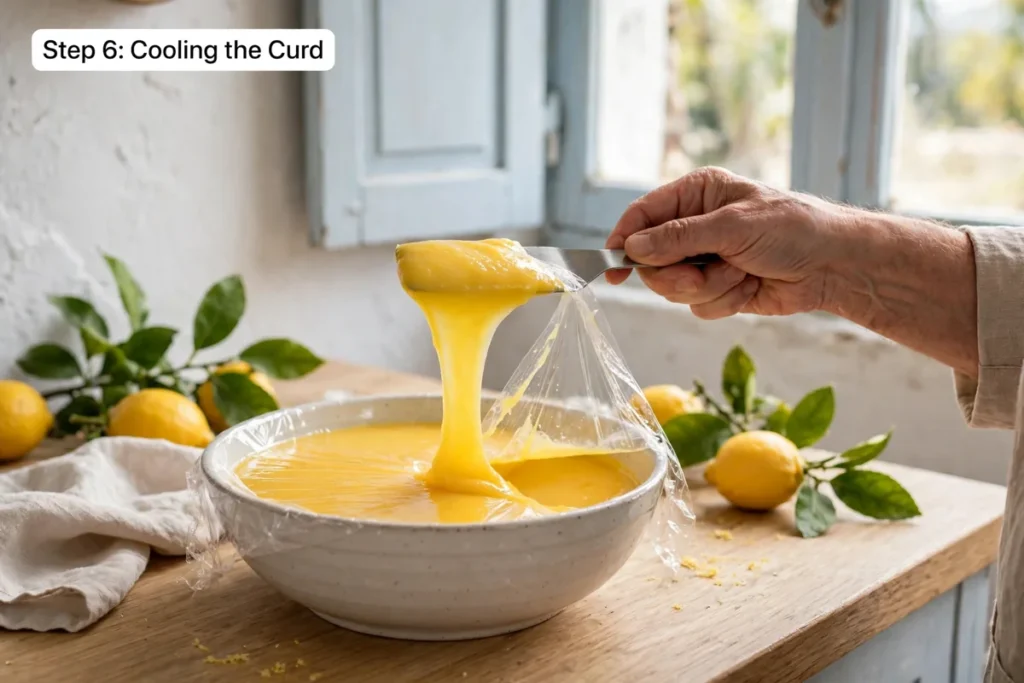
Press a sheet of plastic wrap directly against the surface of the strained curd to prevent a skin from forming. Allow to cool to room temperature, approximately 45 minutes to 1 hour. Do not refrigerate to accelerate cooling. Cold curd is too stiff to fold smoothly into the whipped cream without deflating the foam.
- Whip the Cream
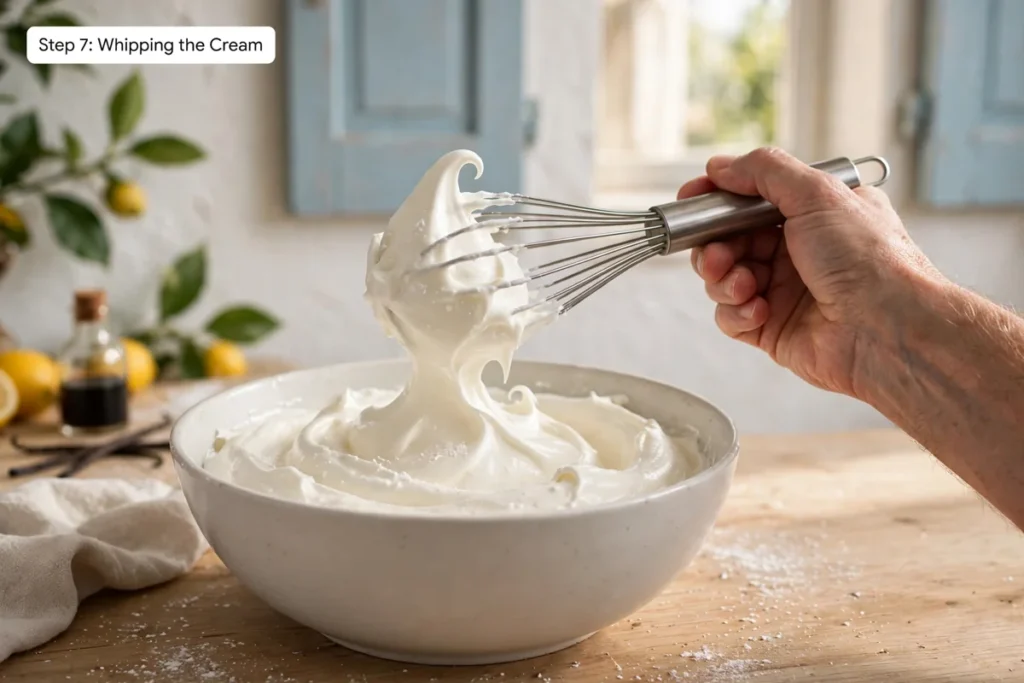
In a cold bowl, whip the cold heavy cream, sifted powdered sugar, and vanilla extract with the whisk attachment at medium speed until the cream begins to thicken, then at high speed until it holds firm peaks, a slight curl at the tip when the whisk is lifted.
- Assemble the Mousse
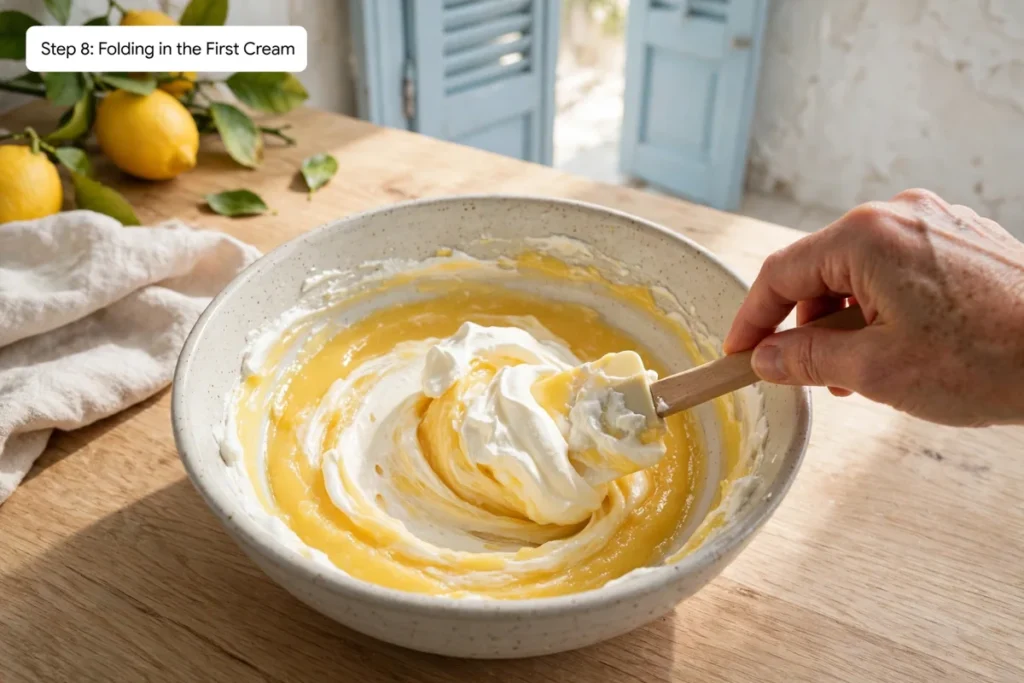
Add one third of the whipped cream to the room temperature lemon curd. Fold with 8 to 10 deliberate strokes to lighten the curd base toward the consistency of the remaining cream.
Add the remaining two thirds of the whipped cream. Fold with 12 to 15 strokes until the mousse is completely uniform, no cream streaks, no curd streaks, a pale yellow throughout. Do not overfold, stop the moment the mixture is uniform even if it appears slightly marbled.
- Portion and Chill
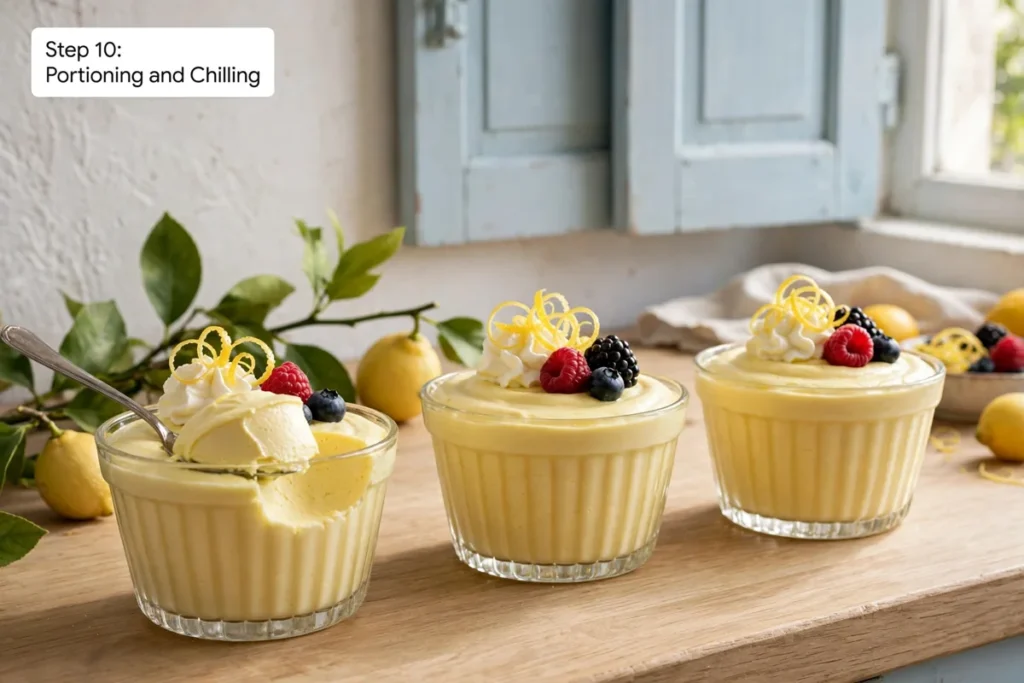
Spoon or pipe the mousse immediately into serving glasses or ramekins. Refrigerate uncovered for a minimum of 2 hours until completely firm and cold throughout. Cover with plastic wrap after the first 30 minutes once the surface has set. Garnish with a small rosette of whipped cream, fresh lemon zest curls, and fresh berries immediately before serving.
Step by Step Process
Bloom the Gelatin
Step 1. Sprinkle the powdered gelatin over the 1 tablespoon of cold water in a small bowl. Stir once and allow to sit undisturbed for 5 minutes until the gelatin has absorbed the water and formed a firm, opaque gel.

Cook the Lemon Curd
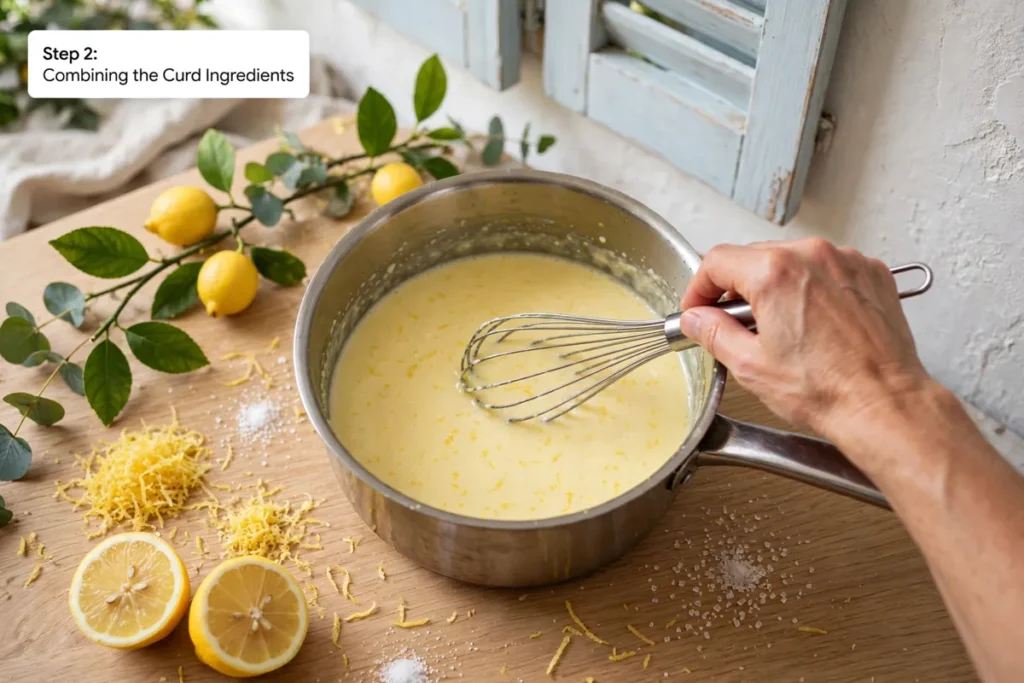
Step 2. Combine the lemon zest, lemon juice, granulated sugar, egg yolks, whole eggs, and salt in the heavy bottomed saucepan.Whisk together until completely smooth and uniform before placing the pan on the heat.
Combining all curd ingredients cold before applying heat produces a more uniform curd than adding ingredients to a pre heated pan. Cold ingredients introduced to heat simultaneously give the egg proteins time to distribute evenly through the sugar juice solution before the temperature rises high enough to begin coagulation.

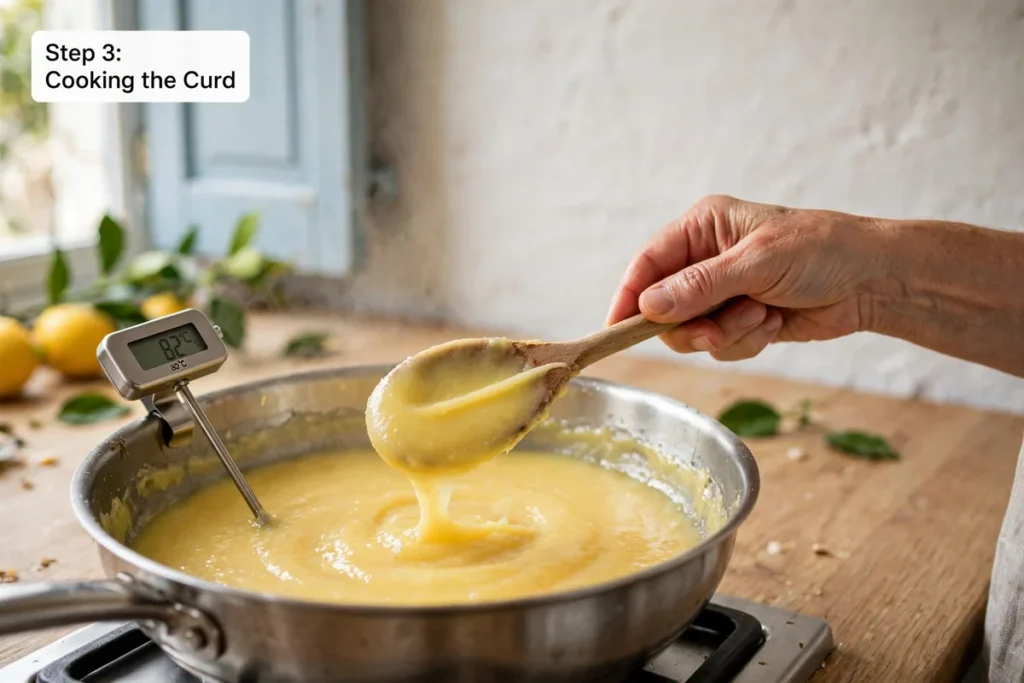
Step 3. Cook over medium heat, stirring constantly with a rubber spatula or wooden spoon,until the curd thickens enough to coat the back of the spoon and the thermometer reads 170 to 175°F (77 to 79°C), approximately 8 to 12 minutes. Do not allow the curd to boil.
Stir constantly and reach into every part of the pan base and sides with each stroke. The egg proteins in the curd begin coagulating at approximately 160°F, between 160 and 175°F the proteins set gradually and the curd thickens. Above 185°F the proteins coagulate too rapidly and scramble. The 170 to 175°F target is the point at which the curd is fully cooked without risk of scrambling.

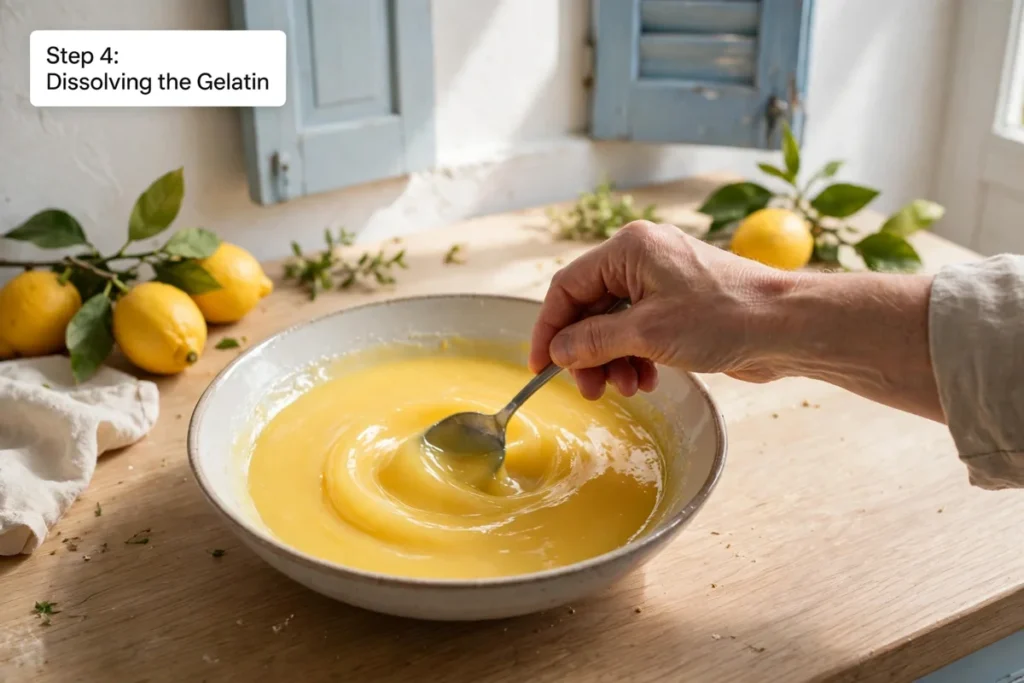
Step 4. Remove the pan from heat immediately. Add the bloomed gelatin to the hot curd and stir until the gelatin is completely dissolved, approximately 30 seconds of stirring. The residual heat of the curd is sufficient to melt the gelatin without returning the pan to the stovetop.

Step 5. Add the room temperature butter pieces to the hot curd a few pieces at a time,stirring after each addition until each piece is fully melted and incorporated before adding the next. Strain the finished curd immediately through the fine mesh strainer into a clean bowl, pressing with a spatula to push the curd through while leaving any cooked egg solids and zest pieces behind.

Step 6. Press a sheet of plastic wrap directly against the surface of the strained curd to prevent a skin from forming.Allow to cool to room temperature, approximately 45 minutes to 1 hour. Do not refrigerate to accelerate cooling. Cold curd is too stiff to fold smoothly into the whipped cream without deflating the foam.

Whip the Cream
Step 7. In a cold bowl, whip the cold heavy cream, sifted powdered sugar, and vanilla extractwith the whisk attachment at medium speed until the cream begins to thicken, then at high speed until it holds firm peaks, a slight curl at the tip when the whisk is lifted.

Assemble the Mousse
Step 8. Add one third of the whipped cream to the room temperature lemon curd.Fold with 8 to 10 deliberate strokes to lighten the curd base toward the consistency of the remaining cream.

Step 9. Add the remaining two thirds of the whipped cream.Fold with 12 to 15 strokes until the mousse is completely uniform, no cream streaks, no curd streaks, a pale yellow throughout. Do not overfold, stop the moment the mixture is uniform even if it appears slightly marbled.

Portion and Chill
Step 10. Spoon or pipe the mousse immediately into serving glasses or ramekins. Refrigerate uncovered for a minimum of 2 hours until completely firm and cold throughout. Cover with plastic wrap after the first 30 minutes once the surface has set. Garnish with a small rosette of whipped cream, fresh lemon zest curls, and fresh berries immediately before serving.

Why Lemon Mousse Needs Gelatin When Chocolate Mousse Does Not
The structural difference between lemon mousse and chocolate mousse is the absence of a self setting fat in the lemon curd base. Chocolate mousse sets through the crystallisation of cocoa butter, a fat that solidifies at refrigerator temperature and creates a continuous fat crystal network holding the foam firm without any added agent. Lemon curd contains no comparable self setting fat. Its structure at refrigerator temperature is provided entirely by the egg protein network coagulated during cooking, supplemented by the water binding capacity of the dissolved sugar.
The egg protein network in a well cooked lemon curd is firm enough to hold the curd’s own weight in a spoonable consistency, but not firm enough to hold a curd to cream ratio of 1:1 or greater in a stable foam over 24 hours of refrigeration. As the egg protein network contracts during extended cold storage, it expels the water bound within it, a process called syneresis, producing the liquid pooling at the surface of an unstabilised lemon mousse that appears after overnight refrigeration. The small quantity of gelatin, 1 teaspoon per 6 servings, provides a protein gel network supplementary to the egg network that holds the expelled water within the mousse matrix rather than allowing it to pool, extending the mousse’s stable, non weeping life from 4 to 6 hours to 48 hours without producing a perceptible gelatin texture in the finished dessert.
How Does Lemon Mousse Compare to Related Desserts?
| Attribute | Lemon Mousse | Lemon Curd | Lemon Posset | Lemon Panna Cotta | Lemon Syllabub |
|---|---|---|---|---|---|
| Base | Lemon curd plus whipped cream | Egg yolks, sugar, lemon juice, butter | Heavy cream, sugar, lemon juice | Cream, gelatin, lemon juice | Cream, lemon juice, white wine |
| Setting agent | Egg protein plus gelatin plus cocoa butter in cream | Egg protein coagulation | Citric acid cream casein interaction | Gelatin protein gel | None, served immediately |
| Aeration | Whipped cream folded in | None | None | None | Whipped cream only |
| Texture | Light, airy, creamy | Dense, rich, spreadable | Silky, firm, pourable set | Silky, uniform, firm | Light, airy, less stable |
| Gelatin required | Small quantity for stability | No | No | Yes | No |
| Make ahead window | Up to 48 hours with gelatin | Up to 2 weeks refrigerated | Up to 3 days | Up to 3 days | Same day only |
| Origin | French American, general | British, 17th century | British, medieval | Italian adapted | British, 17th century |
| Lemon juice critical | Yes, fresh only | Yes, fresh only | Yes, fresh only | Fresh preferred | Fresh preferred |
The most meaningful difference between lemon mousse and lemon posset is the setting mechanism. Lemon posset sets through a chemical reaction between the citric acid in lemon juice and the casein proteins in heavy cream, the acid partially denatures the casein, causing the cream to thicken and set without eggs or gelatin. Lemon mousse sets through the combination of a pre cooked egg protein curd and gelatin, then is aerated with whipped cream. Posset is simpler, three ingredients, no cooking beyond a brief cream warming, but produces a denser, less airy texture than mousse and a more one dimensional lemon cream flavour without the egg yolk richness of the curd base.
What Variations Can You Make?
Lemon Raspberry Mousse
After portioning the lemon mousse into serving glasses in Step 10 and before refrigerating, press 4 to 5 fresh raspberries into the top of each portion. The raspberries sink slightly into the surface of the mousse during refrigeration and are partially surrounded by the set mousse after 2 hours, providing a concentrated fruit note and a colour contrast against the pale yellow surface. Alternatively layer 1 tablespoon of fresh raspberry coulis, blended and strained raspberries with 1 teaspoon of powdered sugar, at the base of each glass before adding the mousse for a hidden colour reveal when the spoon reaches the bottom.
Result: A lemon raspberry mousse with a concentrated fruit note and a colour contrast against the pale yellow mousse.
Lemon Lime Mousse
Replace 2 tablespoons of the fresh lemon juice with 2 tablespoons of fresh lime juice and add 1 teaspoon of finely grated lime zest to the curd base in Step 2 alongside the lemon zest. Lime juice contains a higher proportion of citric acid than lemon juice at the same volume and a distinctly different aromatic profile driven by the volatile compound limonene at a different enantiomeric ratio, the combination produces a mousse that is sharper, more aromatic, and more tropical in character than lemon alone without reading as either a pure lemon or a pure lime dessert.
Result: A lemon lime mousse that is sharper, more aromatic, and more tropical than lemon alone.
Meyer Lemon Mousse
Replace all Eureka lemon juice and zest with Meyer lemon juice and zest at the same quantities. Meyer lemons contain less citric acid and more sugars than standard lemons, producing a softer, more floral, less tart curd that requires reducing the granulated sugar to 1/2 cup (100g) to prevent the finished mousse from being cloying. The Meyer lemon version suits tasters who find standard lemon desserts too sharp and pairs particularly well with a garnish of fresh thyme leaves or a small drizzle of warm honey rather than the fresh berries specified for the standard version.
Result: A Meyer lemon mousse that is softer, more floral, and less tart than the standard version.
Dietary Adjustments and Substitutions
Eggless Lemon Mousse
Replace the egg yolks and whole eggs in the curd base with a combination of 1/2 cup (120g) of full fat canned coconut cream and 3 tablespoons (24g) of cornstarch whisked together until smooth, then cooked with the lemon juice, zest, sugar, and salt over medium heat until thickened, approximately 5 to 7 minutes, stirring constantly. The cornstarch gelatinises and thickens the coconut cream base in the same way that egg proteins thicken a standard curd. Add the butter, strain, and proceed from Step 4 with the gelatin addition. The eggless version produces a slightly less rich, less golden mousse but sets correctly and carries the full lemon flavour.
Dairy Free Lemon Mousse
Replace the butter in the curd with refined coconut oil at the same weight, refined rather than virgin to avoid coconut flavour competing with the lemon. Replace the heavy whipping cream with full fat canned coconut cream chilled overnight in the refrigerator, scooping only the solidified cream from the top of the can and whipping to firm peaks using the same technique as Step 7. The dairy free version sets correctly and carries the full lemon curd flavour, the coconut cream’s neutral fat profile does not compete with the citrus character the way a strongly flavoured non dairy alternative would.
Reduced Sugar Version
Reduce the granulated sugar in the curd from 3/4 cup (150g) to 1/2 cup (100g) and omit the powdered sugar from the whipped cream. The finished mousse will be noticeably more tart, the citric acid in the lemon juice registers more sharply against a lower sugar background. This version suits tasters who prefer the lemon’s acidity to register prominently rather than being balanced by the sweetness, and pairs well with a small drizzle of honey at the table rather than sweetness built into the mousse itself.
What Are the Most Common Problems When Making Lemon Mousse?
| Problem | Most Likely Cause | Prevention or Fix |
|---|---|---|
| Curd is lumpy with cooked egg pieces | Heat too high during cooking, or stirring was not continuous, egg proteins scrambled at hot spots | Always cook over medium rather than medium high heat. Stir constantly and reach into the full base and sides of the pan with each stroke. Strain immediately after cooking, the strainer catches scrambled pieces before they are incorporated into the mousse base. |
| Mousse weeps liquid at the surface after overnight refrigeration | Gelatin was omitted or was not fully dissolved into the hot curd before cooling | Always add the bloomed gelatin to the hot curd immediately after removing from heat and stir for a full 30 seconds to ensure complete dissolution. If weeping has already occurred, spoon off the surface liquid and serve immediately. |
| Mousse is dense and heavy rather than airy | Lemon curd was still warm when the whipped cream was folded in, melting the fat globule walls of the cream foam | The curd must reach room temperature, not warm to the touch, before folding. If the curd feels warm, allow 15 additional minutes at room temperature before proceeding. |
| Curd did not thicken after cooking and cooling | Under cooked, did not reach 170°F during cooking | Return the strained curd to the saucepan and cook over medium low heat, stirring constantly, until it reaches 170°F. Strain again before proceeding. |
| Finished mousse is too tart | Lemons were particularly high in acid, or the sugar was measured short | Taste the curd before straining and adjust sugar by 1 tablespoon at a time, stirring until dissolved in the hot curd, until the tartness is balanced. The mousse will be slightly less tart than the curd alone because the whipped cream dilutes the acidity. |
How Do You Store Lemon Mousse?
Lemon mousse is a cold set dessert that should be refrigerated and served cold, and its stable, non weeping window is extended to 48 hours by the small gelatin quantity.
| Storage Method | Duration | Instructions |
|---|---|---|
| Refrigerated in serving glasses, covered | Up to 48 hours with gelatin, up to 6 hours without | Cover each glass with plastic wrap after the surface has set, approximately 30 minutes after portioning. The gelatin in this recipe extends the stable, non weeping window to 48 hours. Add the fresh garnish immediately before serving, not before refrigerating. |
| Lemon curd base only, refrigerated | Up to 2 weeks | The strained lemon curd without the whipped cream incorporated keeps refrigerated in a sealed container for up to 2 weeks. Make the curd in advance and fold in the whipped cream on the day of serving for the freshest mousse texture and the most stable foam. |
| Frozen | Not recommended | The whipped cream foam collapses permanently during freezing and thawing, producing a dense, flat curd rather than an airy mousse. |
Make Ahead
The strained lemon curd base can be made up to 2 weeks in advance and refrigerated in a sealed container. On the day of serving, bring the curd to room temperature, whip the cream, and fold the two together for the freshest mousse texture and the most stable foam. The fully assembled mousse can be portioned into serving glasses and refrigerated for up to 48 hours with the gelatin, but the fresh garnish should only be added immediately before serving.
Serving
Lemon mousse is served cold, in individual glasses or ramekins, topped with whipped cream, a lemon zest curl, and fresh berries.
| Serving Suggestion | Why It Works |
|---|---|
| Chilled, in individual serving glasses | The portioned glass presentation preserves the mousse's airy foam structure and the individual serving format makes the dessert feel special without any additional plating effort. |
| Topped with whipped cream, a lemon zest curl, and fresh berries | The whipped cream adds a cool, dairy rich top layer, the lemon zest curl reinforces the citrus identity, and the berries' bright acidity contrasts the mousse's creamy richness. |
| With shortbread or a thin butter cookie | The cookie's crisp texture contrasts the mousse's soft, airy texture, and the butter cookie's fat complements the mousse's creamy curd base. |
Nutritional Information
Per serving: 1 portion approximately 120g, based on 6 servings from one batch without garnish. Values calculated using USDA FoodData Central reference data.
| Nutrient | Per Serving | Nutrient | Per Serving |
|---|---|---|---|
| Calories | 348 kcal | Total carbohydrate | 26g |
| Total fat | 26g | Dietary fibre | 0.2g |
| Saturated fat | 15g | Total sugars | 24g |
| Cholesterol | 228mg | Protein | 4.8g |
| Sodium | 78mg | Vitamin C | 12mg (13% DV) |
Frequently Asked Questions
Chocolate mousse sets through cocoa butter crystallisation, a self setting fat present in dark chocolate at 30 to 40 percent by weight that solidifies at refrigerator temperature and holds the foam firm without any added agent. Lemon curd contains no comparable self setting fat. Its egg protein network is firm enough to hold the curd’s own weight but not firm enough to stabilise a curd to cream foam ratio over 24 hours, the proteins contract during extended cold storage and expel water. The small gelatin quantity supplements the egg network and prevents this syneresis without producing a perceptible gelatin texture.
Warm curd above approximately 25°C melts the fat globule walls of the whipped cream foam on contact, collapsing the air bubbles before the mousse sets during refrigeration and producing a dense, flat result. Cold curd from the refrigerator has set too firmly from the gelatin to fold smoothly into the cream, the stiff curd breaks the cream foam during folding rather than blending with it. Room temperature curd is fluid enough to fold evenly into the cream without collapsing the foam.
Fresh lemon juice contains citral, the primary aldehyde responsible for the bright, sharp lemon note, alongside more than 20 additional volatile aromatic compounds. Pasteurisation degrades citral within weeks of processing, which is why bottled lemon juice produces a flat, one dimensional lemon character in the finished mousse regardless of the quantity used. The difference between fresh and bottled juice is more perceptible in lemon mousse than in almost any other dessert because the lemon is the only flavour present with nothing else to mask the degraded aromatic profile.
No, not correctly. Uncooked lemon curd, simply whisking lemon juice, sugar, eggs, and butter together without cooking, does not produce a set, thickened curd because the egg proteins have not been coagulated by heat. Without the coagulated egg protein network, the mousse base has no structural support and the whipped cream dilutes rather than lightens it, producing a thin, sweet lemon cream that does not set in the refrigerator. The cooking step is the structural foundation of the recipe and cannot be omitted.
Lemon mousse is a cold set citrus dessert built on a two component structure: a cooked lemon curd of egg yolks, whole eggs, fresh lemon juice and zest, sugar, and butter, cooked to 170 to 175°F to fully coagulate the egg proteins and set the curd, stabilised with a small quantity of gelatin that prevents syneresis during overnight refrigeration, and lightened with whipped cream folded in after the curd has cooled to room temperature. The lemon curd must use freshly squeezed juice exclusively because pasteurisation degrades citral, the primary volatile aldehyde responsible for the bright lemon note, within weeks of processing, and the mousse’s single flavour profile makes the difference between fresh and bottled juice more perceptible here than in almost any other dessert format.

Table of Contents
Recent Recipes
American · Cakes Orange Pound Cake Recipe This orange pound cake recipe rubs the zest into the sugar before creaming. […]
Check Out..!American · Layer Cakes Coconut and Carrot Cake Recipe Moist, oil-based spiced layer cake packed with freshly grated carrot and […]
Check Out..!American Cakes Tandy Cake Recipe This Tandy cake recipe spreads peanut butter on the warm cake, then chills it before […]
Check Out..!American · Cakes Portillo’s Chocolate Cake Recipe This Portillo’s chocolate cake recipe adds mayonnaise to the batter. Mayo is just […]
Check Out..!Recent Blogs
I’ve glazed our Amish apple cake too hot, too cold, and exactly right, and the difference is not small. The […]
Read Blog..!I’ve pulled a sunken Amish Apple Cake out of my oven, and I know the exact sinking feeling that comes […]
Read Blog..!A cup measures volume, not weight, so a cup of flour and a cup of sugar weigh completely different amounts. […]
Read Blog..!Every pasta shape was designed to carry a certain kind of sauce. Thin strands suit light sauces that coat, wide […]
Read Blog..!Every egg method, from a jammy boiled egg to a silky French omelet, comes down to one fact: the white […]
Read Blog..!