Strawberry mousse is a cold-set fruit dessert in which fresh strawberries are pureed, cooked briefly to concentrate their flavour and activate their natural pectin, strained smooth, and combined with a small quantity of gelatin for structural stability before being lightened with whipped cream folded in after cooling, producing a dessert that is simultaneously more intensely strawberry in flavour than any whipped cream dessert and significantly lighter in texture than a strawberry jam or compote eaten alone. The colour of the finished mousse is determined entirely by the quality of the strawberries used: deeply red, fully ripe strawberries at peak season produce a mousse with a vivid, saturated pink-red colour from their anthocyanin pigments that no artificial colouring can replicate, while out-of-season strawberries with white shoulders and pale interiors produce a mousse that is visually pale and flavourlessly sweet regardless of the quantity used.
The structural difference between strawberry mousse and chocolate or lemon mousse is important to understand before starting. Chocolate mousse sets through cocoa butter crystallisation requiring no gelatin. Lemon mousse sets through the egg protein network of a cooked curd supplemented by a small gelatin quantity. Strawberry mousse contains no self-setting fat and no cooked egg protein structure, it relies entirely on gelatin to hold the whipped cream foam in a stable, spoonable consistency during refrigeration. The gelatin quantity must be calibrated correctly: too little and the mousse softens and weeps liquid after 2 to 3 hours; too much and the mousse sets to a rubbery, bouncy consistency that feels like flavoured jello rather than a light, airy fruit cream.
What Is Strawberry Mousse?
Strawberry mousse is a gelatin-set fruit mousse in the same category as raspberry mousse, mango mousse, and passion fruit mousse, fruit desserts where the structural setting agent is gelatin rather than chocolate’s cocoa butter or a curd’s egg protein network, because the fruit’s own natural pectin and water content do not provide sufficient structural support for a cream foam at refrigerator temperature without assistance.
The brief cooking of the strawberry puree before the gelatin is added serves three functions simultaneously. It concentrates the flavour by evaporating a portion of the fruit’s free water, intensifying the strawberry character in the finished mousse. It activates the strawberry’s natural pectin, polysaccharide chains in the cell walls that partially gelatinise during heating and contribute a small amount of additional body to the puree beyond what gelatin alone provides. It also eliminates any surface bacteria on the fruit that, in an ungelled raw fruit mousse, could accelerate the breakdown of the gelatin network during refrigeration. The cooking time is brief, 3 to 5 minutes, because extended cooking begins degrading the anthocyanin pigments that produce the mousse’s vivid pink-red colour, shifting the colour toward a duller, brownish-pink that does not represent the strawberry flavour as attractively as the fresh colour does.
What Equipment Do You Need?
A medium saucepan, a blender or food processor, a fine mesh strainer, a stand or hand mixer for the whipped cream, and six serving glasses or ramekins are the core equipment.
What Ingredients Do You Need?
Use only fully ripe, deeply red strawberries with no white shoulders or pale interiors. The mousse’s flavour and colour ceiling is set entirely by the strawberry quality, no amount of additional sugar, vanilla, or lemon juice compensates for under ripe fruit. All cream cold from the refrigerator.
For the Strawberry Base
For the Whipped Cream
Optional Garnish
Step by Step Process
Bloom the Gelatin
Step 1. Sprinkle the powdered gelatin evenly over the 2 tablespoons of cold water in a small bowl. Stir once and allow to sit undisturbed for 5 minutes until the gelatin has fully absorbed the water and formed a firm, opaque gel.
Make the Strawberry Base
Step 2. Hull the strawberries and place them in the blender or food processor. Blend until completely smooth, approximately 30 to 45 seconds. The puree should be uniformly smooth with no visible berry pieces.
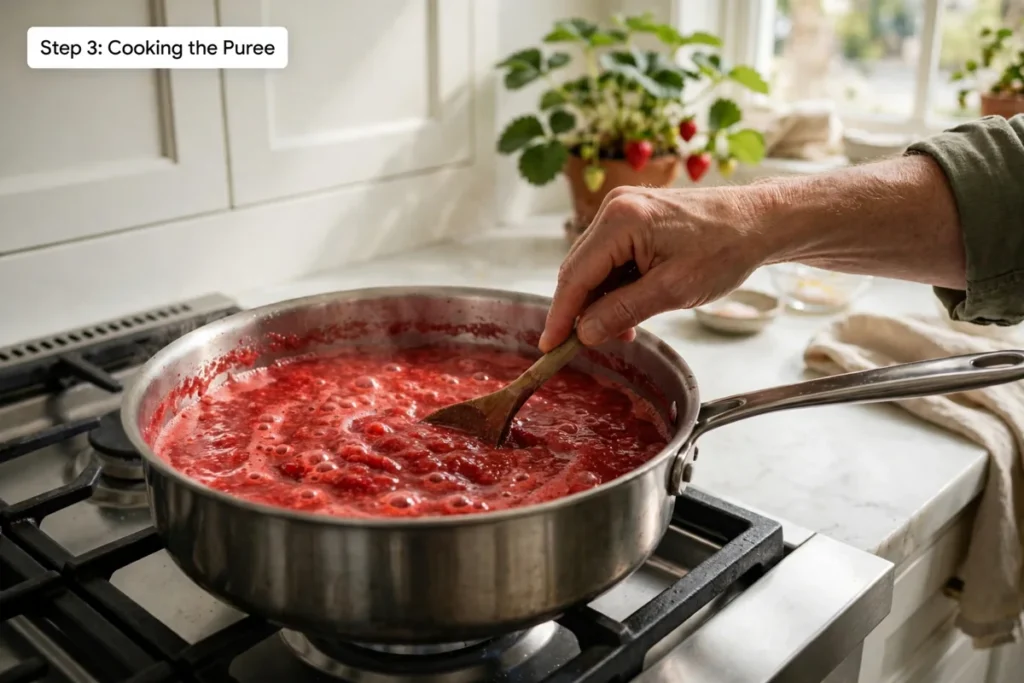
Step 3. Pour the strawberry puree into the saucepan. Add the granulated sugar, fresh lemon juice, and salt. Stir to combine. Cook over medium heat, stirring frequently, for 3 to 5 minutes until the puree is gently bubbling across the full surface and has reduced very slightly.
The lemon juice serves two functions in the strawberry base. Its citric acid brightens and sharpens the strawberry’s own fruity aromatic character by lowering the perceived sweetness of the sugar slightly, allowing the strawberry flavour to register more clearly. It also lowers the pH of the puree, which stabilises the anthocyanin pigments responsible for the mousse’s colour, anthocyanins are more colour stable in an acidic environment and shift toward a duller, less vivid hue as pH rises above 4.5.
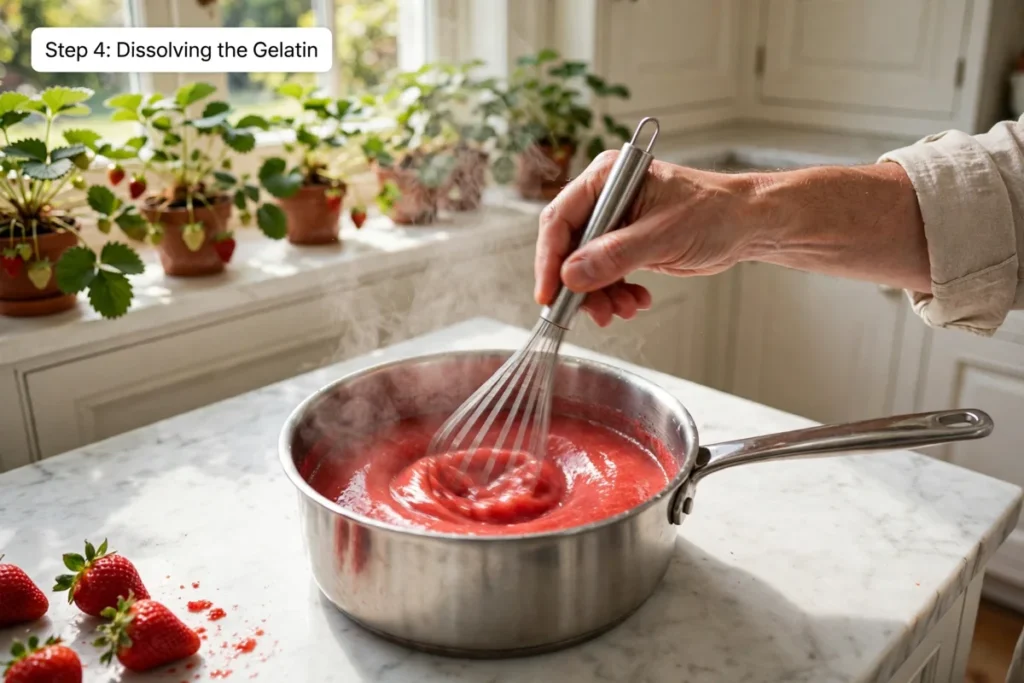
Step 4. Remove the pan from heat. Immediately add the bloomed gelatin to the hot puree and stir vigorously for 60 seconds until the gelatin is completely dissolved. The puree must be hot, above 130°F, for the gelatin to dissolve fully. Below this temperature the gelatin will not melt completely and undissolved gelatin pieces produce rubbery spots in the finished mousse.
Step 5. Strain the hot strawberry base through the fine mesh strainer into a clean bowl, pressing with a spatula to push the puree through while leaving seeds and fibrous pulp behind.
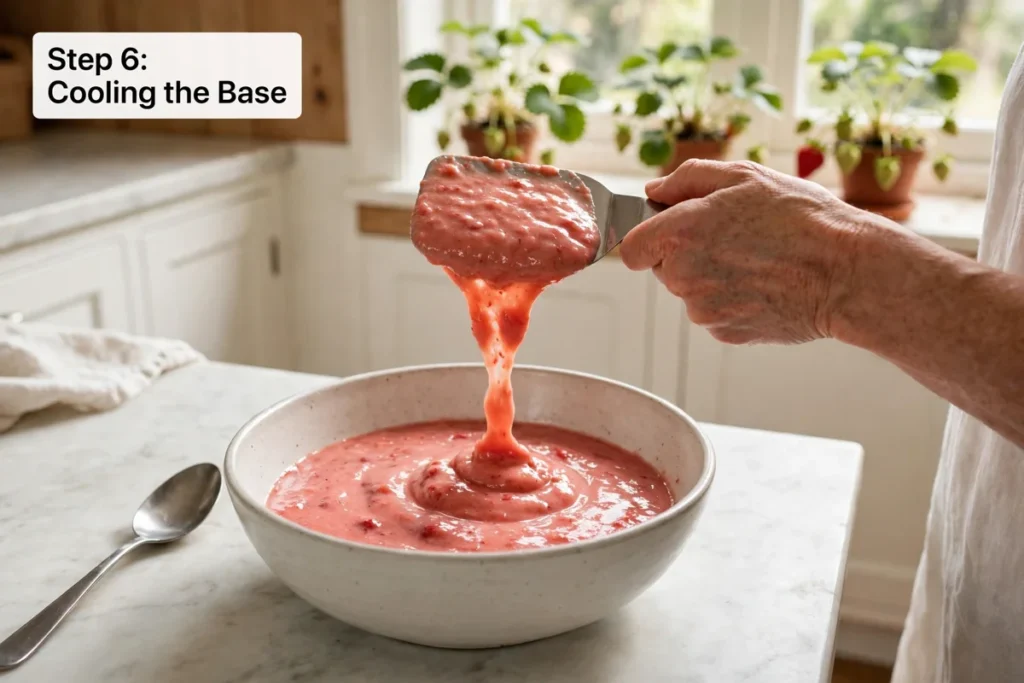
Step 6. Allow the strained strawberry base to cool to room temperature, approximately 30 to 45 minutes, stirring occasionally to prevent a skin from forming. Do not refrigerate to accelerate cooling. The base must be at room temperature before the whipped cream is folded in, warm base melts the cream foam and cold base has begun gelling and cannot fold smoothly into the cream without breaking the foam.
Whip the Cream
Step 7. In a cold bowl, whip the cold heavy cream, sifted powdered sugar, and vanilla extract at medium speed until the cream begins to thicken, then at high speed until it holds firm peaks, a slight curl at the tip when the whisk is lifted.
Assemble the Mousse
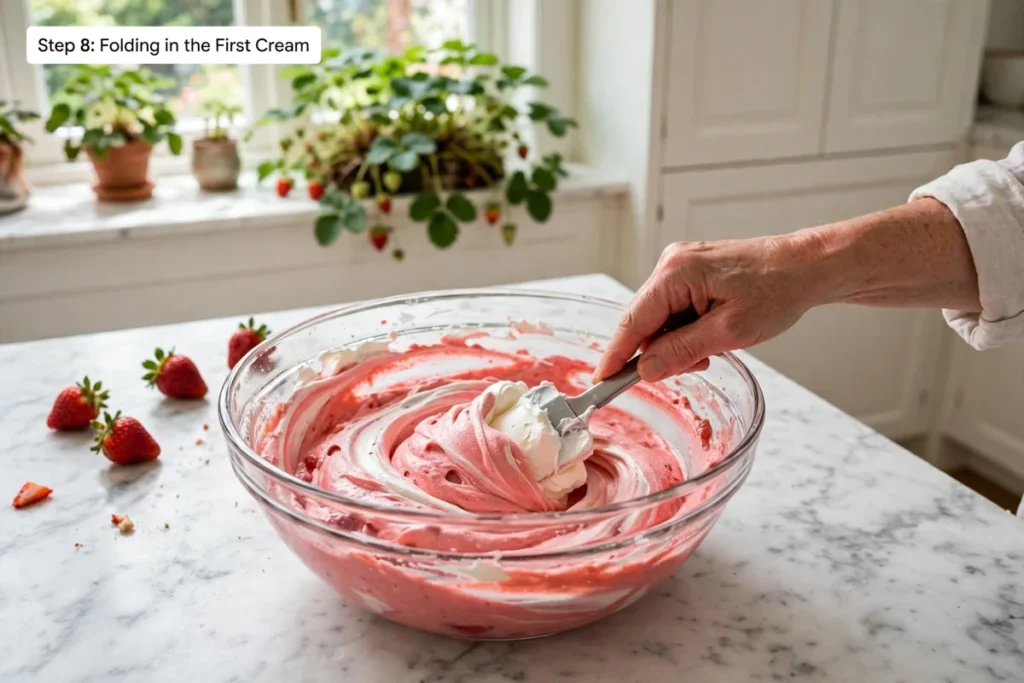
Step 8. Add one third of the whipped cream to the room temperature strawberry base. Fold with 8 to 10 deliberate strokes, cutting down through the centre, sweeping along the bottom, and turning the mixture up and over. This first addition lightens the base and brings its density closer to the remaining cream, reducing foam deflation in subsequent folds.
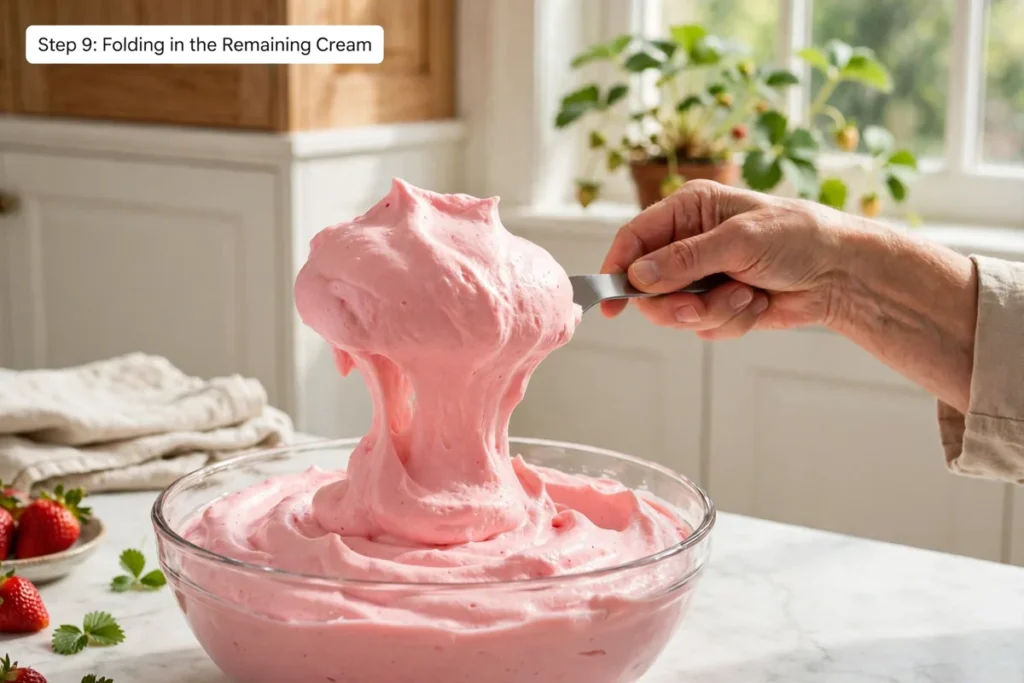
Step 9. Add the remaining two thirds of the whipped cream. Fold with 12 to 15 strokes until the mousse is completely uniform, no cream streaks, no darker strawberry streaks. Stop the moment the mixture is uniform.
Portion and Chill
Step 10. Spoon or pipe the mousse immediately into serving glasses or ramekins. Refrigerate uncovered for a minimum of 2 hours until completely firm and cold throughout. Cover with plastic wrap after the first 30 minutes once the surface has set. Garnish with a small rosette of whipped cream, fresh strawberry slices, and fresh mint leaves immediately before serving.
Why the Strawberry Base Must Be Cooked Before the Gelatin Is Added
Raw strawberry puree combined directly with gelatin and whipped cream produces a mousse that is softer, less flavourful, and less stable than the cooked version for three distinct reasons.
Raw strawberries contain the enzyme actinidin, a protease that degrades gelatin’s collagen protein chains during refrigeration, progressively weakening the gel network and producing a mousse that softens and weeps liquid after 4 to 6 hours rather than holding firm for 48 hours. Brief cooking at above 140°F (60°C) denatures actinidin irreversibly, eliminating the enzyme’s gelatin degrading activity before the gelatin is added. This is the same reason that raw pineapple, papaya, kiwi, and mango, all of which contain similar proteases, cannot be used in gelatin set desserts without prior cooking or canning: the proteases prevent gelatin from setting at all.
Cooking also concentrates the strawberry’s flavour compounds by evaporating free water from the puree. The primary volatile aromatic compounds in strawberry, furaneol (2,5 dimethyl 4 hydroxy 3(2H) furanone), linalool, and methyl anthranilate, are present at low concentrations in fresh fruit and are easily diluted by the volume of whipped cream folded into the mousse. A 3 to 5 minute cook that reduces the puree by approximately 15 to 20 percent concentrates these aromatic compounds proportionally, producing a finished mousse with a more pronounced, more recognisably strawberry character than an equivalent uncooked puree would deliver at the same fruit to cream ratio.
How Does Strawberry Mousse Compare to Related Desserts?
The most meaningful practical difference between strawberry mousse and strawberry fool is stability. A fool, crushed fresh strawberries folded directly into whipped cream with no gelatin, must be served within 2 hours of assembly because the raw fruit’s juice progressively breaks down the cream foam, producing a liquid, pooled result after standing. Strawberry mousse holds its set structure for up to 48 hours because the gelatin network maintains the foam’s integrity regardless of the fruit’s juice content. For a same day dessert served immediately, a fool is faster and equally delicious. For a make ahead celebration dessert, mousse is the only correct format.
What Variations Can You Make?
Strawberry Rhubarb Mousse
Replace 150g of the fresh strawberries with 150g of fresh rhubarb stalks cut into 1 inch pieces. Cook the rhubarb with the sugar and 2 tablespoons of water over medium heat for 5 minutes until completely softened before adding the strawberries to the pan and cooking together for an additional 3 minutes. Blend, strain, and proceed from Step 4. The rhubarb contributes malic acid alongside the strawberry’s citric acid, producing a sharper, more complex tartness than strawberry alone and a slightly more orange pink colour from the rhubarb’s own anthocyanins mixing with the strawberry’s. Increase the sugar to 1/2 cup (100g) to compensate for the rhubarb’s higher acidity.
Result: A strawberry rhubarb mousse with a sharper, more complex tartness and a slightly more orange pink colour than strawberry alone.
Strawberry Basil Mousse
Add 8 large fresh basil leaves to the strawberry puree in the blender in Step 2 before blending. The basil’s linalool, its primary aromatic compound, is chemically related to the linalool present in strawberry’s own aromatic profile, producing a combined basil strawberry note that reads as a more complex, more herbal version of the strawberry character rather than as basil and strawberry separately. Remove the basil during straining in Step 5 along with the seeds. The finished mousse has a subtle, aromatic depth that most tasters cannot attribute to basil specifically but describe as a more interesting strawberry than expected.
Result: A strawberry basil mousse with a subtle, aromatic depth that reads as a more complex strawberry rather than as basil and strawberry separately.
Strawberry White Chocolate Mousse
Melt 3 oz (85g) of good quality white chocolate with 1 tablespoon of heavy cream in a double boiler until smooth. Cool to room temperature. Fold the cooled white chocolate into the room temperature strawberry base in Step 8 before adding the whipped cream. The white chocolate’s cocoa butter supplements the gelatin’s setting strength and produces a slightly firmer, richer mousse with a sweet vanilla cream background note that contrasts the strawberry’s acidity. Reduce the powdered sugar in the whipped cream to 1 tablespoon as the white chocolate contributes additional sweetness.
Result: A strawberry white chocolate mousse, slightly firmer and richer, with a sweet vanilla cream background note that contrasts the strawberry’s acidity.
Frozen Strawberry Mousse
Pour the fully assembled mousse into a 9×5 inch loaf pan lined with plastic wrap rather than into individual serving glasses. Freeze for a minimum of 6 hours or overnight until completely solid. Unmold by lifting the plastic wrap overhang, slice with a hot knife dipped in warm water between cuts, and serve immediately as a frozen dessert. The gelatin in the formula prevents the ice crystals from forming the large, grainy structures that produce a coarse texture in a standard sorbet, the frozen mousse has a finer, creamier texture than any gelatin free frozen fruit dessert at the same fruit to cream ratio.
Result: A frozen strawberry mousse with a finer, creamier texture than any gelatin free frozen fruit dessert at the same fruit to cream ratio.
Dietary Adjustments and Substitutions
Dairy Free Strawberry Mousse
Replace the heavy whipping cream with full fat canned coconut cream chilled overnight in the refrigerator, scoop only the solidified cream from the top of the can and whip to firm peaks using the same technique as Step 7. The coconut cream’s neutral fat profile does not compete with the strawberry’s aromatic character the way a strongly flavoured non dairy alternative would. Replace the butter in any variation that calls for it with refined coconut oil. The finished mousse sets correctly, carries the full strawberry flavour and colour, and is indistinguishable in texture from the dairy version to most tasters.
Vegan Strawberry Mousse
Replace the powdered gelatin with agar agar powder at 3/4 teaspoon, agar sets more firmly than gelatin at equivalent quantities, so the reduction from 1 1/2 teaspoons of gelatin to 3/4 teaspoon of agar is required to avoid a rubbery result. Add the agar to the strawberry puree in Step 3 at the beginning of cooking rather than blooming it separately, agar must reach a full boil to activate, unlike gelatin which dissolves in hot liquid. Boil the puree with the agar for 1 full minute while stirring, then remove from heat, strain, and cool. Replace the heavy cream with whipped coconut cream as in the dairy free version above. Note that agar sets at a higher temperature than gelatin, approximately 95 to 104°F versus gelatin’s 50 to 59°F, which means the agar set strawberry base begins firming as it cools and must be folded into the whipped coconut cream before it sets, requiring slightly faster assembly than the gelatin version.
Reduced Sugar Version
Reduce the granulated sugar in the strawberry base from 1/3 cup (67g) to 3 tablespoons (38g) and omit the powdered sugar from the whipped cream entirely. The finished mousse will be noticeably more tart and the strawberry’s natural acidity will register prominently. This version works best with very ripe, naturally sweet strawberries at peak season, out of season strawberries at reduced sugar produce a mousse that tastes primarily sour rather than balanced.
What Are the Most Common Problems When Making Strawberry Mousse?
How Do You Store Strawberry Mousse?
Strawberry mousse is a gelatin set fruit dessert that should be refrigerated and served cold, and it holds its stable, non weeping window for up to 48 hours.
Make Ahead
The full mousse can be portioned into serving glasses and refrigerated for up to 48 hours. The fresh strawberry garnish and whipped cream rosette should be added immediately before serving. For a frozen dessert variation, the mousse can be frozen as a log for up to 1 month and sliced with a hot knife to serve.
Serving
Strawberry mousse is served cold, in individual glasses, topped with whipped cream, fresh strawberry slices, and a fresh mint leaf.
Nutritional Information
Per serving: 1 portion approximately 130g, based on 6 servings from one batch without garnish. Values calculated using USDA FoodData Central reference data.
Frequently Asked Questions
Strawberry mousse is a gelatin set fruit dessert built on a cooked, strained strawberry puree, cooking is non negotiable because raw strawberries contain the protease enzyme actinidin, which degrades gelatin’s collagen protein chains during refrigeration and prevents the mousse from setting regardless of gelatin quantity. The brief 3 to 5 minute cook at above 140°F denatures actinidin irreversibly, concentrates the strawberry’s primary aromatic compounds by evaporating free water from the puree, and stabilises the anthocyanin pigments responsible for the mousse’s vivid pink red colour in the acidic lemon juice environment, producing a base that sets firmly with gelatin, carries maximum strawberry flavour through the volume of folded whipped cream, and holds its colour and structure for up to 48 hours of refrigeration without weeping or fading.