
American (Pennsylvania Dutch) · Fruit Cakes Amish Apple Cake Recipe A moist, oil-based spiced sheet cake made with pre-cooked diced […]
Check Out..!
American · Savory
Chicken Pot Pie Recipe
An American comfort food classic with a creamy, herb-seasoned chicken and vegetable filling encased in a flaky, buttery double pie crust and baked until golden-brown.
- Prep: 30 min
- Cook: 55 min
- Total: 1 hr 45 min
- Servings: 6
- Difficulty: Easy-Medium
- Dietary: Non-Vegetarian
 Chef's review · Chef Arshad Ghafoor, Pastry & Bread Chef · Reviewed Nov 10, 2026
“Cook the flour into the butter for a full 2 minutes before adding stock undercooked roux produces a starchy, raw-flour taste that no baking time in the filling eliminates.”
Our investigation: 29 recipes add chicken stock immediately after the flour without a roux-cooking period, producing a filling with a detectable starchy, paste-like flavor that most tasters attribute to too much flour rather than the undercooked roux that a 2-minute cook time resolves at the same flour quantity.
Chicken pot pie is an American comfort food classic in which a creamy, herb-seasoned chicken and vegetable filling thickened through a properly cooked butter-flour roux that eliminates raw starch flavor before the stock is added is encased in a flaky, buttery double pie crust and baked until the filling is bubbling and the crust is deep golden-brown.
The roux-cooking duration is the single most critical technique decision. Flour’s starch granules contain raw starch compounds primarily amylose and amylopectin that produce a distinctly pasty, slightly gluey flavor when they reach the taster’s palate in an insufficiently cooked state. Cooking the flour into the melted butter for 2 full minutes at medium heat subjects the starch granules to sufficient thermal energy to break down the raw starch compounds through dextrinisation.
Chicken pot pie’s cultural roots in America trace to the British meat pie tradition brought by colonial settlers the earliest American pot pie records appearing in Pennsylvania Dutch cooking from the late 18th century. The double-crust format became the standard American presentation by the mid-19th century, distinguishing the American pot pie from the British pie’s pastry-lid-only convention.
What Is Chicken Pot Pie?
Chicken pot pie is a savory double-crust pie in which tender poached or roasted chicken pieces and diced vegetables classically carrots, peas, celery, and onion are suspended in a thick, cream-enriched chicken stock sauce and baked inside a fully enclosing flaky butter pastry crust. It differs from a chicken casserole in that the pastry crust is structural providing the primary textural contrast to the creamy filling rather than serving as a topping only.
It differs from a British chicken pie in the double-crust format’s complete enclosure of the filling on all sides, producing a fully self-contained portion whose pastry bottom absorbs the filling’s cream and stock during baking to produce a slightly softened, flavor-saturated bottom crust that is as much a part of the eating experience as the flaky, golden top crust.
What Equipment Do You Need?
| Equipment | Specification | Why It Matters |
|---|---|---|
| 9-inch deep-dish pie plate | Ceramic or glass, minimum 2 inches deep | The deep-dish format accommodates the generous filling volume that distinguishes a satisfying chicken pot pie from an underfilled preparation where pastry dominates. Glass and ceramic distribute heat more evenly than metal, producing a more evenly set filling and more uniformly golden bottom crust. |
| Large skillet or sauté pan | 12-inch, heavy-bottomed | For cooking the filling, the wide base allows the flour to cook evenly across the roux's full surface area and the vegetables to soften without steaming from overcrowding. |
| Pastry blender or food processor | Standard | For cutting the cold butter into the flour for the pie crust, cold butter pieces must remain visible through the mixing process to produce the steam-separated flaky layers that characterise a properly made butter pie crust. |
| Pastry brush | Standard | For applying the egg wash to the top crust before baking, the egg wash's albumin and fat produce the deep, uniform golden-brown crust colour that distinguishes a finished pot pie from a pale, underbaked appearance. |
| Instant-read thermometer | Standard | For verifying the filling's internal temperature at 165°F, the primary food safety indicator for the chicken filling rather than visual assessment of the crust colour alone. |
What Ingredients Do You Need?
Use bone-in, skin-on chicken thighs poached specifically for this preparation rather than leftover rotisserie chicken or pre-cooked chicken breast. Bone-in thighs poached in seasoned stock produce the most flavourful, most tender, most moist chicken pieces available for pot pie filling.
For the Butter Pie Crust
| Ingredient | Volume | Weight |
|---|---|---|
| All-purpose flour | 2 1/2 cups | 300g |
| Fine sea salt | 1 teaspoon | 6g |
| Granulated white sugar | 1 tablespoon | 12g |
| Unsalted butter, very cold — cut into 1/2-inch cubes | 1 cup | 226g |
| Ice water | 6 to 8 tablespoons | 90 to 120ml |
For the Chicken and Vegetable Filling
| Ingredient | Volume | Weight |
|---|---|---|
| Bone-in skin-on chicken thighs | 4 thighs | approx. 900g |
| Chicken stock — reserved poaching liquid plus additional if needed | 2 cups | 480ml |
| Unsalted butter | 4 tablespoons | 57g |
| Yellow onion, finely diced | 1 medium | 150g |
| Celery stalks, diced 1/4-inch | 3 stalks | 120g |
| Carrots, diced 1/4-inch | 3 medium | 200g |
| Garlic cloves, minced | 3 cloves | 9g |
| All-purpose flour | 1/3 cup | 40g |
| Whole milk | 1/2 cup | 120ml |
| Heavy cream | 1/2 cup | 120ml |
| Frozen peas | 1 cup | 135g |
| Fresh thyme leaves | 1 teaspoon | 1g |
| Fresh flat-leaf parsley, chopped | 2 tablespoons | 8g |
| Fine sea salt | 1 teaspoon | 6g |
| Black pepper, freshly ground | 1/2 teaspoon | 1.5g |
For the Egg Wash
| Ingredient | Volume | Weight |
|---|---|---|
| Large egg | 1 egg | 50g |
| Whole milk | 1 tablespoon | 15ml |
| Flaky sea salt — for the crust top | A pinch | Optional |
Chicken Pot Pie
An American comfort food classic with a creamy, herb-seasoned chicken and vegetable filling encased in a flaky, buttery double pie crust and baked until golden-brown.
Prep time
30
minutesCooking time
55
minutesTotal
1 hr 45
minutesYield
6
servingsEasy-Medium
American
Ingredients
- For the Butter Pie Crust
2 1/2 cups (300g) all-purpose flour
1 tsp (6g) fine sea salt
1 tbsp (12g) granulated white sugar
1 cup (226g) unsalted butter, very cold, cubed
6 to 8 tbsp (90-120ml) ice water
- For the Filling
4 bone-in, skin-on chicken thighs (approx. 900g)
2 cups (480ml) chicken stock (reserved poaching liquid)
4 tbsp (57g) unsalted butter
1 medium (150g) yellow onion, finely diced
3 stalks (120g) celery, diced 1/4-inch
3 medium (200g) carrots, diced 1/4-inch
3 cloves (9g) garlic, minced
1/3 cup (40g) all-purpose flour
1/2 cup (120ml) whole milk
1/2 cup (120ml) heavy cream
1 cup (135g) frozen peas
1 tsp (1g) fresh thyme leaves
2 tbsp (8g) fresh flat-leaf parsley, chopped
1 tsp (6g) fine sea salt
1/2 tsp (1.5g) black pepper
- For the Egg Wash
1 large egg
1 tbsp (15ml) whole milk
Pinch of flaky sea salt (optional)
Instructions
- Make the Pie Crust
Make the dough.
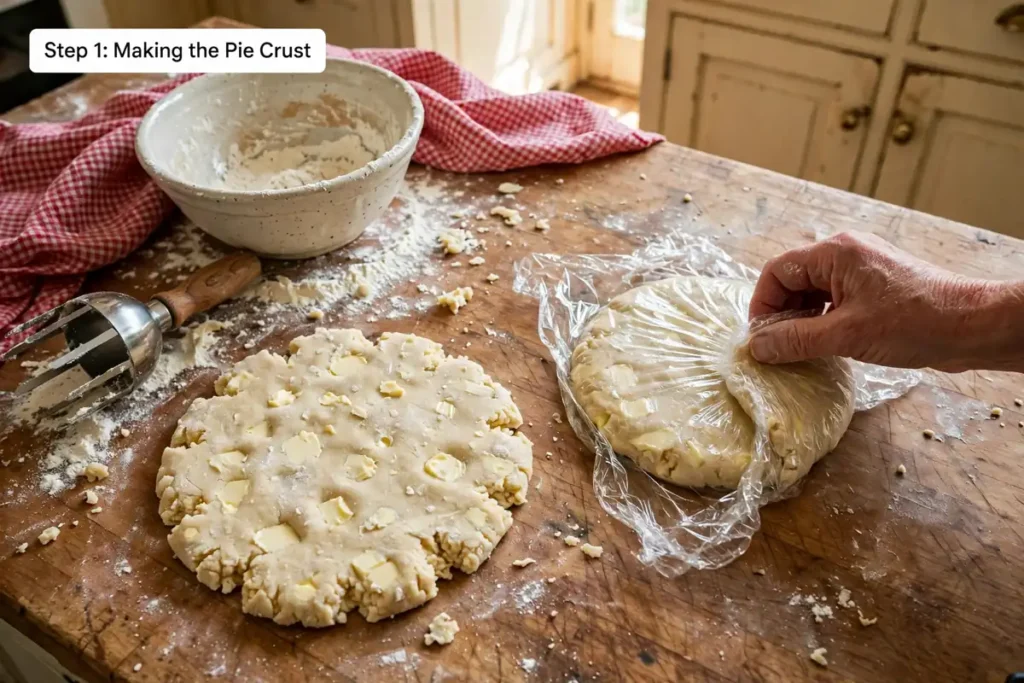
Combine flour, salt, and sugar. Cut in the cold butter until the mixture resembles coarse crumbs with visible pea-to-almond-sized pieces. Add ice water 1 tbsp at a time until the dough just holds together. Divide in half, flatten into discs, wrap, and refrigerate for 1 hour.- Poach the Chicken
Poach.
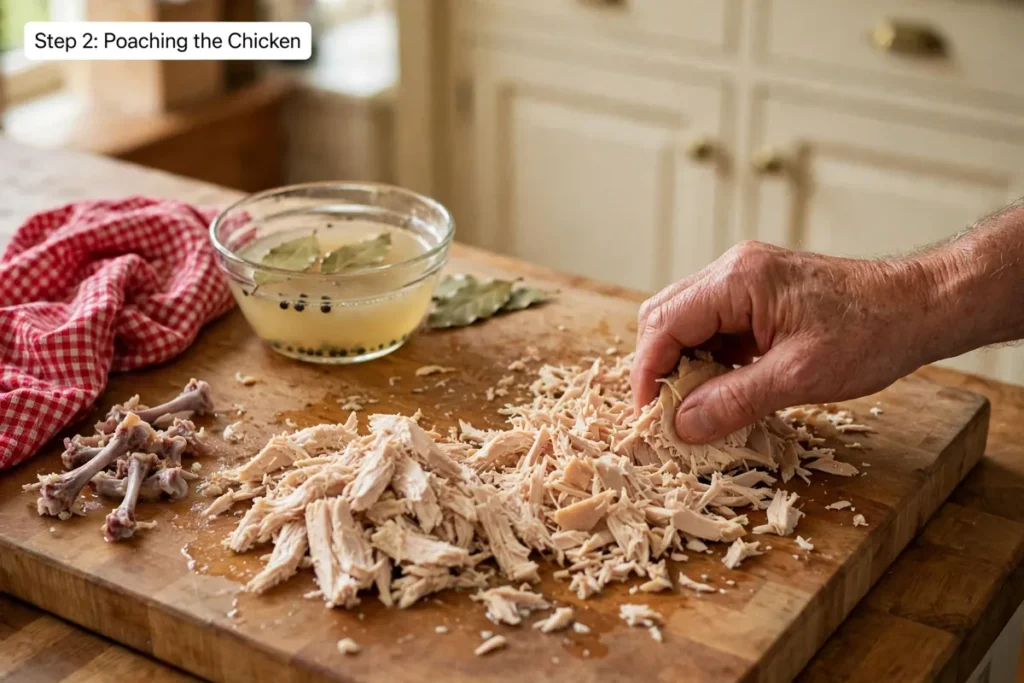
Place chicken thighs in a saucepan, cover with cold water by 2 inches. Add salt, bay leaves, and peppercorns. Simmer gently for 25 minutes until internal temperature reaches 165°F. Remove chicken, strain and reserve liquid. Shred chicken into 3/4-inch pieces.- Make the Filling
Sauté vegetables and make roux.
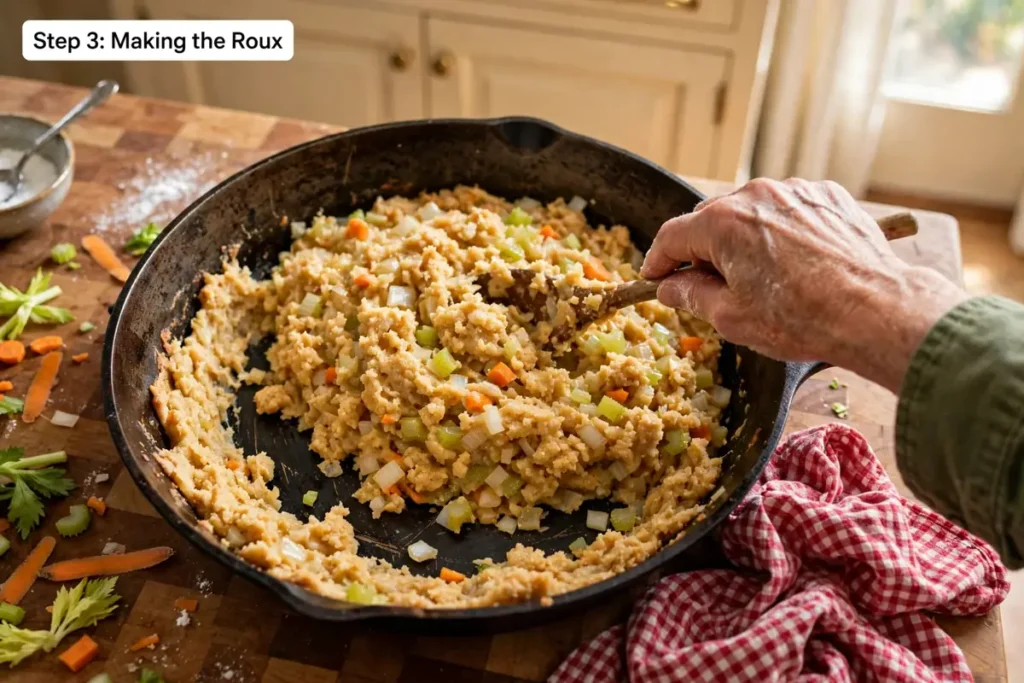
Melt butter in a skillet over medium heat. Add onion, celery, and carrots; cook 8-10 minutes until softened. Add garlic, cook 1 minute. Add flour and stir constantly for exactly 2 minutes to cook out the raw flour taste.Thicken and finish.
Slowly whisk in the reserved chicken stock, then the milk and cream. Simmer for 3-4 minutes until thickened. Add shredded chicken, peas, thyme, parsley, salt, and pepper. Stir to combine. Remove from heat and cool for 15 minutes.- Assemble and Bake
Bottom crust.
Preheat oven to 400°F (205°C). Roll one pastry disc to a 12-inch circle. Transfer to a 9-inch pie plate, pressing gently without stretching. Trim overhang to 1 inch.Fill and top.
Pour the cooled filling into the crust. Roll the second disc to an 11-inch circle and place over the filling. Fold the edge under and crimp firmly. Cut 4 to 5 steam vents in the top crust.Egg wash and bake.
Whisk egg and milk. Brush over the top crust and crimped edge. Sprinkle with flaky salt if using. Bake at 400°F for 45-55 minutes until deep golden-brown and the filling is bubbling through the vents.Rest.
Remove from oven and rest for 15 minutes before serving to allow the filling to set.
Step by Step Process
Make the Pie Crust
Step 1. Combine the flour, salt, and sugar in a large bowl. Add the very cold butter cubes. Using the pastry blender or food processor, cut the butter into the flour until the mixture resembles coarse crumbs with visible butter pieces ranging from pea-sized to almond-sized the size variation is intentional. Add ice water 1 tablespoon at a time, tossing with a fork after each addition, until the dough just holds together when squeezed between two fingers. Divide in half, flatten each half into a disc, wrap in plastic wrap, and refrigerate for minimum 1 hour.
Poach the Chicken
Step 2. Place the chicken thighs in a medium saucepan and cover with cold water by 2 inches. Add 1 teaspoon of salt, 2 bay leaves, and 4 black peppercorns. Bring to a gentle simmer over medium heat never a full boil, which toughens the thigh meat’s protein network. Simmer gently for 25 minutes until the internal temperature reads 165°F. Remove the chicken and allow to cool for 15 minutes. Strain and reserve the poaching liquid. Remove the skin, pull the meat from the bones, and shred or dice into 3/4-inch pieces. Measure 2 cups of the reserved poaching liquid.
Make the Filling
Step 3. Melt the butter in the large skillet over medium heat. Add the onion, celery, and carrots. Cook, stirring occasionally, for 8 to 10 minutes until the vegetables are softened and the onion is translucent not browned. Add the garlic and cook for 1 minute. Add the flour to the softened vegetables. Stir constantly for exactly 2 minutes the roux-cooking period that converts the raw starch compounds through dextrinisation.
Step 4. Add the reserved chicken poaching liquid in a slow, steady stream while stirring constantly. Add the whole milk and heavy cream. Bring to a simmer, stirring constantly, and cook for 3 to 4 minutes until the filling has thickened to a consistency that coats the back of a spoon. Add the shredded chicken, frozen peas, thyme, parsley, salt, and black pepper. Stir to combine. Remove from heat and allow to cool for 15 minutes before filling the pie.

Assemble and Bake
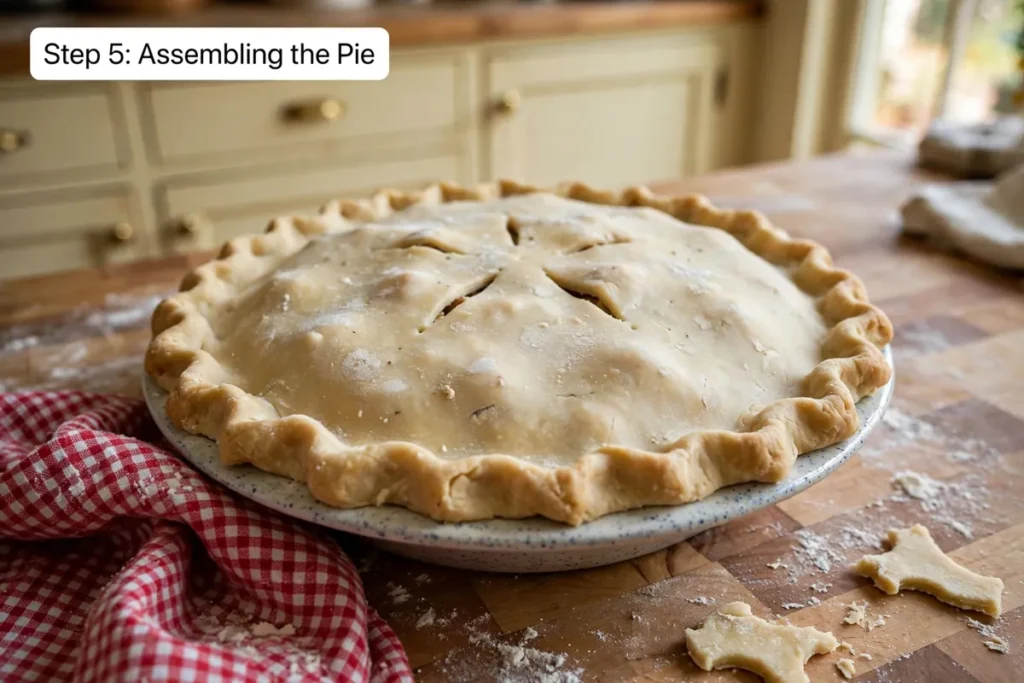
Step 5. Preheat the oven to 400°F (205°C). Remove one pastry disc from the refrigerator. On a lightly floured surface, roll to a 12-inch circle. Transfer to the pie plate and press gently into the base and sides do not stretch the pastry. Trim the overhang to 1 inch. Pour the cooled filling into the pastry-lined pie plate. Roll the second pastry disc to an 11-inch circle and place over the filling. Fold the top crust’s edge under the bottom crust’s overhang and crimp together firmly. Cut 4 to 5 steam vents in the top crust using a sharp knife.
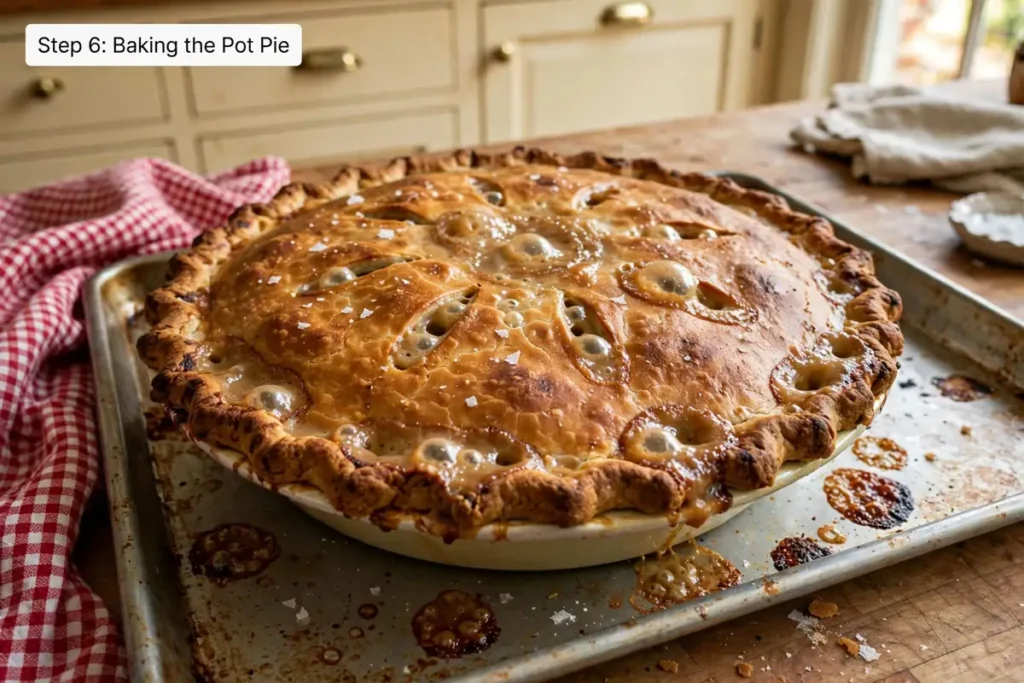
Step 6. Whisk together the egg and milk for the egg wash. Brush the full top crust surface and crimped edge evenly. Scatter flaky sea salt over the top if using. Place the pie plate on a rimmed baking sheet. Bake at 400°F for 45 to 55 minutes until the crust is deep golden-brown across the full top surface and the filling is visibly bubbling through the steam vents.
Step 7. Remove from the oven and rest for 15 minutes before serving the filling continues setting during this period from residual heat, producing the correct thick, spoonable consistency rather than the too-fluid filling that cutting into a just-baked pot pie immediately produces.

Why a 2-Minute Roux Cook Eliminates Raw Flour Flavor
Wheat flour’s primary starch components amylose at approximately 25 percent of the starch weight and amylopectin at 75 percent contain raw starch compounds that produce a distinctly pasty, gluey, slightly chalky flavor when they reach the palate without sufficient thermal processing. This raw starch flavor is not present in cooked flour alone it requires the starch to be tasted in its under-dextrinised state, where the amylose chains retain their native helical structure rather than the partially unwound, thermally modified structure that sufficient roux cooking produces.
At medium heat with butter as the surrounding fat medium, the flour’s starch granules reach temperatures of 250 to 280°F within 90 seconds to 2 minutes sufficient for dextrinisation of the amylose and amylopectin surface compounds to begin producing the shorter-chain dextrins and maltodextrins that replace the raw starch’s pasty flavor with the neutral, clean thickening character of a fully cooked roux.
How Does Chicken Pot Pie Compare to Related Savory Pies?
| Attribute | Chicken Pot Pie | Beef Pot Pie | Turkey Pot Pie | Vegetable Pot Pie | Chicken Cobbler |
|---|---|---|---|---|---|
| Primary protein | Poached chicken thighs | Braised beef chuck | Roasted or poached turkey | None vegetables only | Poached chicken thighs |
| Crust type | Double butter pie crust | Double butter or suet crust | Double butter pie crust | Double butter pie crust | Single biscuit topping no bottom crust |
| Filling thickener | Butter-flour roux | Butter-flour roux | Butter-flour roux | Butter-flour roux | Butter-flour roux |
| Cooking time for protein | 25 minutes poaching | 2 to 3 hours braising | 20 minutes poaching or leftover | N/A | 25 minutes poaching |
| Most common vegetables | Carrot, pea, celery, onion | Carrot, parsnip, onion, potato | Carrot, pea, celery, onion | Mushroom, leek, potato, carrot | Carrot, pea, celery, onion |
| Cultural association | American nationwide | British-American | American post-Thanksgiving | American vegetarian tradition | American South biscuit tradition |
| Serving format | Whole pie, portioned at table | Whole pie or individual ramekins | Whole pie, leftover-utilisation | Whole pie | Baking dish, scooped portions |
What Variations Can You Make?
Chicken and Mushroom Pot Pie
Add 250g of sliced cremini mushrooms to the skillet with the onion, celery, and carrot at Step 3 cooking for an additional 3 minutes until the mushrooms have released their moisture and the liquid has fully evaporated before adding the flour. The mushroom’s glutamic acid content amplifies the chicken filling’s savory depth through umami stacking.
Individual Chicken Pot Pies
Divide the filling among six 10-ounce individual ramekins. Roll the pastry to 1/4-inch thickness and cut circles 1 inch larger than each ramekin’s diameter. Drape each pastry circle over the filled ramekin, pressing the overhang against the ramekin’s exterior to seal. Apply egg wash and cut 2 steam vents. Bake at 400°F for 25 to 30 minutes.
Dietary Adjustments and Substitutions
Dairy-Free Version
Replace the butter in both the crust and the filling with dairy-free butter sticks at the same weights. Replace the whole milk in the filling with full-fat oat milk (120ml) and the heavy cream with full-fat coconut cream (120ml). The roux-cooking protocol is unchanged.
Gluten-Free Version
Replace the all-purpose flour in the crust with a certified gluten-free 1:1 pastry flour blend at the same weight (300g) add 1 additional tablespoon of ice water. Replace the all-purpose flour in the roux with sweet rice flour (mochiko) at the same weight (40g).
What Are the Most Common Problems When Making Chicken Pot Pie?
| Problem | Most Likely Cause | Prevention or Fix |
|---|---|---|
| Raw flour taste in the filling | Roux cooked less than 2 minutes starch not fully dextrinized | Always cook the flour into the butter for exactly 2 minutes at medium heat before adding any liquid. The nutty slightly golden aroma is the sensory confirmation that dextrinization has proceeded sufficiently. |
| Soggy bottom crust | Hot filling poured into raw pastry, or filling too thin | Always cool the filling for 15 minutes before pouring into the pastry. Ensure the filling has thickened to coat-the-spoon consistency before removing from heat. |
| Top crust lifting away from filling during baking | Steam vents too few or too small because steam pressure lifted the crust | Cut at minimum 4 to 5 vents in the top crust. Ensure the crust is sealed firmly at the crimp before baking. |
| Filling too thin when served | Insufficient roux, or filling cut before the 15-minute rest | The roux thickening re-gels during the 15-minute rest so always rest before cutting. If still too thin after resting then the roux flour quantity was insufficient and increase to 1/2 cup in the next batch. |
| Crust shrinking during baking | Pastry stretched rather than draped during lining because gluten tension causes shrinkage | Never stretch the pastry into the pie plate and always lift and drape. Refrigerate the lined pie plate for 15 minutes before filling if the pastry shows any signs of springing back from the edges. |
How Do You Store Chicken Pot Pie?
| Storage Method | Duration | Instructions |
|---|---|---|
| Refrigerated, whole or individual portions, covered | Up to 4 days | Cover tightly with plastic wrap or foil. Reheat individual slices in a 350°F oven for 15 to 20 minutes until the filling is bubbling and the crust has re-crisped. |
| Frozen, fully baked and cooled, wrapped tightly | Up to 3 months | Wrap the fully cooled pie in plastic wrap then foil. Thaw overnight in the refrigerator. Reheat at 350°F for 30 to 35 minutes. |
| Frozen, assembled unbaked | Up to 2 months | Assemble fully, wrap tightly without egg wash, and freeze. Apply egg wash directly from frozen and bake at 375°F for 60 to 75 minutes. |
Scaling
| Servings | Chicken Thighs | Stock | Butter (filling) | Flour (filling) | Cream | Pie Plate |
|---|---|---|---|---|---|---|
| 4 servings | 3 thighs | 320ml | 40g | 27g | 80ml each | 8-inch standard pie plate |
| 6 servings (standard) | 4 thighs | 480ml | 57g | 40g | 120ml each | 9-inch deep-dish pie plate |
| 8 servings | 6 thighs | 640ml | 75g | 53g | 160ml each | 11-inch deep-dish pie plate |
Nutritional Information
Per serving: 1 slice approximately 380g including double butter crust and chicken filling, based on 6 servings. Values calculated using USDA FoodData Central reference data.
| Nutrient | Per Serving | Nutrient | Per Serving |
|---|---|---|---|
| Calories | 688 kcal | Total carbohydrate | 52g |
| Total fat | 42g | Dietary fibre | 3.8g |
| Saturated fat | 24g | Total sugars | 4.8g |
| Cholesterol | 198mg | Protein | 28g |
| Sodium | 788mg | Iron | 3.8mg (21% DV) |
Frequently Asked Questions
Why are chicken thighs specified rather than chicken breasts?
Chicken thighs’ higher fat content approximately 9 percent versus breast’s 3 percent prevents the drying that breast meat produces at the 165°F poaching temperature needed for food safety. The thigh’s collagen-rich connective tissue also converts to gelatin during the 25-minute poaching period, enriching the poaching liquid that becomes the filling’s stock base with body and chicken flavour compounds that breast meat’s lower collagen content cannot provide at the same cooking time.
Why must the filling cool before going into the pastry?
Hot filling poured directly into the raw pastry base raises the pastry’s temperature above the butter’s melting point before the oven’s heat can set the pastry structure around the solid butter pieces the liquid butter absorbs into the pastry’s flour structure rather than remaining as the discrete pieces that produce flaky layers during baking. A 15-minute cooled filling maintains the pastry’s butter in its solid-piece state until the oven’s radiant heat produces the steam that separates the layers in the first 10 minutes of baking.
Why does the filling need to bubble through the vents before the pie is done?
The filling’s visible bubbling through the steam vents confirms the filling’s internal temperature has reached approximately 180 to 190°F the temperature at which the roux’s starch network has fully reactivated after the cooling-period gel formation and the chicken filling has reached a safe serving temperature above the 165°F food safety threshold. The crust’s golden colour alone does not confirm filling temperature a correctly golden crust can appear over a filling that has not yet reached serving temperature in a deep-dish format.
Can I use store-bought pie crust?
Yes two sheets of refrigerated Pillsbury or similar store-bought pie crust produce an acceptable result at significantly reduced preparation time. The store-bought crust’s shortening-based formula produces a more tender but less flaky texture than the butter crust the discrete butter pieces’ steam-separation mechanism that produces defined flaky layers is absent in a shortening-based crust whose more homogeneous fat distribution produces a uniformly tender crumb without the layered separation. For the filling’s roux-cooked quality, store-bought crust is a workable convenience substitution that does not affect the preparation’s primary technique requirement.
Chicken pot pie is an American comfort food classic in the colonial British meat pie tradition whose defining quality is a thick, herb-seasoned cream sauce carrying tender poached chicken thigh pieces and diced vegetables, thickened through a butter-flour roux cooked for exactly 2 minutes to eliminate the raw amylose and amylopectin starch flavor through dextrinisation before any stock contacts the flour, enclosed in a double butter pie crust whose solid butter pieces produce steam-separated flaky layers during the 400°F baking period and whose 4 to 5 steam vents release the filling’s moisture pressure to prevent the gap between filling and crust that under-vented pot pies consistently produce a preparation whose technical precision at the roux stage and whose ingredient quality at the chicken poaching stage together determine whether the finished pie delivers the deeply savory, richly sauced, cleanly flavored comfort eating experience that has made chicken pot pie one of the most beloved American savory preparations across generations of home cooks.
Table of Contents
Recent Recipes
American · Cakes Orange Pound Cake Recipe This orange pound cake recipe rubs the zest into the sugar before creaming. […]
Check Out..!
American · Layer Cakes Coconut and Carrot Cake Recipe Moist, oil-based spiced layer cake packed with freshly grated carrot and […]
Check Out..!
American Cakes Tandy Cake Recipe This Tandy cake recipe spreads peanut butter on the warm cake, then chills it before […]
Check Out..!
American · Cakes Portillo’s Chocolate Cake Recipe This Portillo’s chocolate cake recipe adds mayonnaise to the batter. Mayo is just […]
Check Out..!Recent Blogs
I’ve glazed our Amish apple cake too hot, too cold, and exactly right, and the difference is not small. The […]
Read Blog..!
I’ve pulled a sunken Amish Apple Cake out of my oven, and I know the exact sinking feeling that comes […]
Read Blog..!
A cup measures volume, not weight, so a cup of flour and a cup of sugar weigh completely different amounts. […]
Read Blog..!
Every pasta shape was designed to carry a certain kind of sauce. Thin strands suit light sauces that coat, wide […]
Read Blog..!
Every egg method, from a jammy boiled egg to a silky French omelet, comes down to one fact: the white […]
Read Blog..!