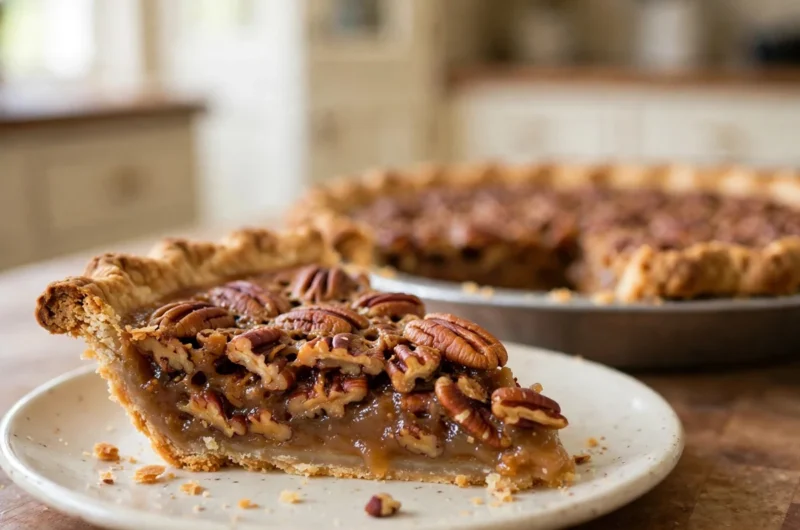
Pecan pie is the most distinctively American of all the country’s classic dessert pies a single-crust pie in which toasted pecan halves are suspended in a deeply caramelised filling of corn syrup, brown sugar, eggs, and butter that sets during baking to a dense, gently yielding, sticky-sweet custard whose texture sits precisely at the boundary between a set custard and a soft caramel, producing one of the most intensely sweet and most texturally satisfying desserts in the American Southern baking canon.
The toasting protocol is the single most critical technique decision. The pecan’s cellular structure a network of oil-filled cells within a relatively low-moisture nut compared to the walnut or almond responds dramatically to the 325°F pre-toast’s thermal drying and Maillard browning: the surface moisture evaporates, the cell wall structure firms through partial dehydration, and the pyrazine and furanone Maillard compounds produced from the nut’s proteins and natural sugars contribute the warm, roasted aromatic that most tasters identify as the definitive pecan character. When raw pecans enter the pie filling sealed under the corn syrup filling’s liquid phase before the filling sets the filling’s moisture and the steam produced during baking re-hydrates the pecan’s surface, reversing the dehydration that would have produced crunch and producing the soft, flabby texture of a nut that has been cooked in liquid rather than roasted in dry heat.
Pecan pie’s American origin is as Southern as the pecan tree itself Carya illinoinensis, native to the river valleys of the American South and Midwest, whose nuts were harvested by Indigenous Americans for thousands of years before European settlement and whose cultivation became a significant agricultural industry in Georgia, Texas, New Mexico, and throughout the Gulf Coast states from the late 19th century onward. The corn syrup filling the preparation’s most debated ingredient became standard in American pecan pie recipes from the early 20th century onward, with the earliest documented corn syrup pecan pie recipe appearing on the Karo Corn Syrup label around 1902. The corn syrup’s glucose-dominant sugar composition produces a filling that sets more softly and more uniformly than a sucrose-only filling from the glucose’s lower crystallisation tendency the corn syrup’s invert sugar character preventing the granular crystallisation that an all-sucrose filling would produce during cooling.
What Is Pecan Pie?
Pecan pie is a single-crust American Southern dessert pie in which the filling rather than a fruit or custard preparation is a corn syrup and egg-based caramel that sets around the toasted pecans during baking to a dense, soft, gently yielding consistency that is simultaneously the pie’s most celebrated and most misunderstood quality.
The correct pecan pie filling set is not a firm custard and not a liquid caramel it is a soft, slightly wobbly, barely-set caramel-custard hybrid that holds its shape when sliced but yields to light pressure and stretches slightly when pulled, in the same way that a just-set caramel candy yields at room temperature. It differs from a chocolate pecan pie in that the filling’s caramel character is the complete flavor identity without chocolate supplementation. It differs from a pecan tart in the format a full 9-inch pie rather than individual tart shells and in the higher filling-to-pecan ratio that the pie’s greater depth accommodates.
What Equipment Do You Need?
What Ingredients Do You Need?
Use dark corn syrup rather than light corn syrup the dark corn syrup’s molasses component produces a deeper, more complex caramel character in the finished filling that most Southern pecan pie traditions specify as the correct flavour. Light corn syrup produces a paler, sweeter, one-dimensional filling whose lack of molasses complexity most experienced pecan pie tasters describe as the identifying mark of an inferior or inauthentic preparation. Use dark brown sugar to reinforce the molasses depth that the dark corn syrup contributes the combined molasses from both the dark corn syrup and the dark brown sugar produces the warm, caramelised depth that distinguishes a deeply flavored Southern pecan pie from a generically sweet one.
For the Butter Pie Crust
For the Pecan Pie Filling
The bourbon at 1 tablespoon is listed as optional but is the standard inclusion in most serious Southern pecan pie recipes the bourbon’s barrel-aging ester compounds complement the corn syrup filling’s caramel character through the same warm-sweet aromatic family complementarity. At 1 tablespoon the ethanol volatilises completely during baking, leaving only the ester aromatics in the finished filling.
Step by Step Process
Toast the Pecans
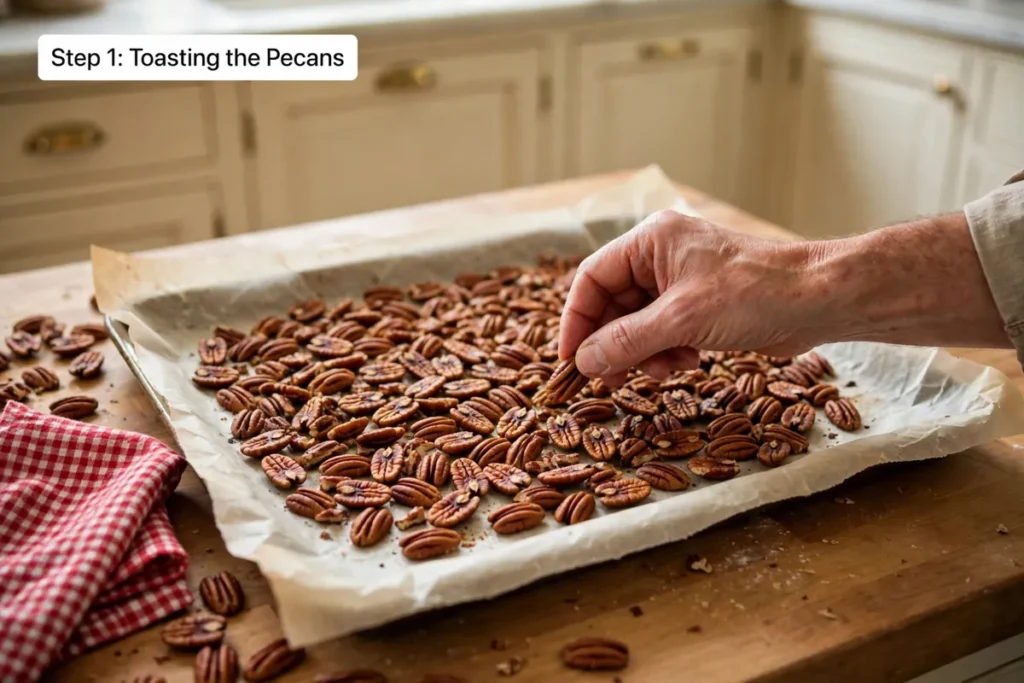
Step 1. Preheat the oven to 325°F (163°C). Spread the pecan halves in a single even layer on the parchment-lined baking sheet. Toast at 325°F for exactly 8 minutes the same protocol applied here at the pecan’s lower natural bitterness level where the toasting goal is Maillard pyrazine and furanone development rather than juglone conversion. At 8 minutes the pecan surface reaches 290 to 310°F the Maillard browning threshold for the pecan’s proteins and natural sugars producing the characteristic warm, deeply nutty aromatic and the surface dehydration that produces the crunch that survives the filling’s baking period. Remove and cool completely before adding to the filling warm pecans added to the corn syrup filling begin softening from the filling’s residual warmth before the pie even enters the oven.
Make the Pie Crust
Step 2. Prepare the butter pie crust using the same method documented in the sweet potato pie and chicken pot pie cut cold butter into flour-salt-sugar mixture, add ice water until dough just coheres, form into a disc, and refrigerate for 1 hour. Roll to a 12-inch circle, transfer to the 9-inch pie plate, trim and crimp the edge, and freeze for 15 minutes.
Blind bake the frozen crust at 375°F for 15 minutes with pie weights removing after 15 minutes rather than the sweet potato pie’s 25 minutes because the pecan pie filling’s denser, lower-moisture composition requires less bottom-crust protection from moisture softening than the sweet potato custard. Remove the weights and bake for 5 additional minutes until the base is dry and matte. The partial blind bake for pecan pie is not as critical as for custard pies but prevents the raw, doughy bottom crust that unblind-baked pecan pie crust occasionally produces at the filling’s base where the dense corn syrup filling insulates the crust from the oven’s bottom heat.
Make the Filling
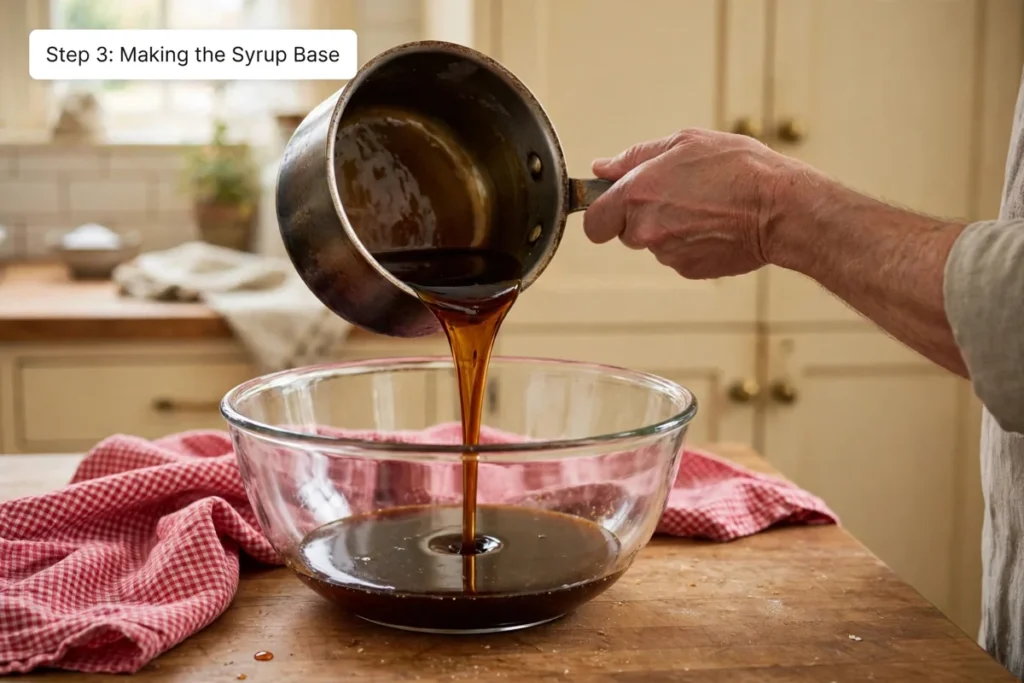
Step 3. Combine the dark corn syrup, dark brown sugar, and butter in the medium saucepan over medium heat. Stir until the butter is completely melted and the brown sugar has dissolved into the corn syrup approximately 3 to 4 minutes. Remove from heat and allow to cool for 10 minutes until the mixture is warm but not hot approximately 120°F. The cooling period is essential: eggs added to a corn syrup mixture above 140°F begin scrambling on contact from the heat’s immediate coagulation of the albumin proteins, producing a filling with cooked egg protein flecks rather than a smooth, uniform caramel custard.
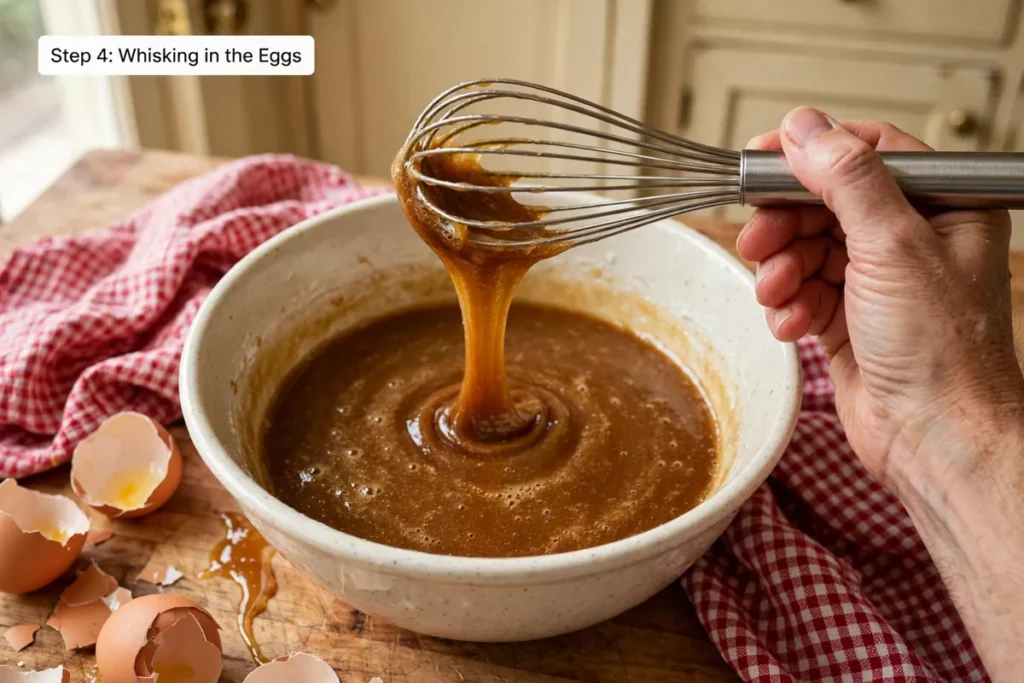
Step 4. Add the eggs one at a time to the cooled corn syrup mixture, whisking vigorously after each until completely incorporated. Add the vanilla, salt, and bourbon if using. Whisk until the filling is completely smooth and uniform the egg proteins fully dispersed through the corn syrup matrix without any visible egg white streaks.
Assemble and Bake
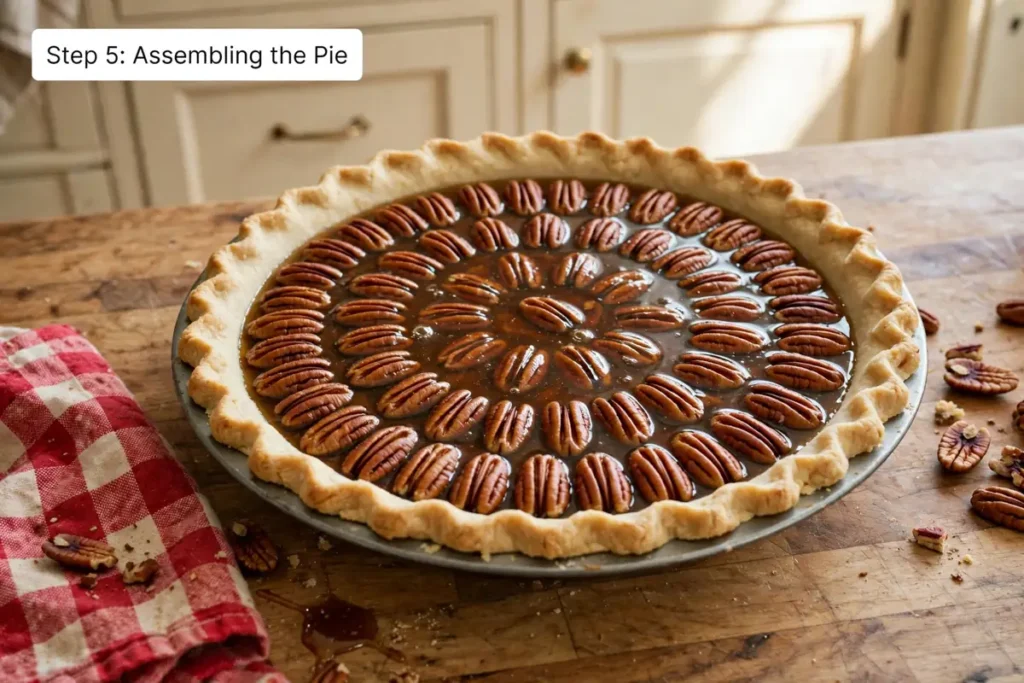
Step 5. Arrange the cooled toasted pecan halves in the partially blind-baked crust either arranged in concentric circles with the flat sides down for a formal presentation, or scattered evenly for a rustic presentation. Pour the corn syrup filling slowly over the arranged pecans pouring from the centre outward and allowing the filling to flow between and around the pecan halves rather than pouring directly onto the pecans which would displace the arranged pattern.
Step 6. Increase the oven to 350°F (177°C). Brush the exposed crust edge with egg wash. Place the filled pie on the baking sheet. Bake at 350°F for 50 to 60 minutes until the filling is set at the edges and shows a slow, uniform jiggle at the centre when the pan is gently moved, and the internal temperature reads 200°F at the centre. The 200°F target is higher than the sweet potato pie’s 175°F the corn syrup filling’s glucose-dominant sugar composition requires a higher temperature for the caramel-custard set that produces the correct sliceable texture, because the glucose syrup’s lower egg protein coagulation amplification requires the higher temperature to fully set the filling’s structure.
Step 7. Remove from the oven and cool completely on a wire rack minimum 2 hours. The pecan pie filling continues setting during cooling as the glucose syrup’s caramel network firms and the egg protein gel completes its room-temperature consolidation. Cutting before the full 2-hour cooling produces a filling that flows from the cut edge rather than the soft, gently yielding set that the fully cooled pie achieves. Pecan pie is most completely itself at room temperature the caramel filling’s glucose network is at its softest, most yielding consistency at 68 to 72°F.
Why Toasted Pecans Stay Crunchy Where Raw Pecans Soften
The pecan’s textural behavior inside a corn syrup filling during baking is determined by the nut’s moisture content at the moment it enters the filling, and the difference between a toasted pecan’s low-moisture surface and a raw pecan’s slightly higher-moisture surface produces dramatically different outcomes at the same filling temperature and baking time.
A raw pecan at room temperature contains approximately 3 to 4 percent surface moisture — low relative to most foods but sufficient for the steam-rehydration mechanism that the sealed corn syrup filling produces during baking. When the filled pie enters the 350°F oven, the filling’s water content — from the eggs, the corn syrup’s residual moisture, and the butter’s water fraction — begins producing steam at temperatures above 212°F. This steam has nowhere to escape in the sealed filling matrix and instead migrates through the filling toward the lower-moisture pecan surfaces, condensing on contact with the slightly cooler pecan surface and rehydrating the surface cells. The net result is a pecan that has absorbed moisture from the surrounding filling during baking — producing the soft, pale, slightly waterlogged texture that makes raw-pecan pecan pie’s pecan layer texturally indistinct from the surrounding filling.
A toasted pecan at 325°F for 8 minutes has had its surface moisture content reduced to approximately 1 to 1.5 percent from the oven’s thermal drying — and more importantly, the Maillard browning of the surface cells’ proteins and sugars has produced a thin, firm, cross-linked protein layer at the pecan surface that resists moisture penetration more effectively than the raw pecan’s un-Maillard-modified surface. When the same steam migration occurs in the filling during baking, the toasted pecan’s drier, more cross-linked surface absorbs significantly less condensing moisture than the raw pecan’s wetter, more permeable surface — maintaining the pre-toast crunch that the Maillard-modified cell wall structure provides through the full baking period.
How Does Pecan Pie Compare to Related Southern Nut Pies?
What Variations Can You Make?
Chocolate Pecan Pie
Add 4 oz (113g) of finely chopped dark chocolate — 60 to 65 percent — to the warm corn syrup-sugar-butter mixture after removing from heat at Step 3, stirring until completely melted and smooth before the cooling period. The dark chocolate’s cocoa butter integrates into the corn syrup filling’s fat phase during the melting, and the solid cocoa mass contributes the polyphenol complexity — producing a filling that is simultaneously more complex and slightly less cloying than the straight corn syrup filling from the dark chocolate’s polyphenol bitterness moderating the glucose syrup’s intense sweetness through TAS2R receptor cross-modal suppression.
Maple Pecan Pie
Replace the dark corn syrup with pure Grade A dark maple syrup at the same volume (340g) and reduce the dark brown sugar to 1/4 cup (55g) — the maple syrup’s own sugar concentration compensates for the reduction. The maple syrup’s furfural, syringaldehyde, and vanillin aromatic compounds produce a filling with a more complex, more sophisticated warm-sweet aromatic than the corn syrup-molasses combination — the maple’s aromatic family complementing the toasted pecan’s pyrazine character through the shared warm-caramelised aromatic register that both ingredients occupy.
Brown Butter Pecan Pie
Brown the 4 tablespoons of butter before combining with the corn syrup and brown sugar — using a stovetop browning technique, pouring immediately into the saucepan with the corn syrup and brown sugar. The browned butter’s diacetyl and acetoin Maillard compounds dissolve into the corn syrup filling’s fat phase during the gentle warming, distributing the butterscotch-caramel aromatic through the full filling matrix rather than existing only at the surface-accessible butter fat zones of the standard melted-butter version.
Dietary Adjustments and Substitutions
Corn Syrup-Free Version
Replace the dark corn syrup with an equal weight of pure dark maple syrup (340g) or golden syrup (Lyle’s brand) at the same volume. Both alternatives produce a filling that sets adequately at the same egg quantity and baking temperature — maple syrup’s higher fructose content produces a slightly softer set than corn syrup, and golden syrup’s sucrose-invert sugar blend produces a slightly firmer set closer to the corn syrup standard. Neither alternative produces the grainy crystallisation that an all-sucrose filling produces during cooling — both contain sufficient invert sugars to prevent crystallisation at room temperature storage.
Dairy-Free Version
Replace the butter with dairy-free butter sticks at the same weight (57g). The filling’s primary structure comes from the egg protein and corn syrup network rather than from the butter’s fat — the dairy-free butter substitution affects the filling’s aromatic richness marginally but does not affect the set or texture at the same baking conditions. Replace the butter pie crust’s butter with dairy-free butter sticks at the same weight (113g).
Gluten-Free Version
Replace the all-purpose flour in the crust with a certified gluten-free 1:1 pastry flour blend at the same weight (150g). The pecan pie filling is inherently gluten-free corn syrup, sugar, eggs, pecans, butter, and vanilla contain no gluten. Verify the dark corn syrup brand’s gluten-free status — Karo brand dark corn syrup is labelled gluten-free.
What Are the Most Common Problems When Making Pecan Pie?
How Do You Store Pecan Pie?
Scaling
Nutritional Information
Per serving: 1 slice approximately 155g including butter pie crust and pecan corn syrup filling, based on 8 slices. Values calculated using USDA FoodData Central reference data using dark corn syrup, dark brown sugar, and toasted pecans.
Frequently Asked Questions
Pecan pie is the most distinctively American of the country’s classic dessert pies rooted in the Gulf Coast states’ pecan cultivation tradition and the Karo Corn Syrup recipe label tradition of the early 20th century whose defining quality is a toasted pecan layer whose 325°F pre-toast’s Maillard-modified surface resists the steam condensation rehydration that raw pecans undergo inside the sealed corn syrup filling during baking, suspended in a dark corn syrup and dark brown sugar caramel-custard filling that sets to the soft, gently yielding, barely-sliceable consistency of a just-set caramel candy only when the internal temperature reaches 200°F the threshold at which the glucose syrup’s resistance to egg protein network formation has been overcome sufficiently for a room-temperature-stable set producing when correctly executed the most intensely sweet, most texturally distinctive, and most culturally specific dessert pie in the American Southern baking canon.