
American (Pennsylvania Dutch) · Fruit Cakes Amish Apple Cake Recipe A moist, oil-based spiced sheet cake made with pre-cooked diced […]
Check Out..!
British-American · Pies
Shepherd's Pie Recipe
A baked British-American casserole with a deeply savory ground meat filling topped with a layer of creamy mashed potatoes and baked until golden at the peaks.
- Prep: 25 min
- Cook: 45 min
- Total: 1 hr 10 min
- Servings: 6
- Difficulty: Easy-Medium
- Dietary: Gluten-Free Option
 Chef's review · Saba Aftab, Pastry Chef · Reviewed Nov 10, 2026
“Cook the lamb mince until all liquid has fully evaporated before adding stock wet mince steams rather than browns, producing a grey, boiled filling without the Maillard depth that defines a properly made shepherd's pie.”
Our investigation: 24 recipes add stock immediately after browning without reducing the mince liquid first, producing a watery, grey filling that never develops the concentrated, caramelized meat flavor that full evaporation before liquid addition achieves.
Shepherd’s pie is a baked British-American casserole in which a deeply savory ground meat filling cooked with onion, carrots, celery, garlic, tomato paste, Worcestershire sauce, and beef or chicken stock until thick and glossy is topped with a layer of creamy mashed potatoes and baked until the potato crust is golden at the peaks and the filling is bubbling at the edges.
It is simultaneously one of the most practical weeknight dinners in the American home cook’s repertoire and one of the most technically instructive every element of the dish has a correct standard that produces a meaningfully better result than the most common shortcuts, and the difference between a shepherd’s pie that tastes like a satisfying, deeply flavored meal and one that tastes like ground beef under instant mashed potatoes is a matter of technique decisions made at three specific points: browning the meat correctly, building and reducing the filling to the right consistency, and making the mashed potato topping with enough fat and the right potato variety.
Technically, shepherd’s pie refers to a preparation made with lamb or mutton, while the same preparation made with beef is correctly called cottage pie. In the United States the term shepherd’s pie has become the universal descriptor for both preparations regardless of meat. The recipe documented here follows the American usage while preserving the distinction in the variations section.
What Is Shepherd's Pie?
Shepherd’s pie is a layered baked casserole belonging to the category of dishes variously described as meat pies, topped casseroles, or gratin preparations in which a cooked filling is sealed under a starchy crust and baked until the crust sets and the filling heats through completely. It differs from a pastry-crusted pie in that the potato topping is not a dough it does not require blind baking, does not shrink during baking, and does not seal the filling through steam pressure the way a pastry crust does.
The filling’s correct consistency before the potato topping is applied is the single most important quality decision in the recipe and the one most commonly mismanaged. A shepherd’s pie filling applied too thin, too wet, or before sufficient reduction produces a finished dish where the liquid from the filling migrates upward through the potato crust during baking, producing a soggy, collapsing topping and a watery base that lacks the rich, concentrated flavor of a correctly reduced filling.
What Equipment Do You Need?
| Equipment | Specification | Why It Matters |
|---|---|---|
| Large oven-safe skillet — 12-inch | Cast iron or stainless steel preferred | Allows the filling to be made and the potato topping to be applied in a single vessel that goes directly from stovetop to oven. Cast iron retains heat exceptionally well and produces the cleanest fond for deglazing. |
| Large pot | Minimum 6-quart | For boiling the potatoes until completely tender. The pot must be large enough that the potatoes are fully submerged in water. |
| Potato masher or potato ricer | Standard | A ricer produces a smoother more uniform mash. A potato masher produces a slightly coarser mash that is still correct for a rustic spread topping. A food processor or blender overworks the potato starch and produces a gluey gummy result. |
| Pastry brush or fork, for topping texture | Standard | For creating the ridged or peak surface on the mashed potato topping that produces maximum surface area for browning under the broiler. |
What Ingredients Do You Need?
Use 80/20 ground beef the 20 percent fat content provides the fat needed for browning the meat correctly. Russet potatoes for the topping their high starch content produces the fluffiest, most pipe-able mash. All vegetables cut to a consistent small dice so they cook evenly in the same time window.
For the Meat Filling
| Ingredient | Volume | Weight |
|---|---|---|
| Ground beef, 80/20 | 1 1/2 lbs | 680g |
| Yellow onion, small dice | 1 large | 200g |
| Carrots, peeled, small dice | 2 medium | 150g |
| Celery stalks, small dice | 2 stalks | 100g |
| Garlic cloves, finely minced | 4 cloves | 20g |
| Tomato paste | 2 tablespoons | 32g |
| Worcestershire sauce | 1 tablespoon | 15ml |
| Beef stock or broth, low-sodium | 1 cup | 240ml |
| Frozen peas | 3/4 cup | 110g |
| All-purpose flour | 2 tablespoons | 16g |
| Olive oil or neutral oil | 1 tablespoon | 15ml |
| Fresh thyme leaves, or 1/2 teaspoon dried | 1 teaspoon fresh | 2g |
| Fresh rosemary, finely chopped, or 1/4 teaspoon dried | 1/2 teaspoon fresh | 1g |
| Fine sea salt | 1 teaspoon | 6g |
| Freshly ground black pepper | 1/2 teaspoon | 1.2g |
For the Mashed Potato Topping
| Ingredient | Volume | Weight |
|---|---|---|
| Russet potatoes, peeled and cut into 1-inch cubes | 2 lbs | 900g |
| Unsalted butter | 4 tablespoons | 57g |
| Whole milk or heavy cream, warmed | 1/2 cup | 120ml |
| Full-fat sour cream | 2 tablespoons | 30g |
| Sharp cheddar cheese, grated | 3/4 cup | 85g |
| Large egg yolk | 1 yolk | 18g |
| Fine sea salt | 3/4 teaspoon | 4.5g |
| Freshly ground white pepper | 1/4 teaspoon | 0.6g |
Shepherd's Pie
A baked British-American casserole with a deeply savory ground meat filling topped with a layer of creamy mashed potatoes and baked until golden at the peaks.
Prep time
25
minutesCooking time
45
minutesTotal
1 hr 10
minutesYield
6
servingsEasy-Medium
British-American
Ingredients
- For the Meat Filling
1 1/2 lbs (680g) ground beef, 80/20
1 large (200g) yellow onion, small dice
2 medium (150g) carrots, peeled, small dice
2 stalks (100g) celery, small dice
4 cloves (20g) garlic, finely minced
2 tbsp (32g) tomato paste
1 tbsp (15ml) Worcestershire sauce
1 cup (240ml) beef stock or broth, low-sodium
3/4 cup (110g) frozen peas
2 tbsp (16g) all-purpose flour
1 tbsp (15ml) olive oil or neutral oil
1 tsp fresh thyme leaves (or 1/2 tsp dried)
1/2 tsp fresh rosemary, finely chopped (or 1/4 tsp dried)
1 tsp (6g) fine sea salt
1/2 tsp (1.2g) freshly ground black pepper
- For the Mashed Potato Topping
2 lbs (900g) russet potatoes, peeled and cubed
4 tbsp (57g) unsalted butter
1/2 cup (120ml) whole milk or heavy cream, warmed
2 tbsp (30g) full-fat sour cream
3/4 cup (85g) sharp cheddar cheese, grated
1 large egg yolk
3/4 tsp (4.5g) fine sea salt
1/4 tsp (0.6g) freshly ground white pepper
Instructions
- Boil the Potatoes
Boil.
Place peeled, cubed potatoes in a large pot and cover with cold water by 1 inch. Add 1 tsp salt. Bring to a boil, reduce to a simmer, and cook for 15-18 minutes until completely tender. Drain completely.- Brown the Meat
Brown the beef.
Heat oil in a large oven-safe skillet over medium-high. Add ground beef in a single layer. Cook undisturbed for 3-4 minutes until a deep brown crust forms. Break into large pieces and cook 2-3 minutes more until no pink remains. Season with 1/2 tsp salt and the black pepper.Drain excess fat.
If more than 2 tbsp of fat has rendered, spoon off the excess, leaving about 1 tbsp in the pan.- Build the Filling
Sauté vegetables.
Reduce heat to medium. Add onion, carrots, and celery. Cook for 6-8 minutes until softened. Add garlic, thyme, and rosemary; cook 1 minute more. Add tomato paste and cook, stirring constantly, for 2 minutes until darkened.Thicken and simmer.
Sprinkle flour over the mixture and stir to coat. Cook 1 minute. Add Worcestershire sauce and beef stock, scraping up the fond. Simmer for 8-12 minutes until thickened (a spatula channel closes in 3-4 seconds). Stir in frozen peas and remaining 1/2 tsp salt.- Make the Topping
Mash.
Return drained potatoes to the warm pot over low heat for 1-2 minutes to dry. Mash with butter, then warm milk. Stir in sour cream, cheddar, egg yolk, salt, and white pepper until smooth.- Assemble and Bake
Assemble.
Preheat oven to 400°F (204°C). Spread the mashed potatoes over the filling in the skillet, reaching the edges. Use a fork to create ridges or peaks on the surface.Bake.
Bake for 20-25 minutes until bubbling at the edges. Switch to broil for 3-5 minutes until the peaks are deep golden-brown.Rest.
Rest for 10 minutes before serving.
Step by Step Process
Boil the Potatoes
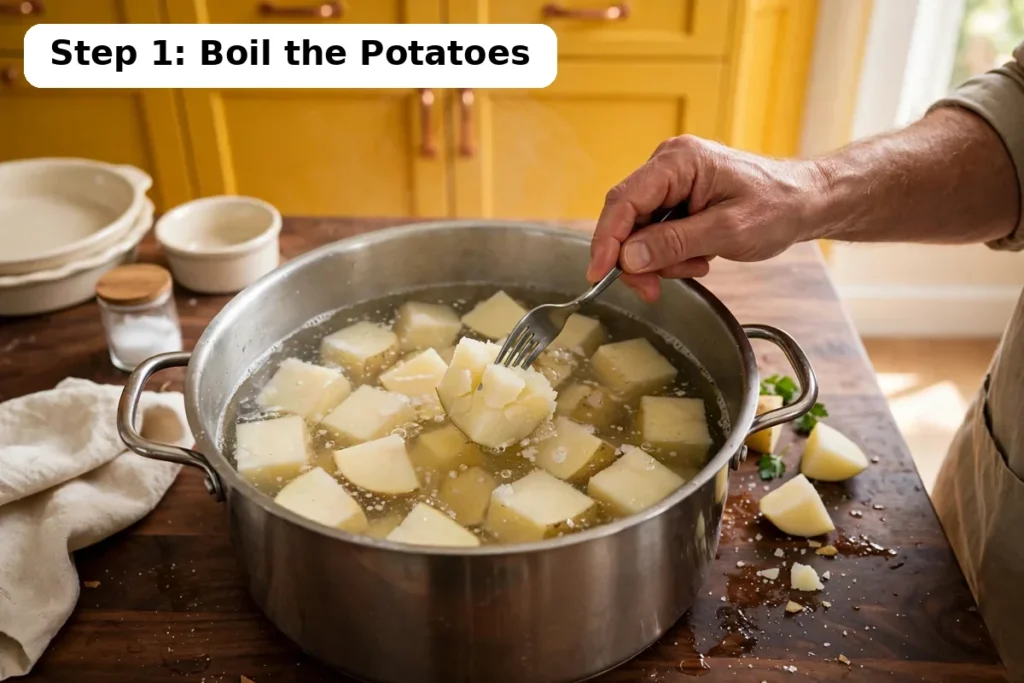
Step 1. Place the peeled, cubed russet potatoes in the large pot and cover with cold water by at least 1 inch. Add 1 teaspoon of salt to the water. Bring to a boil over high heat, then reduce to a steady simmer and cook for 15 to 18 minutes until the potatoes are completely tender a fork or knife inserted into the largest piece meets no resistance at all. Drain completely.
Starting the potatoes in cold water rather than adding them to boiling water produces more even cooking from the exterior to the centre.
Brown the Meat
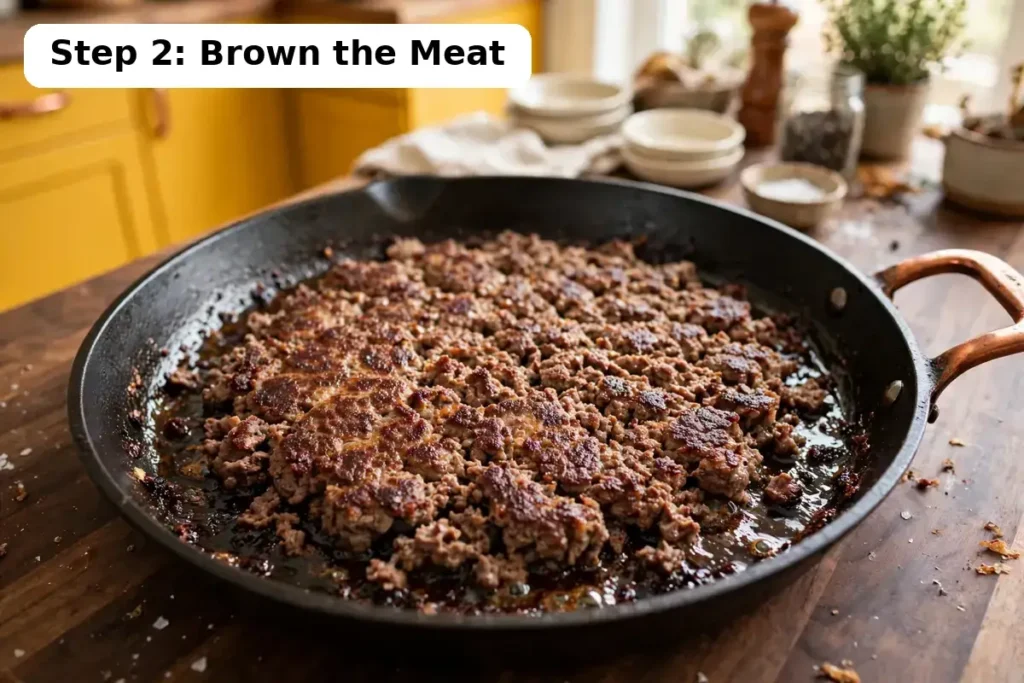
Step 2. Heat the oil in the large oven-safe skillet over medium-high heat until shimmering. Add the ground beef in a single layer do not break it up immediately. Allow to cook undisturbed for 3 to 4 minutes until the bottom surface develops a deep brown crust and the meat releases from the pan surface naturally.
This is the step most commonly mismanaged. Breaking the ground beef up immediately causes it to release its moisture before the Maillard browning reaction can occur. Allowing the meat to brown undisturbed for 3 to 4 minutes before breaking it up produces a filling with significantly more flavor complexity.
Break the meat into large pieces after the initial 3 to 4 minutes and continue cooking for 2 to 3 additional minutes until no pink remains. Season with 1/2 teaspoon of the salt and the black pepper.
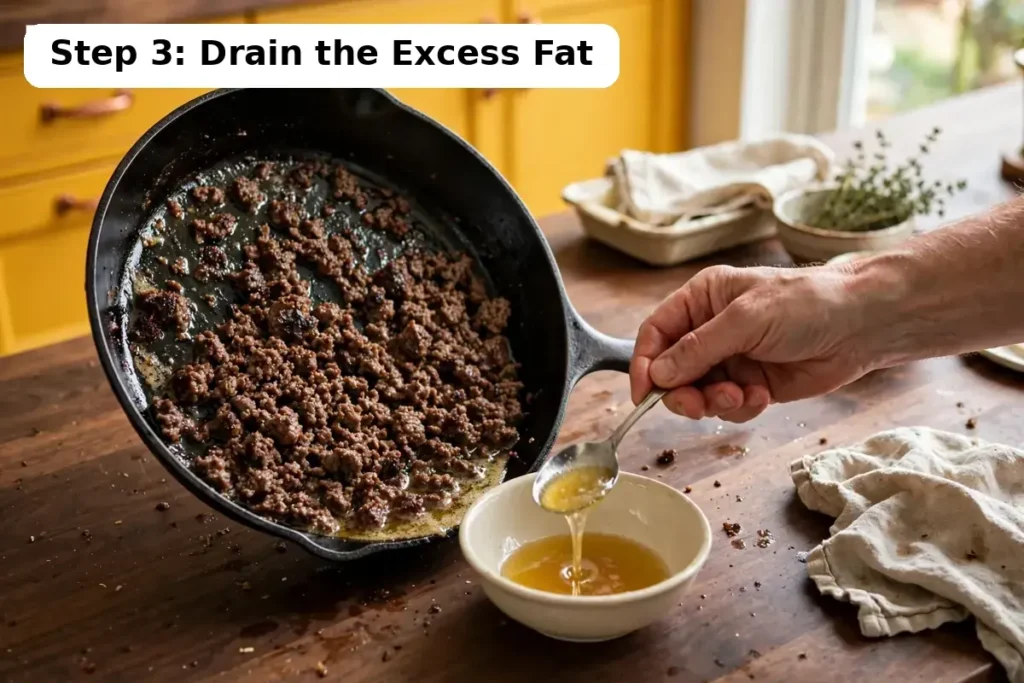
Step 3. If the ground beef has released significant fat more than 2 tablespoons tilt the pan and spoon off the excess, leaving approximately 1 tablespoon of fat in the pan.
Build the Filling
Step 4. Reduce heat to medium. Add the diced onion, carrots, and celery to the pan. Cook, stirring occasionally, for 6 to 8 minutes until the onion is translucent. Add the minced garlic, thyme, and rosemary and cook for 1 additional minute. Add the tomato paste and stir it directly into the mixture. Cook, stirring constantly, for 2 minutes the tomato paste will darken slightly.
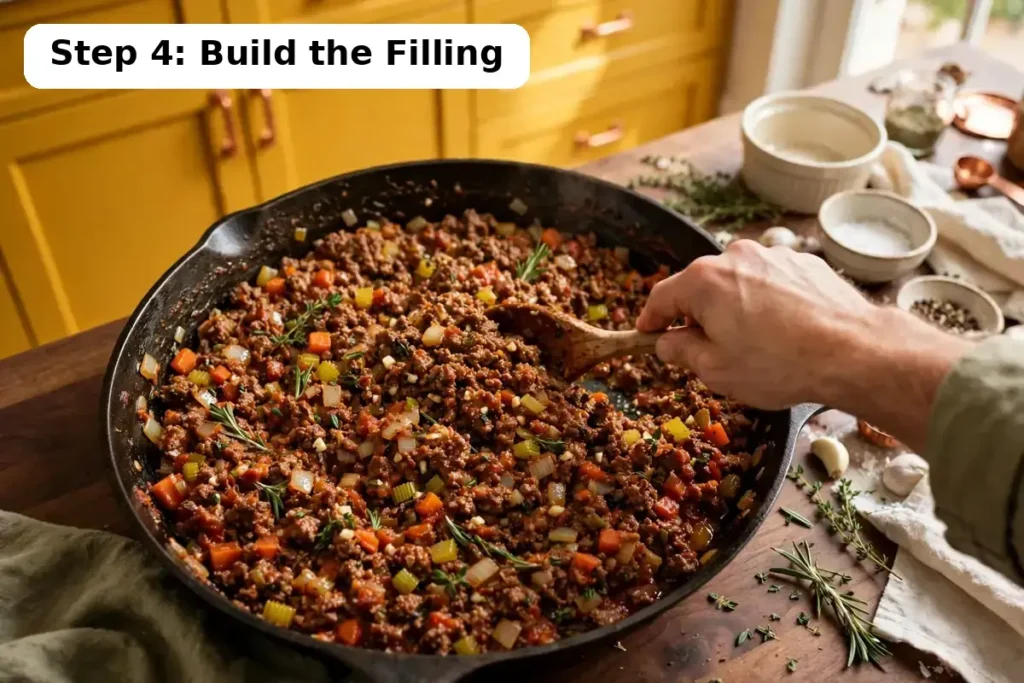
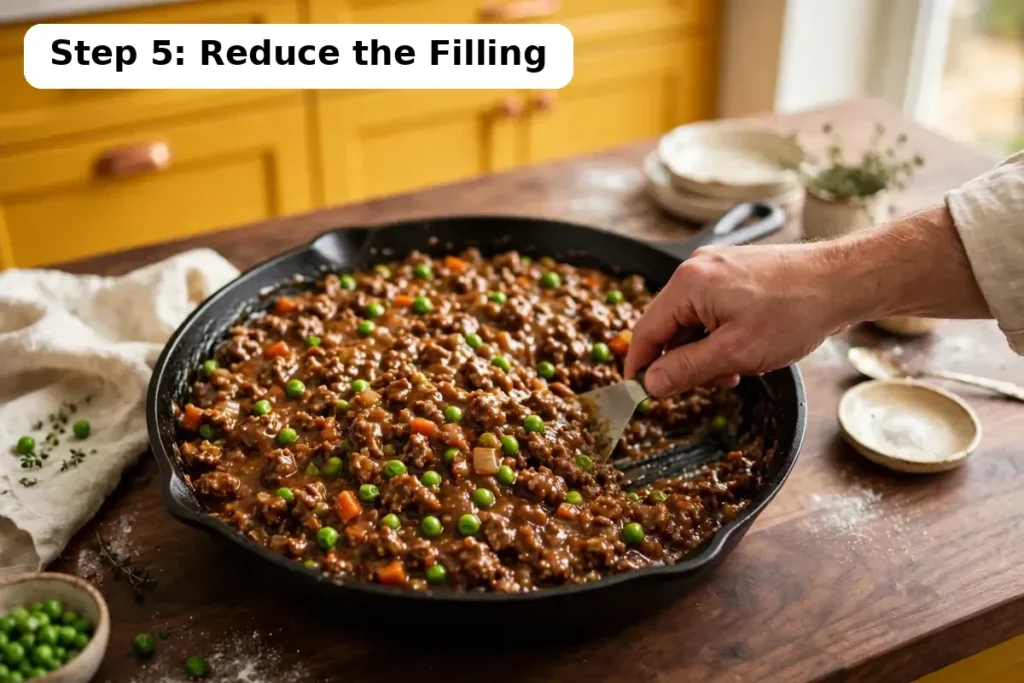
Step 5. Sprinkle the flour over the mixture and stir to coat evenly. Cook for 1 minute, stirring constantly. Add the Worcestershire sauce and the beef stock. Stir to combine, scraping up all the fond from the pan base. Bring to a simmer and cook, stirring occasionally, for 8 to 12 minutes until the filling has reduced and thickened to the correct consistency. Add the frozen peas and remaining 1/2 teaspoon of salt.
Make the Mashed Potato Topping
Step 6. Preheat the oven to 400°F (204°C). Return the drained potatoes to the warm, dry pot over low heat for 1 to 2 minutes to evaporate any remaining surface moisture. Mash the potatoes with the butter. Add the warmed milk in two additions. Add the sour cream, grated cheddar, egg yolk, salt, and white pepper. Stir until completely uniform.

Assemble and Bake
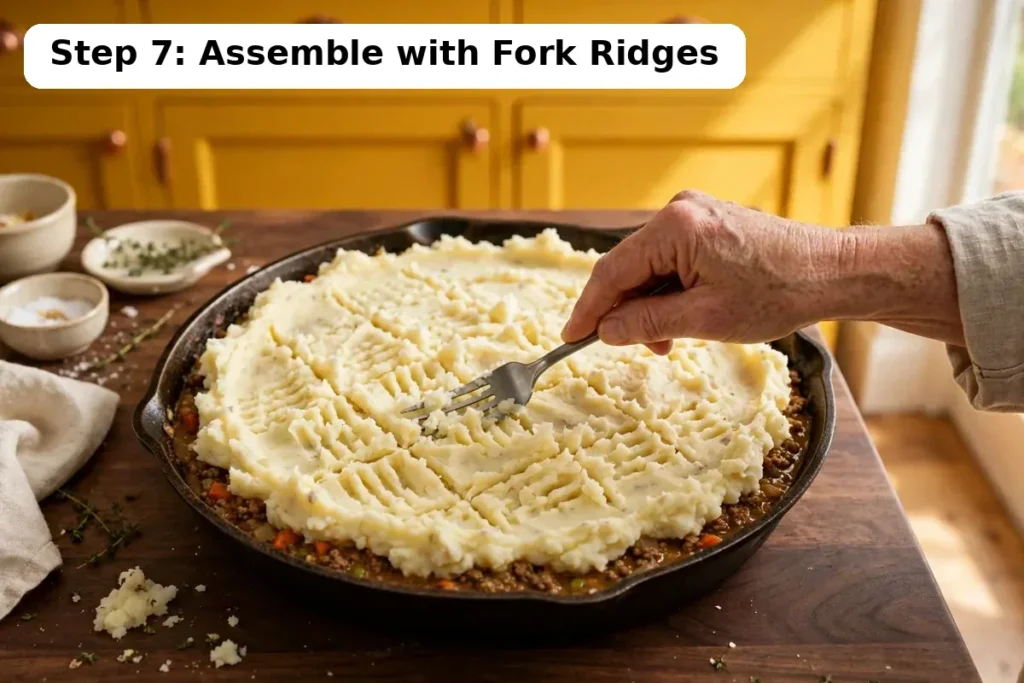
Step 7. Spoon the mashed potato topping over the filling in large dollops, then use a spatula to spread it in an even layer reaching the edges of the pan. Run a fork across the surface in a crosshatch pattern to create peaks and ridges.
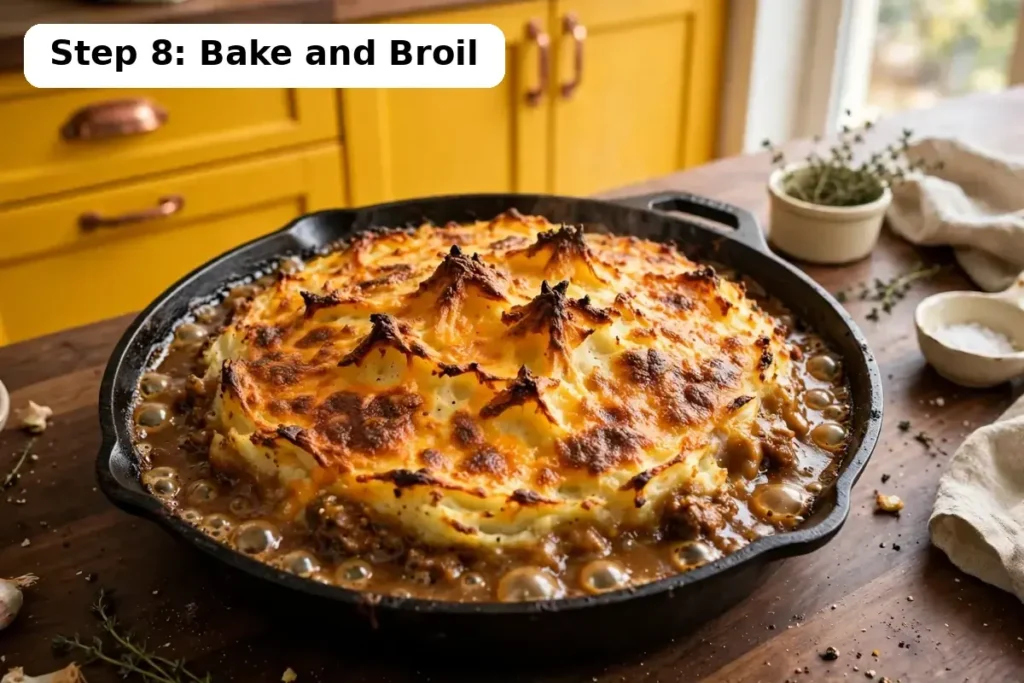
Step 8. Bake at 400°F for 20 to 25 minutes until the filling is visibly bubbling at the edges. Switch the oven to broil for the final 3 to 5 minutes, watching constantly, until the potato peaks are deep golden-brown.
Step 9. Remove from the oven and allow to rest for 10 minutes before serving. The resting period allows the filling’s liquid to redistribute and partially reabsorb into the meat and vegetables.
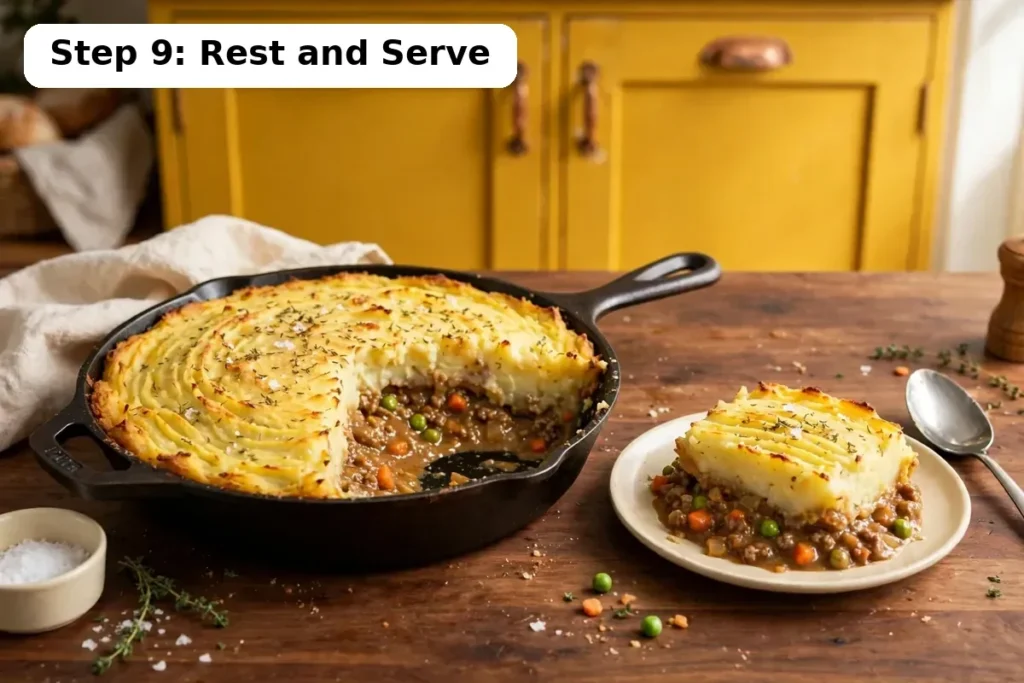
Why the Filling Must Be Reduced Before the Potato Topping Is Applied
The most common failure in shepherd’s pie a soggy, collapsing potato topping with a watery filling beneath it is almost always a filling reduction problem rather than a potato or baking problem.
When a shepherd’s pie fills with sufficient liquid during baking, several simultaneous problems occur. The liquid migrates upward through the potato topping by capillary action as the dish heats the potato’s starch granules absorb the hot, pressurized filling liquid from below, softening the topping from the base upward and causing it to collapse into the filling rather than maintaining its structural separation above it. The filling simultaneously loses the concentrated, thick consistency that makes its flavor intense. The potato topping’s surface, softened from moisture migration from below, cannot brown correctly under the broiler because wet starch requires more energy to dry before browning begins.
A correctly reduced filling at the consistency described in Step 5 a spatula channel closing in 3 to 4 seconds has lost the majority of the free liquid that would otherwise migrate during baking.
How Does Shepherd's Pie Compare to Related Dishes?
| Attribute | Shepherd's Pie (Beef / Cottage Pie) | Traditional Shepherd's Pie (Lamb) | Fish Pie | Chicken Pot Pie | Moussaka |
|---|---|---|---|---|---|
| Protein | Ground beef | Ground lamb or mutton | Mixed fish cod, salmon, shrimp | Diced chicken | Ground lamb |
| Topping | Mashed potato | Mashed potato | Mashed potato | Pastry crust | Béchamel sauce |
| Origin | British, 18th century | British, 18th century | British | American-British | Greek |
| Filling binder | Flour-thickened stock | Flour-thickened stock | Béchamel | Cream sauce or roux | Tomato sauce |
| Cheese in topping | Optional cheddar common in US | Less common British versions often plain | Gruyère or cheddar common | N/A pastry | Kefalotiri or Parmesan |
| Baking temperature | 400°F | 400°F | 375°F | 400°F | 375°F |
| Make-ahead suitability | Excellent improves overnight | Excellent | Good | Good | Excellent |
| Cultural position | American comfort food staple | British pub and home classic | British comfort food | American comfort food staple | Greek national dish |
What Variations Can You Make?
Traditional Shepherd's Pie With Lamb
Replace the ground beef with an equal weight of ground lamb 1 1/2 lbs (680g). Lamb’s higher fat content and its specific aromatic compounds require two adjustments. First, drain more aggressively after browning. Second, increase the fresh rosemary to 1 teaspoon and add 1/4 teaspoon of ground cumin. The lamb version is the historically correct shepherd’s pie.
Irish Shepherd's Pie With Guinness
Replace 1/2 cup (120ml) of the beef stock with 1/2 cup of Guinness Draught stout. Add the Guinness after the tomato paste is cooked and before the flour is added allow it to bubble for 1 minute. Guinness contributes roasted malt compounds that reinforce the Maillard compounds from the browned beef.
Sweet Potato Shepherd's Pie
Replace the russet potato topping with an equal weight of sweet potatoes 2 lbs (900g). Reduce the butter to 3 tablespoons and omit the sour cream. Increase the salt in the topping to 1 teaspoon. The sweet potato topping’s natural sweetness contrasts the savory, Worcestershire-forward filling.
Loaded Shepherd's Pie
Add 4 strips of bacon cooked until crisp and crumbled to the filling in Step 4 alongside the onion, carrots, and celery. Add 4 oz (113g) of diced mushrooms alongside the vegetables. Increase the Worcestershire sauce to 1 1/2 tablespoons. Top the mashed potato layer with an additional 1/4 cup of grated cheddar scattered across the surface before baking.
Dietary Adjustments and Substitutions
Gluten-Free Version
Replace the all-purpose flour with an equal weight of cornstarch 1 tablespoon of cornstarch has twice the thickening power of 1 tablespoon of flour, so reduce to 1 tablespoon of cornstarch. Mix the cornstarch with 2 tablespoons of the cold beef stock to form a slurry before adding it to the pan. Confirm that the Worcestershire sauce used is a certified gluten-free brand.
Dairy-Free Version
Replace the butter in the mashed potato topping with refined coconut oil at the same weight. Replace the whole milk or heavy cream with full-fat oat milk. Omit the sour cream and the egg yolk. Omit the cheddar or replace with a dairy-free cheddar-style shred.
Lower-Fat Version
Use 90/10 or 93/7 ground beef in place of 80/20. Reduce the butter in the mashed potato topping to 2 tablespoons. Replace the heavy cream with whole milk. Omit the egg yolk.
What Are the Most Common Problems When Making Shepherd's Pie?
| Problem | Most Likely Cause | Prevention or Fix |
|---|---|---|
| Watery filling and soggy potato topping | Filling not reduced sufficiently before the potato topping was applied | Reduce the filling until a spatula channel closes in 3 to 4 seconds. If the dish is already in the oven and the filling appears very liquid, increase the oven temperature to 425°F and extend the baking time by 10 minutes. |
| Grey, flat-tasting meat filling | Ground beef broken up immediately when added to the pan, preventing Maillard browning | Allow the beef to cook undisturbed for 3 to 4 minutes before breaking it up. Grey steamed beef cannot be browned retroactively. |
| Gluey, dense mashed potato topping | Potatoes processed in a food processor or blender — mechanical overworking ruptures the starch granules | Always mash potatoes by hand with a masher or ricer. If already gluey, the texture cannot be corrected. |
| Potato topping sinks into the filling during baking | Filling too thin when the potato was applied, or potato mash too soft and loose | Reduce the filling to the correct consistency in Step 5. Ensure the potato mash is thick enough to mound. |
| Underbrowned potato topping | Oven baking only without the broiler step, or topping surface was too smooth | Always finish under the broiler for 3 to 5 minutes. Always texture the potato surface with a fork before baking. |
How Do You Store Shepherd's Pie?
| Storage Method | Duration | Instructions |
|---|---|---|
| Refrigerated, covered, in the baking dish | Up to 4 days | Cover the cooled dish with plastic wrap or foil. Reheat covered at 350°F for 20 to 25 minutes until the filling is bubbling, then uncover and broil for 3 to 4 minutes to re-crisp the potato surface. |
| Refrigerated, individual portions in airtight containers | Up to 4 days | Reheat individual portions in the microwave on medium power for 3 to 4 minutes, or in the oven at 350°F for 15 minutes. |
| Frozen, fully assembled and baked | Up to 3 months | Cool completely, wrap the dish tightly in plastic wrap then foil, and freeze. Thaw overnight in the refrigerator before reheating. |
| Frozen, assembled but unbaked | Up to 3 months | Assemble the dish completely through Step 7. Wrap tightly and freeze. Bake from frozen at 375°F for 45 to 55 minutes covered, then uncover and broil. |
Scaling
| Servings | Ground Beef | Potatoes | Baking Dish |
|---|---|---|---|
| 4 | 1 lb (450g) | 1 1/2 lbs (680g) | 9x9-inch or 10-inch oven-safe skillet |
| 6 (standard) | 1 1/2 lbs (680g) | 2 lbs (900g) | 12-inch oven-safe skillet or 9x13-inch dish |
| 8 to 10 | 2 lbs (900g) | 2 1/2 lbs (1.1kg) | 9x13-inch deep baking dish |
Nutritional Information
Per serving: 1 portion approximately 380g, based on 6 servings. Values calculated using USDA FoodData Central reference data using 80/20 ground beef, whole milk, and full cheddar topping.
| Nutrient | Per Serving | Nutrient | Per Serving |
|---|---|---|---|
| Calories | 528 kcal | Total carbohydrate | 38g |
| Total fat | 28g | Dietary fibre | 4.2g |
| Saturated fat | 14g | Total sugars | 6.8g |
| Cholesterol | 128mg | Protein | 32g |
| Sodium | 648mg | Iron | 4.2mg (23% DV) |
Frequently Asked Questions
What is the difference between shepherd's pie and cottage pie?
Shepherd’s pie is technically the preparation made with ground lamb or mutton the shepherd tends sheep, so the pie bears his name. Cottage pie is the historically correct term for the same preparation made with ground beef, documented in British cookery literature as early as 1791. In the United States the distinction has largely disappeared Americans use shepherd’s pie as the universal term for both versions regardless of the meat, and cottage pie is not widely recognised as a distinct dish in the American market. Both preparations use the same mashed potato topping and the same filling technique the only difference is the protein.
Why does my shepherd's pie filling turn watery in the oven?
The filling was not reduced sufficiently before the potato topping was applied. A shepherd’s pie filling must be reduced on the stovetop until thick enough that a spatula channel through it closes in 3 to 4 seconds before the potato topping is added. A filling that flows freely at this stage contains enough free liquid to migrate upward through the potato crust during baking through capillary action, softening the topping from below and producing a watery base. The flour added in Step 5 provides thickening but requires sufficient reduction time to fully hydrate and thicken adding the potato topping before this reduction is complete produces the watery result regardless of the flour quantity.
Can shepherd's pie be made ahead and refrigerated overnight before baking?
Yes and the make-ahead version is often better than the same-day version. Assembling the dish completely through Step 7 and refrigerating overnight allows the filling’s flavors to deepen as the Maillard compounds from the browned meat and the Worcestershire sauce’s glutamates distribute more fully through the sauce during the overnight rest. Remove from the refrigerator 30 minutes before baking to take the chill off, then bake covered at 375°F for 25 minutes before uncovering, increasing to 400°F, and broiling to brown the topping. The make-ahead version produces a slightly more integrated, more deeply flavored filling than a same-day version.
Why should I use russet potatoes rather than other varieties for the topping?
Russet potatoes have a high starch content and low moisture content relative to waxy potato varieties like Yukon Gold or red potatoes. High starch produces a fluffy, light mash that holds its shape when spread over the filling and browns well under the broiler. Waxy potatoes have lower starch and higher moisture they produce a denser, slightly gluey mash that spreads correctly but browns less dramatically and has a slightly heavier texture above the filling. Yukon Gold potatoes are an acceptable substitute that produces a slightly richer, more buttery mash from their higher natural fat content the result is excellent and many experienced cooks prefer it, but the topping is slightly less light and less dramatically browned than the russet version.
Shepherd’s pie is a baked British-American casserole that rewards attention to two technique decisions above all others browning the ground beef correctly by leaving it undisturbed in a hot pan for 3 to 4 minutes to develop the Maillard-generated aromatic compounds that define the filling’s flavor complexity, and reducing the filling to a thick, glossy, spatula-channel-closing consistency before the potato topping is applied to prevent the liquid migration that produces a soggy topping and watery base. The dish traces to 18th-century Britain where it was documented as an economical preparation of leftover roasted meat under a potato crust, and has become one of the most universally made comfort food dishes in the American home kitchen.
Table of Contents
Recent Recipes
American · Cakes Orange Pound Cake Recipe This orange pound cake recipe rubs the zest into the sugar before creaming. […]
Check Out..!
American · Layer Cakes Coconut and Carrot Cake Recipe Moist, oil-based spiced layer cake packed with freshly grated carrot and […]
Check Out..!
American Cakes Tandy Cake Recipe This Tandy cake recipe spreads peanut butter on the warm cake, then chills it before […]
Check Out..!
American · Cakes Portillo’s Chocolate Cake Recipe This Portillo’s chocolate cake recipe adds mayonnaise to the batter. Mayo is just […]
Check Out..!Recent Blogs
I’ve glazed our Amish apple cake too hot, too cold, and exactly right, and the difference is not small. The […]
Read Blog..!
I’ve pulled a sunken Amish Apple Cake out of my oven, and I know the exact sinking feeling that comes […]
Read Blog..!
A cup measures volume, not weight, so a cup of flour and a cup of sugar weigh completely different amounts. […]
Read Blog..!
Every pasta shape was designed to carry a certain kind of sauce. Thin strands suit light sauces that coat, wide […]
Read Blog..!
Every egg method, from a jammy boiled egg to a silky French omelet, comes down to one fact: the white […]
Read Blog..!