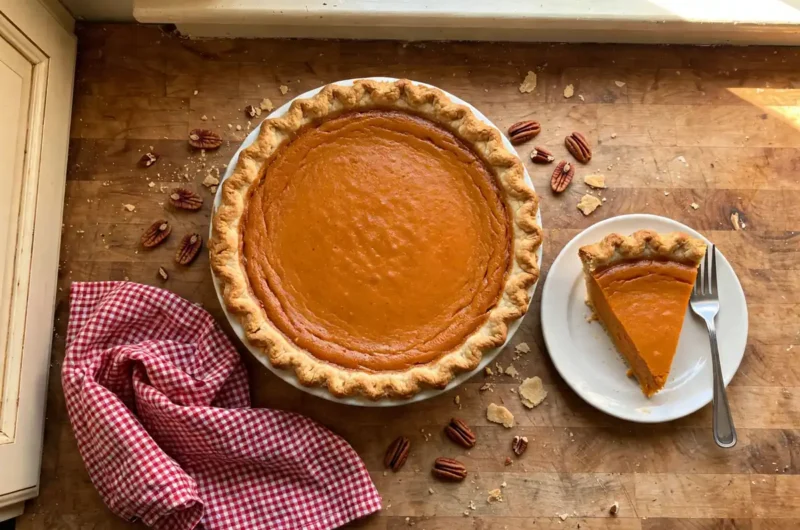
Sweet potato pie is the most culturally significant dessert of the American Southern and African American food traditions a single-crust custard pie in which roasted sweet potato purée replaces the pumpkin of New England’s canonical autumn pie with a sweeter, denser, more complex filling whose natural sugar concentration and carotenoid-rich orange flesh produce a deeper flavor, a more vivid color, and a more cleanly sliceable custard set than pumpkin achieves at equivalent filling quantities.
The roasting protocol is the single most critical ingredient preparation decision. Sweet potatoes’ natural sugar content primarily sucrose, glucose, and fructose at approximately 13 percent of the raw flesh’s total weight concentrates during whole roasting as the moisture content drops from approximately 77 percent in the raw flesh to approximately 65 percent in the roasted flesh, simultaneously intensifying the sugar’s flavor through the beginnings of caramelisation at the flesh’s interior temperatures of 300 to 320°F during the final 15 minutes of roasting. Boiled sweet potatoes absorb cooking water rather than losing moisture arriving at the mashing stage with higher water content and lower sugar concentration than the roasted equivalent, producing a filling that requires additional flour or starch thickening to compensate for the excess moisture, and that never achieves the caramelised depth of the roasted version’s sugar concentration.
Sweet potato pie’s cultural history in America is inseparable from the history of African American Southern cooking the preparation appearing in the food traditions of enslaved African Americans who cultivated and cooked sweet potatoes throughout the American South from the colonial period onward, and whose culinary tradition elevated the sweet potato to a cultural and culinary significance in Southern African American food culture that the sweet potato has never achieved in any other American regional tradition. Historian Michael Twitty, in his 2017 James Beard Award-winning book The Cooking Gene, documents the sweet potato pie’s centrality to African American holiday and celebration food culture appearing at Thanksgiving, Christmas, and family reunion tables throughout the American South and the African American diaspora communities of the American North from at least the late 18th century onward.
What Is Sweet Potato Pie?
Sweet potato pie is a Southern American single-crust custard pie whose filling roasted sweet potato purée enriched with butter, eggs, warm spices, and evaporated milk bakes in a blind-baked butter pie crust to a smooth, slightly dense custard set that is firmer and more cleanly sliceable than pumpkin pie’s softer, more trembling custard.
It differs from pumpkin pie in that the sweet potato’s higher natural sugar concentration produces a sweeter, denser filling without additional sugar at the same volume, and the sweet potato’s smoother, less fibrous flesh texture produces a completely smooth filling without straining. It differs from a sweet potato casserole in that the custard format egg-set rather than marshmallow-topped produces a dessert rather than a side dish from the same primary ingredient.
What Equipment Do You Need?
What Ingredients Do You Need?
Use garnet or jewel variety sweet potatoes the deep orange-fleshed varieties whose high beta-carotene content produces the vivid orange filling color and whose higher sugar concentration relative to the paler-fleshed varieties produces the more intensely sweet, more caramelisation-forward flavor that the roasting protocol concentrates to maximum effect. Avoid the paler-fleshed sweet potato varieties sold in some American grocery chains as “white sweet potatoes” their lower beta-carotene and lower sugar content produces a pale, less intensely flavored filling that most tasters find indistinguishable from a butternut squash pie.
For the Butter Pie Crust
For the Sweet Potato Filling
The evaporated milk rather than fresh whole milk or heavy cream is the canonical liquid for Southern sweet potato pie a deliberate choice whose rationale is both historical and functional. Historically, evaporated milk was widely available in Southern American kitchens from the early 20th century onward as a stable, storable dairy product accessible to communities without reliable refrigeration. Functionally, evaporated milk’s reduced water content approximately 60 percent of the original milk’s water has been removed through the evaporation process contributes dairy richness without the additional liquid that whole milk’s higher water content adds to the filling at the same volume, producing a denser, more cleanly setting custard than whole milk at equivalent quantities.
Step by Step Process
Roast the Sweet Potatoes
Step 1. Preheat the oven to 400°F (205°C). Scrub the sweet potatoes clean. Pierce each potato several times with a fork 8 to 10 pierces per potato to allow steam to escape during roasting and prevent the skin from splitting from steam pressure build-up. Place directly on the oven rack or on the foil-lined baking sheet. Roast at 400°F for 45 to 55 minutes until completely tender throughout a skewer or paring knife inserted into the thickest point of each potato meets no resistance. Allow to cool for 15 minutes. Split lengthwise and scoop the flesh from the skin the roasted flesh releases cleanly from the skin with a large spoon. Measure 480g of roasted sweet potato flesh for the filling.
Make the Pie Crust
Step 2. Combine the flour, salt, and sugar in a bowl. Cut in the very cold butter cubes with the pastry blender until the mixture resembles coarse crumbs with visible pea-sized butter pieces. Add ice water 1 tablespoon at a time until the dough just holds together when squeezed. Form into a disc, wrap in plastic wrap, and refrigerate for 1 hour minimum.
Roll the chilled dough on a lightly floured surface to a 12-inch circle. Transfer to the 9-inch pie plate, pressing gently into the base and sides without stretching. Trim and crimp the edge. Freeze the lined pie plate for 15 minutes frozen rather than simply chilled, because the 15-minute freeze fully solidifies the butter pieces and the gluten network simultaneously, producing a crust that holds its shape and its crimped edge with significantly less shrinkage during blind baking than a simply refrigerated crust.
Blind Bake the Crust
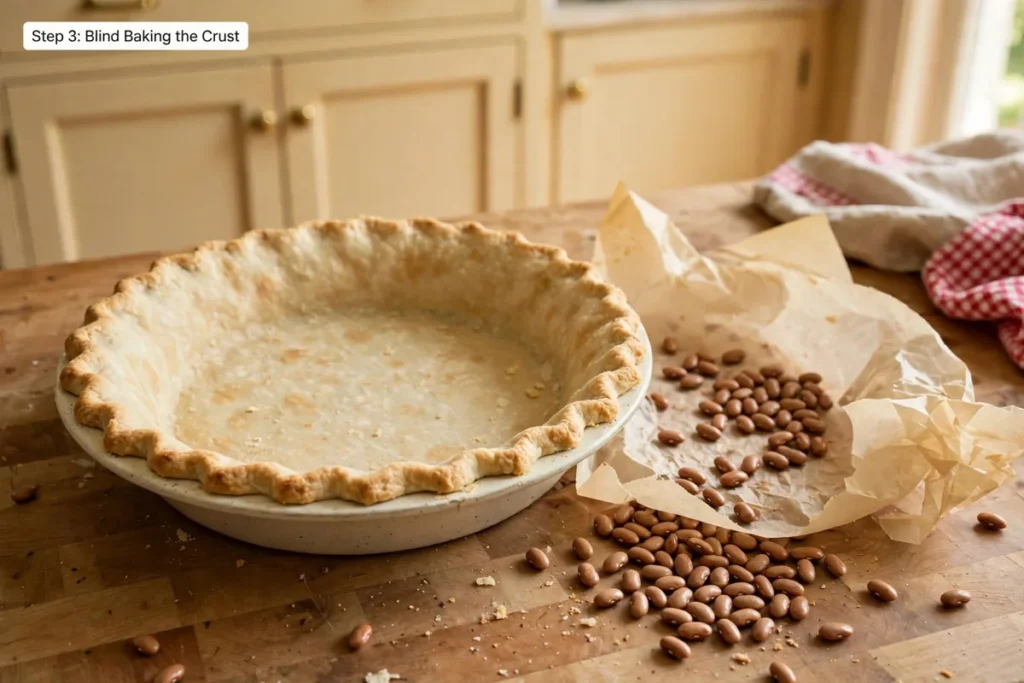
Step 3. Reduce the oven to 375°F (190°C). Line the frozen crust with parchment paper and fill with pie weights or dried beans pressing the weights gently but firmly into the corners and against the sides. Blind bake at 375°F for 20 minutes until the visible crust edges are pale golden and the sides have set. Remove the parchment and weights. Bake for an additional 5 minutes until the base appears dry and just beginning to colour the partial blind bake sets the crust structure before the custard filling’s moisture can soften the raw pastry during baking.
Make and Bake the Filling
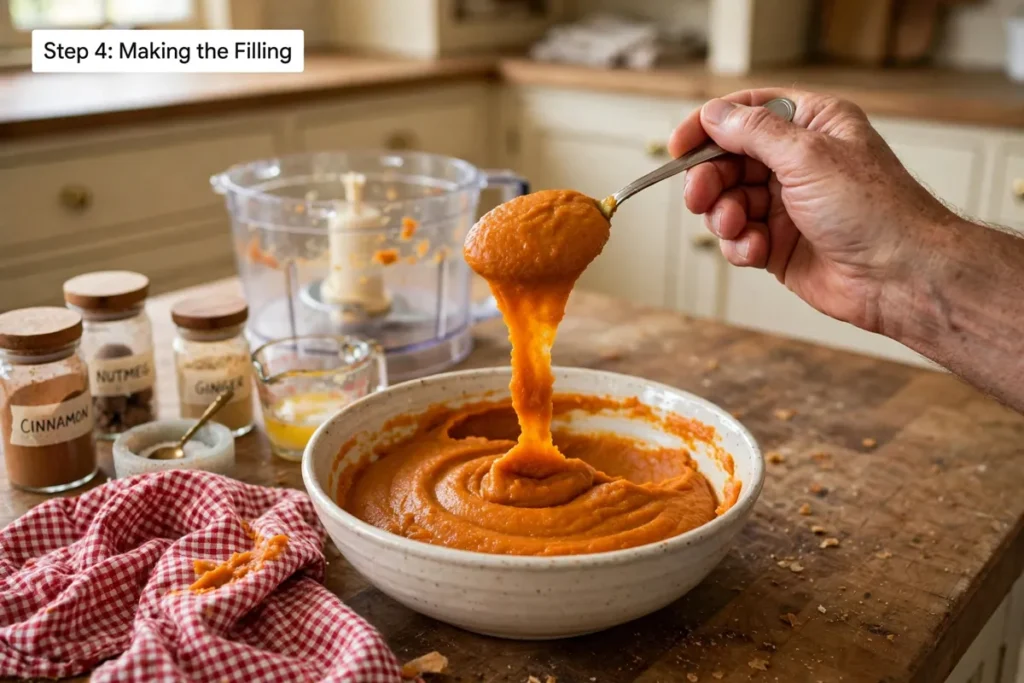
Step 4. Process the warm roasted sweet potato flesh in the food processor for 1 minute until completely smooth. Add the melted butter, granulated sugar, dark brown sugar, eggs, egg yolk, evaporated milk, vanilla, cinnamon, nutmeg, ginger, and salt. Process for 30 seconds until completely uniform and smooth. The filling at this stage is thick, deeply orange, and falls from the processor blade in a slow, heavy ribbon denser than a pumpkin pie filling from the sweet potato’s lower moisture content and higher solid concentration.
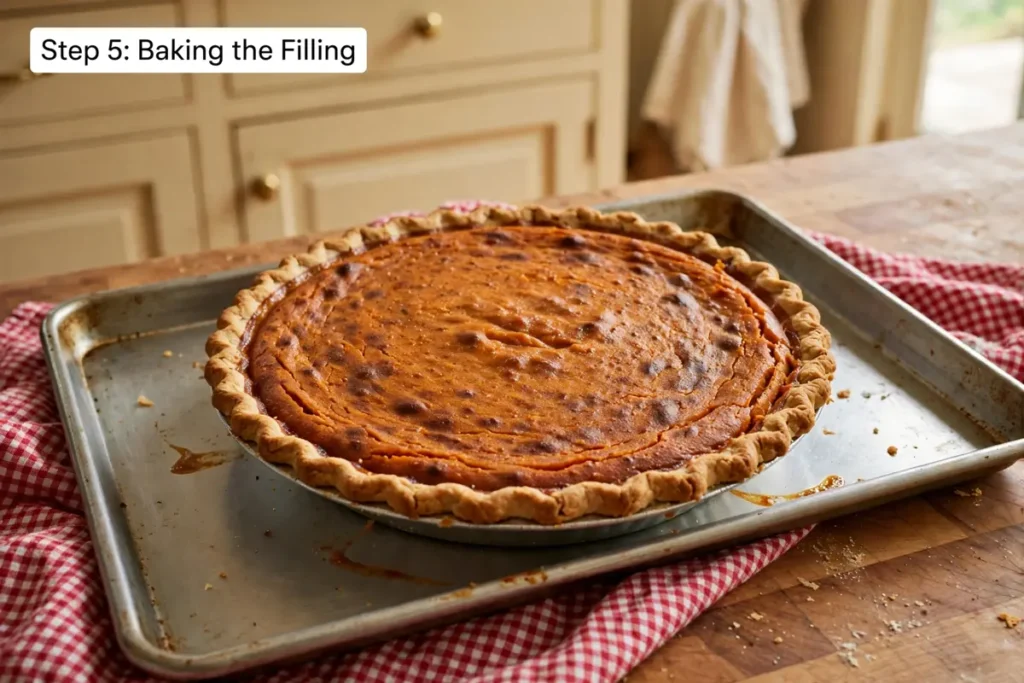
Step 5. Pour the filling into the warm blind-baked crust filling to within 1/4 inch of the crust’s crimped edge. Place the filled pie plate on the baking sheet. Bake at 375°F for 40 to 50 minutes until the filling is set at the edges and shows a slow, uniform jiggle at the centre approximately 2 inches in diameter when the pan is gently moved the custard’s specific egg protein coagulation threshold of 175°F.
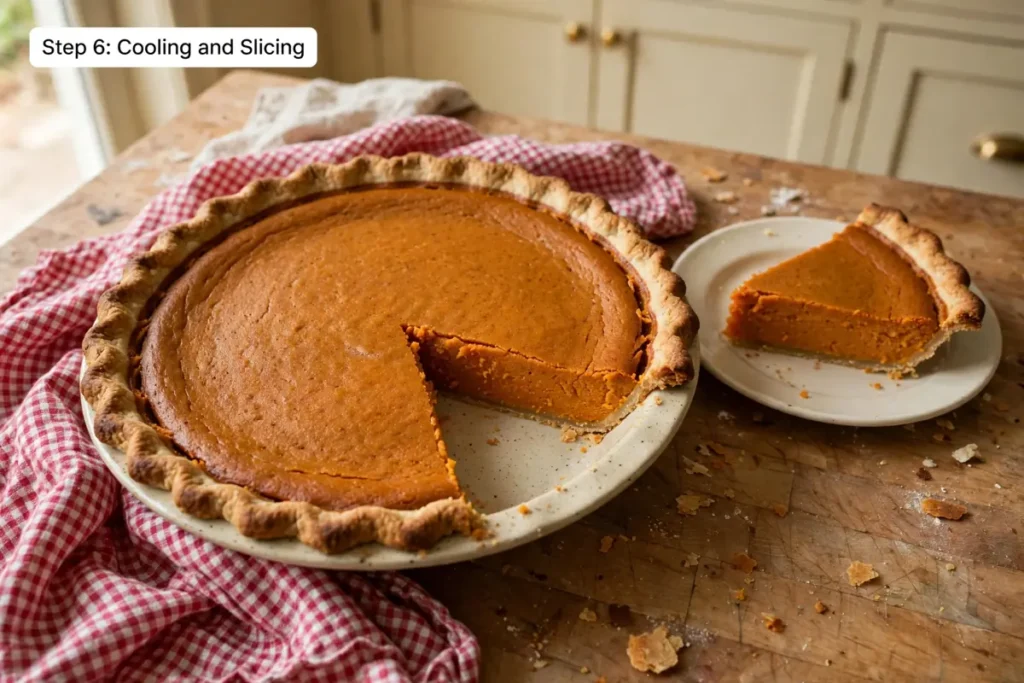
Step 6. Remove from the oven and cool completely on a wire rack minimum 2 hours at room temperature. The custard continues setting during cooling through carryover cooking as the residual heat conducts from the outer filling inward, completing the centre’s egg protein coagulation at temperatures below the oven’s sustained heat. Do not refrigerate during the initial cooling period the cold temperature shock applied to a hot custard produces the surface cracking from rapid differential contraction between the set outer layer and the still-setting inner layer.
Why Roasting Produces More Intense Flavor Than Boiling
The flavor difference between roasted and boiled sweet potato filling is not subtle most tasters describe it as the difference between a filling that tastes of sweet potato and one that tastes of sweetened potato, and the chemical mechanism explains why the preparation method produces a categorically different ingredient from the same raw vegetable.
When a sweet potato is boiled in water, osmotic pressure drives water from the high-concentration cooking water into the sweet potato’s cells through the semi-permeable cell membranes, simultaneously diluting the cell’s sugar concentration and preventing the moisture loss that concentrating the flavor requires. At boiling temperature the amylase enzymes that convert the sweet potato’s starch to sugars are active producing additional sugar from starch but this enzymatic sugar production is offset and exceeded by the osmotic water absorption, producing a cooked sweet potato with higher water content and lower sugar concentration than the raw equivalent in net terms at most standard boiling times.
When the same sweet potato is roasted at 400°F, the dry oven heat drives moisture outward through the skin via evaporation rather than inward from surrounding water. The amylase enzymes remain active between 135 and 170°F during the early roasting period, converting starch to maltose at their maximum rate as the potato’s interior temperature rises through this window producing significantly more sugar from the available starch than the shortened amylase activity window of the more rapidly heated boiled potato allows. As the interior temperature rises above 170°F the amylase denatures and the sugar production ceases, but the sugar concentration that has accumulated during the extended low-temperature window is now significantly higher than the boiled potato’s at equivalent cooked weight. Above 300°F at the surface the concentrated sugars begin caramelising at the flesh adjacent to the skin, producing the caramelised syrup visible seeping from the pierce holes and the caramelised depth of flavor that roasted sweet potato’s filling achieves without any additional caramelisation step.
How Does Sweet Potato Pie Compare to Related Southern Custard Pies?
What Variations Can You Make?
Brown Butter Sweet Potato Pie
Brown the 3 tablespoons of butter using a standard browning technique before adding to the sweet potato purée. The browned butter’s diacetyl and Maillard aromatic compounds complement the roasted sweet potato’s caramelised sugar character through the same warm-caramelised aromatic family stacking the browned dairy fat’s caramelised complexity amplifying the roasted sweet potato’s already-caramelised sugar depth into a filling whose flavor complexity most tasters immediately describe as more interesting and more sophisticated than the standard melted butter version.
Bourbon Sweet Potato Pie
Add 2 tablespoons (30ml) of Kentucky bourbon to the filling alongside the vanilla extract at Step 4. The bourbon’s barrel-aging ester compounds dissolve into the filling’s fat phase during the food processor blending distributing the warm, slightly smoky barrel character through the filling without a perceptible alcohol presence in the baked custard from the ethanol’s near-complete volatilisation during the 40 to 50-minute baking period. The bourbon-sweet potato combination is the most culturally authentic variation of the standard recipe bourbon appears in sweet potato pie recipes throughout the mid-20th century Southern community cookbook tradition, most commonly in Kentucky and Tennessee community cookbooks where both the sweet potato and the bourbon are products of the same regional agricultural tradition.
Sweet Potato Pie With Pecan Streusel
Prepare the filling and blind-baked crust as directed. Pour the filling into the crust and bake for 30 minutes until the filling is partially set at the edges. Quickly scatter a pecan streusel 1/3 cup (33g) of roughly chopped pecans combined with 2 tablespoons (28g) of dark brown sugar and 1 tablespoon (14g) of melted butter over the partially set filling surface. Return to the oven for the remaining 15 to 20 minutes until the filling is jiggle-set at the centre and the pecan streusel is golden-brown and fragrant. The pecan streusel applied to the partially set filling surface sits at the filling’s top rather than sinking into the still-liquid filling as it would if applied at the start of baking.
Dietary Adjustments and Substitutions
Dairy-Free Version
Replace the butter with dairy-free butter sticks both in the crust at the same weight (113g) and melted for the filling at the same weight (43g). Replace the evaporated milk with full-fat coconut evaporated milk at the same volume (180ml). The coconut evaporated milk’s similar fat content and reduced water content to dairy evaporated milk produces an essentially equivalent custard set at the same egg quantity and baking conditions.
Gluten-Free Version
Replace the all-purpose flour in the crust with a certified gluten-free 1:1 pastry flour blend at the same weight (150g) plus 1/4 teaspoon of xanthan gum if the blend does not already contain it. The sweet potato filling is inherently gluten-free no modification needed. Handle the gluten-free crust with slightly more care during rolling it is more fragile than wheat flour crust and benefits from rolling between two sheets of parchment paper rather than on a floured surface.
What Are the Most Common Problems When Making Sweet Potato Pie?
How Do You Store Sweet Potato Pie?
Scaling
Nutritional Information
Per serving: 1 slice approximately 165g including butter pie crust and sweet potato custard filling, based on 8 slices. Values calculated using USDA FoodData Central reference data using garnet sweet potatoes and evaporated whole milk.
Frequently Asked Questions
Sweet potato pie is the definitive American Southern custard pie rooted in the African American Southern culinary tradition documented by historians including Michael Twitty as one of the most culturally significant preparations in the American South’s food heritage whose defining quality is a roasted garnet sweet potato filling whose moisture-concentrating, sugar-amplifying, caramelisation-initiating roasting protocol produces a denser, sweeter, more deeply flavored custard than boiled sweet potato achieves at the same quantity, set to a firm, cleanly sliceable custard by the egg protein network’s soft coagulation at the jiggle-stop 175°F centre temperature, enclosed in a blind-baked butter pie crust whose partial pre-bake before the custard filling’s addition prevents the moisture-softened soggy bottom that raw crust contact with the wet filling invariably produces making whole roasting and blind baking the two technique decisions that together determine whether the finished pie delivers the intensely sweet, caramelised, warmly spiced Southern celebration dessert that the preparation’s cultural significance demands.