American · Salads Brussels Sprout Salad Recipe Massage the shaved Brussels sprouts with the dressing for 90 seconds before adding […]
Check Out..!Brussels Sprout Salad Recipe
Massage the shaved Brussels sprouts with the dressing for 90 seconds before adding any other ingredients. The acid massage tenderises the leaf structure and reduces the harsh glucosinolate bitterness to a mild, pleasant peppery note rather than the sulfurous character of un-massaged raw sprouts.
- Prep: 20 min
- Cook: 0 min
- Total: 35 min
- Servings: 6
- Difficulty: Easy
- Dietary: Vegetarian / Gluten-Free
Chef's review · Chef M Afzal, Chef, Karachi · Reviewed Nov 22, 2026“Massage the shaved Brussels sprouts with the dressing for 90 seconds before adding any other ingredients. Raw Brussels sprouts contain sinigrin glucosinolate whose enzymatic hydrolysis by myrosinase produces the bitter, sulfurous character that makes raw Brussels sprouts unpleasant without preparation. The 90-second massage physically ruptures the remaining intact cell walls that brief shaving does not fully open, accelerating the myrosinase-sinigrin contact that produces the allyl isothiocyanate conversion, and the lemon juice's citric acid partially inhibits the myrosinase activity mid-conversion, reducing the final allyl isothiocyanate concentration to the pleasant, mildly peppery level rather than the harsh, throat-catching bitterness of un-massaged raw Brussels sprouts.”
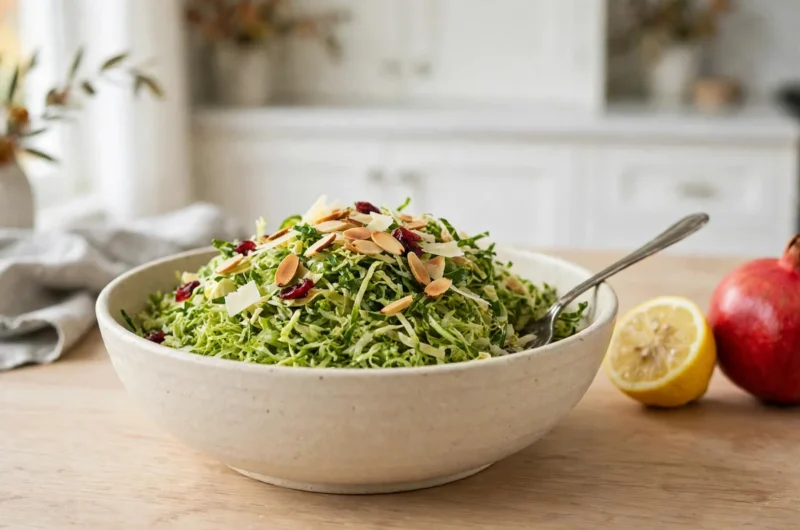
Brussels sprout salad is an American autumn and winter raw vegetable salad in which shaved raw Brussels sprouts are massaged with an acid dressing to tenderise the leaf structure and reduce the harsh glucosinolate bitterness to a pleasant peppery note, producing a substantial, hearty salad whose nutty, slightly peppery character against a bright lemon dressing provides one of the most satisfying cold-weather salad experiences in the American repertoire.
The 90-second massage is the single most critical technique decision, operating through two simultaneous mechanisms: the physical massage ruptures the intact leaf cell walls that the shaving’s slicing action leaves partially intact at the cell edges, accelerating the myrosinase enzyme’s contact with the sinigrin glucosinolate substrate across a broader cell surface area; and the lemon juice’s citric acid, delivered simultaneously with the massage, partially inhibits the myrosinase activity at pH 4.0 to 4.5, reducing the myrosinase-catalysed conversion of sinigrin to allyl isothiocyanate before the inhibition halts the reaction at a concentration that produces mild peppery character rather than the full-conversion harsh bitterness of the uninhibited reaction.
What Is Brussels Sprout Salad?
Brussels sprout salad is an American raw vegetable salad in which shaved Brussels sprouts form the base for a bright lemon-Parmesan or lemon-tahini dressing, toasted nuts, dried fruit, and sharp cheese, producing a hearty, substantial salad appropriate as a main course or a substantial side during the autumn and winter months when Brussels sprouts are at peak season and fresh lettuce-based salads feel too light.
It differs from a roasted Brussels sprout dish in the raw, shaved format’s crisp, slightly peppery character versus the roasted sprout’s caramelised, soft, Maillard-developed character. It differs from a kale salad in the Brussels sprout’s more assertively flavored glucosinolate character requiring the acid massage for palatability in the same way that kale’s oxalic acid requires massaging for tenderness.
What Equipment Do You Need?
| Equipment | Specification | Why It Matters |
|---|---|---|
| Food processor with slicing disc or sharp mandoline | Standard | For shaving the Brussels sprouts to 1 to 2mm thin slices that maximise the leaf surface area for the massage and the dressing's penetration. Hand-slicing with a knife produces uneven thickness that results in simultaneously over-massaged thin pieces and under-massaged thick pieces in the same bowl. |
| Large mixing bowl | Standard | Large enough for the vigorous 90-second massage without the shaved sprouts escaping the bowl. |
| Small jar with lid | Standard | For shaking the dressing to emulsify. |
What Ingredients Do You Need?
Use fresh Brussels sprouts on the stalk or loose from a refrigerated display rather than pre-shaved bagged Brussels sprout salad mixes. Pre-shaved packaged mixes have already undergone the myrosinase-sinigrin reaction during the mechanical slicing and subsequent storage in the package, producing a product with elevated allyl isothiocyanate concentration that the massage cannot reduce and that produces the harsh, sulfurous character that pre-shaved mixes are consistently associated with. Fresh whole sprouts shaved immediately before massaging allows the acid massage to intercept the myrosinase reaction at the optimal intermediate stage.
For the Brussels Sprout Salad
| Ingredient | Volume | Weight |
|---|---|---|
| Fresh Brussels sprouts, trimmed and shaved 1 to 2mm thin | 6 cups shaved | 450g whole before shaving |
| Toasted slivered almonds or toasted walnuts | 1/2 cup | 60g |
| Dried cranberries or dried cherries | 1/3 cup | 50g |
| Freshly grated Parmesan or Pecorino Romano | 1/2 cup | 40g |
| Red apple, thinly sliced (optional) | 1/2 apple | 75g |
| Pomegranate arils (optional, autumn) | 1/4 cup | 40g |
For the Lemon Parmesan Dressing
| Ingredient | Volume | Weight |
|---|---|---|
| Extra-virgin olive oil | 1/4 cup | 60ml |
| Fresh lemon juice | 3 tablespoons | 45ml |
| Lemon zest | 1 teaspoon | 2g |
| Dijon mustard | 1 teaspoon | 5g |
| Honey | 1 teaspoon | 7g |
| Garlic, finely grated | 1 small clove | 2g |
| Fine sea salt | 1/2 teaspoon | 3g |
| Black pepper, freshly ground | 1/4 teaspoon | 0.6g |
| Freshly grated Parmesan | 2 tablespoons | 10g |
Brussels Sprout Salad
A hearty autumn and winter raw vegetable salad of shaved Brussels sprouts massaged for 90 seconds in a lemon Parmesan dressing to tame the glucosinolate bitterness, topped with toasted almonds, dried cranberries, and freshly grated Parmesan.
20
minutes0
minutes35
minutes6
servingsIngredients
- For the Brussels Sprout Salad
6 cups shaved (450g whole) fresh Brussels sprouts, trimmed and shaved 1 to 2mm thin
1/2 cup (60g) toasted slivered almonds or toasted walnuts
1/3 cup (50g) dried cranberries or dried cherries
1/2 cup (40g) freshly grated Parmesan or Pecorino Romano
1/2 (75g) red apple, thinly sliced, optional
1/4 cup (40g) pomegranate arils, optional, autumn
- For the Lemon Parmesan Dressing
1/4 cup (60ml) extra-virgin olive oil
3 tablespoons (45ml) fresh lemon juice
1 teaspoon (2g) lemon zest
1 teaspoon (5g) Dijon mustard
1 teaspoon (7g) honey
1 small clove (2g) garlic, finely grated
1/2 teaspoon (3g) fine sea salt
1/4 teaspoon (0.6g) black pepper, freshly ground
2 tablespoons (10g) freshly grated Parmesan
Instructions
- Shave the Brussels Sprouts
Shave the sprouts.
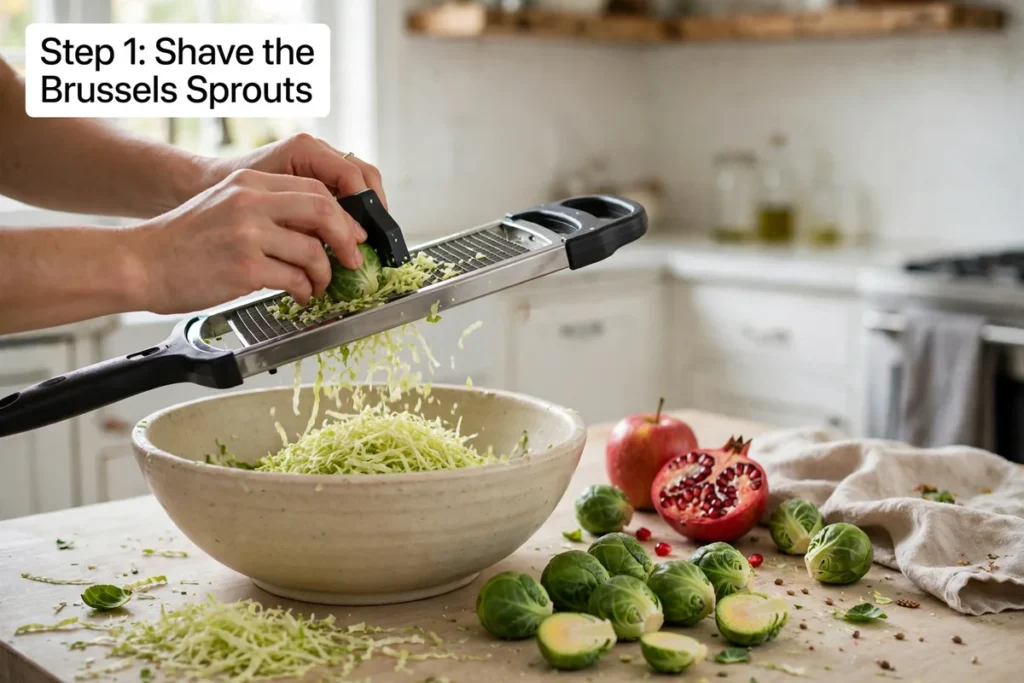
Trim the stem end of each Brussels sprout and remove any damaged or yellowed outer leaves. Feed through the food processor's slicing disc or shave on the mandoline at the 1 to 2mm setting. Transfer the shaved sprouts immediately to the large mixing bowl and do not allow them to rest before massaging.- Massage with the Dressing
Make the dressing and massage.
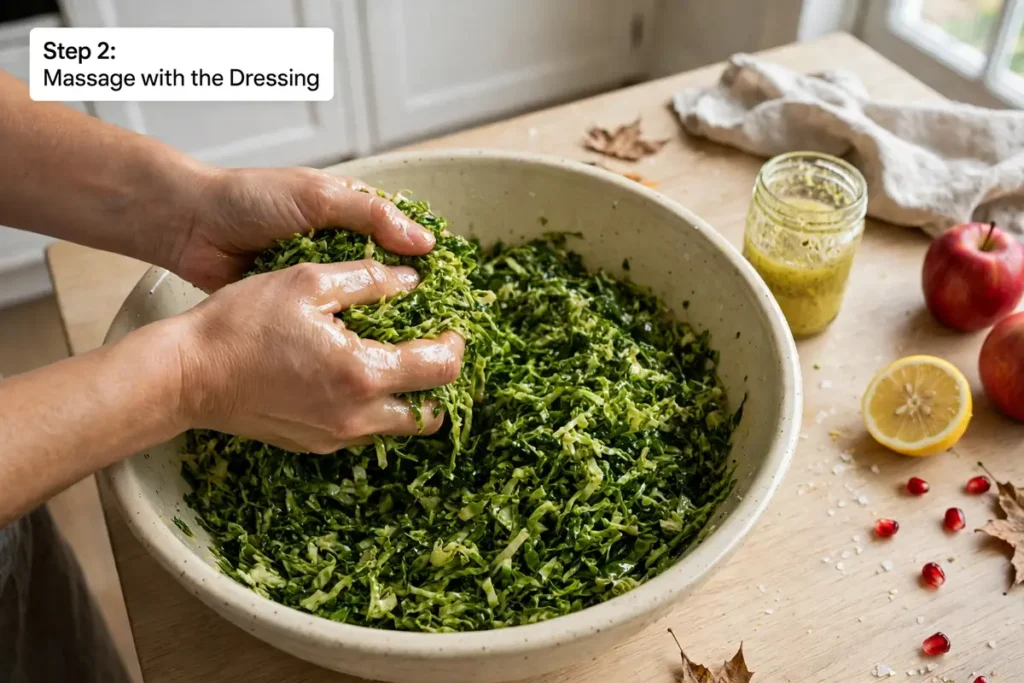
Combine all dressing ingredients in the small jar and shake vigorously for 20 seconds. Pour approximately two-thirds of the dressing over the shaved sprouts immediately and massage firmly and continuously with both hands for 90 seconds. Allow the massaged sprouts to rest for 10 minutes at room temperature.- Assemble and Finish
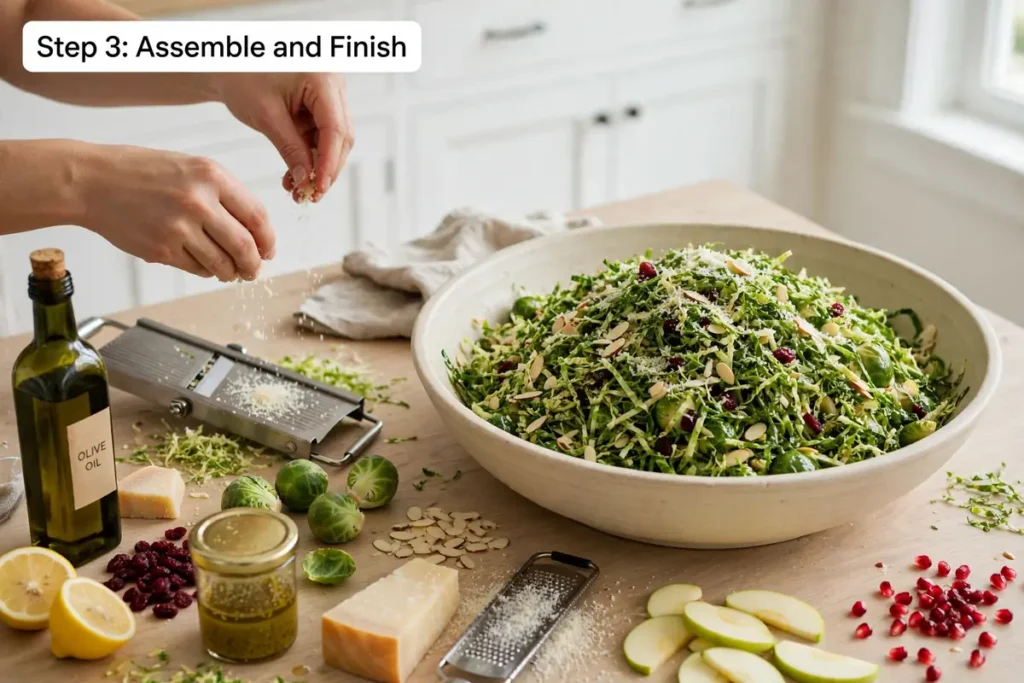
Assemble and finish.
Add the toasted almonds or walnuts, dried cranberries or cherries, grated Parmesan or Pecorino, and any optional additions to the massaged sprouts. Drizzle with the remaining one-third of the dressing, toss gently to combine, and taste and adjust seasoning with additional salt, lemon juice, or honey. Serve immediately or rest for up to 30 minutes at room temperature.
Step by Step Process
Shave the Brussels Sprouts
Step 1. Trim the stem end of each Brussels sprout and remove any damaged or yellowed outer leaves. Feed through the food processor’s slicing disc or shave on the mandoline at the 1 to 2mm setting. The Brussels sprout’s dense, compact head produces the characteristic feathery, thin leaf shreds at this thickness that separate naturally into individual leaves and leaf fragments during the massage.
Transfer the shaved sprouts immediately to the large mixing bowl. Do not allow the shaved sprouts to rest before massaging. Every minute of open-air rest after shaving increases the myrosinase-sinigrin reaction progress before the acid’s inhibitory effect can intercept it, producing a progressively more bitter result from the same massage time.

Massage with the Dressing
Step 2. Make the dressing by combining all dressing ingredients in the small jar and shaking vigorously for 20 seconds.
Pour approximately two-thirds of the dressing over the shaved sprouts immediately. Using both hands, massage the sprouts firmly and continuously for 90 seconds. The massage technique is identical to kale massage: grasp handfuls, squeeze firmly, release, and repeat across the full bowl. The physical squeezing ruptures the remaining intact cell walls across the shaved leaf surfaces, releasing the myrosinase enzyme and the sinigrin substrate from the separate cellular compartments where they are stored in intact cells. The simultaneously-present lemon juice’s citric acid partially inhibits the myrosinase at pH 4.0 to 4.5 by 30 to 40 percent, reducing the allyl isothiocyanate production to the mild-peppery range rather than the harsh-bitter full-conversion.
After 90 seconds the shaved sprouts have reduced in volume by approximately 30 to 40 percent from the cell wall rupture and the water release, appear darker green, are visibly glistening from the dressing, and feel distinctly more tender and pliable between the fingers than the pre-massage rigid, stiff leaf structure.
Allow the massaged, dressed sprouts to rest for 10 minutes at room temperature. During this rest the residual allyl isothiocyanate dissipates further through continued acid inhibition and partial volatilisation from the ruptured cells’ open surfaces, producing a milder final character in the assembled salad than the immediately-post-massage taste indicates.

Assemble and Finish
Step 3. Add the toasted almonds or walnuts, dried cranberries or cherries, grated Parmesan or Pecorino, and any optional additions to the massaged sprouts. Drizzle with the remaining one-third of the dressing. Toss gently to combine (about 5 minutes). Taste and adjust seasoning with additional salt, lemon juice, or honey.
Serve immediately or rest for up to 30 minutes at room temperature. Unlike a lettuce salad, the massaged Brussels sprout salad does not wilt dramatically under the dressing during a 30-minute hold because the physical massage has already partially collapsed the leaf structure. Beyond 30 minutes at room temperature, the textural quality begins declining as the nuts lose their crunch and the acid continues softening the cell walls (for longer holds, refrigerate the dressed sprouts without toppings per the Storage guide).


Why 90-Second Acid Massage Reduces Bitterness Where Direct Dressing Produces Harsh Character
The myrosinase-sinigrin-allyl isothiocyanate reaction pathway and the acid’s inhibitory effect at the intermediate stage determine the massage technique’s bitterness-reduction mechanism.
Brussels sprouts and other Brassica vegetables store sinigrin glucosinolate in the cell vacuole and the myrosinase enzyme in a separate cellular compartment, the protein bodies adjacent to the myrosin cells. This physical separation prevents the enzymatic reaction from proceeding in the intact vegetable. When the cell walls are disrupted by cutting, shaving, or chewing, the two compartments’ contents mix and the myrosinase catalyses the rapid hydrolysis of sinigrin to allyl isothiocyanate, the compound responsible for the sharp, pungent, throat-catching heat of mustard and horseradish and the harsh bitterness of over-mature or over-cut Brassica vegetables.
The 90-second massage with the acid dressing intercepts this reaction at two points. Physically, the massage ruptures the remaining intact cell walls across the shaved leaf surfaces, releasing the myrosinase-sinigrin contents and beginning the conversion reaction. Chemically, the lemon juice’s pH of approximately 2.2 to 2.5 reduces the bowl’s combined pH to approximately 4.0 to 4.5 when mixed with the sprouts’ buffered cellular contents, and myrosinase’s optimal pH range is 5.5 to 7.0. At pH 4.0 to 4.5 the myrosinase activity is reduced by 30 to 40 percent from its optimal level, meaning the allyl isothiocyanate production rate slows before the full sinigrin reservoir has been converted. The combination of partial conversion from the physical massage and partial inhibition from the acid produces the allyl isothiocyanate concentration that most tasters perceive as pleasantly peppery rather than the full-conversion harsh bitterness of un-acidified raw Brussels sprouts.
How Does Brussels Sprout Salad Compare to Related Hearty Raw Vegetable Salads?
| Attribute | Brussels Sprout Salad | Kale Salad | Shaved Cabbage Salad | Broccoli Salad | Radicchio Salad |
|---|---|---|---|---|---|
| Primary bitterness compound | Allyl isothiocyanate from sinigrin | Oxalic acid | Allyl isothiocyanate, milder | Glucoraphanin, milder | Lactucopicrin, inulin |
| Massage requirement | Yes, 90 seconds with acid | Yes, 60 seconds reduces oxalic acid perception | Recommended | Not required | Not required |
| Acid inhibition mechanism | Citric acid inhibits myrosinase | Acid breaks down oxalic acid crystal network | Citric acid inhibits myrosinase | Not applicable | Not applicable |
| Pre-shaved commercial availability | Yes but inferior, avoid | Yes but inferior, avoid | Yes, acceptable | Pre-cut acceptable | Pre-cut acceptable |
| Peak season | Autumn, winter | Year-round, best autumn-winter | Year-round | Year-round | Autumn, winter |
| Flavor character | Nutty, peppery, slightly bitter | Earthy, slightly bitter, mineral | Mild, slightly sweet | Mild, slightly sulfurous | Bitter, slightly raddichio-specific |
| Classic American pairing | Lemon-Parmesan, toasted almonds, dried cranberries | Lemon-tahini, toasted seeds, dried fruit | Asian sesame dressing, cabbage slaw format | Bacon, cheddar, sunflower seeds | Blue cheese, walnuts, citrus |
What Variations Can You Make?
Brussels Sprout Salad with Tahini Dressing
Replace the Parmesan dressing with a tahini-lemon dressing: whisk 3 tablespoons (45g) of well-stirred natural tahini, 3 tablespoons (45ml) of fresh lemon juice, 1 tablespoon (15ml) of warm water, 1 teaspoon (5ml) of maple syrup, 1 small grated garlic clove, and 1/2 teaspoon of salt until smooth. The tahini’s toasted sesame pyrazine character complements the Brussels sprout’s glucosinolate peppery note through the shared warm-roasted aromatic family, and the preparation becomes fully vegan. Top with toasted sesame seeds, pomegranate arils, and shaved Medjool dates rather than the Parmesan and dried cranberries.
Warm Brussels Sprout Salad with Bacon Vinaigrette
Render 4 strips (120g) of bacon in a small skillet until crispy. Remove the bacon and crumble. Pour off all but 2 tablespoons of the rendered fat. Add 2 tablespoons of apple cider vinegar, 1 teaspoon of Dijon mustard, and 1 teaspoon of honey to the warm bacon fat and whisk to combine. Pour the warm bacon vinaigrette immediately over the shaved Brussels sprouts and massage for 90 seconds, the warm vinaigrette’s heat accelerating the cell wall softening beyond what the room-temperature lemon dressing produces. Top with crumbled bacon, shaved Parmesan, and toasted walnuts.
Dietary Adjustments
Vegan Version
Omit the Parmesan from the dressing and the salad. Replace with 2 tablespoons of nutritional yeast in the dressing for the umami character that the Parmesan provides. Use maple syrup rather than honey. The toasted almonds, dried cranberries, and lemon dressing are all inherently vegan.
Nut-Free Version
Replace the toasted slivered almonds with toasted pepitas or toasted sunflower seeds at the same quantity. Both provide the crunch and the warm-roasted Maillard aromatic that the almonds contribute without the tree nut allergen.
What Are the Most Common Problems?
| Problem | Most Likely Cause | Prevention or Fix |
|---|---|---|
| Harsh, bitter, sulfurous flavor | Massage too brief or too gentle, or pre-shaved packaged sprouts used | Massage firmly for the full 90 seconds. Use fresh whole sprouts shaved immediately before massaging. |
| Stiff, rubbery texture remaining after massage | Sprouts shaved too thick, or massage too gentle | Shave at 1 to 2mm maximum. If slices are slightly thick or under-worked, massage more vigorously for 15 to 30 additional seconds (only as a rescue step; properly shaved 1–2mm sprouts should not exceed 90 seconds total). |
| Salad wilting and pooling liquid quickly | Sprouts over-massaged beyond 90 seconds | Stick to the 90-second guideline. Over-massage collapses the cell structure completely, producing a soggy, liquid-releasing texture rather than the tender-crisp result. |
| Dressing too tart | Lemon juice quantity too high for the sprout batch | Add 1 additional teaspoon of honey and taste. The massaged sprout's acidity from the myrosinase reaction products adds to the dressing's acid, producing a more tart combined impression than the dressing alone. |
| Pre-made salad soggy or soft by serving time | Toppings added too early, or held at room temperature past 30 minutes | Fold in the nuts, dried fruit, and cheese within 30 minutes of serving so they stay crisp. Beyond 30 minutes at room temperature, the nuts soften and continued acid activity breaks down the sprouts' crunch for longer holds, refrigerate the dressed sprouts alone per the Storage guide. |
Storage
| Method | Duration | Instructions |
|---|---|---|
| Refrigerated, dressed massaged sprouts only | Up to 2 days | Massage the sprouts with two-thirds of the dressing (per Step 2) and refrigerate without toppings. The allyl isothiocyanate continues dissipating during refrigerator storage, producing a milder flavor on day 2 than day 1. Toss with the remaining one-third dressing, nuts, dried fruit, and cheese on the day of serving. |
| Refrigerated, fully assembled | Up to 1 day | Textural quality declines overnight but the salad remains edible. The nuts lose crunch and the dried fruit swells from the dressing moisture. |
| Meal prep format | Up to 3 days | Store shaved, un-massaged sprouts in an airtight container, dressing in the jar, and toppings separately. Massage and assemble individual portions daily. |
Nutritional Information
Per serving: approximately 150g without optional additions. Based on 6 servings. Values from USDA FoodData Central using fresh Brussels sprouts, olive oil, almonds, and Parmesan.
| Nutrient | Per Serving | Nutrient | Per Serving |
|---|---|---|---|
| Calories | 228 kcal | Total carbohydrate | 16g |
| Total fat | 16g | Dietary fibre | 4.2g |
| Saturated fat | 2.8g | Total sugars | 8.4g |
| Cholesterol | 6mg | Protein | 7.2g |
| Sodium | 282mg | Vitamin C | 72mg (80% DV) |
Frequently Asked Questions
Raw Brussels sprouts store sinigrin glucosinolate and myrosinase enzyme in separate cellular compartments. Shaving ruptures some cell walls and begins the myrosinase-catalysed conversion of sinigrin to bitter allyl isothiocyanate. The 90-second massage ruptures remaining intact cells to accelerate the conversion while the simultaneously-present lemon juice’s citric acid reduces the bowl pH to 4.0 to 4.5, inhibiting myrosinase activity by 30 to 40 percent from its optimal pH 5.5 to 7.0 range and halting the allyl isothiocyanate production at the mild-peppery concentration before the full sinigrin reservoir converts to the harsh, throat-catching bitterness that un-acidified raw Brussels sprouts deliver.
Pre-shaved packaged Brussels sprouts have undergone the full myrosinase-sinigrin reaction during the mechanical shaving and subsequent storage period, with the allyl isothiocyanate concentration continuing to rise throughout the package’s shelf life as the enzyme continues acting on the exposed sinigrin in the opened cells at refrigerator temperature. By the time of purchase the allyl isothiocyanate concentration is at or near the full-conversion level that produces harsh bitterness, and the acid massage cannot reduce this already-formed compound. The massage reduces bitterness by inhibiting the myrosinase reaction before full conversion, not by reversing the allyl isothiocyanate already produced.
Every minute between shaving and acid massage contact allows the myrosinase-sinigrin reaction to progress toward full allyl isothiocyanate conversion at room temperature without the acid’s inhibitory effect. At room temperature the myrosinase converts sinigrin at the uninhibited optimal rate, producing progressively more allyl isothiocyanate per minute of delay. A 5-minute delay between shaving and acid contact produces a starting allyl isothiocyanate concentration that the subsequent 90-second massage cannot reduce to the pleasant-peppery level from the already-formed compound’s irreversibility.
No, for this preparation’s identity. Roasting converts the allyl isothiocyanate’s sharp, peppery character through the Maillard reaction’s caramelisation and pyrazine development, producing the sweet, nutty, caramelised character of the roasted sprout rather than the raw format’s mild peppery note against the bright acid dressing. The roasted sprout does not absorb the vinaigrette in the same way as the raw massaged sprout from the oven’s dehydration reducing the surface porosity. A roasted Brussels sprout salad is a legitimate and delicious preparation but it is a different preparation with a different flavor architecture: warm, caramelised, nut-adjacent rather than the raw format’s bright, acid-forward, peppery character.
Brussels sprout salad is an American autumn and winter raw vegetable salad whose pleasant, mildly peppery character rather than harsh sulfurous bitterness depends on the 90-second acid massage that simultaneously ruptures the remaining intact cell walls across the shaved leaf surfaces to accelerate the myrosinase-sinigrin enzymatic contact and delivers the lemon juice’s citric acid at pH 4.0 to 4.5 to inhibit the myrosinase activity by 30 to 40 percent from its optimal pH 5.5 to 7.0 range, halting the allyl isothiocyanate production at the mild-peppery concentration before the full sinigrin reservoir converts to the harsh, throat-catching bitterness that un-massaged raw Brussels sprouts and pre-shaved packaged mixes deliver at their full-conversion allyl isothiocyanate concentration, making the immediate shaving-to-massage timing and the vigorous 90-second duration the two non-negotiable technique requirements that separate the genuinely enjoyable Brussels sprout salad from the harsh, bitter preparation that skipping the massage or using pre-shaved sprouts produces.

Table of Contents
Recent Recipes
Korean-American · Salads Kimchi Salad Recipe Well-fermented kimchi provides both the primary flavor component and the dressing’s acid base. Use […]
Check Out..!Recent Blogs
I’ve glazed our Amish apple cake too hot, too cold, and exactly right, and the difference is not small. The […]
Read Blog..!I’ve pulled a sunken Amish Apple Cake out of my oven, and I know the exact sinking feeling that comes […]
Read Blog..!A cup measures volume, not weight, so a cup of flour and a cup of sugar weigh completely different amounts. […]
Read Blog..!Every pasta shape was designed to carry a certain kind of sauce. Thin strands suit light sauces that coat, wide […]
Read Blog..!Every egg method, from a jammy boiled egg to a silky French omelet, comes down to one fact: the white […]
Read Blog..!